Chainlink’s ‘$80T update’ sees LINK reserves, Open Interest climb – Details

ambcrypto2026-01-23 tarihinde yayınlandı2026-01-23 tarihinde güncellendi

Özet

Chainlink has significantly expanded its blockchain infrastructure by introducing real-time U.S. stock and ETF prices on-chain, a development projected to unlock $80 trillion in assets for DeFi. This positions Chainlink as a primary data layer for on-chain financial products. Key metrics show strong growth: LINK reserves increased by over 88,000 tokens in 24 hours, Open Interest climbed to $233 million, and the number of holders reached 177,000. These trends signal accumulation, rising institutional participation, and broader adoption, reinforcing Chainlink's critical role in bridging traditional markets and decentralized finance.

The Chainlink (LINK) network has taken a major step in expanding and growing blockchain infrastructure with the introduction of real-time U.S stock and ETF prices on-chain. The recent announcement by the firm claims to unlock $80 trillion worth of assets in equities for decentralised finance, as stated in a recent update.

By further connecting traditional markets and blockchain technology, Chainlink will confidently position itself within the primary data layer for on-chain financial product support.

Most importantly, the development will enable DeFi projects to rely on live equity prices through a support provided by Chainlink’s oracle solution.

As tokenization continues to attract widespread interest, reliable token prices remain a foundational element. Especially for token-based products that include settlements, derivatives and synthetic assets.

LINK reserve activity signals accumulation

While infrastructure expansion is on its way, there has also been a considerable hike in LINK reserve balances recently. In fact, the reserve balance on the network gained by 88,845.86 LINK in just 24 hours.

At press time, the total holdings stood at 1,675,112.67 LINK – Reflecting a steady increase in reserve-controlled supply.
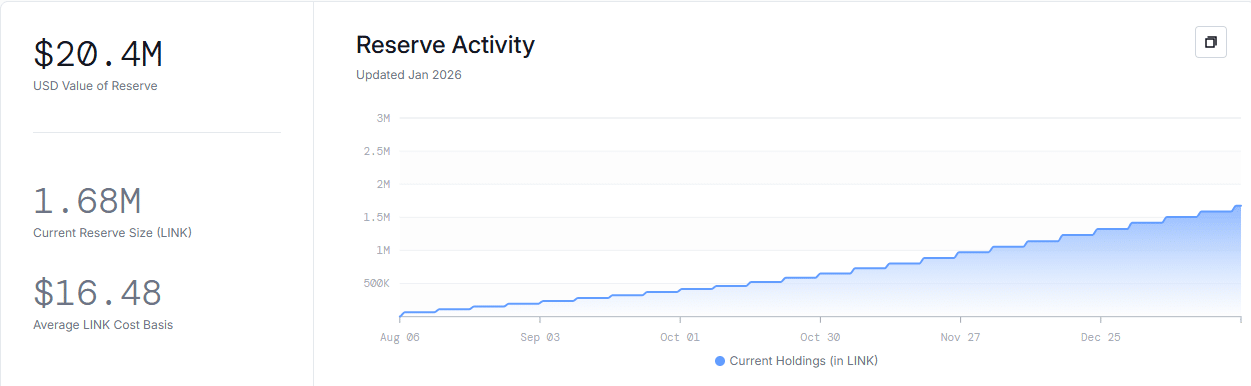
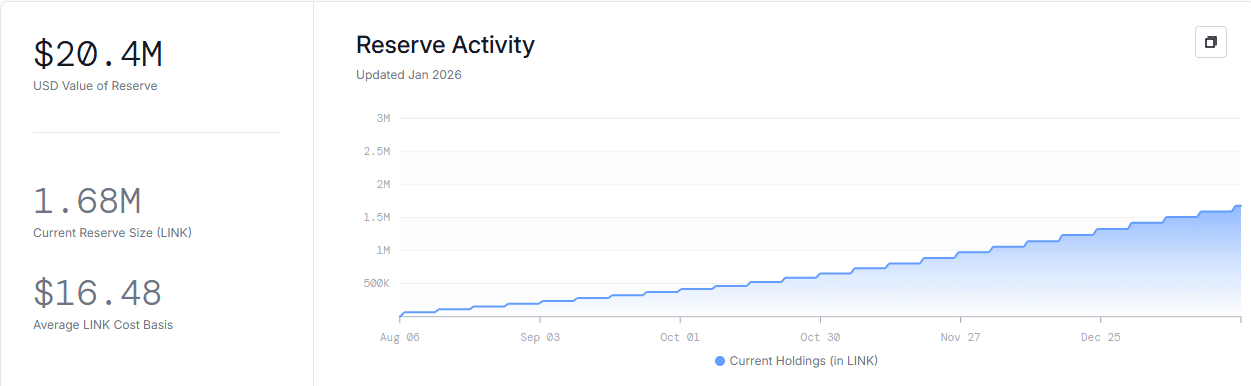
Historically, such movements have highlighted active treasury management during a period of growing network adoption. For LINK, the reserve accumulation coincides with periods of structural expansion. Especially as infrastructure providers align resources with long-term usage growth.

Derivatives point to a rising institutional participation

Adding to the aforemential bullish indicators, the token’s market participation metrics have also shifted. LINK’s Open Interest, for instance, had climbed to $233 million at the time of writing.

The hike in Open Interest levels highlight LINK’s growing capital mobilization in the derivative markets as traders and investors ramp up their trading activities.

Also, the institutional demand increase aligns with the timing of Chainlink’s latest infrastructure rollout. In the long rum, this can seen as a positive signal for LINK’s price.

What about the number of holders?

Beyond derivatives data, holders’ metrics is worth looking at too. The number of LINK holders has continued to rise steadily, indicating growing distribution across the network.

In fact, the number of holders stood at 177k at press time. LINK holders’ count surge mirrors broader participation, especially during periods when adoption narratives gain visibility.

The expansion into real-time equity pricing, the hike in reserve balances, the upswing in derivatives interest, and the sustained growth in holders all highlight the growing relevance of Chainlink’s network in the context of the tokenized finance industry.

As the line between traditional markets and DeFi continues to blur, Chainlink’s role as a data backbone will remain firmly in focus.


Final Thoughts

  • LINK is strengthening its infrastructure role as it brings real-time U.S. stock and ETF prices on-chain.
  • Network also recorded greater participation as reserves, Open Interest, and holder counts all registered an uptick.


Trend Kriptolar

İlgili Sorular

QWhat major infrastructure expansion did Chainlink announce, and what value of assets does it claim to unlock?

AChainlink announced the introduction of real-time U.S. stock and ETF prices on-chain, which it claims will unlock $80 trillion worth of assets in equities for decentralized finance.

QHow much did the LINK reserve balance increase in 24 hours, and what was the total holding at press time?

AThe LINK reserve balance increased by 88,845.86 LINK in 24 hours, with total holdings standing at 1,675,112.67 LINK at press time.

QWhat was the value of LINK's Open Interest at the time of writing, and what does this indicate?

ALINK's Open Interest climbed to $233 million at the time of writing, indicating growing capital mobilization in the derivative markets and increased trading activity.

QHow many LINK holders were there at press time, and what does this trend signify?

AThere were 177,000 LINK holders at press time, signifying growing distribution across the network and broader participation during periods of adoption.

QWhat are the key factors highlighted that demonstrate Chainlink's growing relevance in the tokenized finance industry?

AThe key factors are the expansion into real-time equity pricing, the increase in reserve balances, the rise in derivatives interest, and the sustained growth in the number of holders.

İlgili Okumalar

Amidst Capital's Encirclement, Decentralization is the Sole Defense for Public Blockchains

In a landscape dominated by power and profit motives, the author argues that decentralization is not merely one desirable feature among many in blockchain design—it is the singular, non-negotiable defense against corporate and capital capture. The article adopts a Machiavellian, realist perspective on human institutions, positing that businesses will inevitably attempt to co-opt any valuable network to protect their profits and dominance. While external attacks like 51% forks are often discussed, the greater existential risk is internal capture—the gradual erosion of a protocol’s neutrality by vested interests, as seen historically with platforms like Visa and Google. The piece critiques permissioned chains, highly centralized “permissionless” layer-1s, and layer-2s without sufficient decentralization (e.g., single sequencers) as inherently vulnerable. These compromised systems, promoted by established financial players, are framed as delaying tactics to stifle truly open networks that threaten existing high-fee, inefficient business models. Real-world examples, such as closed enterprise consortiums that exclude competitors, illustrate how such systems cement oligopolies rather than foster innovation. The author concludes that while decentralized protocols like Ethereum are imperfect and costly to operate, they represent the only viable long-term equilibrium. In a market where value naturally flows to the most secure and neutral settlement layer, only maximally decentralized public blockchains can resist being subsumed by capital and powerful incumbents.

Foresight News12 dk önce

Amidst Capital's Encirclement, Decentralization is the Sole Defense for Public Blockchains

Foresight News12 dk önce

Who Decides the Rules of Bitcoin? BIP-110 Ignites Governance Debate

Bitcoin's governance is once again at the center of a heated debate, this time ignited by BIP-110, the "Reduced Data Temporary Softfork." This proposal aims to curb non-monetary data (like inscriptions and Runes) by introducing seven new consensus-layer restrictions over a year, such as limiting new output scripts to 34 bytes and restoring the OP_RETURN cap to 83 bytes. The controversy stems from BIP-110's fundamental shift: it moves the battle against "spam" from node relay and miner policies to the consensus layer, rendering currently valid transactions invalid. Supporters, arguing that default policy governance has failed (highlighted by Bitcoin Core v30's relaxation of OP_RETURN limits), see this as necessary to protect node resources and Bitcoin's monetary focus. Opponents, led by figures like Michael Saylor and Adam Back, warn it dangerously centralizes governance. Saylor listed 110 reasons against it, criticizing its low 55% miner activation threshold and potential for chain splits. Back emphasized Bitcoin's "permissionless" ethos, arguing no single group should impose value judgments via consensus rules. Further complicating matters, technical critiques suggest BIP-110 may be technically circumventable, and a "BlockSlop" vulnerability in its upgrade path poses a consensus risk. The debate has drawn in diverse stakeholders: miners (with pools like Ocean signaling support and Foundry polling clients), node operators (like Bitcoin Knots), and new players like corporate treasury holder MicroStrategy (Saylor), whose market influence adds a novel dimension. Ultimately, BIP-110 acts as a governance stress test, exposing the unresolved question: who decides Bitcoin's rules? It pits the authority of miners, node operators, developers, and capital holders against each other, with each side claiming to defend Bitcoin's core principles of neutrality and security.

marsbit29 dk önce

Who Decides the Rules of Bitcoin? BIP-110 Ignites Governance Debate

marsbit29 dk önce

Who Decides Bitcoin's Rules? BIP-110 Ignites Governance Debate

Title: Who Decides Bitcoin's Rules? BIP-110 Ignites Governance Debate A new technical proposal, BIP-110 (Reduced Data Temporary Softfork), has sparked a fundamental governance debate within the Bitcoin community. It aims to impose new consensus rules for one year to limit non-financial data (like inscriptions and Runes) on-chain, moving beyond simple node and miner policy filters to invalidate currently valid transactions. Supporters argue that default policies have failed due to workarounds, necessitating consensus-layer changes to protect Bitcoin's core monetary function from data spam. Critics, including Michael Saylor and Adam Back, contend this dangerously centralizes judgment, undermines permissionlessness, and sets a risky governance precedent. They advocate for market-based solutions like fees or Layer 2s instead. The debate exposes deeper tensions: miners are divided on activation; node operators assert their sovereignty; Bitcoin Core developers influence defaults without direct accountability; and large corporate holders like MicroStrategy now wield narrative influence. Technically, BIP-110 may not fully block data and carries a disclosed consensus bug risk. Ultimately, BIP-110 acts as a stress test, forcing the community to confront the unresolved question: who legitimately decides what Bitcoin is and how it evolves, amidst competing claims from miners, nodes, developers, and capital holders.

链捕手41 dk önce

Who Decides Bitcoin's Rules? BIP-110 Ignites Governance Debate

链捕手41 dk önce

Zcash's New Node Zakura Goes Live: Privacy Payments Can Reach 50,000 TPS, Aiming to Rival Visa and Mastercard

Zcash, a privacy-focused cryptocurrency, has launched a new full node software called Zakura version 1.0.0. Developed by Zcash co-founder Sean Bowe and Dev Ojha, with private ZEC donations, its goal is to enable Zcash to process over 50,000 transactions per second (TPS)—matching the scale of Visa and Mastercard—while maintaining full transaction privacy and verifiability. This addresses a key bottleneck, as Zcash currently handles only about 1 private transaction per second. Zakura is a fork of the Zcash Foundation's Zebra node. It features chain pruning and snapshots, reducing disk usage and allowing new nodes to sync in under two minutes. It also offers compatibility with the legacy `zcashd` client interface. The scalability challenge stems from the large data size of privacy proofs. Bowe's Tachyon project aims to use recursive proofs to reduce consensus-layer data needs from ~500 MB/s to ~100 MB/s. For wallet scalability, Valar Group is researching Private Information Retrieval (PIR) tech to allow wallets to fetch their data privately. Zakura supports fast block propagation and the upcoming "Ironwood" network upgrade (NU6.3), scheduled for activation around July 28th. Ironwood was created to contain a critical inflation bug discovered in the Orchard shielded pool in May 2024. The fix uses "turnstiles" to trap any counterfeit ZEC created during the vulnerability period within the shielded pool, preventing it from entering circulation and restoring supply integrity.

marsbit56 dk önce

Zcash's New Node Zakura Goes Live: Privacy Payments Can Reach 50,000 TPS, Aiming to Rival Visa and Mastercard

marsbit56 dk önce

İşlemler

Spot

Popüler Makaleler

LINK Nasıl Satın Alınır

HTX.com’a hoş geldiniz! ChainLink (LINK) satın alma işlemlerini basit ve kullanışlı bir hâle getirdik. Adım adım açıkladığımız rehberimizi takip ederek kripto yolculuğunuza başlayın. 1. Adım: HTX Hesabınızı OluşturunHTX'te ücretsiz bir hesap açmak için e-posta adresinizi veya telefon numaranızı kullanın. Sorunsuzca kaydolun ve tüm özelliklerin kilidini açın. Hesabımı Aç2. Adım: Kripto Satın Al Bölümüne Gidin ve Ödeme Yönteminizi SeçinKredi/Banka Kartı: Visa veya Mastercard'ınızı kullanarak anında ChainLink (LINK) satın alın.Bakiye: Sorunsuz bir şekilde işlem yapmak için HTX hesap bakiyenizdeki fonları kullanın.Üçüncü Taraflar: Kullanımı kolaylaştırmak için Google Pay ve Apple Pay gibi popüler ödeme yöntemlerini ekledik.P2P: HTX'teki diğer kullanıcılarla doğrudan işlem yapın.Borsa Dışı (OTC): Yatırımcılar için kişiye özel hizmetler ve rekabetçi döviz kurları sunuyoruz.3. Adım: ChainLink (LINK) Varlıklarınızı SaklayınChainLink (LINK) satın aldıktan sonra HTX hesabınızda saklayın. Alternatif olarak, blok zinciri transferi yoluyla başka bir yere gönderebilir veya diğer kripto para birimlerini takas etmek için kullanabilirsiniz.4. Adım: ChainLink (LINK) Varlıklarınızla İşlem YapınHTX'in spot piyasasında ChainLink (LINK) ile kolayca işlemler yapın.Hesabınıza erişin, işlem çiftinizi seçin, işlemlerinizi gerçekleştirin ve gerçek zamanlı olarak izleyin. Hem yeni başlayanlar hem de deneyimli yatırımcılar için kullanıcı dostu bir deneyim sunuyoruz.

938 Toplam GörüntülenmeYayınlanma 2024.12.13Güncellenme 2026.06.02

LINK Nasıl Satın Alınır

Tartışmalar

HTX Topluluğuna hoş geldiniz. Burada, en son platform gelişmeleri hakkında bilgi sahibi olabilir ve profesyonel piyasa görüşlerine erişebilirsiniz. Kullanıcıların LINK (LINK) fiyatı hakkındaki görüşleri aşağıda sunulmaktadır.

活动图片