Cardano Hard Fork Expected Next Month, Leios Still ‘This Year’: Hoskinson

bitcoinist2026-02-20 tarihinde yayınlandı2026-02-20 tarihinde güncellendi

Özet

In a February 19 livestream, Charles Hoskinson announced that the Cardano blockchain is expected to undergo a hard fork "next month," while the Leios scalability solution remains on track for release "this year." He highlighted several key developments, including the upcoming launch of the Midnight network, a LayerZero integration connecting Cardano to over 80 blockchains, and the introduction of USDCx—a stablecoin-like asset emphasizing privacy and non-freezability. Hoskinson also discussed ongoing ecosystem growth, such as Plutus upgrades, Aiken development, and the integration of Pyth as a tier-one oracle. Additionally, he expressed concerns about the industry's shift toward permissioned networks controlled by financial institutions, warning against centralized control over user assets. At the time of reporting, ADA was trading at $0.2748.

Charles Hoskinson said Cardano is tracking toward a hard fork “next month,” while the long-discussed Leios scalability work remains on schedule for “this year,” in a Feb. 19 livestream recorded after a trip through Japan and a stop at Consensus in Hong Kong.

Hoskinson framed the next few weeks as a convergence point for two parallel roadmaps: Cardano’s protocol and developer-stack upgrades on one side, and the Midnight network launch he expects “coming next month” on the other, an effort he described as unusually difficult to execute even for teams with prior experience shipping major chains.

Cardano Momentum: Midnight, LayerZero And USDCx

In the livestream, Hoskinson spent his opening stretch recapping what he characterized as a productive Consensus week, pointing to “a lot of great announcements” and relationships around the Midnight ecosystem, including infrastructure and distribution names he said were involved with the network. He argued that the ability to launch a large, exchange-listed project like Midnight is itself a signal about Cardano’s maturity as a platform for “tier one” efforts.

On the Cardano side, he highlighted a newly announced LayerZero integration that he said connects Cardano “to more than 80 blockchains,” positioning it as a step away from the perception that the network operates in isolation. In the same segment, Hoskinson pointed to USDCx as a stablecoin-like asset he said is designed for “these non-EVM systems,” and emphasized the user-experience work around exchange flows—“autoconvert,” as he described it, so users can move value “straight to the exchange, straight back from the exchange.”

He also drew a distinction between USDCx and “basically USDC,” saying the tradeoff for Cardano users is an asset that, in his telling, preserves “privacy” and “can’t be frozen.” Hoskinson positioned that as “the best compromise” available for a “tier one stablecoin of that nature” in the Cardano ecosystem, while arguing that the LayerZero integration could open the door to “eight major stablecoins” over time, depending on integration sequencing.

Hard Fork ‘Next Month,’ Leios ‘This Year’

The most concrete near-term timing signal came when Hoskinson addressed the protocol schedule directly, saying: “Cardano hard fork is happening I believe next month. But you know the community is kind of working its way through that and getting these things done.”

In the same breath, he reiterated that Leios, Cardano’s scalability initiative, remains on track, noting recent travel and discussions with product manager Michael Smolenski about progress. “All things considered we’re pretty happy with the rate of progress of Cardano,” Hoskinson said, while also pointing to a new Plutus version, continued development of Aiken, and “node diversity coming this year,” alongside Leios.

Hoskinson also flagged developer activity he expects in March, referencing a “Dev Builder Fest down in Argentina” and describing the “integration of Pyth” into the ecosystem, which he presented as the arrival of a “tier one Oracle” for Cardano.

Beyond shipping timelines, Hoskinson used the livestream to argue that the industry’s central fight is shifting from enforcement actions to culture and narrative, particularly around non-custodial wallets and permissionless settlement. He warned about what he called “factions” that want crypto transactions routed through “permission federated networks owned and operated by large financial institutions,” and singled out US policy debates as part of that backdrop.

“What’s not okay is to build a network that’s forever owned and operated by five or 10 or 20 banks and they basically lord and leverage that power and position over the users,” he said. “And once they have absolute control, they just simply flip a switch and you’re at their mercy and they own all your money. And unfortunately, the system is moving in that direction right now.”

At press time, ADA traded at $0.2748.
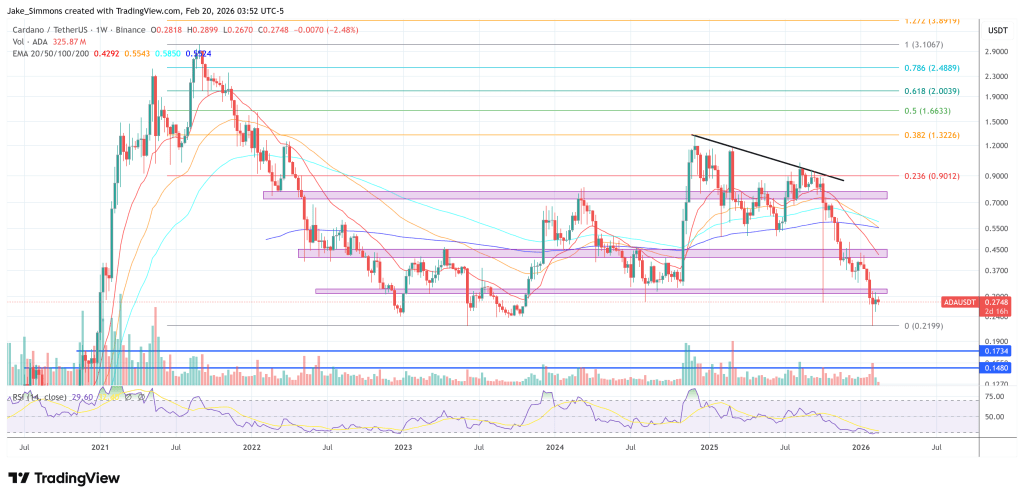
ADA hovers above key support, 1-week chart | Source: ADAUSDT on TradingView.com

Trend Kriptolar

İlgili Sorular

QWhen is the Cardano hard fork expected to occur according to Charles Hoskinson?

ANext month.

QWhat is the expected timeline for the Leios scalability initiative?

AThis year.

QWhich major integration did Hoskinson highlight that connects Cardano to over 80 blockchains?

ALayerZero integration.

QWhat is the name of the stablecoin-like asset mentioned that is designed for non-EVM systems on Cardano?

AUSDCx.

QWhat did Hoskinson identify as the central fight shifting to in the crypto industry?

AThe fight is shifting from enforcement actions to culture and narrative, particularly around non-custodial wallets and permissionless settlement.

İlgili Okumalar

Unlocking $100 Million in Liquidity? Pump.fun's New Policy Tests the 5-Minute Pump Technique

Pump.fun, a popular meme coin launchpad, has introduced a new standard mechanism called BOOST. It aims to address a significant capital efficiency issue: when a newly launched token graduates from its initial bonding curve to a liquidity pool (LP), roughly 20% of its liquidity becomes permanently locked as "dead liquidity," estimated to waste over $100 million annually. Instead of locking these funds permanently, BOOST repurposes them. Upon a token's migration, approximately 20% of the settlement funds (e.g., 17.6 SOL or ~$2516 USDC) are used to buy back the token on the open market over a 5-minute period via a Time-Weighted Average Price (TWAP) mechanism. All purchased tokens are immediately burned. This creates a brief, systematic buy pressure immediately after migration, potentially generating a short-term price surge ("pump") while permanently reducing the token's circulating supply. The goal is to enhance the immediate post-launch trading experience, potentially increasing trader retention and sustainable protocol revenue, which funds ongoing token buybacks. However, concerns exist that this artificial 5-minute boost could lower the barrier for launching low-quality tokens and lead to steeper price crashes once the buy pressure stops, if followed by large sell-offs. The feature automatically applies to tokens migrating after July 21, 2024, but not to previously migrated tokens or those launched via the Mayhem AI Agent lab.

marsbit4 dk önce

Unlocking $100 Million in Liquidity? Pump.fun's New Policy Tests the 5-Minute Pump Technique

marsbit4 dk önce

Podcast Notes | Conversation with GSR Asset Management Head: To Determine if This Crypto Rally is Real, Just Watch the Lending Rates on Aave

Podcast Summary: Dialogue with GSR's Head of Asset Management: To Determine if This Crypto Rally is Real, Just Check Lending Rates on Aave Andy Baehr, Managing Director of Asset Management at GSR, discusses the current crypto market, characterizing it as stuck in a state of "ambivalence" with short-lived, unsustainable rallies. He outlines a simple framework: the market moves between "ambivalence" and "conviction" (sustained upward momentum). Currently, every rally resembles a single-stage rocket booster that quickly fizzles out. Baehr identifies three key signals to watch: 1) DeFi lending rates, 2) the potential passage of the CLARITY Act, and 3) the market forming a consensus on the "Fed hawkish peak." He emphasizes that the most immediate indicator for the sustainability of the recent CPI-triggered rally is the USDC borrowing rate on Aave, currently around 3.75%—close to U.S. Treasury yields. The absence of a credit spread indicates low leverage demand and a lack of market energy. He explains that a healthy, sustained rally requires layered buying pressure. Last year's rally progressed from an ETH short squeeze to crypto-native trader influx and finally to ETF inflows. Currently, this structure is missing. Other potential structural buyers like Digital Asset Treasury (DAT) companies are absent, and ETF flows have proven transient. Baehr notes that while small-cap crypto tokens outperformed large caps in Q2—a potential sign of capitation in major assets—capital is also flowing to more exciting opportunities like AI stocks and tech IPOs, leaving crypto sidelined. Regarding DeFi, he highlights that platforms like Aave provide a clear, real-time signal of leverage demand through their supply/demand-driven interest rates. A significant, sustained rate increase would signal genuine market conviction. He also observes the quiet emergence of fixed-income-like products and vaults in DeFi. On regulation, the probability of the CLARITY Act passing before the August 7th deadline has dropped linearly from 75% to below 40% on Polymarket. Baehr suggests its passage would be treated as a bullish surprise, a potent driver for price movement. However, political hurdles, including ethical clause debates and disclosures about the First Family's crypto profits, remain significant obstacles. Ultimately, the market awaits clarity on the Fed's terminal rate under Chair Warsh. Until the "Fed Solstice"—the point where the market collectively understands the peak of hawkish policy—sustained conviction will be difficult to achieve.

marsbit35 dk önce

Podcast Notes | Conversation with GSR Asset Management Head: To Determine if This Crypto Rally is Real, Just Watch the Lending Rates on Aave

marsbit35 dk önce

İşlemler

Spot

Popüler Makaleler

ADA Nasıl Satın Alınır

HTX.com’a hoş geldiniz! Cardano (ADA) satın alma işlemlerini basit ve kullanışlı bir hâle getirdik. Adım adım açıkladığımız rehberimizi takip ederek kripto yolculuğunuza başlayın. 1. Adım: HTX Hesabınızı OluşturunHTX'te ücretsiz bir hesap açmak için e-posta adresinizi veya telefon numaranızı kullanın. Sorunsuzca kaydolun ve tüm özelliklerin kilidini açın. Hesabımı Aç2. Adım: Kripto Satın Al Bölümüne Gidin ve Ödeme Yönteminizi SeçinKredi/Banka Kartı: Visa veya Mastercard'ınızı kullanarak anında Cardano (ADA) satın alın.Bakiye: Sorunsuz bir şekilde işlem yapmak için HTX hesap bakiyenizdeki fonları kullanın.Üçüncü Taraflar: Kullanımı kolaylaştırmak için Google Pay ve Apple Pay gibi popüler ödeme yöntemlerini ekledik.P2P: HTX'teki diğer kullanıcılarla doğrudan işlem yapın.Borsa Dışı (OTC): Yatırımcılar için kişiye özel hizmetler ve rekabetçi döviz kurları sunuyoruz.3. Adım: Cardano (ADA) Varlıklarınızı SaklayınCardano (ADA) satın aldıktan sonra HTX hesabınızda saklayın. Alternatif olarak, blok zinciri transferi yoluyla başka bir yere gönderebilir veya diğer kripto para birimlerini takas etmek için kullanabilirsiniz.4. Adım: Cardano (ADA) Varlıklarınızla İşlem YapınHTX'in spot piyasasında Cardano (ADA) ile kolayca işlemler yapın.Hesabınıza erişin, işlem çiftinizi seçin, işlemlerinizi gerçekleştirin ve gerçek zamanlı olarak izleyin. Hem yeni başlayanlar hem de deneyimli yatırımcılar için kullanıcı dostu bir deneyim sunuyoruz.

1.5k Toplam GörüntülenmeYayınlanma 2024.12.10Güncellenme 2026.06.02

ADA Nasıl Satın Alınır

Tartışmalar

HTX Topluluğuna hoş geldiniz. Burada, en son platform gelişmeleri hakkında bilgi sahibi olabilir ve profesyonel piyasa görüşlerine erişebilirsiniz. Kullanıcıların ADA (ADA) fiyatı hakkındaki görüşleri aşağıda sunulmaktadır.

活动图片













