Cardano Founder To Leave X Permanently, Details Next Steps

bitcoinist2025-12-29 tarihinde yayınlandı2025-12-29 tarihinde güncellendi

Özet

Cardano founder Charles Hoskinson has announced he will permanently leave X (formerly Twitter) by the end of December, with a "digital twin" set to take over his account in January. He plans to shift his communication to platforms like Discord for weekly AMAs, YouTube for livestreams, and long-form writing on his personal blog. Hoskinson cited X's tendency to "reward outrage" as a key reason for leaving, emphasizing that his focus will remain on building meaningful projects like Cardano's development, Africa initiatives, and Midnight. He also hinted at past conflicts on the platform, thanking supportive followers while dismissing critics. Further details about the digital twin will be explained in his first YouTube stream of the new year. At the time of writing, ADA was trading at $0.3779.

Cardano founder Charles Hoskinson says he will stop using X at the end of December, with a “digital twin” set to take over his account in January, an unusual handoff that reshapes how one of crypto’s most visible founders communicates with the Cardano community. “Five more days on X,” Hoskinson wrote in a Dec. 27 post. “Come January, a digital twin takes over this account—I’ll explain what that means on the first YouTube stream of the new year.”

Here’s Why The Cardano Founder Will Leave X

Hoskinson pointed followers to where he intends to be active next. “Where to find me: Midnight Discord for weekly AMAs, YouTube for livestreams, and the long-form writing I’ve owed myself for a decade,” he wrote, tying the shift to Midnight and to a renewed emphasis on longer-form communication.

The motivation, he said, is incentive design. “Why leave? X rewards outrage,” Hoskinson wrote, adding that “the work that matters—Africa, Basho, Midnight 1.0, Cardano governance—rewards building.” He framed it as a conclusion drawn from a full decade on the platform: “Ten years taught me which game is worth playing.”

The farewell also carried a sharper edge that nodded to the disputes he has been drawn into on X. “To everyone who made this decade worthwhile: thank you. To the rest: I won’t miss you,” he wrote. Hoskinson has been a prolific and often combative presence on the platform, frequently engaging critics directly and weighing in on Cardano’s technical direction, governance arguments, and broader industry controversies.

Hoskinson’s writing pivot is already underway. On Dec. 25, he published a long post titled “What the Horizon Kept” on his personal Blogger site, opening with a vignette in which “The old fisherman said, ‘The ocean’s too quiet,’” before moving into a surreal narrative about instruments failing, maps not matching reality, and an island appearing where none was marked. The site’s profile bio describes him, bluntly, as a “Guy who writes stuff that makes people angry.”

He also continued posting in a more typically terse mode in recent days. In one message, Hoskinson wrote: “Before Crypto and After Crypto. Friends don’t let friends do crypto.”

Hoskinson has not provided details about the “digital twin” beyond promising an explanation in his first YouTube livestream of the year. For Cardano and Midnight followers, the near-term question is how that handoff works in practice, and whether the conversation he has historically driven on X consolidates on Discord, YouTube, and whatever long-form writing comes next.

At press time, ADA traded at $0.3779.
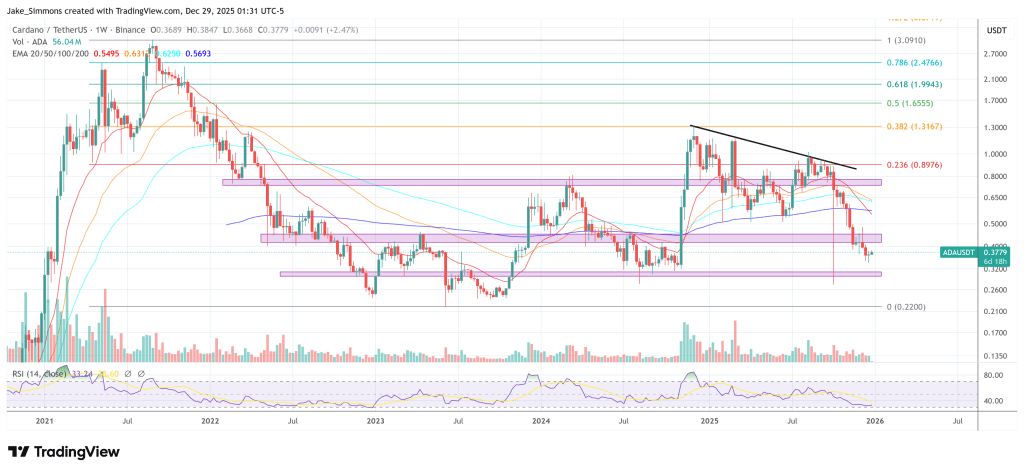
ADA falls below key support, 1-week chart | Source: ADAUSDT on TradingView.com

İlgili Sorular

QWhy is Cardano founder Charles Hoskinson leaving X (formerly Twitter)?

ACharles Hoskinson is leaving X because he believes the platform rewards outrage, while the work that matters, such as the development of Africa, Basho, Midnight 1.0, and Cardano governance, rewards building. He concluded from his ten years on the platform that building is the game worth playing.

QWhat is the 'digital twin' that Charles Hoskinson mentioned?

AHoskinson has not provided specific details about the 'digital twin' yet. He has only promised to explain what it means during his first YouTube livestream of the new year in January.

QWhere does Charles Hoskinson plan to be active after leaving X?

AAfter leaving X, Hoskinson plans to be active on the Midnight Discord for weekly AMAs, on YouTube for livestreams, and he will focus on long-form writing that he has wanted to do for a decade.

QWhat was the tone of Hoskinson's farewell message on X?

AHis farewell message had a sharp edge. He thanked those who made his decade on the platform worthwhile but also stated, 'To the rest: I won’t miss you,' nodding to the many disputes he has been involved in on the platform.

QWhat is the trading price of ADA (Cardano's token) mentioned at the end of the article?

AAt the time the article was written, ADA was trading at $0.3779.

İlgili Okumalar

Silicon Valley 'Startup Guru' Steve Hoffman: Web3 + AI Could Be a Trap

Silicon Valley investor and "Godfather of Startups" Steve Hoffman warns that combining Web3 with AI is likely a trap, not a promising venture. In an interview, Hoffman argues that while AI is a foundational technology touching all industries, Web3 adds complexity, friction, and regulatory risk without solving mainstream consumer or business needs. He advises founders to focus on deep, specialized applications where startups can out-iterate giants, rather than on generic features easily replicated by large tech companies. Hoffman observes that Silicon Valley will lead foundational AI research, while China excels at rapid, large-scale application and commercialization, particularly in robotics. He stresses that AI-driven autonomous agents capable of collaborative, multi-step tasks are 2-4 years away, which will cause significant job displacement. The solution is not to slow AI but to redesign business models around human-AI collaboration and reform social systems like education and retraining. For startups, Hoffman recommends focusing on vertical, expertise-heavy domains to build defensibility. He sees major opportunities in AI fraud detection and cybersecurity. Key founder mindsets include systemic thinking over feature-focus, relentless customer centricity, building adaptive teams, and deeply understanding AI's capabilities and limits. Hoffman is also leading a non-profit initiative to establish university centers aimed at training future leaders in responsible, human-value-aligned AI innovation.

marsbit1 saat önce

Silicon Valley 'Startup Guru' Steve Hoffman: Web3 + AI Could Be a Trap

marsbit1 saat önce

Token Inefficient, Economy Tokenless

The article "Tokens Aren't Economical, Economics Aren't Tokenized" analyzes a pivotal shift in the AI industry from a technology-driven narrative to one dominated by capital efficiency. It highlights two concurrent trends: a severe capital shortage due to the exorbitant and recurring costs of compute (e.g., OpenAI's high burn rate) and a wave of corporate spin-offs where major tech companies are separating their AI units (like Kuaishou's Kling and Baidu's Kunlunxin). The core argument is that AI's "anti-internet" business model, where user growth increases costs rather than profits, has created a disconnect between high valuations and actual cash flow. Spin-offs address this by allowing AI assets to be valued independently. Within a parent company, they are seen as cost centers, but as standalone entities, they are priced based on their growth potential and scarcity in the primary market, leading to massive valuation premiums (e.g., Kling's estimated value tripling post-spin-off). The industry is at an inflection point, moving from "model worship" to "value realization." The competition is evolving from a pure compute (GPU) race to a broader focus on systemic efficiency and full-stack engineering (involving CPUs and orchestration) to achieve viable commercialization. The year 2026 is framed as a critical moment where the industry must definitively answer how to economically translate AI capability into tangible business value, reshaping the sector's future power structure.

marsbit1 saat önce

Token Inefficient, Economy Tokenless

marsbit1 saat önce

Crossing the 'Memory Wall': The Wafer-Level Revolution and Computing Power Routes in the AI Inference Era

In 2026, a historic shift occurred in AI as major cloud providers' inference spending surpassed training spending for the first time, signaling a move from "building large models" to "using large models." This shifts the core challenge from computing power to the "memory wall"—the bottleneck of data movement (model weights, activations, KV Cache) between external DRAM and processors, where energy and latency from data transfer far exceed computation itself. Companies like Nvidia face GPU idle time due to bandwidth limits. In contrast, Cerebras Systems adopts a radical "wafer-scale" approach with its Wafer-Scale Engine (WSE). Instead of cutting a silicon wafer into many chips, Cerebras uses almost the entire wafer as one massive chip (WSE-3). This design provides 44GB of on-chip SRAM, delivering memory bandwidth thousands of times higher than traditional HBM (e.g., 21 PB/s vs. Nvidia B200). For LLM inference, weights are streamed layer-by-layer from external MemoryX storage to the chip, avoiding HBM bottlenecks. This results in token generation speeds 1.5–5 times faster than Nvidia's B200 in some models and significant advantages in first-token latency and long-context tasks. Additionally, Cerebras's architecture offers much lower interconnect power consumption (0.15 pJ/bit vs. GPU's ~10 pJ/bit). However, Cerebras faces challenges: SRAM scaling has slowed with advanced nodes, limiting future capacity gains; the chip requires specialized liquid cooling and custom software stacks; and its external I/O bandwidth (150 GB/s) is low compared to NVLink, hindering multi-system scaling for very large models. Competition is intensifying. Major players are pursuing three paths: 1) Developing proprietary inference ASICs (e.g., Google TPU, Microsoft Maia), 2) Leveraging advanced packaging (e.g., TSMC's SoW) to democratize wafer-scale-like integration, potentially eroding Cerebras's process advantage within a few years, and 3) Exploring optical interconnects for ultimate bandwidth. Commercially, Cerebras is transitioning from a hardware vendor to a service provider, facing the immense challenge of building high-power, specialized data centers to meet large contracts (e.g., 250MW/year from 2026–2028). In conclusion, the AI inference era presents a fundamental architectural trade-off. Cerebras opts for extreme physical optimization for low-latency, single-task performance, while Nvidia prioritizes versatility and massive cluster throughput. The path forward remains uncertain, with technology and business models still evolving in the race toward advanced AI.

marsbit1 saat önce

Crossing the 'Memory Wall': The Wafer-Level Revolution and Computing Power Routes in the AI Inference Era

marsbit1 saat önce

Has Bitcoin's 'Rebound Ended', Officially Entering the Late Bear Market Phase?

**Title: Has Bitcoin's Rebound Ended, Entering the Late Bear Market Phase?** **Summary:** Bitcoin's price has declined by 13% this week, signaling a potential return to late-stage bear market conditions. The price fell to around $67k, positioned between the Realized Price and Realized Cap Weighted Average. For the first time since early 2022, the Short-Term Holder cost basis has dropped below this key average, confirming a hallmark of late-cycle bear markets. Profitability metrics have collapsed sharply. The 7-day average of the Realized Profit/Loss ratio plummeted from a local high of 3.16 to 0.29, mirroring the February panic sell-off. Critically, the 90-day average never breached the threshold of 2, indicating the recent rally to $82k was a bear market bounce, not a structural shift. Realized losses surged to $1.35 billion daily, with $770 million coming from Long-Term Holders selling at a loss. This accelerating redistribution of supply from weak to strong hands is a necessary but ongoing process for a market bottom. The rally stalled almost precisely at the aggregate cost basis (~$83k) of US spot Bitcoin ETF investors, turning that level into strong resistance and leaving the average ETF holder underwater again. Spot market flows have turned decisively negative, showing sellers are dominating order books despite the price drop. While a significant futures long liquidation event cleared over $400 million in leverage, providing a potential reset, sustained spot demand is yet to materialize. Options markets continue to price in higher future volatility (Implied Volatility) than recent price action (Realized Volatility) has shown, with a persistent skew towards put options, indicating ongoing demand for downside protection. In conclusion, multiple metrics point to a fragile market structure. Resistance at the ETF cost basis, accelerating realized losses, dominant spot selling, and cautious options pricing all suggest the bear market trend persists. A sustainable recovery likely requires a resurgence of spot demand, ETF holders returning to profit, and a clear reduction in selling pressure.

marsbit1 saat önce

Has Bitcoin's 'Rebound Ended', Officially Entering the Late Bear Market Phase?

marsbit1 saat önce

İşlemler

Spot
Futures

Popüler Makaleler

ADA Nasıl Satın Alınır

HTX.com’a hoş geldiniz! Cardano (ADA) satın alma işlemlerini basit ve kullanışlı bir hâle getirdik. Adım adım açıkladığımız rehberimizi takip ederek kripto yolculuğunuza başlayın. 1. Adım: HTX Hesabınızı OluşturunHTX'te ücretsiz bir hesap açmak için e-posta adresinizi veya telefon numaranızı kullanın. Sorunsuzca kaydolun ve tüm özelliklerin kilidini açın. Hesabımı Aç2. Adım: Kripto Satın Al Bölümüne Gidin ve Ödeme Yönteminizi SeçinKredi/Banka Kartı: Visa veya Mastercard'ınızı kullanarak anında Cardano (ADA) satın alın.Bakiye: Sorunsuz bir şekilde işlem yapmak için HTX hesap bakiyenizdeki fonları kullanın.Üçüncü Taraflar: Kullanımı kolaylaştırmak için Google Pay ve Apple Pay gibi popüler ödeme yöntemlerini ekledik.P2P: HTX'teki diğer kullanıcılarla doğrudan işlem yapın.Borsa Dışı (OTC): Yatırımcılar için kişiye özel hizmetler ve rekabetçi döviz kurları sunuyoruz.3. Adım: Cardano (ADA) Varlıklarınızı SaklayınCardano (ADA) satın aldıktan sonra HTX hesabınızda saklayın. Alternatif olarak, blok zinciri transferi yoluyla başka bir yere gönderebilir veya diğer kripto para birimlerini takas etmek için kullanabilirsiniz.4. Adım: Cardano (ADA) Varlıklarınızla İşlem YapınHTX'in spot piyasasında Cardano (ADA) ile kolayca işlemler yapın.Hesabınıza erişin, işlem çiftinizi seçin, işlemlerinizi gerçekleştirin ve gerçek zamanlı olarak izleyin. Hem yeni başlayanlar hem de deneyimli yatırımcılar için kullanıcı dostu bir deneyim sunuyoruz.

1.4k Toplam GörüntülenmeYayınlanma 2024.12.10Güncellenme 2026.06.02

ADA Nasıl Satın Alınır

Tartışmalar

HTX Topluluğuna hoş geldiniz. Burada, en son platform gelişmeleri hakkında bilgi sahibi olabilir ve profesyonel piyasa görüşlerine erişebilirsiniz. Kullanıcıların ADA (ADA) fiyatı hakkındaki görüşleri aşağıda sunulmaktadır.

活动图片













