Cardano Founder Says Pentad Faces $40 Million Shortfall After ADA Price Crash

bitcoinist2026-03-09 tarihinde yayınlandı2026-03-09 tarihinde güncellendi

Charles Hoskinson says Cardano’s Pentad initiative is dealing with a roughly $40 million funding gap after ADA fell from around $0.83 at the time of the original proposal to roughly $0.25. In a March 6 video update, the Cardano founder said the plan was initially working with the equivalent of about $58 million in value from 70 million ADA, but that figure has since dropped to about $18 million.

That repricing, he argued, has fundamentally changed the economics of the program. “The reality is that there’s a $40 million shortfall between when we wanted to do it and where we’re at today,” Hoskinson said. “Every single member of the Pentad has to accept that shortfall, meaning out of pocket for commitments and obligations. They have to make it up.”

Hoskinson Defends The Cardano Pentad

Pentad was designed as a coordinated effort between five core Cardano ecosystem entities to secure commercially important integrations for the network more efficiently and at scale. Hoskinson said the original logic was that Cardano and Midnight could negotiate together and get better aggregate terms, but the collapse in ADA’s dollar value means even the Cardano-side integrations now cost more than the treasury-backed funding effectively covers. Midnight, he said, is also paying for its own integrations out of pocket, with liabilities exceeding $10 million.

A central point of the update was a reimbursement dispute tied to Fireblocks. Hoskinson said one party had negotiated separately with Fireblocks outside the Pentad process, reached its own fee arrangement, and then later sought reimbursement. That, he argued, is not comparable to the more expansive and expensive integration the Midnight Foundation had been negotiating and was never part of the original governance-approved structure.

“Everyone in the Pentad is at a loss. We did not make a profit,” he said. “The vast majority of the integrations will require out-of-pocket expenses from the Cardano Foundation, the Midnight Foundation, Input Output, Emergo, and Intersect and long-term liabilities because many of these things required multi-year contracts.” By contrast, he added, external actors who were not signers to those liabilities cannot reasonably expect to be made whole simply because earlier public comments were made under different assumptions.

Hoskinson nevertheless cast Pentad V1 as an operational success. He said Cardano went from signing a deal with Circle to having USDCX live on the network in 84 days, calling it the number one stablecoin on Cardano already. He also pointed to integrations with LayerZero, Pyth, Dune Analytics and custodians, arguing the effort has moved Cardano from being “an island” to being connected to the broader crypto market.

Related Reading: Cardano Founder Sounds Alarm Over New US Crypto Bill

That shift matters because, in Hoskinson’s view, Cardano’s next challenge is no longer core infrastructure. It is utility, user experience and DeFi traction. He said the ecosystem still needs strategic capital deployment to help applications survive and compete, and floated Pentad V2 as a possible treasury-backed “weighted index” of Cardano DApps and DeFi projects rather than a grant program.

“We don’t have an infrastructure problem,” he said later in the video. “We have DApps and DeFi and we have an experience problem. We were an island. We’re no longer an island. We built those bridges. That’s what you paid for with Pentad.”

The broader message was political as much as financial. Hoskinson framed the reimbursement fight as a test of whether Cardano’s on-chain governance can function under stress without collapsing into public infighting. If the ecosystem can align behind difficult capital-allocation decisions despite lower token prices, he argued, Pentad could become less a funding controversy than an early demonstration of whether Cardano’s governance model can actually execute.

At press time, ADA traded at $0.2548.
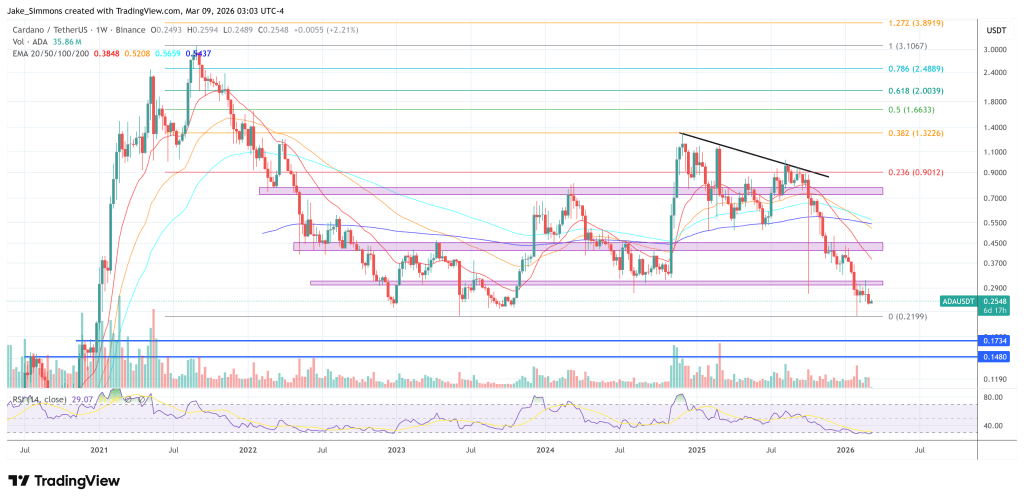
ADA hovers below key resistance, 1-week chart | Source: ADAUSDT on TradingView.com

İlgili Sorular

QWhat is the main financial issue facing Cardano's Pentad initiative according to Charles Hoskinson?

AThe main financial issue is a roughly $40 million funding shortfall due to the sharp decline in ADA's price, which has reduced the value of the treasury from an initial $58 million to about $18 million.

QWhat was the original purpose of the Pentad initiative?

APentad was designed as a coordinated effort between five core Cardano ecosystem entities to secure commercially important integrations for the network more efficiently and at scale.

QHow did Hoskinson defend the operational success of Pentad V1 despite the financial shortfall?

AHe cited the rapid 84-day integration of USDCX, making it the number one stablecoin on Cardano, and pointed to successful integrations with LayerZero, Pyth, Dune Analytics, and custodians, which connected Cardano to the broader crypto market.

QWhat did Hoskinson identify as Cardano's next major challenge after improving its infrastructure?

AHe stated that the next challenge is no longer core infrastructure, but rather utility, user experience, and DeFi traction for the ecosystem.

QWhat broader, non-financial test did Hoskinson say the reimbursement dispute represents for the Cardano ecosystem?

AHe framed it as a test of whether Cardano's on-chain governance can function under stress without public infighting and if it can execute difficult capital-allocation decisions despite lower token prices.

İlgili Okumalar

Anthropic's IPO Launch: Commercial Miracle or Valuation Bubble?

Anthropic has confidentially filed for an IPO, led by Morgan Stanley and Goldman Sachs, potentially going public by October. Following its latest $650 billion funding round, its pre-IPO valuation stands at $965 billion, with projections reaching up to $2 trillion at listing, which would make it the highest-valued private company ever. The article, written by Fu Sheng, addresses skepticism that this represents an AI bubble akin to the 2000 dot-com crash. It argues the current situation differs fundamentally. Unlike the internet bubble era, which relied on speculative narratives with little revenue, Anthropic's valuation is backed by unprecedented, measurable financial performance. Key data points include: * **Revenue Growth:** ARR skyrocketed from $10 billion in early 2025 to $470 billion by May 2026, targeting $100 billion by year-end—a growth curve unmatched in business history. * **Profitability:** It achieved operating profitability in Q2 2026 with an estimated $5.6 billion profit. * **Efficiency:** With ~3,000 employees and ~$470 billion ARR, its revenue per employee exceeds $10 million. Products like Claude Code, launched less than a year ago, already generate $25 billion in annualized revenue. * **Enterprise Adoption:** It boasts a strong enterprise client base, with 8 of the Fortune 10 and over 1,000 large firms spending over $1 million annually on Claude. The valuation is framed using a traditional SaaS model (e.g., a 10x Price-to-Sales multiple on $100 billion revenue). The author contends the core question for analysts has shifted from "How big could this be?" to "How much is it earning and will earn next quarter?" The discussion extends beyond Anthropic to a broader paradigm shift: the transition from a "carbon-based" to a "silicon-based" economy. Companies are increasingly prioritizing investment in compute and AI capabilities over human resources, as these directly scale productivity and competitive advantage. Anthropic's IPO is thus positioned not just as a corporate milestone, but as a price anchor for this new economic era.

链捕手12 dk önce

Anthropic's IPO Launch: Commercial Miracle or Valuation Bubble?

链捕手12 dk önce

Near Returns to the AI Stage: Transformation into a Public Chain Due to 'Payroll Difficulties,' Agent and Privacy Emerge as New Growth Narratives

NEAR Returns to AI Origins: From Payroll Struggles to Blockchain, Now Focusing on AI Agents and Privacy NEAR Protocol's journey began not with grand blockchain ambitions, but from a practical hurdle: its AI startup founders, including Transformer paper co-author Illia Polosukhin, couldn't efficiently pay international developers in 2017. This led them to pivot and build a high-performance, scalable blockchain. After years navigating various crypto narratives like sharding and cross-chain interoperability, NEAR is now leveraging its AI roots to re-enter the AI arena. A key driver is its "NEAR Intents" layer, which abstracts complex cross-chain transactions. Users simply state their goal (e.g., swap BTC for ETH), and a solver network finds the optimal route. This system has processed over $20B in cross-chain volume, generating significant fee revenue. A major growth area is private transactions via "Confidential Intents/Swaps," which hide trade details until settlement to protect against MEV and front-running. Remarkably, private swaps recently accounted for over 40% of NEAR's transaction volume, highlighting strong demand but also potential regulatory scrutiny. With its AI-founder pedigree, NEAR is positioning itself at the intersection of blockchain, AI agents, and privacy, aiming to become infrastructure for the emerging agent economy while navigating the challenges of its rapid adoption.

marsbit2 saat önce

Near Returns to the AI Stage: Transformation into a Public Chain Due to 'Payroll Difficulties,' Agent and Privacy Emerge as New Growth Narratives

marsbit2 saat önce

From Ethereum to AI's 'CROPS': What Exactly is This Set of 'Slow Variables' That Vitalik Repeatedly Emphasizes?

In recent discussions, Vitalik Buterin has frequently emphasized the concept of "CROPS," a framework defining core values for Ethereum's development. CROPS stands for Censorship Resistance, Capture Resistance, Open Source, Privacy, and Security. Initially outlined in the Ethereum Foundation's "EF Mandate," it represents a commitment to user sovereignty, ensuring that the network resists external control, remains open, protects privacy, and prioritizes security. The relevance of CROPS extends beyond Ethereum's foundational principles, becoming crucial in the context of AI integration. As AI agents begin handling wallet operations and automated transactions, the risk increases that users may cede control over their digital assets, privacy, and intentions to centralized AI service providers. A "CROPS AI" would therefore emphasize local execution where possible, privacy-preserving remote model calls (e.g., using zero-knowledge proofs), and transparent, verifiable processes to maintain user agency. Vitalik highlights a significant convergence between "CROPS Ethereum access layer" and "CROPS AI." Both address the same fundamental challenge: how users can access powerful services—be it blockchain data via RPCs or AI models—without exposing sensitive information or relinquishing ultimate control. This intersection points toward a future digital entry point that is more private, secure, and user-controlled. Ultimately, CROPS is not merely an abstract ideal but a practical guidepost. It steers development—from protocol resilience and wallet design to AI agent safety—towards a future where users retain self-sovereignty even as digital systems grow more complex and powerful. In an era of accelerating AI adoption, these "slow variables" of censorship resistance, openness, privacy, and security may define Ethereum's enduring value.

marsbit2 saat önce

From Ethereum to AI's 'CROPS': What Exactly is This Set of 'Slow Variables' That Vitalik Repeatedly Emphasizes?

marsbit2 saat önce

İşlemler

Spot
Futures

Popüler Makaleler

ADA Nasıl Satın Alınır

HTX.com’a hoş geldiniz! Cardano (ADA) satın alma işlemlerini basit ve kullanışlı bir hâle getirdik. Adım adım açıkladığımız rehberimizi takip ederek kripto yolculuğunuza başlayın. 1. Adım: HTX Hesabınızı OluşturunHTX'te ücretsiz bir hesap açmak için e-posta adresinizi veya telefon numaranızı kullanın. Sorunsuzca kaydolun ve tüm özelliklerin kilidini açın. Hesabımı Aç2. Adım: Kripto Satın Al Bölümüne Gidin ve Ödeme Yönteminizi SeçinKredi/Banka Kartı: Visa veya Mastercard'ınızı kullanarak anında Cardano (ADA) satın alın.Bakiye: Sorunsuz bir şekilde işlem yapmak için HTX hesap bakiyenizdeki fonları kullanın.Üçüncü Taraflar: Kullanımı kolaylaştırmak için Google Pay ve Apple Pay gibi popüler ödeme yöntemlerini ekledik.P2P: HTX'teki diğer kullanıcılarla doğrudan işlem yapın.Borsa Dışı (OTC): Yatırımcılar için kişiye özel hizmetler ve rekabetçi döviz kurları sunuyoruz.3. Adım: Cardano (ADA) Varlıklarınızı SaklayınCardano (ADA) satın aldıktan sonra HTX hesabınızda saklayın. Alternatif olarak, blok zinciri transferi yoluyla başka bir yere gönderebilir veya diğer kripto para birimlerini takas etmek için kullanabilirsiniz.4. Adım: Cardano (ADA) Varlıklarınızla İşlem YapınHTX'in spot piyasasında Cardano (ADA) ile kolayca işlemler yapın.Hesabınıza erişin, işlem çiftinizi seçin, işlemlerinizi gerçekleştirin ve gerçek zamanlı olarak izleyin. Hem yeni başlayanlar hem de deneyimli yatırımcılar için kullanıcı dostu bir deneyim sunuyoruz.

1.4k Toplam GörüntülenmeYayınlanma 2024.12.10Güncellenme 2026.06.02

ADA Nasıl Satın Alınır

Tartışmalar

HTX Topluluğuna hoş geldiniz. Burada, en son platform gelişmeleri hakkında bilgi sahibi olabilir ve profesyonel piyasa görüşlerine erişebilirsiniz. Kullanıcıların ADA (ADA) fiyatı hakkındaki görüşleri aşağıda sunulmaktadır.

活动图片