Cardano Founder Says Midnight Could Eclipse All Privacy Projects Within A Year

bitcoinist2026-01-27 tarihinde yayınlandı2026-01-27 tarihinde güncellendi

Özet

Cardano founder Charles Hoskinson introduced Midnight as the ecosystem's "crown jewel" and a critical privacy solution for mainstream crypto adoption. He argued that while existing blockchains perfected transparency, they lack a compliant privacy layer essential for real-world business. Midnight enables selective data disclosure for regulatory compliance (like KYC/AML) without sacrificing privacy, and supports hybrid applications across multiple blockchains. Hoskinson revealed that over 50% of Midnight’s tokens were distributed to ADA holders, and early trading volume exceeded $9 billion. He projected that Midnight will surpass all privacy-focused projects within a year, crediting Cardano’s deep research team, which includes pioneering computer scientists. At the time of writing, ADA was trading at $0.3512.

Cardano founder Charles Hoskinson used the opening of a Midnight workshop in Sapporo (Japan tour) on Jan. 25 to frame Midnight as Cardano’s “crown jewel” and a missing primitive for mainstream crypto adoption, arguing the privacy layer is positioned to outpace incumbent privacy-focused networks within 12 months.

Why Cardano’s Midnight ‘Eclipses’ All Privacy Projects

Hoskinson told attendees that while crypto spent the past decade perfecting transparent ledgers, it never built a first-class “private side” that real businesses and regulators can work with. “When you have the yin and yang, well, we only built one side of the yin and yang. We only built the transparent side. We didn’t build the private side,” he said. “So the challenge is that blockchains, every single one of them, they’re missing something. They’re missing a component that’s required for real-life business.”

In his telling, the gap sits at the intersection of privacy-enhancing technology (PET), compliance, and an emerging “abstraction” stack aimed at making crypto usable without forcing consumers to learn how blockchains work. Hoskinson argued that regulated activity like KYC/KYB/AML requires selective disclosure, but public chains force a tradeoff between compliance and privacy. “If you share information about yourself on a public network, everyone in the world, everywhere in the world, gets to see that,” he said. “That doesn’t make any sense. That doesn’t make sense to do commerce.”

He extended the same logic to intent-based execution and account abstraction-style UX, where users describe outcomes and a solver network routes liquidity and settlement across chains. “If I know your intentions, I can trade against you,” Hoskinson said, warning that revealing price bounds or execution constraints invites adverse selection. “Never tell me your intention because I can use it against you. So, intentions also require privacy.”

Midnight, he said, is designed to supply those primitives without demanding wholesale migration to a new Layer 1. Hoskinson described the network as built for “hybrid applications” across multiple ecosystems, claiming Midnight’s launch architecture connected it to “eight different ecosystems, seven different blockchains,” so users can stay on chains like Solana, Cardano, Bitcoin, or Ethereum while invoking Midnight’s privacy features.

He also positioned Midnight as a catalyst for Cardano’s DeFi ambitions, acknowledging a participation gap between staking and on-chain application usage. “There’s 1.4 million people staking, but only about 50,000 people participating on a monthly basis in our DeFi ecosystem,” Hoskinson said, adding that the next phase is to upgrade a subset of leading Cardano dApps so they can tap Midnight and market privacy-native products—such as private DEXs, prediction markets, or stablecoins—to users from other ecosystems.

On rollout, Hoskinson said the first stage of Midnight launched in December and that the first mainnet is “very soon” to follow. He highlighted what he characterized as an unusually retail-heavy distribution: “We never sold a single token. We just gave it away,” he said, claiming ADA holders received more than 50% of supply and that early trading activity surpassed $9 billion in volume and more than $1 billion in value.

Hoskinson closed with his boldest projection: “Within a year, Midnight is going to eclipse anybody in the privacy space because we know how to solve these problems,” he said, attributing the edge to the depth of Cardano’s research bench.

“Because we hired 168 scientists, and they happen to have spent the last four decades of their life chasing this. One of the guys working on this wrote the first computer game online. He was at Stanford when they were building the internet, [...]. He wrote Pong, and it was the first online game. That’s the legacy we have. Now, 40 years later, he’s a fellow in the Royal Society, the same society that Sir Isaac Newton was a member of. He’s working on this, as is that 22-year-old graduate student, as is the developer here in Japan, and everyone in between, and that’s why we’re going to win. It’s not a US cryptocurrency. It’s global,” Hoskison said.

At press time, ADA traded at $0.3512.
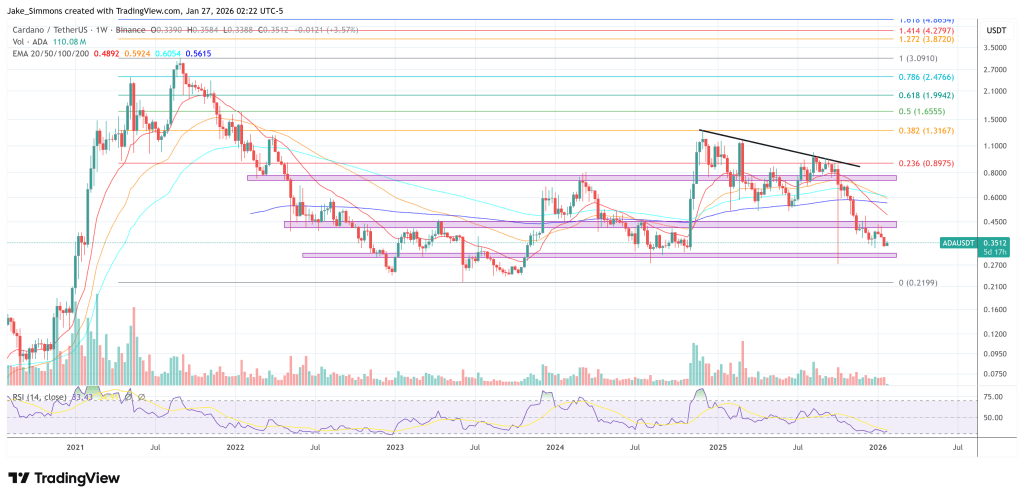
ADA hovers below key resistance, 1-week chart | Source: ADAUSDT on TradingView.com

İlgili Sorular

QWhat is the main argument Charles Hoskinson makes about Midnight in relation to other privacy projects?

ACharles Hoskinson argues that Midnight is positioned to outpace all incumbent privacy-focused networks within 12 months, calling it Cardano's 'crown jewel' and a missing primitive for mainstream crypto adoption.

QAccording to Hoskinson, what key component are current blockchains missing for real-life business?

AHoskinson states that current blockchains are missing a first-class 'private side' that allows for selective disclosure, which is necessary for regulated activities like KYC/KYB/AML and commerce, as public chains force a tradeoff between compliance and privacy.

QHow does Hoskinson describe the distribution of Midnight's tokens?

AHe describes it as an unusually retail-heavy distribution, claiming they never sold a single token but gave it away, with ADA holders receiving more than 50% of the supply, and early trading activity surpassed $9 billion in volume.

QWhat does Hoskinson cite as Midnight's key advantage in the privacy space?

AHe attributes Midnight's edge to the depth of Cardano's research bench, highlighting that they hired 168 scientists, including experienced professionals with decades of expertise in the field, such as a fellow in the Royal Society who wrote the first online game Pong.

QHow is Midnight designed to function in relation to other blockchain ecosystems?

AMidnight is built for 'hybrid applications' across multiple ecosystems, with its launch architecture connected to eight different ecosystems and seven different blockchains, allowing users to stay on chains like Solana, Cardano, Bitcoin, or Ethereum while invoking its privacy features.

İlgili Okumalar

Has the 'Digital Gold' Narrative for BTC Failed?

**Title: Has the "Digital Gold" Narrative for Bitcoin Failed?** The article argues that Bitcoin's "digital gold" narrative remains valid despite a recent sharp price decline (from a peak near $126k in Oct 2025 to briefly under $61k in Feb 2026). It presents a long-term investment framework based on three core points: **1. Viewing Bitcoin as an Asset:** Bitcoin is presented as a superior potential store of value compared to gold. Key arguments are its absolute scarcity (21 million cap), superior portability, and transparent auditability via its public ledger. While acknowledging its current use in early, volatile stages (~3-4% global adoption), the author draws parallels to the early, disruptive phases of the internet and e-commerce. **2. Understanding the Recent Downturn:** The current ~50% correction is framed as a predictable, consensus-driven cycle following its post-halving peak (the 2024 halving preceded the Oct 2025 high). A crucial factor is a historic "changing of hands": the influx of new institutional buyers via ETFs allowed early, low-cost holders (miners, OG believers) to take profits. The author notes that while severe, Bitcoin's historical drawdowns (e.g., 93% in 2011, 77% in 2021-22) have been progressively smaller, suggesting maturing holder structure and decreasing volatility over time. **3. The Long-Term Perspective:** The long-term thesis hinges on Bitcoin capturing a portion of gold's market value. With Bitcoin's market cap at ~$1.4 trillion (at $70k) versus gold's ~$20 trillion, significant upside potential exists if the "digital gold" narrative is partially realized. However, the author strongly cautions that short-term risks remain, the bottom is unpredictable, and high volatility is inherent. The real risk is not Bitcoin failing but poor personal position management (over-leverage, wrong capital) and a lack of deep understanding, which can force investors out during severe downturns. The conclusion uses Amazon's 95% crash post-2000 dot-com bubble and subsequent 42x recovery as an analogy. The ultimate question is not if Bitcoin's price will rise, but if an investor's strategy and conviction can withstand the volatility to see the long-term play out. The recent divergence (gold up, Bitcoin down) is posed not as a narrative failure, but as potential evidence of this ongoing, painful transition from a speculative asset to a mainstream allocation.

marsbit5 saat önce

Has the 'Digital Gold' Narrative for BTC Failed?

marsbit5 saat önce

Has BTC's 'Digital Gold' Narrative Failed?

The article discusses Bitcoin's "digital gold" narrative, its recent price drop, and long-term outlook through the perspective of "Jason". It argues the narrative is not a failure but that Bitcoin represents a superior, new asset class due to its fixed supply (21 million), portability, and auditability. The piece compares its current ~3-4% global adoption rate to early internet/e-commerce, suggesting significant growth potential. Regarding the 2025-2026 price decline (from ~$126k to briefly under $61k), the author views it as a predictable, consensus-driven sell-off within Bitcoin's ~4-year cycle post-halving, exacerbated by a major "handover" from early, low-cost holders to new institutional buyers via ETFs. A key observation is that historical peak-to-trough drawdowns have lessened over time (e.g., 93% in 2011 to ~50% in 2026), indicating maturing volatility as holder structure changes. For the long term, the author uses a simple framework: Bitcoin's total market cap (~$1.4T at $70k) is only about 7% of gold's (~$20T). Even capturing 30-50% of gold's value would imply substantial upside. However, the article strongly cautions against viewing this as investment advice, emphasizing extreme volatility and the critical importance of risk management, position sizing, and deep fundamental understanding to survive severe drawdowns. It concludes by drawing a parallel to Amazon's 95% crash in 2000 and subsequent 42x recovery, stressing that the key is surviving market cycles to realize long-term potential.

链捕手5 saat önce

Has BTC's 'Digital Gold' Narrative Failed?

链捕手5 saat önce

From Code to Cognition: A Ten-Thousand-Word Guide to the Evolution of the Robot Brain

"From Code to Cognition: The Evolution of Robot Brains" The journey of robotic intelligence has shifted dramatically from manually coded systems to AI-driven brains. For decades, robots relied on layered software stacks—perception, state estimation, planning, control—each handcrafted. While predictable, they lacked adaptability. The 2010s saw deep learning revolutionize perception (e.g., object detection) and control (via reinforcement learning), but learned skills remained narrow. The arrival of Large Language Models (LLMs) marked a turning point. LLMs acted as high-level planners, interpreting natural language instructions and generating sequences of actions for traditional robotic systems to execute. However, true integration came with Visual-Language-Action (VLA) models, which fused vision, language, and motion prediction into a single network. Pioneered by models like RT-2 and open-source projects like OpenVLA, VLAs enable robots to reason and act directly from visual input and commands. The most advanced humanoid robots now employ a "dual-brain" architecture: a slow-thinking, large VLA (System 2) for reasoning and planning, and a fast-reacting, small network (System 1) for high-frequency motion control, sometimes with an even lower-level System 0 for balance. This split balances cognition with the physics of real-time movement. Computation is split between onboard hardware (e.g., NVIDIA Jetson) for safety-critical control loops and cloud/edge servers for non-critical tasks like learning and interfaces. A crucial driver is the open-source ecosystem—models like GR00T and OpenVLA allow startups to build upon pre-trained brains and fine-tune them with their own data, accelerating development. Despite progress, current systems struggle with recovery from errors, sample inefficiency, and long-horizon tasks. This has spurred the rise of **World Models**—neural networks that predict the consequences of actions. By simulating possible futures before acting (like NVIDIA Cosmos or Meta V-JEPA), robots can plan, recover, and generalize better. This represents the next frontier: shifting intelligence from learned reactions to an internal model of physics and cause-and-effect. The field is rapidly evolving. While not yet at its "ChatGPT moment," the convergence of cheaper hardware, scalable simulation, and world models points toward robots that are increasingly capable, adaptive, and useful. The question is shifting from "what can robots do?" to "what *should* they do?"

marsbit5 saat önce

From Code to Cognition: A Ten-Thousand-Word Guide to the Evolution of the Robot Brain

marsbit5 saat önce

İşlemler

Spot
Futures

Popüler Makaleler

ADA Nasıl Satın Alınır

HTX.com’a hoş geldiniz! Cardano (ADA) satın alma işlemlerini basit ve kullanışlı bir hâle getirdik. Adım adım açıkladığımız rehberimizi takip ederek kripto yolculuğunuza başlayın. 1. Adım: HTX Hesabınızı OluşturunHTX'te ücretsiz bir hesap açmak için e-posta adresinizi veya telefon numaranızı kullanın. Sorunsuzca kaydolun ve tüm özelliklerin kilidini açın. Hesabımı Aç2. Adım: Kripto Satın Al Bölümüne Gidin ve Ödeme Yönteminizi SeçinKredi/Banka Kartı: Visa veya Mastercard'ınızı kullanarak anında Cardano (ADA) satın alın.Bakiye: Sorunsuz bir şekilde işlem yapmak için HTX hesap bakiyenizdeki fonları kullanın.Üçüncü Taraflar: Kullanımı kolaylaştırmak için Google Pay ve Apple Pay gibi popüler ödeme yöntemlerini ekledik.P2P: HTX'teki diğer kullanıcılarla doğrudan işlem yapın.Borsa Dışı (OTC): Yatırımcılar için kişiye özel hizmetler ve rekabetçi döviz kurları sunuyoruz.3. Adım: Cardano (ADA) Varlıklarınızı SaklayınCardano (ADA) satın aldıktan sonra HTX hesabınızda saklayın. Alternatif olarak, blok zinciri transferi yoluyla başka bir yere gönderebilir veya diğer kripto para birimlerini takas etmek için kullanabilirsiniz.4. Adım: Cardano (ADA) Varlıklarınızla İşlem YapınHTX'in spot piyasasında Cardano (ADA) ile kolayca işlemler yapın.Hesabınıza erişin, işlem çiftinizi seçin, işlemlerinizi gerçekleştirin ve gerçek zamanlı olarak izleyin. Hem yeni başlayanlar hem de deneyimli yatırımcılar için kullanıcı dostu bir deneyim sunuyoruz.

1.4k Toplam GörüntülenmeYayınlanma 2024.12.10Güncellenme 2026.06.02

ADA Nasıl Satın Alınır

Tartışmalar

HTX Topluluğuna hoş geldiniz. Burada, en son platform gelişmeleri hakkında bilgi sahibi olabilir ve profesyonel piyasa görüşlerine erişebilirsiniz. Kullanıcıların ADA (ADA) fiyatı hakkındaki görüşleri aşağıda sunulmaktadır.

活动图片