Cardano Founder Reveals Leios Solves The Blockchain Trilemma

bitcoinist2026-02-10 tarihinde yayınlandı2026-02-10 tarihinde güncellendi

Özet

Cardano is developing a major layer-1 upgrade called Ouroboros Leios, aimed at significantly increasing the network's throughput from the current 10–15 transactions per second (TPS) to around 500 TPS initially, with a long-term goal of reaching 10,000 TPS. The upgrade, targeted for release in 2026, is designed to enhance scalability while maintaining decentralization and security—addressing the blockchain trilemma. Cardano founder Charles Hoskinson emphasized that Leios is the result of a decade of research and collaboration among numerous scientists and engineers. The protocol introduces a new block type called "endorser blocks" to bundle more transactions efficiently. Additionally, the upgrade is engineered to fail safely back to the current Ouroboros Praos consensus if needed. The development team plans a gradual rollout to avoid overburdening stake pool operators (SPOs), with a public testnet expected by the end of Q2 2026. Hoskinson also highlighted Cardano’s on-chain governance and treasury as key long-term advantages for funding future upgrades.

Cardano is preparing a layer-1 upgrade it says will push mainnet throughput from roughly 10–15 transactions per second to hundreds, while keeping the network’s decentralization and security profile intact. At a Tokyo community event on the Midnight Japan Tour, Input Output’s Michael Smolenski and Cardano founder Charles Hoskinson framed Ouroboros Leios as both a scaling step and a broader consensus breakthrough.

Smolenski, Cardano Core product manager at Input Output, told attendees Leios is “an upgrade to layer 1 to make Cardano faster,” with active development underway and a target release “this year in 2026.” He described the current throughput ceiling as suitable for proving out Ouroboros’ design, but insufficient for the next phase of adoption and for the economics of stake pool operators (SPOs).

Cardano’s Leios Eyes 50x Speed Boost In 2026

“Up until now the speed of the network has been around [...] 10 to 15 transactions per second,” Smolenski said. “But now we need to move on to higher transaction throughput in order to compete and drive further adoption. Another factor, SPOs, they in the long term need to support the cost of their operations from transaction fees instead of from block rewards [...] they need to see network usage of around 50 transactions per second.”

The initial Leios mainnet release is pitched as a “50 times improvement,” with Smolenski translating that into an early move from roughly 10 TPS to around 500 TPS. Rather than sticking to transactions-per-second as the headline metric, he emphasized “transaction kilobytes per second” to account for varied transaction sizes, calling out a target of “300 transaction kilobytes per second” and a confirmation window “between 20 to 80 seconds,” based on prototype results.

Smolenski described Leios as Cardano’s “next generation consensus protocol,” built around additional block types. “There’s a new block. It’s called an endorser block,” he said, adding that existing blocks would be referred to as “ranking blocks.” The practical consequence, in his telling, is the ability to “pack a whole lot more transactions” by bundling them into endorser blocks, alongside other prioritization mechanics he did not detail on stage.

He also stressed that scaling will be incremental to avoid overburdening node operators. The team plans to demonstrate higher throughput in steps, first targeting 500 TPS on mainnet, then proving 1,000 TPS in the near term, with an eventual ambition of 10,000 TPS. “We can’t just go from where we are [...] and go up to 10,000 transactions per second because this needs to be done in a strategic manner,” Smolenski said, repeatedly pointing to the need to “bring the SPOs along with us.”

On timeline, he said a first public Leios testnet is targeted “at the end of Q2 this year,” ahead of a mainnet hard fork.

Hoskinson: ‘Not Just TPS’ But The Trilemma

Hoskinson widened the frame, positioning Leios as the culmination of a decade-long research and engineering pipeline. “Ouroboros Leios didn’t begin in 2026 [...] Leios actually began in 2016, 10 years ago,” he said, describing “more than two dozen papers,” “dozens of protocols,” and contributions spanning “more than 15 engineering firms” and “168 scientists over a 10-year period.”

“Why Leios is special is it’s not TPS,” Hoskinson said. “It’s actually a resolution of the hardest problem in consensus and blockchain, the blockchain trilemma [...] you have decentralization, you have security, and you have scalability [...] we’re told you can only pick two.” He then made the core claim: “This protocol is decentralized, secure, and fast.”

Notably, Ethereum co-founder Vitalik Buterin also said the blockchain trilemma has effectively been solved, comments he made just a few weeks ago.

Hoskinson also argued the design is engineered to degrade safely. “If the protocol fails, the protocol fails to what we have today. It collapses to Ouroboros Praos,” he said, referencing a prior network incident he characterized as a soft fork in which “Cardano split into two networks” and later “came back together by itself.”

In the same remarks, Hoskinson repeatedly returned to governance capacity as the longer-horizon advantage, suggesting pure technical differentiation is transient. He pointed to Cardano’s on-chain governance and treasury — “a billion dollars in it [...] that you control [...] the ADA holders,” he said — as the mechanism to fund upgrades and coordinate change over time.

At press time, ADA traded at $0.2638.
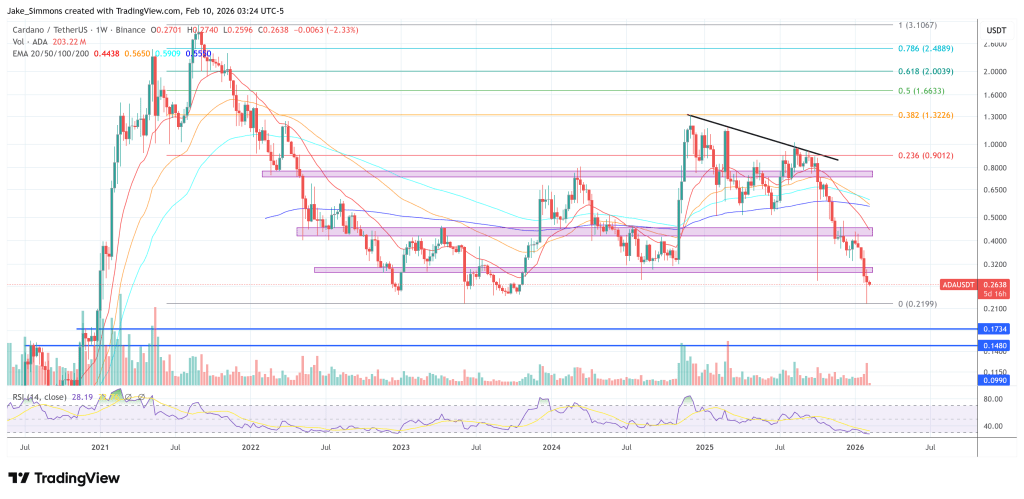
ADA hovers above key support, 1-week chart | Source: ADAUSDT on TradingView.com

Trend Kriptolar

İlgili Sorular

QWhat is the main goal of the Cardano Leios upgrade and when is it targeted for release?

AThe main goal of the Cardano Leios upgrade is to significantly increase the mainnet throughput from 10-15 transactions per second to hundreds, while maintaining decentralization and security. It is targeted for release in 2026.

QAccording to Michael Smolenski, what are the two key reasons Cardano needs higher transaction throughput?

AAccording to Michael Smolenski, Cardano needs higher transaction throughput to compete and drive further adoption, and to allow stake pool operators (SPOs) to support their operational costs from transaction fees, which requires a network usage of around 50 TPS.

QHow does Charles Hoskinson position the significance of Ouroboros Leios beyond just transaction speed?

ACharles Hoskinson positions Ouroboros Leios as a resolution to the blockchain trilemma, claiming it achieves decentralization, security, and scalability simultaneously, which is considered the hardest problem in consensus and blockchain.

QWhat is the safety mechanism described for the Leios protocol if it fails?

AIf the Leios protocol fails, it is engineered to degrade safely by collapsing back to the previous Ouroboros Praos protocol, as demonstrated in a past network incident where Cardano split and then recovered by itself.

QWhat longer-term advantage does Hoskinson suggest is more important than pure technical differentiation for Cardano?

AHoskinson suggests that Cardano's on-chain governance and treasury, controlled by ADA holders and containing about a billion dollars, is the longer-term advantage as it provides the mechanism to fund future upgrades and coordinate change.

İlgili Okumalar

Agent Race Ends, Super Workbench Takes Over

The era of fragmented AI agents is ending. Over the past month, China's tech giants—Tencent, Alibaba, and ByteDance—have simultaneously shifted strategy: instead of launching new, standalone AI agents, they are consolidating their various agent projects into unified "super workbenches." Tencent integrated its QClaw teams into WorkBuddy, a strategic product hailed as a potential third flagship after QQ and WeChat. Alibaba is merging its QoderWork, Wukong, and MuleRun agents into a new "Qianwen Office" platform under DingTalk's leadership. ByteDance rebranded its TRAE SOLO coding agent to TRAE Work, signaling a broader focus on workflow collaboration. This convergence marks a pivotal industry consensus. The initial exploration phase, where companies rapidly built numerous overlapping agents for different scenarios, proved costly and inefficient. With open-source tools eroding technical barriers, competition has shifted from agent creation to resource consolidation and cost control. Historically, platform wars are won not by creating more products, but by simplifying them—as seen with browsers unifying web access and super-apps consolidating services. Now, the "super workbench" aims to become the unified AI entry point for work. This reflects a deeper market realization: the primary audience for AI is no longer just programmers (a market in the tens of millions) but all knowledge workers (a market of billions). The real opportunity lies in augmenting everyday tasks—managing emails, documents, data, and meetings—across the entire workday. The core battleground is becoming control over the primary AI entry point that employees use daily. Tencent's WorkBuddy leverages WeChat and Tencent Docs; Alibaba's Qianwen Office taps into DingTalk's organizational data; ByteDance's TRAE Work integrates with Feishu's workflows. Whoever owns this "super workbench" gains strategic control over orchestrating enterprise data and APIs. This shift is redefining enterprise software. Traditional SaaS applications, valued for their user interfaces, will recede into the background. Their core functionalities will be exposed as standardized "Skills" or APIs for the super workbench's agents to invoke. Software value will shift from selling user seats to charging based on API calls and outcomes delivered. The evolution of agents is moving through clear stages: first as novel standalone products, then as consolidated primary work entry points, and finally as pervasive, invisible capabilities embedded into the digital fabric. The recent moves by major tech firms signal the transition from the first stage into the second, accelerating toward the third. In the end, the most successful agent technology may become invisible—like electricity or the HTTP protocol—a fundamental, unnamed infrastructure powering work itself.

marsbit4 dk önce

Agent Race Ends, Super Workbench Takes Over

marsbit4 dk önce

Michael Saylor: 110 Reasons to Oppose BIP-110

Michael Saylor presents 110 arguments against Bitcoin Improvement Proposal (BIP) 110, a soft fork aimed at restricting certain non-monetary data storage uses (like inscriptions) on the Bitcoin blockchain. He acknowledges the proponents' valid concerns—such as node costs, fee pressure, and preserving Bitcoin's monetary focus—but fundamentally disagrees with the proposed solution. Saylor argues that BIP 110 represents a dangerous precedent of using consensus rules to enforce value judgments on transaction validity, moving away from Bitcoin's core principles of neutrality and permissionless innovation. His key objections are organized into eleven categories: 1) It violates neutrality and hard consensus by banning currently valid transactions. 2) It fails to meet the high burden of proof required for a consensus change, lacking concrete data on the alleged crisis. 3) Its seven bundled technical restrictions are overly broad, targeting generic script functionalities and blocking future upgrade paths. 4) It sacrifices compatibility and future optionality by closing off designed upgrade hooks. 5) Its temporary rules add significant complexity (grandfathering, expiry states) without sufficient justification. 6) The economic and security impacts, particularly on miner revenue and fee markets, are uncertain and unmodeled. 7) Superior, market-based tools (fee markets, relay/mining policies) already exist to manage blockchain load. 8) It stifles innovation by creating a chilling effect for developers. 9) Its modified activation mechanism (55% threshold, forced signaling) is aggressive and risks network splits. 10) The precedent it sets—using consensus to suppress disliked but legal uses—is more dangerous than the problem it aims to solve. 11) A better path exists: improving measurements, refining resource-based policies, and allowing market forces to work. Saylor concludes that Bitcoin's strength lies in its neutral rules, open markets, and hard consensus. Changing these foundational elements to target specific use cases is an unnecessary and risky "iatrogenic" intervention. He advocates for guarding Bitcoin's neutrality rather than acting as its redeemer.

marsbit19 dk önce

Michael Saylor: 110 Reasons to Oppose BIP-110

marsbit19 dk önce

İşlemler

Spot

Popüler Makaleler

ADA Nasıl Satın Alınır

HTX.com’a hoş geldiniz! Cardano (ADA) satın alma işlemlerini basit ve kullanışlı bir hâle getirdik. Adım adım açıkladığımız rehberimizi takip ederek kripto yolculuğunuza başlayın. 1. Adım: HTX Hesabınızı OluşturunHTX'te ücretsiz bir hesap açmak için e-posta adresinizi veya telefon numaranızı kullanın. Sorunsuzca kaydolun ve tüm özelliklerin kilidini açın. Hesabımı Aç2. Adım: Kripto Satın Al Bölümüne Gidin ve Ödeme Yönteminizi SeçinKredi/Banka Kartı: Visa veya Mastercard'ınızı kullanarak anında Cardano (ADA) satın alın.Bakiye: Sorunsuz bir şekilde işlem yapmak için HTX hesap bakiyenizdeki fonları kullanın.Üçüncü Taraflar: Kullanımı kolaylaştırmak için Google Pay ve Apple Pay gibi popüler ödeme yöntemlerini ekledik.P2P: HTX'teki diğer kullanıcılarla doğrudan işlem yapın.Borsa Dışı (OTC): Yatırımcılar için kişiye özel hizmetler ve rekabetçi döviz kurları sunuyoruz.3. Adım: Cardano (ADA) Varlıklarınızı SaklayınCardano (ADA) satın aldıktan sonra HTX hesabınızda saklayın. Alternatif olarak, blok zinciri transferi yoluyla başka bir yere gönderebilir veya diğer kripto para birimlerini takas etmek için kullanabilirsiniz.4. Adım: Cardano (ADA) Varlıklarınızla İşlem YapınHTX'in spot piyasasında Cardano (ADA) ile kolayca işlemler yapın.Hesabınıza erişin, işlem çiftinizi seçin, işlemlerinizi gerçekleştirin ve gerçek zamanlı olarak izleyin. Hem yeni başlayanlar hem de deneyimli yatırımcılar için kullanıcı dostu bir deneyim sunuyoruz.

1.5k Toplam GörüntülenmeYayınlanma 2024.12.10Güncellenme 2026.06.02

ADA Nasıl Satın Alınır

Tartışmalar

HTX Topluluğuna hoş geldiniz. Burada, en son platform gelişmeleri hakkında bilgi sahibi olabilir ve profesyonel piyasa görüşlerine erişebilirsiniz. Kullanıcıların ADA (ADA) fiyatı hakkındaki görüşleri aşağıda sunulmaktadır.

活动图片










