Cardano Founder Reveals Leios Solves The Blockchain Trilemma

bitcoinist2026-02-10 tarihinde yayınlandı2026-02-10 tarihinde güncellendi

Özet

Cardano is developing a major layer-1 upgrade called Ouroboros Leios, aimed at significantly increasing the network's throughput from the current 10–15 transactions per second (TPS) to around 500 TPS initially, with a long-term goal of reaching 10,000 TPS. The upgrade, targeted for release in 2026, is designed to enhance scalability while maintaining decentralization and security—addressing the blockchain trilemma. Cardano founder Charles Hoskinson emphasized that Leios is the result of a decade of research and collaboration among numerous scientists and engineers. The protocol introduces a new block type called "endorser blocks" to bundle more transactions efficiently. Additionally, the upgrade is engineered to fail safely back to the current Ouroboros Praos consensus if needed. The development team plans a gradual rollout to avoid overburdening stake pool operators (SPOs), with a public testnet expected by the end of Q2 2026. Hoskinson also highlighted Cardano’s on-chain governance and treasury as key long-term advantages for funding future upgrades.

Cardano is preparing a layer-1 upgrade it says will push mainnet throughput from roughly 10–15 transactions per second to hundreds, while keeping the network’s decentralization and security profile intact. At a Tokyo community event on the Midnight Japan Tour, Input Output’s Michael Smolenski and Cardano founder Charles Hoskinson framed Ouroboros Leios as both a scaling step and a broader consensus breakthrough.

Smolenski, Cardano Core product manager at Input Output, told attendees Leios is “an upgrade to layer 1 to make Cardano faster,” with active development underway and a target release “this year in 2026.” He described the current throughput ceiling as suitable for proving out Ouroboros’ design, but insufficient for the next phase of adoption and for the economics of stake pool operators (SPOs).

Cardano’s Leios Eyes 50x Speed Boost In 2026

“Up until now the speed of the network has been around [...] 10 to 15 transactions per second,” Smolenski said. “But now we need to move on to higher transaction throughput in order to compete and drive further adoption. Another factor, SPOs, they in the long term need to support the cost of their operations from transaction fees instead of from block rewards [...] they need to see network usage of around 50 transactions per second.”

The initial Leios mainnet release is pitched as a “50 times improvement,” with Smolenski translating that into an early move from roughly 10 TPS to around 500 TPS. Rather than sticking to transactions-per-second as the headline metric, he emphasized “transaction kilobytes per second” to account for varied transaction sizes, calling out a target of “300 transaction kilobytes per second” and a confirmation window “between 20 to 80 seconds,” based on prototype results.

Smolenski described Leios as Cardano’s “next generation consensus protocol,” built around additional block types. “There’s a new block. It’s called an endorser block,” he said, adding that existing blocks would be referred to as “ranking blocks.” The practical consequence, in his telling, is the ability to “pack a whole lot more transactions” by bundling them into endorser blocks, alongside other prioritization mechanics he did not detail on stage.

He also stressed that scaling will be incremental to avoid overburdening node operators. The team plans to demonstrate higher throughput in steps, first targeting 500 TPS on mainnet, then proving 1,000 TPS in the near term, with an eventual ambition of 10,000 TPS. “We can’t just go from where we are [...] and go up to 10,000 transactions per second because this needs to be done in a strategic manner,” Smolenski said, repeatedly pointing to the need to “bring the SPOs along with us.”

On timeline, he said a first public Leios testnet is targeted “at the end of Q2 this year,” ahead of a mainnet hard fork.

Hoskinson: ‘Not Just TPS’ But The Trilemma

Hoskinson widened the frame, positioning Leios as the culmination of a decade-long research and engineering pipeline. “Ouroboros Leios didn’t begin in 2026 [...] Leios actually began in 2016, 10 years ago,” he said, describing “more than two dozen papers,” “dozens of protocols,” and contributions spanning “more than 15 engineering firms” and “168 scientists over a 10-year period.”

“Why Leios is special is it’s not TPS,” Hoskinson said. “It’s actually a resolution of the hardest problem in consensus and blockchain, the blockchain trilemma [...] you have decentralization, you have security, and you have scalability [...] we’re told you can only pick two.” He then made the core claim: “This protocol is decentralized, secure, and fast.”

Notably, Ethereum co-founder Vitalik Buterin also said the blockchain trilemma has effectively been solved, comments he made just a few weeks ago.

Hoskinson also argued the design is engineered to degrade safely. “If the protocol fails, the protocol fails to what we have today. It collapses to Ouroboros Praos,” he said, referencing a prior network incident he characterized as a soft fork in which “Cardano split into two networks” and later “came back together by itself.”

In the same remarks, Hoskinson repeatedly returned to governance capacity as the longer-horizon advantage, suggesting pure technical differentiation is transient. He pointed to Cardano’s on-chain governance and treasury — “a billion dollars in it [...] that you control [...] the ADA holders,” he said — as the mechanism to fund upgrades and coordinate change over time.

At press time, ADA traded at $0.2638.
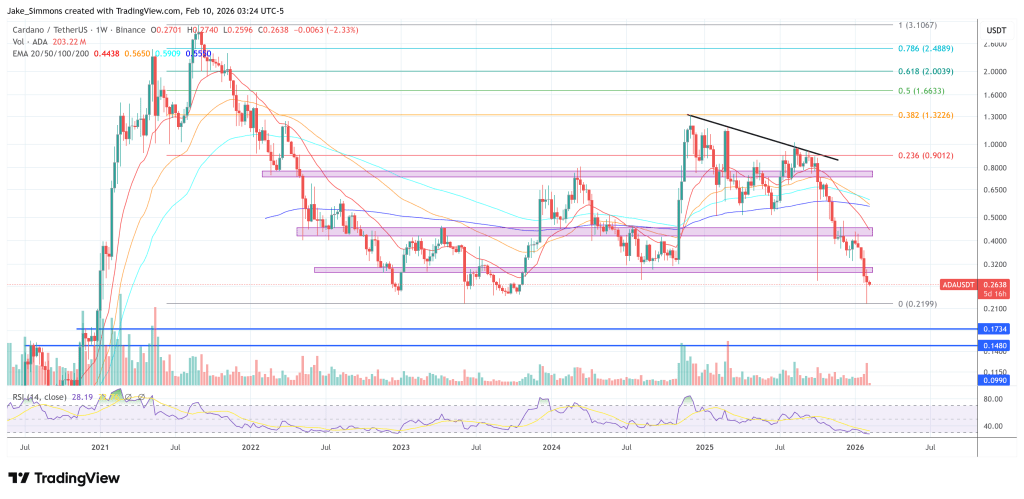
ADA hovers above key support, 1-week chart | Source: ADAUSDT on TradingView.com

Trend Kriptolar

İlgili Sorular

QWhat is the main goal of the Cardano Leios upgrade and when is it targeted for release?

AThe main goal of the Cardano Leios upgrade is to significantly increase the mainnet throughput from 10-15 transactions per second to hundreds, while maintaining decentralization and security. It is targeted for release in 2026.

QAccording to Michael Smolenski, what are the two key reasons Cardano needs higher transaction throughput?

AAccording to Michael Smolenski, Cardano needs higher transaction throughput to compete and drive further adoption, and to allow stake pool operators (SPOs) to support their operational costs from transaction fees, which requires a network usage of around 50 TPS.

QHow does Charles Hoskinson position the significance of Ouroboros Leios beyond just transaction speed?

ACharles Hoskinson positions Ouroboros Leios as a resolution to the blockchain trilemma, claiming it achieves decentralization, security, and scalability simultaneously, which is considered the hardest problem in consensus and blockchain.

QWhat is the safety mechanism described for the Leios protocol if it fails?

AIf the Leios protocol fails, it is engineered to degrade safely by collapsing back to the previous Ouroboros Praos protocol, as demonstrated in a past network incident where Cardano split and then recovered by itself.

QWhat longer-term advantage does Hoskinson suggest is more important than pure technical differentiation for Cardano?

AHoskinson suggests that Cardano's on-chain governance and treasury, controlled by ADA holders and containing about a billion dollars, is the longer-term advantage as it provides the mechanism to fund future upgrades and coordinate change.

İlgili Okumalar

UNI Doubles in Two Months Against the Trend: A 5-Year-Overdue Value Realization

Amidst a generally stagnant crypto market in June and July, UNI, the governance token of Uniswap, saw a significant surge, nearly doubling in price from around $2.3 to $4.6. This rally represents a delayed but significant value reassessment, triggered by the practical implementation of its long-debated "fee switch" mechanism. The key turning point was the on-chain execution of the UNIfication proposal in December 2025. It activated a protocol fee on select pools, directed Unichain sequencer revenue (net of costs) to a communal treasury, executed a one-time burn of 100 million UNI, and established a system where all protocol revenue flows into a "TokenJar" contract. This treasury has a single exit: purchasing and permanently burning UNI via a "Firepit" contract. Initially, the market reacted tepidly as the generated revenue and corresponding burn rate were modest. The narrative shifted dramatically in July 2025 with two major developments. First, the launch of Robinhood Chain, tailored for tokenized stocks, rapidly became a primary source of volume and fees for Uniswap, at one point contributing nearly half of its weekly fees. Second, governance votes successfully expanded the fee mechanism to v4 pools and initiated a temperature check for fees on Robinhood Chain. The activation of v4 fees caused the protocol's daily revenue earmarked for UNI burns to nearly triple. The core of UNI's recent price action is the transition from a pure governance token to a cash-flow asset with a permanent, protocol-funded buyer. Its effectiveness is amplified by UNI's mature and widely distributed supply, with no major impending unlocks to dilute the impact of the buybacks. The sustainability of this rally now hinges on whether the transaction volume, particularly on Robinhood Chain, persists after its initial gas subsidies expire, determining if this is a genuine value realization or a subsidy-fueled spike.

marsbit1 saat önce

UNI Doubles in Two Months Against the Trend: A 5-Year-Overdue Value Realization

marsbit1 saat önce

Breaking: Google Earth Urgently Pulls Back Nano Banana 2 Image Generation Feature!

Google Earth's newly launched "Create image" feature, powered by the Nano Banana 2 AI image generation model, was abruptly withdrawn shortly after its release due to being "played" by users. The feature allowed users to generate and overlay AI-created visuals directly onto real-world satellite and 3D maps in Google Earth. The tool enabled creative applications like historical recreations (e.g., visualizing ancient Pompeii), generating informational graphics for landmarks, and envisioning architectural projects or futuristic cityscapes on real terrain. It operated under "geospatial grounding," meaning the AI respected the underlying geography, topography, and perspective of the chosen map view. The model also integrated with Gemini to retrieve relevant factual information. However, upon release, users quickly tested its limits. A prominent example involved reimagining Philadelphia's historic Independence Hall as a post-apocalyptic ruin overrun by "happy" zombies, evil clowns, and giant alien mechs. This highlighted both the feature's playful potential and its risks regarding the generation of inappropriate or misleading content on realistic maps, leading to its swift temporary removal. Google stated it would re-release the feature after implementing "enhanced guardrails." Analysts note this move strategically leverages Google's vast proprietary geospatial data, positioning its AI not just for artistic generation but for spatially accurate world visualization—a unique advantage in the competitive AI image generation landscape.

marsbit2 saat önce

Breaking: Google Earth Urgently Pulls Back Nano Banana 2 Image Generation Feature!

marsbit2 saat önce

Altman Admits: Overestimated AI Snatching Jobs! Huang Renxun: The Unemployment Narrative Is Completely Backwards

Sam Altman has revised his earlier predictions about AI rapidly replacing jobs, admitting he overestimated the speed at which AI would eliminate entry-level white-collar roles. Speaking on the "Invest Like the Best" podcast, he stated that people do not truly want an AI CEO, as accountability and human connection remain critical. He found that individuals prefer interacting with people who can be held responsible for decisions. Similarly, NVIDIA's Jensen Huang argued that the narrative of AI destroying jobs is misguided. He distinguishes between tasks and jobs, noting that while AI can automate specific tasks, entire jobs—encompassing communication, judgment, coordination, and accountability—are not eliminated. He cited examples like radiologists and software engineers, where demand for these roles has increased as AI handles repetitive tasks, allowing for business expansion and the creation of more positions. Data from a University of Maryland and LinkUp study supports this, showing that U.S. job postings for new graduates have actually risen, countering the fear of vanishing entry-level roles. However, a significant shift is occurring: the traditional entry-level tasks that help newcomers gain experience are being automated, making initial career access more challenging. The key insight is that as AI takes over standardized tasks, the enduring value of human work shifts toward areas of responsibility, trust-building, and final decision-making—aspects that AI cannot replicate. The real "moat" for professionals lies in these irreplaceable human elements.

marsbit2 saat önce

Altman Admits: Overestimated AI Snatching Jobs! Huang Renxun: The Unemployment Narrative Is Completely Backwards

marsbit2 saat önce

İşlemler

Spot

Popüler Makaleler

ADA Nasıl Satın Alınır

HTX.com’a hoş geldiniz! Cardano (ADA) satın alma işlemlerini basit ve kullanışlı bir hâle getirdik. Adım adım açıkladığımız rehberimizi takip ederek kripto yolculuğunuza başlayın. 1. Adım: HTX Hesabınızı OluşturunHTX'te ücretsiz bir hesap açmak için e-posta adresinizi veya telefon numaranızı kullanın. Sorunsuzca kaydolun ve tüm özelliklerin kilidini açın. Hesabımı Aç2. Adım: Kripto Satın Al Bölümüne Gidin ve Ödeme Yönteminizi SeçinKredi/Banka Kartı: Visa veya Mastercard'ınızı kullanarak anında Cardano (ADA) satın alın.Bakiye: Sorunsuz bir şekilde işlem yapmak için HTX hesap bakiyenizdeki fonları kullanın.Üçüncü Taraflar: Kullanımı kolaylaştırmak için Google Pay ve Apple Pay gibi popüler ödeme yöntemlerini ekledik.P2P: HTX'teki diğer kullanıcılarla doğrudan işlem yapın.Borsa Dışı (OTC): Yatırımcılar için kişiye özel hizmetler ve rekabetçi döviz kurları sunuyoruz.3. Adım: Cardano (ADA) Varlıklarınızı SaklayınCardano (ADA) satın aldıktan sonra HTX hesabınızda saklayın. Alternatif olarak, blok zinciri transferi yoluyla başka bir yere gönderebilir veya diğer kripto para birimlerini takas etmek için kullanabilirsiniz.4. Adım: Cardano (ADA) Varlıklarınızla İşlem YapınHTX'in spot piyasasında Cardano (ADA) ile kolayca işlemler yapın.Hesabınıza erişin, işlem çiftinizi seçin, işlemlerinizi gerçekleştirin ve gerçek zamanlı olarak izleyin. Hem yeni başlayanlar hem de deneyimli yatırımcılar için kullanıcı dostu bir deneyim sunuyoruz.

1.5k Toplam GörüntülenmeYayınlanma 2024.12.10Güncellenme 2026.06.02

ADA Nasıl Satın Alınır

Tartışmalar

HTX Topluluğuna hoş geldiniz. Burada, en son platform gelişmeleri hakkında bilgi sahibi olabilir ve profesyonel piyasa görüşlerine erişebilirsiniz. Kullanıcıların ADA (ADA) fiyatı hakkındaki görüşleri aşağıda sunulmaktadır.

活动图片













