Cardano Enters New Phase, Hoskinson Touts ‘ChatGPT For Privacy’

bitcoinist2025-12-19 tarihinde yayınlandı2025-12-19 tarihinde güncellendi

Özet

Charles Hoskinson announced that Cardano is entering a new phase centered on Midnight, a project he describes as a "ChatGPT for privacy." Midnight is positioned as a cross-ecosystem application layer designed to make advanced cryptography usable at scale, enabling privacy-first hybrid applications that can integrate with Ethereum, Solana, Bitcoin, and other chains. Hoskinson emphasized that Midnight is not merely a privacy coin but a platform for selective disclosure, intents, dual tokenomics, and multi-resource consensus, targeting real-world applications capable of handling trillions in transactions. He highlighted Midnight's early traction, citing a $1 billion market cap and $1.8 billion trading volume, attributing this success to a fair distribution model that allocated tokens to 1.5 million users rather than venture capitalists. Hoskinson argued that Cardano can differentiate itself by prioritizing privacy-enabled financial primitives like private DEXs and prediction markets, rather than competing solely on transaction cost. He outlined plans to roll out Midnight across major ecosystems in 2026, aiming to unify crypto markets and eliminate the distinction between DeFi and TradFi.

Charles Hoskinson says Cardano is entering a new phase centered on what he described as a “ChatGPT for privacy,” positioning the Midnight project as a cross-ecosystem application layer designed to make advanced cryptography usable at scale.

Cardano Is Entering A New Phase

Speaking in a Dec. 18 livestream titled “Rays of Sunshine in 2026,” the Cardano founder argued that Midnight marks a shift away from incremental performance battles toward privacy-first, hybrid applications that can plug into Ethereum, Solana, Bitcoin, and beyond.

“I wanted to make a video to talk about the good stuff and talk about the fact that we’re leading the market for the first time in a long time,” Hoskinson said. “And it feels right. This time really does.”

The heart of the pitch was that Midnight’s early traction is not just a hype spike, but a sign the market is tired of the usual crypto incentive loop and looking for a new “paradigm.” “People deep down inside, they know that a new generation is starting,” he said. “We need a new paradigm and we have to have a reset and we have to launch things and do things differently. And they’re just tired of the way things have happened before. They’re tired of it.”

Hoskinson spent time distinguishing Midnight from the category it will inevitably be filed under. “When you looked at Midnight, Midnight is not a privacy coin,” he said. “Midnight is what will enable rational privacy and selective disclosure, but it’s so much more. It’s the platform for intents. It’s the platform for hybrid applications. It’s the platform for capacity exchange, for dual tokenomics. It’s the platform for multi-resource consensus.”

He acknowledged the underlying toolkit—“snarks,” “roll-ups,” “recursion and folding”—but argued those buzzwords miss the point. “It’s never been about roll-ups, recursion, folding, snarks from a scalability perspective,” he said. “It’s about real world applications.” The claim, in his telling, is that Midnight is one of the few projects positioned to handle “trillions of dollars worth of transactions,” precisely because it targets applications where selective disclosure and privacy are features, not trade-offs.

To make the case that Midnight is already outperforming comparable narratives, Hoskinson cited market-cap and volume figures for other ZK and privacy-adjacent projects and contrasted them with Midnight’s reported activity. He cited Starkware at $410 million market cap with $72 million volume, zkSync at $279 million market cap with $29 million volume, and Mina at $97 million market cap—before highlighting his own project: “Midnight, $1 billion market cap, $1.8 billion trading. It doesn’t even have Binance Spot yet.”

A major reason he believes the market has leaned in, Hoskinson argued, is launch structure—specifically, avoiding the standard fear that insiders will overwhelm liquidity. “And they said, well, can I believe in it? Is there an ICO? Is there an insider? Who the f*** is going to dump on me?” he said. “They just gave it away. Eight different ecosystems, seven chains. All the VCs wanted in, they got nothing. They didn’t get in. We gave it to the people.”

He later tied distribution directly to observed trading intensity. “We have about 1.5 million people that got night tokens,” he said. “That’s why the volume is so f***ing high.”

Midnight Is The ‘ChatGPT For Privacy’

For Cardano itself, Hoskinson’s most pointed strategic claim was that “better, faster, cheaper” is not a durable wedge—even if upcoming upgrades land. “Let’s say Leios ships and Hydra ships and we’re better, faster, and cheaper. Great,” he said. “What reason does someone have to leave Solana? And what reason does someone have to leave Ethereum? Because the transaction fee is 3% less. Okay.”

Instead, he argued Cardano can win by being first to build hybrid applications that route through Midnight and unlock privacy-first financial primitives. “They could go through midnight to Cardano and they get privacy,” he said. “They do something new and different [...] private prediction markets, private DEXs, private stablecoins.”

He extended that thinking to Bitcoin-adjacent flows: “Maybe just maybe all those Bitcoin people are going to want to trade on a private DEX instead of a public DEX,” he said. “And maybe we’ll have volumes in the billions of dollars of turnaround every single day.”

Hoskinson repeatedly returned to a simplifying metaphor: Midnight as an abstraction layer that makes heavy cryptography usable. “Everybody else gets jealous. So they’ll go use Midnight too because it’s the ChatGPT of privacy,” he said. “Just send stuff and stuff comes out.” He later described a product-like cadence of improvement: “You basically just have this API. You send something in, you get something back. And every six months it gets better.”

He also framed 2026 as an execution year, sketching an outward-facing expansion plan where Midnight is integrated across major ecosystems in tight succession: “We’re going to do Cardano Midnight. Show them how it’s done. Then we’re gonna do Midnight Ethereum. Two months later, three months later, Midnight Solana... Midnight Avalanche... Midnight Bitcoin.”

The broader ambition, he said, is to move crypto past siloed tribal finance toward one interoperable market. “This is the last generation,” Hoskinson said. “It’s gonna unify the marketplaces and it’s gonna get rid of DeFi and TradFi. And there’s just going to be Fi.”

At press time, Cardano traded at $0.36.
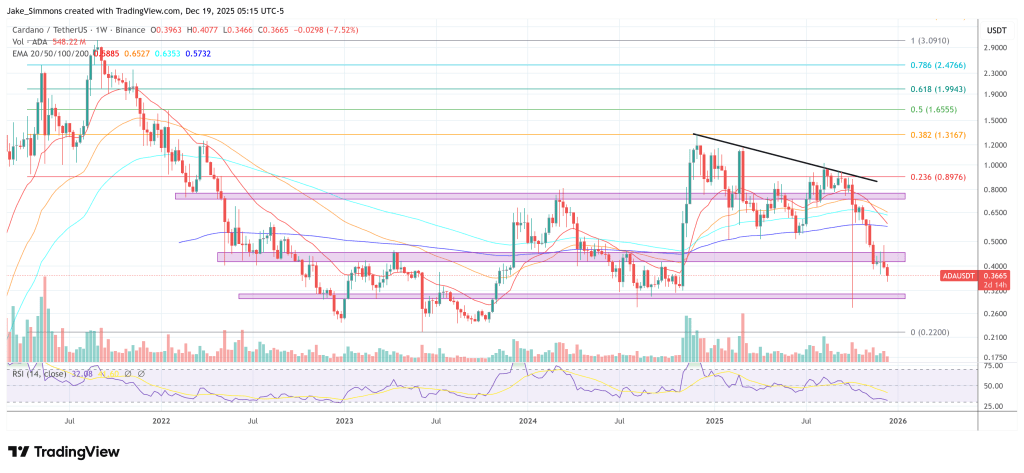
Cardano falls below key support, 1-week chart | Source: ADAUSDT on TradingView.com

Trend Kriptolar

İlgili Sorular

QWhat is the main focus of Cardano's new phase as announced by Charles Hoskinson?

AThe main focus is on the Midnight project, described as a 'ChatGPT for privacy,' which serves as a cross-ecosystem application layer designed to make advanced cryptography usable at scale.

QHow does Hoskinson distinguish Midnight from being categorized as a privacy coin?

AHoskinson states that Midnight is not a privacy coin but a platform that enables rational privacy and selective disclosure, supporting intents, hybrid applications, capacity exchange, dual tokenomics, and multi-resource consensus.

QWhat market cap and trading volume did Hoskinson cite for Midnight compared to other ZK and privacy-adjacent projects?

AHoskinson cited Midnight with a $1 billion market cap and $1.8 billion trading volume, contrasting it with Starkware ($410M market cap, $72M volume), zkSync ($279M market cap, $29M volume), and Mina ($97M market cap).

QWhy does Hoskinson believe the market has responded positively to Midnight's launch structure?

AHe attributes the positive response to the distribution model, where tokens were given away to 1.5 million people across eight ecosystems and seven chains, avoiding insider advantages and VC allocations, which built trust and liquidity.

QWhat is the broader ambition Hoskinson envisions for Midnight and the crypto market?

AThe broader ambition is to unify the marketplaces by integrating Midnight across major ecosystems like Ethereum, Solana, Bitcoin, and Avalanche, moving beyond siloed tribal finance to create one interoperable market, eliminating the distinction between DeFi and TradFi.

İlgili Okumalar

Ethereum Q1 2026 Report: Fees Decline, Users and Transaction Volume Hit New Highs

Ethereum Q1 2026 Report: Fees Down, Users & Transactions Hit New Highs Token Terminal's Q1 2026 report on Ethereum presents a pivotal development: the network achieved record highs in monthly active users (13.2M, +85.9% YoY), total transactions (200.4M, +81.5% YoY), and throughput (25.78 TPS), while transaction fees on the mainnet plummeted by 47.9% quarter-over-quarter. This shift is attributed to the network's strategic move into a "low fees for scale" phase, exemplified by the Fusaka upgrade which increased data capacity and lowered block space costs, releasing pent-up demand (a manifestation of Jevons's Paradox). The report highlights a core narrative shift for Ethereum: from a DeFi-centric blockchain to a global financial settlement layer. It maintains a dominant position in tokenized assets, holding majority market shares among top chains in stablecoins (61.8%), tokenized funds (73.0%), and tokenized commodities (84.0%). Growth in tokenized funds (+73.1% YoY) and commodities (+325.9% YoY) was particularly strong, driven by institutions like BlackRock and JPMorgan entering the space. Contrasting these usage gains, several USD-denominated value metrics declined in Q1: fully diluted market cap fell 30.3% QoQ, total value locked (TVL) dropped 11.0%, and ecosystem transaction volume decreased 24.0%. The report interprets this as Ethereum prioritizing long-term network expansion and cementing its role as the default settlement layer for finance over short-term fee capture. The commentary from Etherealize argues that, much like the early internet, Ethereum's open, permissionless model is poised to win over closed alternatives as institutional tokenization accelerates.

marsbit1 saat önce

Ethereum Q1 2026 Report: Fees Decline, Users and Transaction Volume Hit New Highs

marsbit1 saat önce

He Just Raised 2.7 Billion, and Li Fei-Fei Also Invested

Pete Florence, a former senior research scientist at Google DeepMind and a key contributor to the Vision-Language-Action (VLA) model architecture, is deliberately distancing his startup, Generalist AI, from the trendy "world model" label. He argues that the industry should prioritize concrete goals over buzzwords. His goal is to create robots that can perform a vast range of unseen tasks with high speed and success rates, without needing task-specific training data. Recently, his company raised $400 million (¥2.7 billion) at a $2 billion valuation. Notable investors include NVIDIA's NVentures, Bezos Expeditions, NFDG, as well as Xiaomi co-founder Lin Bin, Zoom founder Eric Yuan, and renowned AI scientist Fei-Fei Li. Florence's approach stems from his academic background at MIT under Professor Russ Tedrake, focusing on understanding the physical world. After joining DeepMind, he developed models like Transporter Network and co-created the VLA framework. He left in 2025 to found Generalist AI. The company has launched two models: GEN-0, which demonstrated that scaling laws apply to physical motion, and GEN-1. GEN-1 was trained on over 500,000 hours of physical interaction data collected via a specialized wearable device. It achieves a 99% success rate on precise mechanical tasks like folding boxes and maintains performance three times faster than its predecessor. Florence believes GEN-1 is reaching a commercial utility threshold similar to the GPT-3 inflection point. The substantial funding round, following GEN-1's release, signifies strong investor confidence in Generalist AI's practical, goal-driven path to creating versatile, useful robots, regardless of the "world model" terminology.

marsbit1 saat önce

He Just Raised 2.7 Billion, and Li Fei-Fei Also Invested

marsbit1 saat önce

Two Legends Lost in Three Days: Is Google's AI Talent Dam Cracking?

In three days, Google lost two AI legends. On June 18, Noam Shazeer, co-author of the seminal "Attention is All You Need" paper and Gemini co-lead, left for OpenAI. Just 48 hours later, John Jumper, 2024 Nobel laureate and AlphaFold lead, departed DeepMind for Anthropic. This follows Andrej Karpathy joining Anthropic in May. These moves highlight a structural trend: top AI talent is concentrating at mission-driven, pre-IPO firms like OpenAI and Anthropic, while Google becomes a primary source. The exodus stems from a core mission mismatch. Google's ad-centric model often subordinates AI research to product and revenue goals, creating friction for pioneers like Shazeer, who returned in 2024 only to leave again. In contrast, OpenAI and Anthropic offer singular focus on pushing AI boundaries, whether towards AGI or safety-aligned models, which deeply appeals to top researchers like Jumper. Financial incentives amplify the pull. With both OpenAI and Anthropic nearing IPO, employees stand to gain immensely from equity, an upside Google's mature stock cannot match. Furthermore, the 2023 merger of Google Brain and DeepMind, intended to consolidate strength, has instead created cultural tension and slowed the path from research to product, as evidenced by Gemini's pace. This talent redistribution is reshaping the AI landscape. While Google retains vast data and compute resources, its true crisis is the quiet, continuous loss of the people who define the field's future. The real moat in AI is not infrastructure, but the concentration of brilliant minds—a battle Google is currently losing.

marsbit3 saat önce

Two Legends Lost in Three Days: Is Google's AI Talent Dam Cracking?

marsbit3 saat önce

Behind the AI Report Card, Lies a Chinese 'Exam Setter'

Beyond the familiar performance charts like MMLU-Pro and MMMU, which major AI models strive to ace, stands a key "examiner": Chinese-Canadian researcher Wenhu Chen. An assistant professor at the University of Waterloo and founder of TIGERLab, Chen addresses the crucial need for more rigorous AI evaluation. As models like GPT-4 began scoring near-perfect results on older benchmarks like MMLU, it became difficult to distinguish their true capabilities. In response, Chen introduced MMLU-Pro in 2024, featuring harder, more reasoning-focused questions with more answer choices, successfully reintroducing meaningful performance gaps. His work extends to multi-modal evaluation with MMMU and its enhanced version, MMMU-Pro. These benchmarks test a model's ability to understand and reason with complex information from images, charts, and text across diverse academic subjects, exposing the significant challenges even top models face in genuine comprehension. Chen's background in complex QA, table reasoning, and his experience at Google DeepMind on projects like Gemini inform his approach. He understands that effective benchmarks must anticipate how models might "cheat" by memorizing data or avoiding visual analysis. His lab also actively researches video understanding and generation models (e.g., UniVideo, Vamba), ensuring his evaluation work is grounded in practical model-building challenges. Now at Meta's Super Intelligence Lab, Chen continues his focus on multi-modal data and evaluation, representing the deep yet often unseen contributions of Chinese talent in shaping the fundamental tools of the AI industry.

marsbit3 saat önce

Behind the AI Report Card, Lies a Chinese 'Exam Setter'

marsbit3 saat önce

İşlemler

Spot
Futures

Popüler Makaleler

ADA Nasıl Satın Alınır

HTX.com’a hoş geldiniz! Cardano (ADA) satın alma işlemlerini basit ve kullanışlı bir hâle getirdik. Adım adım açıkladığımız rehberimizi takip ederek kripto yolculuğunuza başlayın. 1. Adım: HTX Hesabınızı OluşturunHTX'te ücretsiz bir hesap açmak için e-posta adresinizi veya telefon numaranızı kullanın. Sorunsuzca kaydolun ve tüm özelliklerin kilidini açın. Hesabımı Aç2. Adım: Kripto Satın Al Bölümüne Gidin ve Ödeme Yönteminizi SeçinKredi/Banka Kartı: Visa veya Mastercard'ınızı kullanarak anında Cardano (ADA) satın alın.Bakiye: Sorunsuz bir şekilde işlem yapmak için HTX hesap bakiyenizdeki fonları kullanın.Üçüncü Taraflar: Kullanımı kolaylaştırmak için Google Pay ve Apple Pay gibi popüler ödeme yöntemlerini ekledik.P2P: HTX'teki diğer kullanıcılarla doğrudan işlem yapın.Borsa Dışı (OTC): Yatırımcılar için kişiye özel hizmetler ve rekabetçi döviz kurları sunuyoruz.3. Adım: Cardano (ADA) Varlıklarınızı SaklayınCardano (ADA) satın aldıktan sonra HTX hesabınızda saklayın. Alternatif olarak, blok zinciri transferi yoluyla başka bir yere gönderebilir veya diğer kripto para birimlerini takas etmek için kullanabilirsiniz.4. Adım: Cardano (ADA) Varlıklarınızla İşlem YapınHTX'in spot piyasasında Cardano (ADA) ile kolayca işlemler yapın.Hesabınıza erişin, işlem çiftinizi seçin, işlemlerinizi gerçekleştirin ve gerçek zamanlı olarak izleyin. Hem yeni başlayanlar hem de deneyimli yatırımcılar için kullanıcı dostu bir deneyim sunuyoruz.

1.4k Toplam GörüntülenmeYayınlanma 2024.12.10Güncellenme 2026.06.02

ADA Nasıl Satın Alınır

Tartışmalar

HTX Topluluğuna hoş geldiniz. Burada, en son platform gelişmeleri hakkında bilgi sahibi olabilir ve profesyonel piyasa görüşlerine erişebilirsiniz. Kullanıcıların ADA (ADA) fiyatı hakkındaki görüşleri aşağıda sunulmaktadır.

活动图片