Cardano Breaks Governance Deadlock With New Constitutional Committee

bitcoinist2025-12-18 tarihinde yayınlandı2025-12-18 tarihinde güncellendi

Özet

Cardano has resolved a governance deadlock by ratifying a new Constitutional Committee (CC) member through an on-chain vote. The CC, essential for evaluating constitutionality and approving upgrades, budgets, and parameter changes, had been left without a quorum after a mid-term departure. This stalled key governance actions, including treasury withdrawals, budget approvals, and protocol upgrades. The newly elected member, Cardano Curia, was selected off-chain and ratified with over 80% support from delegate representatives (DReps) and sufficient stake pool operator (SPO) backing. The restoration reactivates the CC, allowing Cardano's governance processes to resume normal operation and preventing further delays in network upgrades.

Cardano has moved to resolve a governance bottleneck by ratifying an on-chain vote to restore its Constitutional Committee (CC) to functional capacity, a procedural step that matters because the CC is required to evaluate constitutionality and ratify many categories of governance actions, including upgrades, budgets, and parameter changes.

Intersect, which coordinates parts of Cardano’s governance process, said on X: “On the 7th day of GA... We hit the Epoch’s end. DReps at 80%. Stake pools supporting- It looks like we have a new CC. Ratified. Thank you to everyone who reviewed, voted, and wrote rationales,Santa has been notified.”

Why The Cardano Governance Was Stuck

Cardano’s governance model is tripartite: delegate representatives (DReps), stake pool operators (SPOs), and the Constitutional Committee. The CC plays a gatekeeping role: it judges whether on-chain actions are constitutional and ratifies decisions needed for the network to adapt.

That mechanism stalled after an unexpected mid-term departure left the CC below its minimum operational size. The Cardano Atlantic Council retired mid-term in epoch 597, opening a seat and reducing the committee below quorum. The consequence was that the Cardano CC could not ratify key actions, even as the chain continued to operate normally at the protocol level.

The vote asked DReps and SPOs to ratify a newly elected CC member and restore the committee to full capacity. The candidate, Cardano Curia, was selected off-chain through a DRep vote using the Ekklesia tool, with on-chain ratification required to formalize the result.

The governance materials described the restoration as bringing the CC back to seven members and activating a clarified alternate-member process to handle future vacancies with less disruption. Approval thresholds were set at 67% from DReps and 51% support from SPOs. Intersect’s update indicates those thresholds were met as the epoch ended.

Why This Was Treated As Urgent

The vote was framed as more than housekeeping because an undersized CC effectively blocks major governance flows. Without quorum: Treasury withdrawals couldn’t proceed, the Critical Integrations Budget could not pass, hard forks could not be ratified, delaying network upgrades and several categories of governance actions were blocked, leaving only a limited subset able to move forward.

There was also a timing element: delays risk actions expiring, which would force a repeat of the voting process and extend the governance backlog. With the restoration ratified, Cardano’s governance process can resume normal throughput — reopening the path for upgrades, budget approvals, and protocol changes that depend on a functioning Constitutional Committee.

At press time, Cardano traded at $0.38.
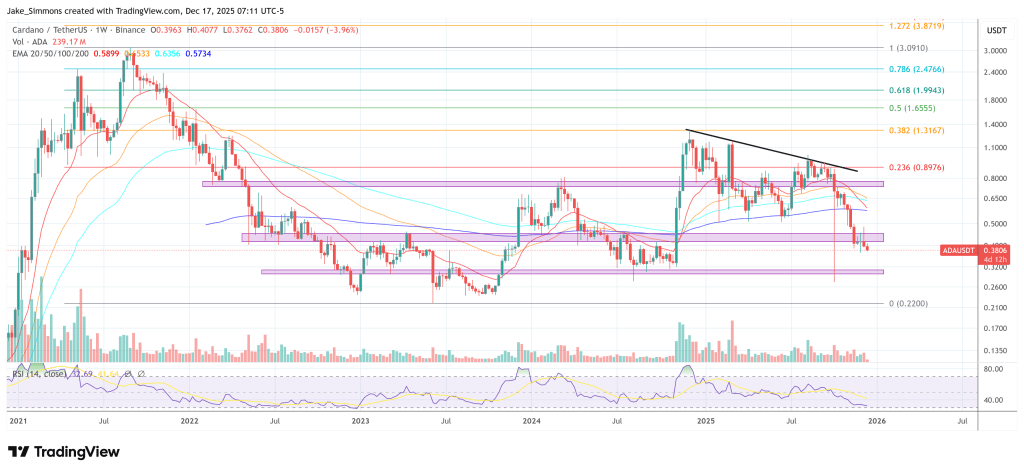
ADA falls below key support, 1-week chart | Source: ADAUSDT on TradingView.com

Trend Kriptolar

İlgili Okumalar

Dialogue with Jia Hang | Looking Back at Two Decades of Chinese Payment Going Global

**Summary: A Conversation with Jia Hang on Two Decades of China's Payment Globalization** Jia Hang, a veteran with over twenty years in payments, reflects on China's attempts to build a global payment network through three key phases: UnionPay (card networks), Alipay+ (digital wallets), and now, stablecoins. His journey began at UnionPay International, aiming to establish China's card network abroad. While successful in following Chinese tourists ("where Chinese go, UnionPay goes"), it struggled to achieve true global scale. The core lesson: card networks like Visa/Mastercard's unassailable advantage isn't just technical standards, but their deeply entrenched **governance and profit-sharing models** that create powerful network effects. Competing as the "same species" is nearly impossible. At Ant Group, he led Alipay+, a strategy to bypass card networks by interconnecting local e-wallets worldwide. While innovative, it faced a similar ceiling. Mobile QR payments and card swipes were essentially **the same species competing for the same pie**, lacking a disruptive value proposition for users or a sustainable new incentive model to replace the card networks' established flywheel. Today, at Singapore's DCS, Jia focuses on stablecoin-based payments. He argues stablecoins represent a fundamental shift. They are not competing with Visa for consumer payments but challenging the **traditional banking and account system for value movement**. Products like "U Cards" (stablecoin-linked payment cards) are transitional, leveraging existing card networks for acceptance while building new rails. The real potential lies in stablecoins enabling seamless, low-cost global value transfer, potentially reorganizing the financial infrastructure around **accounts rather than cards**. Jia believes stablecoin adoption for local retail payments, cross-border transactions, and as high-yield savings vehicles is becoming irreversible. This could gradually reduce reliance on traditional fiat channels, especially in regions with weak currencies or capital controls. The quest for the "next global payment network" continues, now centered on whether stablecoins can successfully bridge Web2 and Web3, establish new governance, and create compelling user value beyond mere cost reduction.

marsbit2 dk önce

Dialogue with Jia Hang | Looking Back at Two Decades of Chinese Payment Going Global

marsbit2 dk önce

Circle's Stock Price Plunges 76%, Hong Kong Dollar Stablecoin Set to Launch Within Two Weeks

Circle's stock price has plunged approximately 76% from its 2023 peak, reflecting a major market revaluation. Despite this, Circle President Heath Tarbert emphasized the company's focus on long-term execution and its dominant position with USDC's $73 billion circulation across 34 blockchains. The competitive landscape is intensifying. A new consortium-backed stablecoin, Open USD, is attempting to challenge incumbents by sharing reserve yields with partners. More significantly, Visa's new stablecoin platform, initially supporting Open USD while also being compatible with USDC, could erode Circle's network effects. In response, Circle is expanding into real-world payments through partnerships like the one with Japan's JCB. Separately, Tether (USDT) faces a two-year compliance window under new U.S. regulations, requiring it to adjust its reserve composition away from assets like Bitcoin and loans towards cash and U.S. Treasuries. Meanwhile, in Hong Kong, Standard Chartered-backed fintech firm Dian Dian is poised to launch a licensed HKD-pegged stablecoin (HKDAP), moving the industry into a phase where the real test is integrating licensed stablecoins into actual payment flows and corporate treasury systems. The sharp decline in Circle's stock underscores a broader shift: the stablecoin market is moving from a winner-takes-all dynamic to a multi-player competitive arena where execution, compliance, and real-world utility are becoming paramount.

marsbit3 dk önce

Circle's Stock Price Plunges 76%, Hong Kong Dollar Stablecoin Set to Launch Within Two Weeks

marsbit3 dk önce

Amidst Capital's Encirclement, Decentralization is the Sole Defense for Public Blockchains

In a landscape dominated by power and profit motives, the author argues that decentralization is not merely one desirable feature among many in blockchain design—it is the singular, non-negotiable defense against corporate and capital capture. The article adopts a Machiavellian, realist perspective on human institutions, positing that businesses will inevitably attempt to co-opt any valuable network to protect their profits and dominance. While external attacks like 51% forks are often discussed, the greater existential risk is internal capture—the gradual erosion of a protocol’s neutrality by vested interests, as seen historically with platforms like Visa and Google. The piece critiques permissioned chains, highly centralized “permissionless” layer-1s, and layer-2s without sufficient decentralization (e.g., single sequencers) as inherently vulnerable. These compromised systems, promoted by established financial players, are framed as delaying tactics to stifle truly open networks that threaten existing high-fee, inefficient business models. Real-world examples, such as closed enterprise consortiums that exclude competitors, illustrate how such systems cement oligopolies rather than foster innovation. The author concludes that while decentralized protocols like Ethereum are imperfect and costly to operate, they represent the only viable long-term equilibrium. In a market where value naturally flows to the most secure and neutral settlement layer, only maximally decentralized public blockchains can resist being subsumed by capital and powerful incumbents.

Foresight News13 dk önce

Amidst Capital's Encirclement, Decentralization is the Sole Defense for Public Blockchains

Foresight News13 dk önce

Who Decides the Rules of Bitcoin? BIP-110 Ignites Governance Debate

Bitcoin's governance is once again at the center of a heated debate, this time ignited by BIP-110, the "Reduced Data Temporary Softfork." This proposal aims to curb non-monetary data (like inscriptions and Runes) by introducing seven new consensus-layer restrictions over a year, such as limiting new output scripts to 34 bytes and restoring the OP_RETURN cap to 83 bytes. The controversy stems from BIP-110's fundamental shift: it moves the battle against "spam" from node relay and miner policies to the consensus layer, rendering currently valid transactions invalid. Supporters, arguing that default policy governance has failed (highlighted by Bitcoin Core v30's relaxation of OP_RETURN limits), see this as necessary to protect node resources and Bitcoin's monetary focus. Opponents, led by figures like Michael Saylor and Adam Back, warn it dangerously centralizes governance. Saylor listed 110 reasons against it, criticizing its low 55% miner activation threshold and potential for chain splits. Back emphasized Bitcoin's "permissionless" ethos, arguing no single group should impose value judgments via consensus rules. Further complicating matters, technical critiques suggest BIP-110 may be technically circumventable, and a "BlockSlop" vulnerability in its upgrade path poses a consensus risk. The debate has drawn in diverse stakeholders: miners (with pools like Ocean signaling support and Foundry polling clients), node operators (like Bitcoin Knots), and new players like corporate treasury holder MicroStrategy (Saylor), whose market influence adds a novel dimension. Ultimately, BIP-110 acts as a governance stress test, exposing the unresolved question: who decides Bitcoin's rules? It pits the authority of miners, node operators, developers, and capital holders against each other, with each side claiming to defend Bitcoin's core principles of neutrality and security.

marsbit30 dk önce

Who Decides the Rules of Bitcoin? BIP-110 Ignites Governance Debate

marsbit30 dk önce

Who Decides Bitcoin's Rules? BIP-110 Ignites Governance Debate

Title: Who Decides Bitcoin's Rules? BIP-110 Ignites Governance Debate A new technical proposal, BIP-110 (Reduced Data Temporary Softfork), has sparked a fundamental governance debate within the Bitcoin community. It aims to impose new consensus rules for one year to limit non-financial data (like inscriptions and Runes) on-chain, moving beyond simple node and miner policy filters to invalidate currently valid transactions. Supporters argue that default policies have failed due to workarounds, necessitating consensus-layer changes to protect Bitcoin's core monetary function from data spam. Critics, including Michael Saylor and Adam Back, contend this dangerously centralizes judgment, undermines permissionlessness, and sets a risky governance precedent. They advocate for market-based solutions like fees or Layer 2s instead. The debate exposes deeper tensions: miners are divided on activation; node operators assert their sovereignty; Bitcoin Core developers influence defaults without direct accountability; and large corporate holders like MicroStrategy now wield narrative influence. Technically, BIP-110 may not fully block data and carries a disclosed consensus bug risk. Ultimately, BIP-110 acts as a stress test, forcing the community to confront the unresolved question: who legitimately decides what Bitcoin is and how it evolves, amidst competing claims from miners, nodes, developers, and capital holders.

链捕手42 dk önce

Who Decides Bitcoin's Rules? BIP-110 Ignites Governance Debate

链捕手42 dk önce

İşlemler

Spot

Popüler Makaleler

ADA Nasıl Satın Alınır

HTX.com’a hoş geldiniz! Cardano (ADA) satın alma işlemlerini basit ve kullanışlı bir hâle getirdik. Adım adım açıkladığımız rehberimizi takip ederek kripto yolculuğunuza başlayın. 1. Adım: HTX Hesabınızı OluşturunHTX'te ücretsiz bir hesap açmak için e-posta adresinizi veya telefon numaranızı kullanın. Sorunsuzca kaydolun ve tüm özelliklerin kilidini açın. Hesabımı Aç2. Adım: Kripto Satın Al Bölümüne Gidin ve Ödeme Yönteminizi SeçinKredi/Banka Kartı: Visa veya Mastercard'ınızı kullanarak anında Cardano (ADA) satın alın.Bakiye: Sorunsuz bir şekilde işlem yapmak için HTX hesap bakiyenizdeki fonları kullanın.Üçüncü Taraflar: Kullanımı kolaylaştırmak için Google Pay ve Apple Pay gibi popüler ödeme yöntemlerini ekledik.P2P: HTX'teki diğer kullanıcılarla doğrudan işlem yapın.Borsa Dışı (OTC): Yatırımcılar için kişiye özel hizmetler ve rekabetçi döviz kurları sunuyoruz.3. Adım: Cardano (ADA) Varlıklarınızı SaklayınCardano (ADA) satın aldıktan sonra HTX hesabınızda saklayın. Alternatif olarak, blok zinciri transferi yoluyla başka bir yere gönderebilir veya diğer kripto para birimlerini takas etmek için kullanabilirsiniz.4. Adım: Cardano (ADA) Varlıklarınızla İşlem YapınHTX'in spot piyasasında Cardano (ADA) ile kolayca işlemler yapın.Hesabınıza erişin, işlem çiftinizi seçin, işlemlerinizi gerçekleştirin ve gerçek zamanlı olarak izleyin. Hem yeni başlayanlar hem de deneyimli yatırımcılar için kullanıcı dostu bir deneyim sunuyoruz.

1.5k Toplam GörüntülenmeYayınlanma 2024.12.10Güncellenme 2026.06.02

ADA Nasıl Satın Alınır

Tartışmalar

HTX Topluluğuna hoş geldiniz. Burada, en son platform gelişmeleri hakkında bilgi sahibi olabilir ve profesyonel piyasa görüşlerine erişebilirsiniz. Kullanıcıların ADA (ADA) fiyatı hakkındaki görüşleri aşağıda sunulmaktadır.

活动图片