Cardano, Avalanche, Sui And IOTA Submit Joint UK Crypto Rules Response

bitcoinist2026-02-13 tarihinde yayınlandı2026-02-13 tarihinde güncellendi

Özet

Cardano, Avalanche, Sui, and IOTA have jointly responded to the UK Financial Conduct Authority’s crypto consultation, advocating for regulations that clearly distinguish between custodial and non-custodial crypto activities. They argue that rules should target intermediaries who control user assets—requiring disclosures, consent, and record-keeping—while exempting developers and infrastructure providers who don’t hold custody or exercise unilateral control. The submission emphasizes that staking and DeFi should be regulated uniformly, and obligations should align with actual risks. The goal is to protect consumers without stifling non-custodial, decentralized innovation, ensuring the UK remains a competitive jurisdiction for blockchain technology.

Organisations around Cardano, Avalanche, Sui and IOTA have filed a joint response to the UK Financial Conduct Authority’s CP25/40 consultation, arguing that the rulebook should draw hard lines around “custody and control” and avoid sweeping non-custodial crypto activity into regimes designed for intermediaries.

The submission, led by the IOTA Foundation alongside the Sui Foundation, Cardano Foundation and the Avalanche Policy Coalition, is a targeted push on two areas the group says are most exposed to “scope, proportionality and technical interpretation” problems: staking and decentralized finance.

In a post on X, IOTA framed the core message as a scoping exercise as much as a policy one: “focus on custody & control, keep it proportionate, and support non-custodial, decentralized innovation for UK.”

Cardano, Avalanche, Sui And IOTA Warn Against Overregulation

The open letter expands that into a broader architecture: “A consistent theme across our feedback on both staking and decentralized finance is the importance of clearly distinguishing between infrastructure functions and intermediary functions. We recommend that regulatory obligations remain focused on entities that exercise custody, discretion, or commercial intermediation, while preserving the neutrality of public blockchain infrastructure.”

The letter adds that developers and infrastructure providers should be exempted: “[They] deliver software development, validation, communications, or other protocol-level services without controlling client assets or exercising unilateral decision-making are performing infrastructure roles rather than financial intermediation, and warrant a proportionate and differentiated regulatory treatment.”

That distinction matters, the group argues, because staking and DeFi aren’t single business models. They sit on a spectrum from fully custodial services where a firm safeguards assets and intermediates execution to protocol-native activity where users retain control of keys and assets.

On staking, IOTA’s X thread distilled the policy ask into a binary: “regulation must clearly distinguish custodial vs non-custodial/models.” It adds that custodial staking “where firms safeguard assets” warrants “appropriate retail disclosures, consent + record-keeping,” while “non-custodial/protocol-level staking (no control of user assets/keys) should not be swept into the same regime.”

The letter mirrors that framing and narrows it to where the risk sits: “Where staking is provided through a custodial arrangement, and the firm safeguards client assets and intermediates the staking process, we recommend applying the proposed requirements on information provision, key contractual terms, express prior consent for retail clients, and record-keeping.”

It then draws the line the signatories want the FCA to adopt: “For non-custodial and delegated staking arrangements, where firms do not control client assets or private keys, we recommend that such activities remain outside the scope of regulated staking activity, as this maintains proportionality and aligns regulatory obligations with the actual sources of risk.”

The second pressure point is the FCA’s concept of a “clear controlling person” in DeFi. IOTA’s post argues the term needs a “technical, objective definition,” warning that obligations should scale with “custody, discretion, and unilateral control; not with writing code, participating in governance, or providing neutral infrastructure.”

The open letter keeps the same structure: it accepts the FCA’s intent to capture cases where an identifiable party is “effectively carrying on regulated cryptoasset activities,” but pushes back on triggering regulatory status based on development and infrastructure. Instead, it urges the FCA to anchor expectations to “demonstrable, unilateral control over protocol operation, governance or economic outcomes,” particularly because DeFi “rel[ies] on self-custody, automated execution and open participation.”

IOTA positioned the argument as pro-scope, not anti-rules: “smarter scoping = better consumer protection where risk is real, plus legal certainty that keeps non-custodial innovation from being regulated out of existence.”
The letter closes on the same trade-off: obligations tied to “custody, discretion and unilateral control” would, the group says, “strengthen legal certainty, enhance consumer protection where it is most needed, and reinforce the UK’s position as a jurisdiction that understands the architectural realities of decentralized technologies.”

At press time, Cardano traded at $0.264.
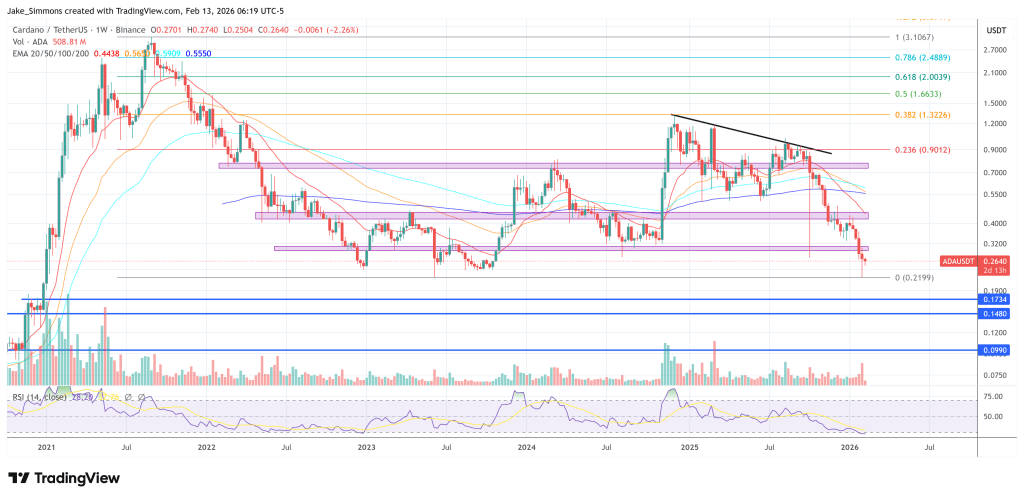
Cardano hovers above key support, 1-week chart | Source: ADAUSDT on TradingView.com

İlgili Sorular

QWhich blockchain organizations jointly submitted a response to the UK Financial Conduct Authority's CP25/40 consultation?

AThe IOTA Foundation, Sui Foundation, Cardano Foundation, and the Avalanche Policy Coalition.

QWhat two areas did the joint submission identify as most exposed to problems of scope, proportionality, and technical interpretation?

AStaking and decentralized finance (DeFi).

QAccording to the open letter, what is the key distinction that should be made in regulation between different types of staking services?

AA clear distinction between custodial staking, where a firm safeguards assets, and non-custodial or protocol-level staking, where users retain control of their keys and assets.

QWhat term used by the FCA in relation to DeFi did the group argue needs a 'technical, objective definition'?

AThe term 'clear controlling person'.

QWhat core principle does the group argue should determine regulatory obligations, rather than writing code or providing neutral infrastructure?

AObligations should be tied to custody, discretion, and unilateral control over assets or protocol operation.

İlgili Okumalar

MoneyGram: Why Did We Launch Our Own Stablecoin?

MoneyGram, a global leader in cross-border remittances for over 80 years, has launched its own stablecoin, MGUSD. The initiative aims to evolve from single-transaction services to becoming a more integral part of users' financial lives. By allowing customers to hold a stable US dollar balance within the MoneyGram app, MGUSD enables not only remittances but also everyday spending, currency exchange, cash access, and future financial services. Targeting the billions globally who face challenges like currency volatility or lack of bank accounts, MGUSD leverages Stellar blockchain technology with a self-custody wallet architecture. This gives users control over their assets while providing a secure, compliant experience through a trusted brand. The approach focuses on solving existing customer pain points within MoneyGram's established network, rather than competing for broad crypto market liquidity. A key advantage is MoneyGram's hybrid model, combining digital services with the world's largest physical network for crypto-to-cash conversions. The stablecoin also modernizes the company's internal infrastructure, streamlining treasury management and partner settlements, with annual forex volume via stablecoins already reaching $2 billion. The project was delivered in about a year, driven by a reorganization into agile, cross-functional teams that operate with startup-like speed while leveraging decades of institutional expertise. Partners include Stablecoin (issuance), Crossmint (wallet APIs), Fireblocks (enterprise treasury), m0 (smart contracts), and the Stellar network. MoneyGram emphasizes that enhancing direct consumer offerings strengthens its partner ecosystem. The future direction is clear: to provide users worldwide with stable value storage, better financial tools, and greater control over their funds through a trusted, existing network.

Foresight News35 dk önce

MoneyGram: Why Did We Launch Our Own Stablecoin?

Foresight News35 dk önce

BIP-110 Controversy Intensifies: Bitcoin May Face Its Most Divisive Hard Fork Battle in Years

Bitcoin is approaching a critical block height of 961,632, which could activate the controversial BIP-110 proposal. This proposal aims to restrict the amount of non-financial data, such as inscriptions and other large data payloads, within Bitcoin transactions. Supporters, including some node operators and Bitcoin purists, argue that BIP-110 is necessary to preserve Bitcoin's core function as a monetary settlement layer by reducing network congestion and node operational burdens caused by non-essential data. They frame it as a correction to keep the network true to its original purpose. However, critics, including prominent figures like Blockstream's Adam Back and developer Jameson Lopp, warn that the proposal's implementation mechanism is dangerously flawed. They highlight that its low 55% miner signaling threshold, coupled with a contentious enforcement mechanism allowing nodes to unilaterally reject non-compliant blocks, significantly increases the risk of a chain split. Opponents argue this sets a dangerous precedent for transaction censorship, undermines Bitcoin's protocol neutrality, and creates excessive uncertainty for developers and businesses, especially since the rule is proposed as a temporary one-year measure. Market analysts, such as those from Bitfinex, suggest a full-scale network split is unlikely due to a lack of broad economic consensus. Major mining pools remain neutral, and adoption of the new rules is minimal. They view the situation more as a governance stress test. The primary risk is operational disruption: if a minority chain persists, major exchanges and custodians may need to temporarily suspend Bitcoin deposits and withdrawals to manage security and liquidity, potentially unsettling newer institutional investors. While BIP-110 is not expected to succeed in overtaking the main chain, its approach has ignited a significant debate about Bitcoin's governance, core values, and resilience.

Foresight News1 saat önce

BIP-110 Controversy Intensifies: Bitcoin May Face Its Most Divisive Hard Fork Battle in Years

Foresight News1 saat önce

NEAR to Airdrop 330,000 Tokens, Betting on TVL Reaching $70 Million

On June 11th, NEAR Protocol launched the Near@3.33 Milestone Incentive Program, targeting users of its Confidential Intents privacy cross-chain execution feature. The program will distribute 333,333 milestone tokens when the Confidential Intents Total Value Locked (TVL) reaches $70 million. Users must have conducted Confidential transactions on near.com and maintain a Confidential balance above $100 in any asset to qualify, with a single wallet capped at 2% of the current airdrop pool. The milestone tokens will be locked upon receipt and cannot be sold or transferred. They can only be converted 1:1 to NEAR tokens once NEAR's Volume Weighted Average Price (VWAP) maintains $3.33 or higher for three consecutive trading days. As of the report, Confidential Intents TVL exceeds $20.69 million, needing roughly a 3x increase to trigger the airdrop. Confidential Intents, launched in February 2026, is NEAR's privacy execution layer designed to prevent MEV, front-running, and strategy leaks by building confidentiality directly into the execution environment. Its TVL has grown from zero to approximately $15 million in about three months. NEAR token price, which surged from around $1 in April to a peak of $3.08, currently trades near $2. The program aims to boost user activity for Confidential Intents, with future incentive rounds planned as community engagement increases.

Foresight News2 saat önce

NEAR to Airdrop 330,000 Tokens, Betting on TVL Reaching $70 Million

Foresight News2 saat önce

Crypto Market Makers Are Collectively Seeking Change as Money Becomes Harder to Earn

**Summary: Crypto Market Makers Adapt as Margins Shrink** Leading crypto market maker GSR exemplifies a broader industry shift, moving beyond traditional market-making to become a full-service "Web3 investment bank." Its recent strategic acquisitions—including an SEC-registered broker-dealer, rebranded as GSR Securities—and purchases of token advisory firms aim to create an integrated platform covering token design, fundraising, listing, liquidity provision, and asset management. This includes launching an ETF and investing in tokenization platforms like Libeara, backed by a strategic investment from Standard Chartered's SC Ventures. This transformation is not unique to GSR. Other major players like Keyrock, B2C2, Wintermute, and DWF Labs are also expanding geographically, pursuing regulatory licenses (especially under frameworks like MiCA in the EU), and diversifying into over-the-counter (OTC) trading, asset management, and real-world asset tokenization. The driving force behind this collective pivot is a rapidly changing market. Profits from traditional altcoin market-making are declining due to fewer viable projects, reduced client budgets, increased competition, and smarter, more demanding clients. Simultaneously, regulatory pressures are mounting, making compliance a baseline cost. Extreme market events further expose teams lacking robust risk controls. Consequently, the crypto market-making business model is evolving from one reliant on information asymmetry and volatility to a more institutionalized, regulated, and service-diverse industry. Survival now depends on building systemic capabilities beyond mere liquidity provision.

marsbit2 saat önce

Crypto Market Makers Are Collectively Seeking Change as Money Becomes Harder to Earn

marsbit2 saat önce

İşlemler

Spot
Futures

Popüler Makaleler

ADA Nasıl Satın Alınır

HTX.com’a hoş geldiniz! Cardano (ADA) satın alma işlemlerini basit ve kullanışlı bir hâle getirdik. Adım adım açıkladığımız rehberimizi takip ederek kripto yolculuğunuza başlayın. 1. Adım: HTX Hesabınızı OluşturunHTX'te ücretsiz bir hesap açmak için e-posta adresinizi veya telefon numaranızı kullanın. Sorunsuzca kaydolun ve tüm özelliklerin kilidini açın. Hesabımı Aç2. Adım: Kripto Satın Al Bölümüne Gidin ve Ödeme Yönteminizi SeçinKredi/Banka Kartı: Visa veya Mastercard'ınızı kullanarak anında Cardano (ADA) satın alın.Bakiye: Sorunsuz bir şekilde işlem yapmak için HTX hesap bakiyenizdeki fonları kullanın.Üçüncü Taraflar: Kullanımı kolaylaştırmak için Google Pay ve Apple Pay gibi popüler ödeme yöntemlerini ekledik.P2P: HTX'teki diğer kullanıcılarla doğrudan işlem yapın.Borsa Dışı (OTC): Yatırımcılar için kişiye özel hizmetler ve rekabetçi döviz kurları sunuyoruz.3. Adım: Cardano (ADA) Varlıklarınızı SaklayınCardano (ADA) satın aldıktan sonra HTX hesabınızda saklayın. Alternatif olarak, blok zinciri transferi yoluyla başka bir yere gönderebilir veya diğer kripto para birimlerini takas etmek için kullanabilirsiniz.4. Adım: Cardano (ADA) Varlıklarınızla İşlem YapınHTX'in spot piyasasında Cardano (ADA) ile kolayca işlemler yapın.Hesabınıza erişin, işlem çiftinizi seçin, işlemlerinizi gerçekleştirin ve gerçek zamanlı olarak izleyin. Hem yeni başlayanlar hem de deneyimli yatırımcılar için kullanıcı dostu bir deneyim sunuyoruz.

1.4k Toplam GörüntülenmeYayınlanma 2024.12.10Güncellenme 2026.06.02

ADA Nasıl Satın Alınır

Tartışmalar

HTX Topluluğuna hoş geldiniz. Burada, en son platform gelişmeleri hakkında bilgi sahibi olabilir ve profesyonel piyasa görüşlerine erişebilirsiniz. Kullanıcıların ADA (ADA) fiyatı hakkındaki görüşleri aşağıda sunulmaktadır.

活动图片













