Cardano (ADA) Could Launch New Bull Phase With Investor Confidence On The Rise

bitcoinist2026-05-16 tarihinde yayınlandı2026-05-16 tarihinde güncellendi

Özet

Cardano (ADA) has broken above $0.25, showing signs of a potential new bullish phase. Analyst Ali Martinez highlights a buy signal from the SuperTrend Indicator on the daily chart, suggesting the end of a corrective period. He predicts a surge toward $0.33, with a secondary target of $0.42, provided ADA holds the $0.25 support level. On-chain data reveals key stakeholders, or "sharks and whales," have been accumulating ADA since December 2023, with addresses holding over 1 million ADA now controlling 67.47% of the supply. This accumulation during a period of discounted prices is seen as a boost for investor confidence and could support a sustained upward price movement.

Following a broader cryptocurrency market bounce on Thursday, Cardano (ADA) has flipped into an upward direction again, breaking past the $0.25 barrier. While the ADA’s price has turned positive, the altcoin’s current structure and on-chain signals are starting to align, raising its potential for a major rally.

Improving Cardano Investor Outlook Collides With Bullish Momentum

Several optimistic predictions from analysts are starting to show up for Cardano as its price makes a bounce back above key resistance levels. A seasoned market expert and trader, Ali Martinez, has outlined a highly bullish outlook for ADA, in which the altcoin could continue its upward trajectory.

In the post shared on the X platform, Ali Martinez has predicted that Cardano’s price could be getting ready to kickstart a new bull rally, suggesting that the current sideways performance will come to an end. Numerous indications are starting to suggest that confidence in the altcoin’s prospects is growing after a period of consolidation and muted price movement.

Martinez’s forecast is mainly backed by the SuperTrend Indicator, which appears to have been a reliable tool for predicting ADA’s shifts in the long term. The indicator has been on the analyst’s radar since it flashed a sell signal on September 25, 2025, that perfectly identified the start of a 73% price decline.
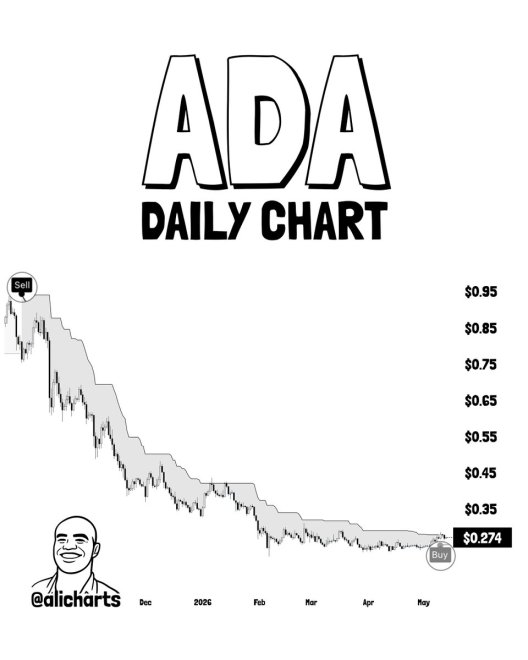
Source: Chart from Ali Charts on X

Following months of this heavy correction, the key indicator has just flipped on the daily chart. This flip simply means that the indicator is signaling a buy signal once again. In the expert’s view, this shift points to the conclusion of a local exhaustion phase and a trend reversal finally taking place.

As a result of the setup, Martinez is confident that a surge toward the $0.33 resistance is likely to occur soon. If ADA is able to maintain this momentum, the rally is expected to continue toward the $0.42, which Martinez labels the secondary target. As long as the $0.25 support holds, this bullish prediction remains valid. However, if it falls below the level, the optimistic outlook is not lost, only delayed.

Key Stakeholders Are Slowly Scooping Up The Altcoin

Amid the price flip toward the upward direction, investors’ sentiment around Cardano has clearly shifted. On-chain activity suggests that confidence seems to be steadily returning after months of erratic market performance.

A report from Santiment reveals that Cardano’s key stakeholders have slowly but surely accumulated. These investors have consistently added more of the existing supply to their portfolio since December 2023. With this accumulation, wallet addresses holding at least 1 million ADA have now acquired over 25.09 billion ADA, which represents 67.47% of the current existing supply.

Although the asset has lost -71% of its market cap within a 9-month period, the millionaire” tier of sharks and whales appear to be content with adding more ADA while prices are at a discount. Should this trend continue, it is likely to influence and shape ADA’s momentum, potentially triggering a steady upward move.

ADA trading at $0.26 on the 1D chart | Source: ADAUSDT on Tradingview.com

İlgili Sorular

QWhat key indicator does analyst Ali Martinez cite to predict Cardano (ADA) could be entering a new bull phase?

AAli Martinez cites the SuperTrend Indicator on the daily chart, which has flipped to a buy signal, suggesting the conclusion of a local exhaustion phase and a potential trend reversal.

QAccording to the analyst's prediction, what is the primary price target for ADA's potential rally?

AAccording to the analyst, the primary target for ADA's potential rally is a surge toward the $0.33 resistance level.

QWhat is the secondary price target mentioned in the article for ADA's upward move?

AThe secondary price target mentioned for ADA's upward move is $0.42.

QWhat on-chain activity suggests growing investor confidence in Cardano (ADA) according to the article?

AOn-chain activity from Santiment shows that key stakeholders (wallet addresses holding at least 1 million ADA) have been consistently accumulating ADA since December 2023, now holding over 67% of the existing supply.

QWhat condition does the analyst say must hold for the bullish ADA price prediction to remain valid?

AThe analyst states that as long as the $0.25 support level holds, the bullish prediction remains valid. If it falls below, the optimistic outlook is delayed but not lost.

İlgili Okumalar

Seeking Alpha's Hot Article: Why Might the U.S. Stock Market Crash in June?

In a recent Seeking Alpha article, financial professor and analyst Damir Tokic argues that the US stock market may be poised for a significant crash in June 2026. The core thesis centers on a "mega-bubble" in equities, particularly within the technology sector, which has driven the S&P 500 to near-record valuations, with a Shiller P/E ratio exceeding 40—a level comparable to the 2000 dot-com bubble. Tokic identifies two primary catalysts for a potential collapse. First, he points to unsustainable market exuberance fueled by what he terms the "Trump Stimulus"—massive AI capital expenditure by tech giants, which he believes is politically driven and cannot last. Second, and more urgently, he highlights the escalating Iran war as a critical threat. The ongoing closure of the Strait of Hormuz has created a severe global energy supply crunch. Strategic petroleum reserves are projected to hit critically low operational levels by June, potentially causing oil prices to spike above $200 per barrel and triggering a severe, supply-driven inflationary shock. This scenario, Tokic warns, would force the Federal Reserve's hand. Despite currently maintaining a dovish bias, the Fed would likely be compelled to officially pivot to a hawkish stance at its June FOMC meeting to combat soaring inflation and bond yields. He contends that such a shift—or even a failure to act, which would destroy Fed credibility—could be the trigger that punctures the market bubble. The resulting downturn, he concludes, could rival the bear markets of 2000 and 2008, advising investors to prepare for a major correction.

marsbit16 dk önce

Seeking Alpha's Hot Article: Why Might the U.S. Stock Market Crash in June?

marsbit16 dk önce

AI PC Battle: Bet on the Toll Booth, Not the Camp

**Title:** The AI PC Battle: Don't Bet on Sides, Bet on the Tollbooth **Summary:** The AI PC competition is moving beyond simple "x86 vs. Arm" narratives. The core investment thesis should focus on identifying which players can sustain margins, cash flow, and pricing power throughout the upgrade cycle, rather than backing a particular architecture. The opportunity is analyzed in three layers: 1. **The Advanced Foundry Tollbooth:** TSMC is positioned to collect "tolls" regardless of which chip designer wins, due to its dominant ~70% share in advanced semiconductor manufacturing, which is essential for high-end AI PC chips. 2. **Compute & Platform Spillover:** AMD represents an offensive in the x86 CPU+GPU space, while NVIDIA leverages its GPU and CUDA software stack dominance. Both benefit from the demand for increased local AI compute. 3. **Architecture Diffusion & Turnaround Plays:** ARM and Intel offer potential for significant upside (elasticity), but investments here require stricter discipline due to higher execution risks and competitive challenges. The industry is transitioning from concept to shipment validation. While short-term forecasts for AI PC adoption have been revised down slightly due to tariffs and procurement delays, the long-term trend towards AI becoming a standard PC feature remains intact. The key driver for upgrade cycles will be whether compelling enterprise applications (e.g., privacy-sensitive computing, low-latency inference) emerge beyond consumer-focused features like meeting summarization. Investment strategy should prioritize companies with platform-level advantages and recurring revenue streams. TSMC offers high certainty as the foundational tollbooth. AMD presents a strong offensive play within the established ecosystem. ARM and Intel are higher-risk, higher-potential-reward turnaround bets. The report cautions against chasing short-term hype and emphasizes a disciplined, long-term approach focused on buying ecosystem strength and cash-flow certainty after market enthusiasm subsides. **Key Risks:** Underwhelming AI PC applications slowing upgrade cycles; slow improvement in Windows on Arm compatibility; macro/tariff impacts on PC demand; potential advanced node supply-demand mismatches affecting TSMC; high overall AI sector valuations making stocks vulnerable to a risk-off shift in markets.

marsbit30 dk önce

AI PC Battle: Bet on the Toll Booth, Not the Camp

marsbit30 dk önce

Ten-Thousand-Word Analysis: From $10 to $290, MRVL Wins the Entire AI Era by 'Not Making GPUs'

Marvell Technology's stock price surged from under $10 in 2016 to a record $290 in June 2026, fueled not by making GPUs, but by dominating AI infrastructure connectivity. This analysis argues the market misvalues MRVL as merely a smaller Broadcom in custom AI chips, overlooking its true, unique position. Marvell's core strength lies in enabling high-speed data flow for AI clusters through three interconnected businesses. First, it holds a commanding ~70% market share in high-speed optical DSPs (essential for data center light modules), a deep-moat business with accelerating growth. Second, its custom AI chip design business serves hyperscalers like AWS, Microsoft, and Google, with a significant revenue pipeline despite lower margins. Third, stable cash flows come from Ethernet switch chips and enterprise storage controllers. Together, they form a full-stack "AI data movement" platform. CEO Matt Murphy's transformative leadership since 2016, involving strategic divestments, key acquisitions (like Inphi for optical DSPs), and securing long-term agreements with major cloud providers, repositioned the company. A pivotal $2 billion strategic investment from NVIDIA in 2026 underscored Marvell's critical role in the AI ecosystem, particularly through collaborations like NVLink Fusion. While Marvell faces risks—including client concentration (losing the Amazon Trainium3 design), lower-margin business mix, competitive threats, insider selling, and complex supply chains—its fundamentals remain strong. The optical interconnect moat is widening with the acquisition of Celestial AI (photonics fabric), and financial metrics show accelerating revenue growth and operating leverage. With a PEG ratio suggesting undervaluation relative to its growth, the thesis is that the market undervalues Marvell's monopolistic position in AI "plumbing" while overemphasizing its competitive custom chip segment. The story transcends investing, symbolizing how in any complex system—from the internet to AI—the value of "connection" ultimately surpasses that of individual "nodes."

marsbit1 saat önce

Ten-Thousand-Word Analysis: From $10 to $290, MRVL Wins the Entire AI Era by 'Not Making GPUs'

marsbit1 saat önce

AI Relay Stations Spark Heated Debate on Zhihu: Behind Cheap Tokens, What Are Users Really Worried About?

A discussion on Zhihu about "AI relay stations" shifted the niche developer topic of "cheap tokens" into broader user awareness. Users moved beyond simply questioning the legitimacy of these services to focus on practical concerns: Where do cheap tokens truly come from? Is the model being accessed the real one? Can relay stations see prompts, code, and API keys? For occasional users, are the risks worth it? The core debate centered less on price and more on trust. A primary worry is model authenticity—the risk of "model swapping," where users paying for a premium model might be routed to a cheaper one, creating an information asymmetry. Others argued that cost comparisons matter; while cheaper than official pay-as-you-go APIs, relay stations may not be the lowest-cost option versus subscriptions, domestic models, or free tiers, making user needs assessment crucial. Speculation about token sources ranged from legitimate bulk discounts to gray-area methods like account sharing or exploiting regional pricing. This opacity makes risk assessment difficult for users. Data security emerged as a critical concern, especially for enterprise use. When processing sensitive information like code, contracts, or client data, the inability to verify a relay station's data handling, retention, or access policies poses significant compliance and confidentiality risks. The evolving consensus suggests relay stations can be used cautiously for low-sensitivity, disposable tasks (e.g., summarizing public info, simple translation). However, they should not be the default for sensitive, professional, or production workflows involving proprietary data, Agents, or automated systems. Recommendations include avoiding large prepayments, not relying on a single service, using test prompts to monitor quality, anonymizing data where possible, and keeping official channels as backups. Ultimately, the discussion framed tokens not just as a billing unit but as a measure of real cost encompassing price, model integrity, data security, and service stability. The popularity of relay stations highlights user demand for affordable access, but the debate underscores a key trade-off: the savings from cheap tokens may come at the price of trust, transparency, and control over one's data and AI experience.

marsbit1 saat önce

AI Relay Stations Spark Heated Debate on Zhihu: Behind Cheap Tokens, What Are Users Really Worried About?

marsbit1 saat önce

İşlemler

Spot
Futures

Popüler Makaleler

ADA Nasıl Satın Alınır

HTX.com’a hoş geldiniz! Cardano (ADA) satın alma işlemlerini basit ve kullanışlı bir hâle getirdik. Adım adım açıkladığımız rehberimizi takip ederek kripto yolculuğunuza başlayın. 1. Adım: HTX Hesabınızı OluşturunHTX'te ücretsiz bir hesap açmak için e-posta adresinizi veya telefon numaranızı kullanın. Sorunsuzca kaydolun ve tüm özelliklerin kilidini açın. Hesabımı Aç2. Adım: Kripto Satın Al Bölümüne Gidin ve Ödeme Yönteminizi SeçinKredi/Banka Kartı: Visa veya Mastercard'ınızı kullanarak anında Cardano (ADA) satın alın.Bakiye: Sorunsuz bir şekilde işlem yapmak için HTX hesap bakiyenizdeki fonları kullanın.Üçüncü Taraflar: Kullanımı kolaylaştırmak için Google Pay ve Apple Pay gibi popüler ödeme yöntemlerini ekledik.P2P: HTX'teki diğer kullanıcılarla doğrudan işlem yapın.Borsa Dışı (OTC): Yatırımcılar için kişiye özel hizmetler ve rekabetçi döviz kurları sunuyoruz.3. Adım: Cardano (ADA) Varlıklarınızı SaklayınCardano (ADA) satın aldıktan sonra HTX hesabınızda saklayın. Alternatif olarak, blok zinciri transferi yoluyla başka bir yere gönderebilir veya diğer kripto para birimlerini takas etmek için kullanabilirsiniz.4. Adım: Cardano (ADA) Varlıklarınızla İşlem YapınHTX'in spot piyasasında Cardano (ADA) ile kolayca işlemler yapın.Hesabınıza erişin, işlem çiftinizi seçin, işlemlerinizi gerçekleştirin ve gerçek zamanlı olarak izleyin. Hem yeni başlayanlar hem de deneyimli yatırımcılar için kullanıcı dostu bir deneyim sunuyoruz.

1.4k Toplam GörüntülenmeYayınlanma 2024.12.10Güncellenme 2026.06.02

ADA Nasıl Satın Alınır

Tartışmalar

HTX Topluluğuna hoş geldiniz. Burada, en son platform gelişmeleri hakkında bilgi sahibi olabilir ve profesyonel piyasa görüşlerine erişebilirsiniz. Kullanıcıların ADA (ADA) fiyatı hakkındaki görüşleri aşağıda sunulmaktadır.

活动图片













