Cardano (ADA) Attracts Fresh Institutional Capital As Grayscale Expands Holdings

bitcoinist2026-02-20 tarihinde yayınlandı2026-02-20 tarihinde güncellendi

Özet

Despite a declining price in a weak crypto market, Cardano (ADA) is attracting renewed institutional investment. Grayscale Investments has significantly increased its ADA holdings, raising its allocation in the Smart Contract Fund from 19.50% to over 20.12%. This consecutive growth signals strong confidence in the altcoin's long-term fundamentals. The move is seen as strategic positioning, potentially linked to Cardano's recent push into Bitcoin DeFi, aiming to restore external BTC liquidity through non-custodial collateral and stablecoin-based lending. While overall network activity has decreased since 2021, the ecosystem is now advancing with long-term, privacy-focused projects like Midnight, separating speculative projects from substantive ones. ADA was trading at $0.27 at the time of reporting.

Cardano’s price may be in a downward action due to a weakening crypto environment, but there has been a resurgence in buying activity from both retail and institutional investors across the sector. This resurgence in buying activity is indicated by the steady purchase by Grayscale, one of the leading treasury companies in the world.

Grayscale Makes More Cardano Allocations

Despite its persistent pullback in price over the past few months, institutional interest in Cardano (ADA) appears to be strengthening once again. According to a recent report from Dave, a crypto enthusiast, Grayscale Investments has increased its exposure to ADA after a fresh purchase.

With its steady allocation move, the ADA weighting in the company’s Smart Contract Fund now sits at over 20.12% from its prior level of 19.50%. This marks another consecutive rise and signals that investors are once again confident in the altcoin’s long-term fundamentals, as they attentively examine high-conviction holdings in the cryptocurrency market.

As ADA secures a larger share within the firm’s holdings, the allocation can also be seen as strategic positioning for what’s ahead. It is worth noting that the latest allocation was conducted just a week after the previous one.
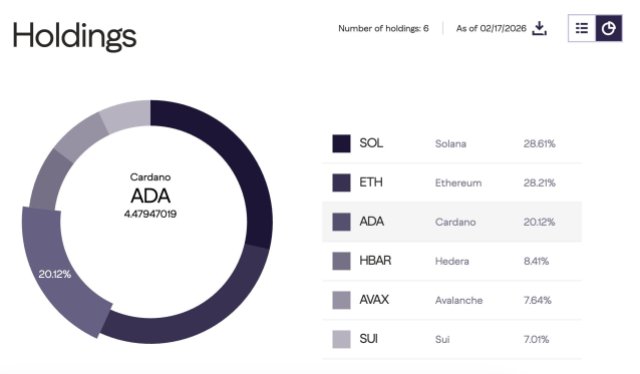
Grayscale adds to its ADA holdings | Source: Chart from Dave on X

During the period, the firm’s ADA allocation moved from 19.50% to 19.55% in the smart contract fund. There are speculations that the move could be linked to recent rapid momentum and integration work around Bitcoin Decentralized Finance (DeFi) within the Cardano ecosystem.

Dave highlighted that this is taking place as Cardano bolsters its push into the Bitcoin DeFi ecosystem. The purpose of his move is to restore external BTC liquidity on the network via non-custodial Collateral, stablecoin-based credit, and lending structures built to avoid fragility driven by liquidation.

Furthermore, Cardano’s smart contract layer makes this possible, and this approach clarifies why large asset managers would be covertly expanding their exposure. Thus, institutions that need predictable, non-liquidating borrowing, and retail users looking for high-quality yield on idle Bitcoin could be able to utilize the network.

The Projects On The Leading Network Are Just Real Ones

Currently, the activity across the Cardano ecosystem is decreasing at a remarkable pace. Mintern, a market expert and Chief Meme Officer (CMO) of Minswap, has reported a sharp drop in the number of projects launched on the network since 2021.

In 2021, the number of projects on the network skyrocketed with more than 100 projects within the year, signaling confidence in the network’s scalability, governance model, and long-term roadmap. Meanwhile, in 2026, the projects have fallen, leaving only the real ones.

Mintern noted that the network is now advancing with Midnight building privacy-focused rails for long-term adoption, not short-term speculation. Amid the reduced network activity, the main question circulating across the community is who is still building in 2026.

ADA trading at $0.27 on the 1D chart | Source: ADAUSDT on Tradingview.com

İlgili Sorular

QWhat is the main reason for the resurgence in buying activity for Cardano (ADA) despite its price decline?

AThe resurgence in buying activity is due to increased purchases by both retail and institutional investors, notably Grayscale Investments, which has been steadily increasing its ADA holdings.

QHow much has Grayscale's ADA weighting in its Smart Contract Fund increased to after the recent purchase?

AGrayscale's ADA weighting in its Smart Contract Fund has increased to over 20.12% from its prior level of 19.50%.

QWhat recent development in the Cardano ecosystem might be linked to Grayscale's increased allocation to ADA?

AThe move could be linked to Cardano's recent rapid momentum and integration work around Bitcoin Decentralized Finance (DeFi), which aims to restore external BTC liquidity via non-custodial collateral and stablecoin-based credit structures.

QWhat trend has been observed regarding the number of projects launched on the Cardano network since 2021?

AThe number of projects launched on the Cardano network has sharply decreased since 2021, with only the 'real ones' remaining, as the network focuses on long-term adoption rather than short-term speculation.

QWhat is the current price of ADA mentioned in the article, and on which chart is it referenced?

AThe current price of ADA mentioned is $0.27, as shown on the 1D chart sourced from ADAUSDT on Tradingview.com.

İlgili Okumalar

Understanding Hash in One Article: The "Browser Miner" on Ethereum

Hash is an Ethereum-based ERC-20 token described as a "browser-minable post-quantum token." Its key features include enabling browser-based GPU mining without specialized hardware, a fixed supply cap of 21 million tokens, immutable and permissionless smart contracts with no team allocation or pre-mining, and an emphasis on post-quantum security using Keccak256 hashing. The mining mechanism is a simplified on-chain proof-of-work where miners solve unique challenges tied to their wallet address. Key design elements prevent answer theft, with epochs resetting every 100 blocks (~20 minutes) and a per-block minting limit. Emission follows a Bitcoin-like halving schedule every 100,000 mints, starting at 100 tokens per mint. Projections suggest all tokens could be mined within approximately 294 days if a target rate of one mint per minute is sustained. Hash emphasizes "post-quantum" security by leveraging hash-based primitives like Keccak256, which are considered more resistant to quantum attacks compared to elliptic-curve cryptography. While not a fully post-quantum asset, it aligns with Ethereum's broader post-quantum research narrative. The project completed its Genesis sale at $0.03 and began trading on Uniswap, with its price reaching around $0.19. The initial circulating supply is small, with 5% sold in Genesis and 5% allocated to liquidity. The majority (47.6% of total supply) is allocated to early-stage mining, leading to a front-loaded emission schedule. This structure, combined with low initial liquidity, makes Hash a high-volatility, high-risk project dependent on sustained miner participation and market demand to absorb new supply.

marsbit1 dk önce

Understanding Hash in One Article: The "Browser Miner" on Ethereum

marsbit1 dk önce

OpenAI's Largest Internal Wealth Creation: 600 People Cash Out a Total of $6.6 Billion, 75 Take Home the Maximum $30 Million Each

A Wall Street Journal report reveals OpenAI's unprecedented pre-IPO wealth creation. In a single employee stock sale last October, over 600 current and former employees sold shares, collectively cashing out approximately $6.6 billion. Due to high investor demand, the company tripled the individual sale cap to $30 million, with about 75 employees selling the maximum amount. This event represents the largest such transaction in tech industry history for a private company. OpenAI's valuation was $500 billion for this tender offer. Employees with over two years of tenure were eligible, allowing many post-ChatGPT hires their first liquidity event. The company's stock has reportedly grown over 100-fold in seven years. Following a restructuring, employees collectively hold about 26% of OpenAI. The scale of executive wealth is also staggering. In court testimony related to Elon Musk's lawsuit, President and co-founder Greg Brockman confirmed his OpenAI stake is worth around $30 billion. Analysis indicates about 165 current and former employees hold a combined ~$164.9 billion in equity, averaging nearly $1 billion per person in paper wealth. OpenAI's per-employee stock-based compensation is estimated to be 34 times the average of major tech firms before their IPOs. OpenAI continues its rapid ascent, closing a $122 billion funding round at an $852 billion valuation in March. With monthly revenue hitting $2 billion, over 900 million weekly ChatGPT users, and plans for a potential trillion-dollar IPO in late 2026, this wealth-creation engine shows no signs of stopping.

链捕手23 dk önce

OpenAI's Largest Internal Wealth Creation: 600 People Cash Out a Total of $6.6 Billion, 75 Take Home the Maximum $30 Million Each

链捕手23 dk önce

Understanding CPO (Co-Packaged Optics) in One Article: Why Nvidia Is Willing to Spend $3.2 Billion on a Fiber?

NVIDIA and Corning announced a multi-year strategic partnership on May 6, 2026, with NVIDIA committing up to $3.2 billion to support Corning's U.S. expansion. This investment will triple Corning's manufacturing plants and significantly boost its optical fiber and communications production capacity. The core driver behind this massive investment is the fundamental shift from copper to optical interconnect technology within AI data centers. As GPU clusters scale, copper wires face critical limitations: severe signal attenuation over distance, high energy consumption for signal integrity, and excessive heat generation. Optical fiber, transmitting light instead of electrical signals, solves these issues with minimal loss, near-light speed, and lower power needs. The article outlines a three-stage evolution of data center interconnect: 1. **Traditional Copper Interconnects:** The mainstream solution of the 2010s, now being phased out due to scaling bottlenecks. 2. **Pluggable Optical Modules:** The current mainstream, where modules convert electrical signals to light externally. This process still introduces energy loss and latency. 3. **CPO (Co-Packaged Optics):** The next-generation technology where the optical engine is integrated directly with the GPU chip package. This drastically reduces the electrical signal travel distance to mere millimeters, slashing power consumption and latency while boosting data density. NVIDIA CEO Jensen Huang has identified CPO as an essential core technology for AI infrastructure. NVIDIA's investment signifies a strategic shift from being a buyer to actively controlling its supply chain for critical components. With demand for specialized optical fiber far outstripping supply—evidenced by soaring prices—securing long-term manufacturing capacity has become a competitive necessity. While Corning's expansion may pressure some suppliers, a projected global fiber supply gap of 5-15% over the next few years creates a significant opportunity window, particularly for Chinese manufacturers competitive in optical preforms, chips, and modules. Ultimately, NVIDIA's move is not about chasing a trend but an engineering imperative. The transition to light-based interconnects like CPO is driven by the physical limits of copper, marking a definitive step in the ongoing AI computing revolution.

marsbit48 dk önce

Understanding CPO (Co-Packaged Optics) in One Article: Why Nvidia Is Willing to Spend $3.2 Billion on a Fiber?

marsbit48 dk önce

İşlemler

Spot
Futures

Popüler Makaleler

ADA Nasıl Satın Alınır

HTX.com’a hoş geldiniz! Cardano (ADA) satın alma işlemlerini basit ve kullanışlı bir hâle getirdik. Adım adım açıkladığımız rehberimizi takip ederek kripto yolculuğunuza başlayın. 1. Adım: HTX Hesabınızı OluşturunHTX'te ücretsiz bir hesap açmak için e-posta adresinizi veya telefon numaranızı kullanın. Sorunsuzca kaydolun ve tüm özelliklerin kilidini açın. Hesabımı Aç2. Adım: Kripto Satın Al Bölümüne Gidin ve Ödeme Yönteminizi SeçinKredi/Banka Kartı: Visa veya Mastercard'ınızı kullanarak anında Cardano (ADA) satın alın.Bakiye: Sorunsuz bir şekilde işlem yapmak için HTX hesap bakiyenizdeki fonları kullanın.Üçüncü Taraflar: Kullanımı kolaylaştırmak için Google Pay ve Apple Pay gibi popüler ödeme yöntemlerini ekledik.P2P: HTX'teki diğer kullanıcılarla doğrudan işlem yapın.Borsa Dışı (OTC): Yatırımcılar için kişiye özel hizmetler ve rekabetçi döviz kurları sunuyoruz.3. Adım: Cardano (ADA) Varlıklarınızı SaklayınCardano (ADA) satın aldıktan sonra HTX hesabınızda saklayın. Alternatif olarak, blok zinciri transferi yoluyla başka bir yere gönderebilir veya diğer kripto para birimlerini takas etmek için kullanabilirsiniz.4. Adım: Cardano (ADA) Varlıklarınızla İşlem YapınHTX'in spot piyasasında Cardano (ADA) ile kolayca işlemler yapın.Hesabınıza erişin, işlem çiftinizi seçin, işlemlerinizi gerçekleştirin ve gerçek zamanlı olarak izleyin. Hem yeni başlayanlar hem de deneyimli yatırımcılar için kullanıcı dostu bir deneyim sunuyoruz.

1.3k Toplam GörüntülenmeYayınlanma 2024.12.10Güncellenme 2025.03.21

ADA Nasıl Satın Alınır

Tartışmalar

HTX Topluluğuna hoş geldiniz. Burada, en son platform gelişmeleri hakkında bilgi sahibi olabilir ve profesyonel piyasa görüşlerine erişebilirsiniz. Kullanıcıların ADA (ADA) fiyatı hakkındaki görüşleri aşağıda sunulmaktadır.

活动图片













