Can RAIN crypto recover as $10M sell-off sparks downside fears?

ambcrypto2026-03-28 tarihinde yayınlandı2026-03-28 tarihinde güncellendi

Özet

RAIN Protocol (RAIN) experienced a sharp decline of over 17% in 24 hours, significantly underperforming the broader crypto market. Despite support from Enlivex as its Digital Asset Treasury, the token faced heavy selling pressure, including a $10 million sell-off by a large holder. RAIN broke below a key support level at $0.0082, with high volatility and increased sell volume raising concerns of a further drop toward a $3.5 billion market cap. However, a swift recovery followed, and a reclaim of $0.0082—or a break above $0.0092—could invalidate the bearish outlook. Institutional buying contrasted with retail and whale selling, highlighting mixed market sentiment.

Rain Protocol [RAIN], a decentralized prediction markets protocol, has lost more than 17% in the past 24 hours as of writing. This was the case even though the protocol was supported by Enlivex [Nasdaq: ENLV] as the Digital Asset Treasury (DAT), which aided in the shift to capital markets.

Historical performance of RAIN crypto

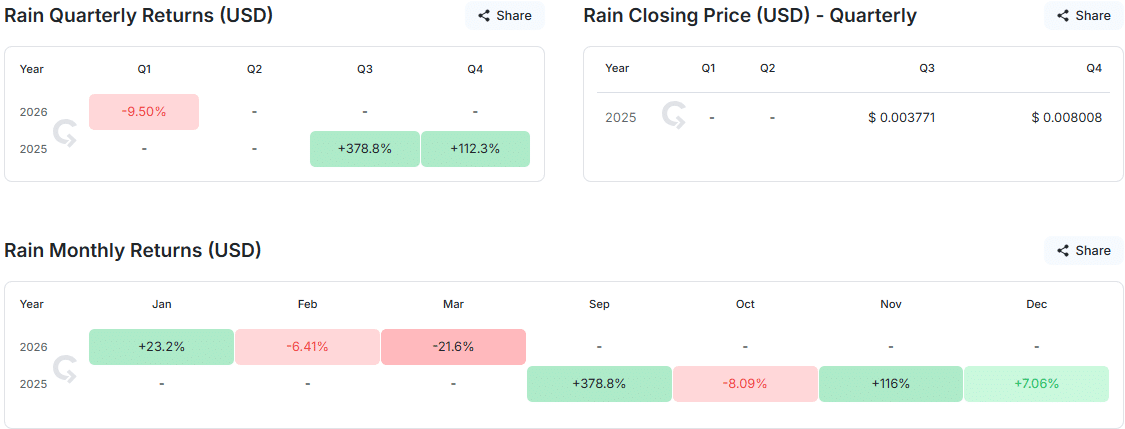
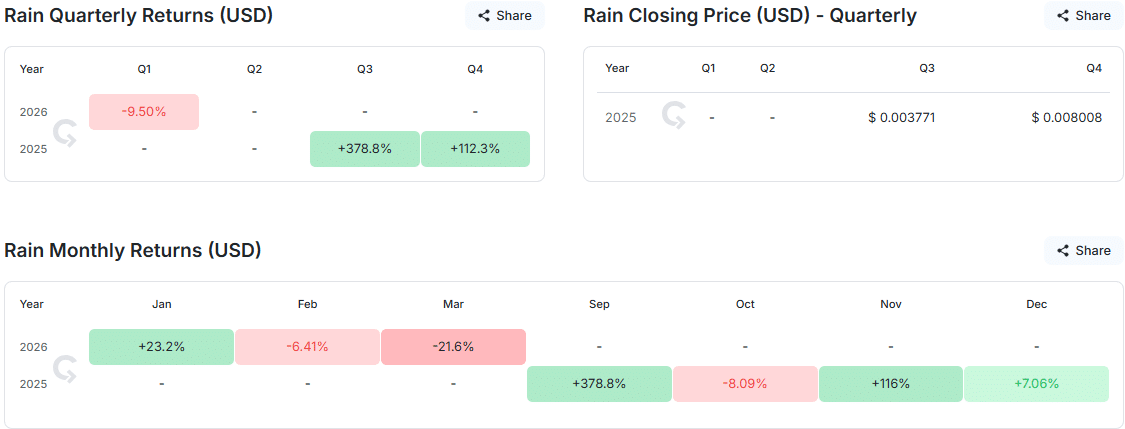
While the overall market fell by around 3%, RAIN fell by double digits. The altcoin fell by 9.5% in Q1 2026, after rising in the third and fourth quarters of 2025.

In Q3, the altcoin rose by more than 378% as Q4 closed 112% higher. For the first quarter of 2026, only January has been bullish, where RAIN recorded 23% in gains, as February and March lost 6.41% and 21.6%, respectively.
Source: CryptoRank

While the altcoin’s price continues to crash, it still commands a significant market cap of around $3.89 billion. Will the market cap continue to fall as sell volume rises to $46 million?

RAIN price loses a KEY support level

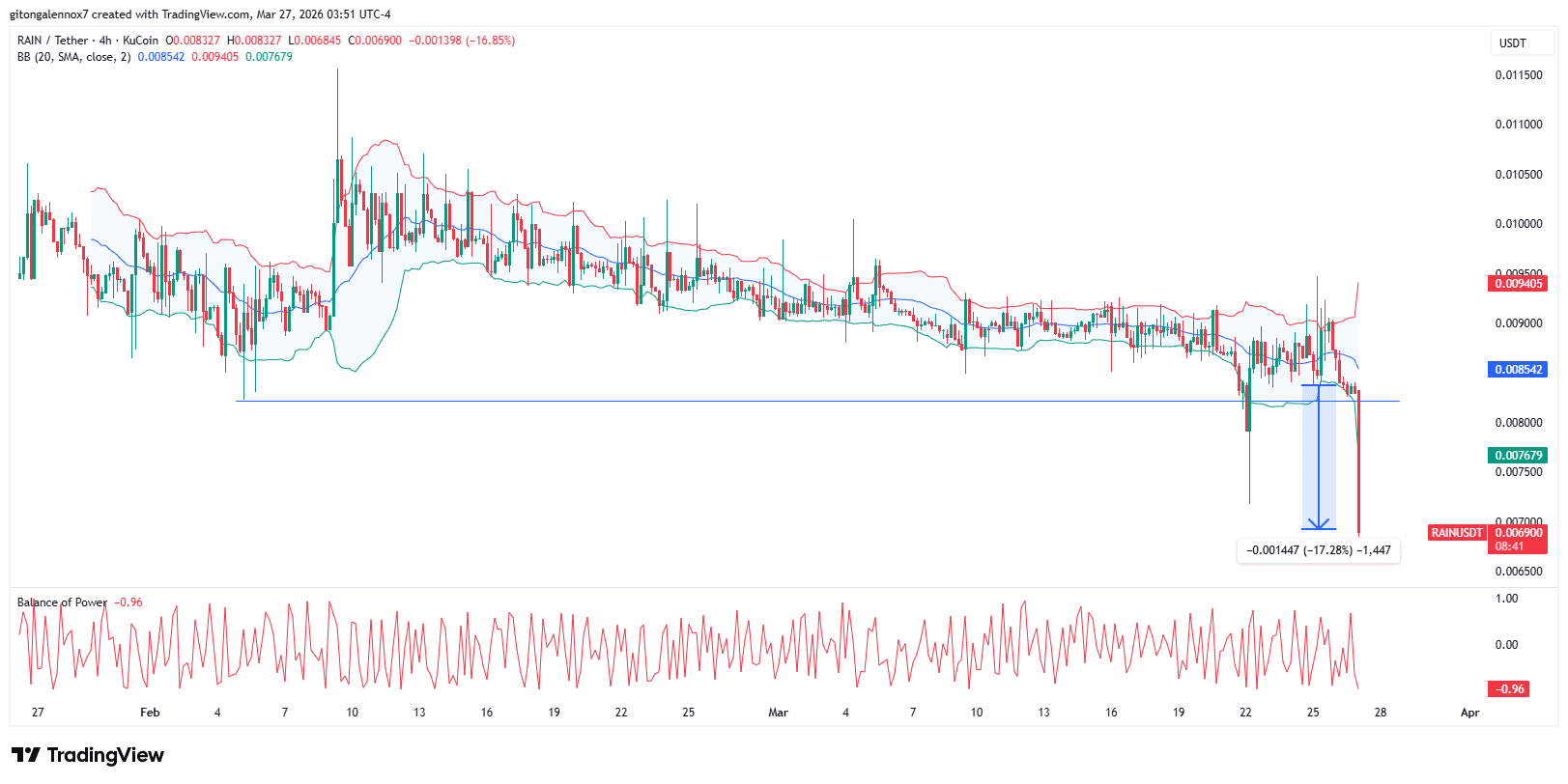
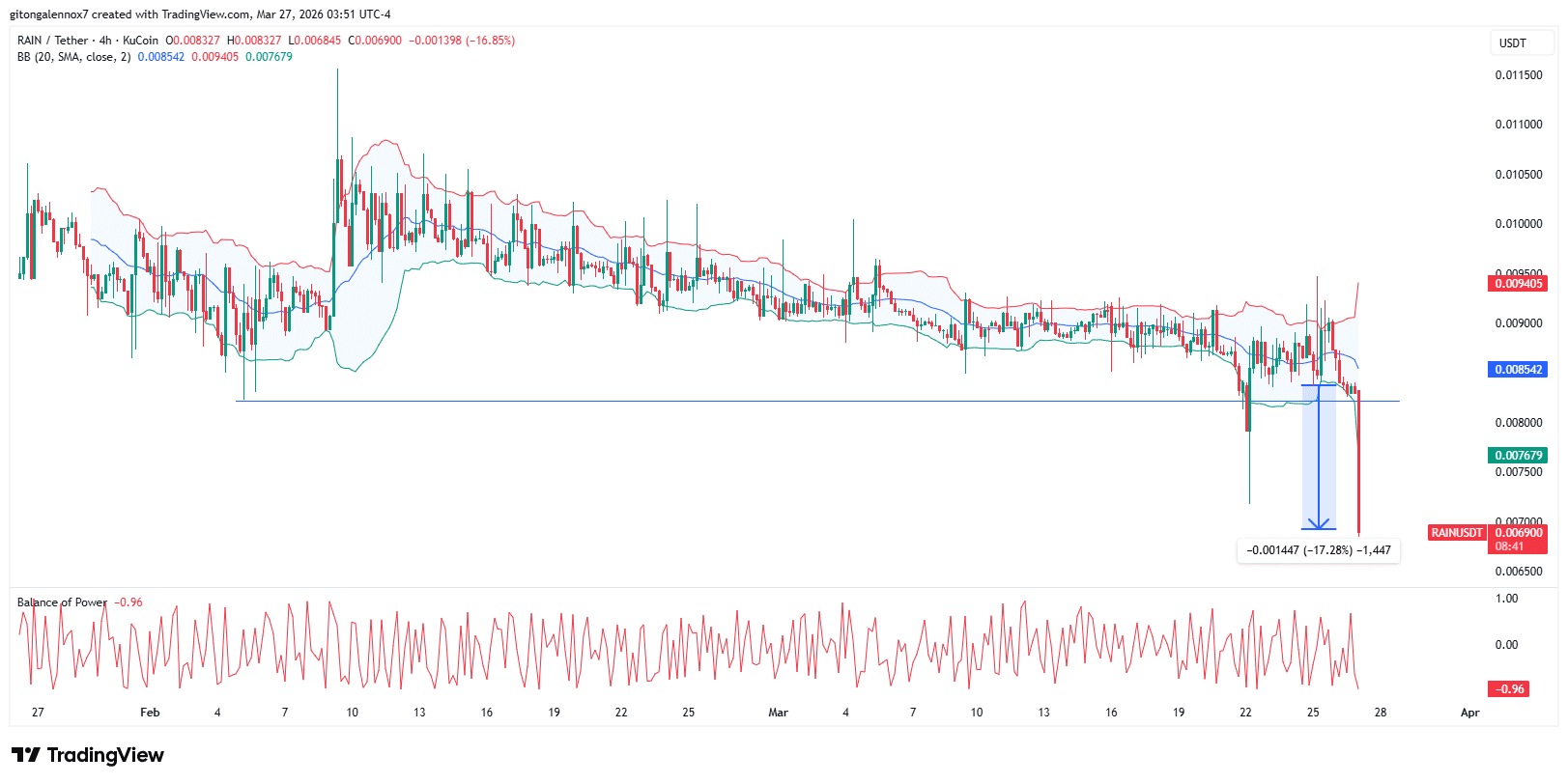
On the charts, the altcoin has been trading inside a consolidation since the beginning of February. The Bollinger Bands (BB) had been tight during this period and expanded upon breakdown below $0.0082.

The Balance of Power indicator was choppy and in the negative territory with a reading of 0.96. This reading was an indication that sellers were the stronger force at the time of writing.

Now, holding below the key support level at $0.0082 while volatility stays high would push the cap toward $3.5 billion.

Conversely, a reclaim of this level alongside the middle band of the BB would invalidate the outlook. Therefore, it would be deemed a fakeout, turning the structure bullish if RAIN breaks above $0.0092.
Source: RAIN/USDT on TradingView

This is because bulls rejected the breakdown, resulting in a strong green candle. However, RAIN had to maintain the rebound momentum to invalidate the structure break.

What accelerated selling pressure?

Meanwhile, it’s worth noting what was behind this sharp drop that was swiftly recovered. For instance, the daily token volume has been rising for the past week, with the high being $28.84 million.

The data showed that the volume came from sellers as the price dropped. For its Total Value Locked (TVL), it remained flat around $4 million since the start of February.
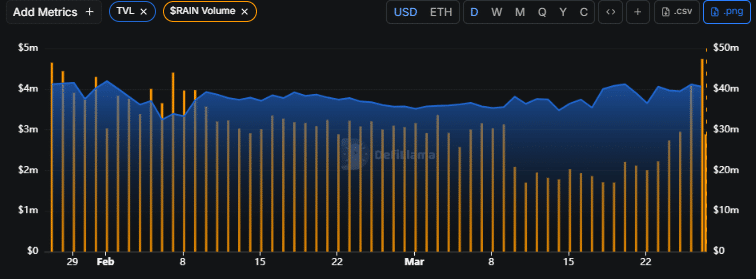
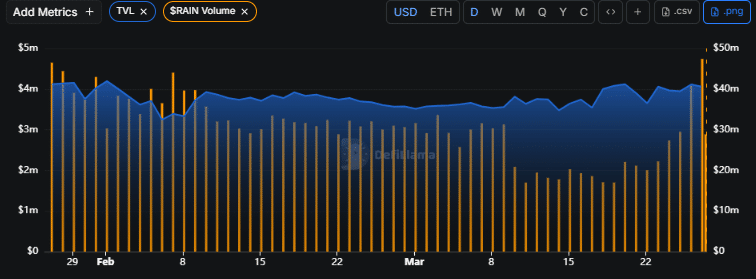
Source: DefiLlama

To be specific, the selling of tokens was driven mainly by the Token Millionaire wallet. As per Nansen AI, more than $10 million in RAIN was offloaded as the portfolio’s valuation dropped from $80 million to $69 million.
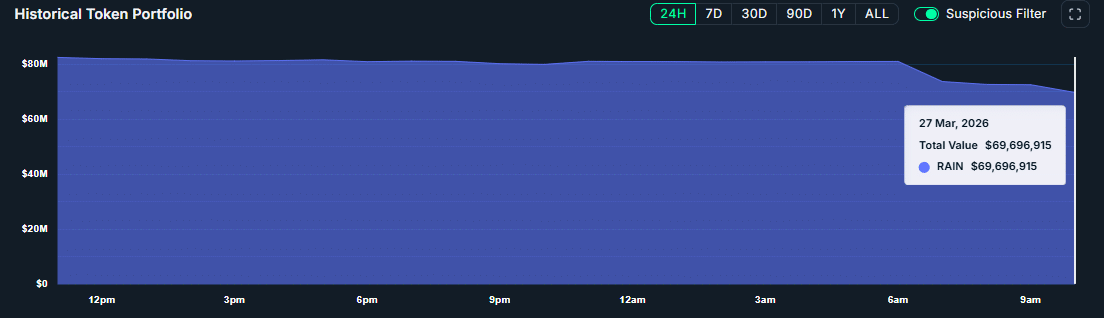
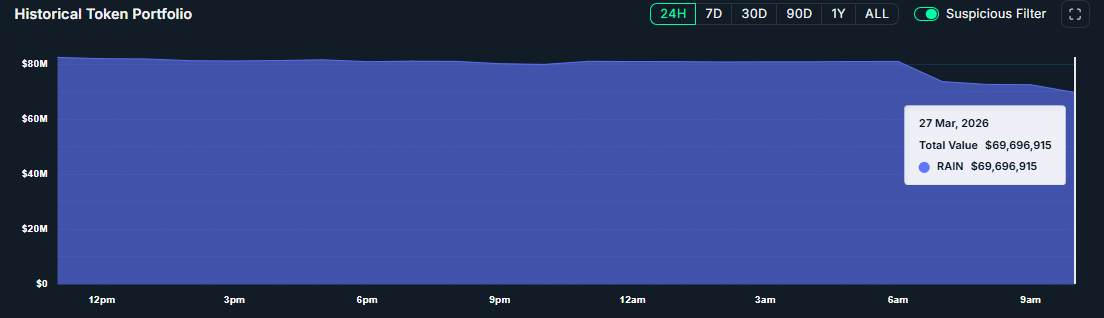
Source: Nansen AI

The volume data showed that the selling pressure came from big holders and retailers. However, institutions like Enlivex were buying, even reporting profits of $1.23 billion following their treasury around the Rain Protocol.


Final Summary

  • RAIN loses 17% of its market cap, but price action recovers swiftly shortly after.
  • The next price move for RAIN depended on its reaction around $0.0082 and $0.0092.

İlgili Sorular

QWhat was the percentage decrease in RAIN crypto's value in the past 24 hours as mentioned in the article?

ARain Protocol [RAIN] lost more than 17% in the past 24 hours.

QAccording to the article, what was the key support level that RAIN's price lost on the charts?

AThe key support level that RAIN lost was $0.0082.

QWhat specific event accelerated the selling pressure, causing a sharp drop in RAIN's price?

AThe selling pressure was accelerated by a Token Millionaire wallet offloading more than $10 million worth of RAIN tokens.

QDespite the sell-off, which institution was reported to be buying RAIN and even making a profit?

AInstitutions like Enlivex were buying RAIN and reported profits of $1.23 billion from their treasury involvement with the Rain Protocol.

QWhat are the two critical price levels that will determine RAIN's next price move, as per the article's analysis?

AThe next price move for RAIN depends on its reaction around the $0.0082 and $0.0092 price levels.

İlgili Okumalar

Global Stock Market's Storm Center: South Korea's Stock Market De-leveraging Is Largely Complete

Storm's Eye: South Korean Market De-leveraging Nears Completion The recent sharp correction in South Korean equities, with the KOSPI index dropping 32% from its June high, has been a key trigger for global tech stock volatility. The core driver was not a fundamental shift but a forced de-leveraging process within the market's unique structure, which is now largely complete. Two main leverage channels amplified the sell-off: 1. **Leveraged ETFs:** Their size, proportionally four times larger than in the U.S., peaked near $50 billion. Their mandatory daily rebalancing mechanism created a vicious cycle of "price drop → forced selling → further drop." Approximately 75% of this excess has been unwound, shrinking to $26 billion, with regulatory curbs now blocking new inflows. 2. **Hedge Fund Leverage:** Using swaps to magnify exposure, hedge funds saw their net long positioning fall by over 50% from peak levels. The most intense phase of this institutional de-leveraging is over. In contrast, **retail margin debt** poses minimal systemic risk. At 0.5% of market cap, it is far lower than in the U.S. or China, lacks automatic triggers, and is concentrated in smaller stocks. The conclusion: the high-leverage structures most prone to "chain-reaction selling" have been substantially cleared. The market is transitioning from a liquidity-driven crash to one priced more on fundamentals. The article argues that the AI trend—centered on Korean memory chips—remains intact. This episode represents a painful but necessary clearing of crowded trades, not the end of the AI revolution. For investors, the key question is conviction in the long-term AI direction; if the trend is real, current volatility is a cost of entry, not a terminal risk.

链捕手46 dk önce

Global Stock Market's Storm Center: South Korea's Stock Market De-leveraging Is Largely Complete

链捕手46 dk önce

The Eternal Fragments of Money: Third-Party Payment Has No First Principle

"The Enduring Fragments of Money: Third-Party Payments Lack a First Principle" Stripe is reportedly attempting to acquire PayPal, marking a significant shift reminiscent of PayPal's merger with the original X.com 30 years ago. The article analyzes Stripe's strategic challenges and the broader payments industry landscape. Despite its initial success with a developer-friendly API model, Stripe missed its optimal IPO window during the pandemic and has since seen its valuation decline. Its attempts to expand through acquisitions and new ventures, particularly in stablecoins (like its OUSD project) and Agent-focused payments (ACP/MPP protocols), have faced headwinds. The author argues that the payment industry remains highly fragmented and is ultimately an adjunct to the traditional banking system. This structure limits the potential for any single player, including Stripe, to achieve complete dominance. While stablecoins and the future rise of autonomous Agent economies present potential growth avenues, they are not yet mainstream and still require integration with the existing financial system. For now, Agent-based transactions are largely used for speculative "volume boosting" rather than substantive business applications. Stripe's current move to acquire PayPal is seen as an attempt to bolster its weak consumer-facing (C-side) business after its stablecoin-focused strategies faltered. Meanwhile, PayPal is described as structurally outdated, unable to revive itself through new products like Venmo or PYUSD. The future of payments may lie not in payments themselves but in value-added services like more efficient settlement networks. The author suggests that companies like Stripe and Circle, which are building their own blockchains (Tempo, Arc) and stablecoins, are positioning themselves to eventually profit from high-efficiency settlement systems. These new networks could potentially bypass some traditional banking layers. In conclusion, the article posits that third-party payment is a perpetually fragmented battlefield where scale alone cannot ensure victory. Players must find new models, focusing on efficiency to compete with the entrenched banking system. Stripe's acquisition of PayPal represents a bet on this uncertain future.

链捕手1 saat önce

The Eternal Fragments of Money: Third-Party Payment Has No First Principle

链捕手1 saat önce

İşlemler

Spot
活动图片