Chip World, June 3rd report, Arm CEO Rene Haas delivered a keynote speech during Computex 2026 yesterday, announcing that ByteDance and Oracle have adopted Arm's self-developed data center CPU chip, Arm AGI.
Last month, Arm doubled its demand forecast for the Arm AGI CPU, expecting it to reach $20 billion (approximately RMB 135 billion) in fiscal years 2027 and 2028, while also projecting the product will generate $150 billion (approximately RMB 1,016 billion) in annual revenue in about five years.
In an interview with foreign media yesterday, Rene Haas stated that it's 'almost impossible' for the U.S. to block AI CPU exports to China because AI CPUs are widely used, making it difficult to determine which CPUs are specifically for AI, unlike AI chips where specific performance thresholds and memory bandwidth limits can be set.
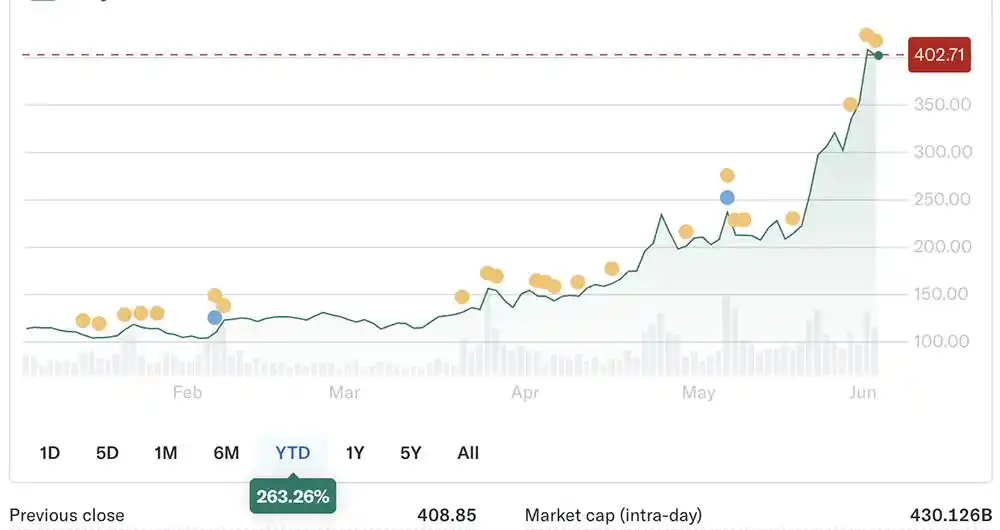
On Monday, NVIDIA released the Arm-based RTX Spark superchip and Vera data center CPU. Arm's stock price surged that night, closing Tuesday with a 16% gain. So far this year, Arm's stock price has accumulated a 263% increase.
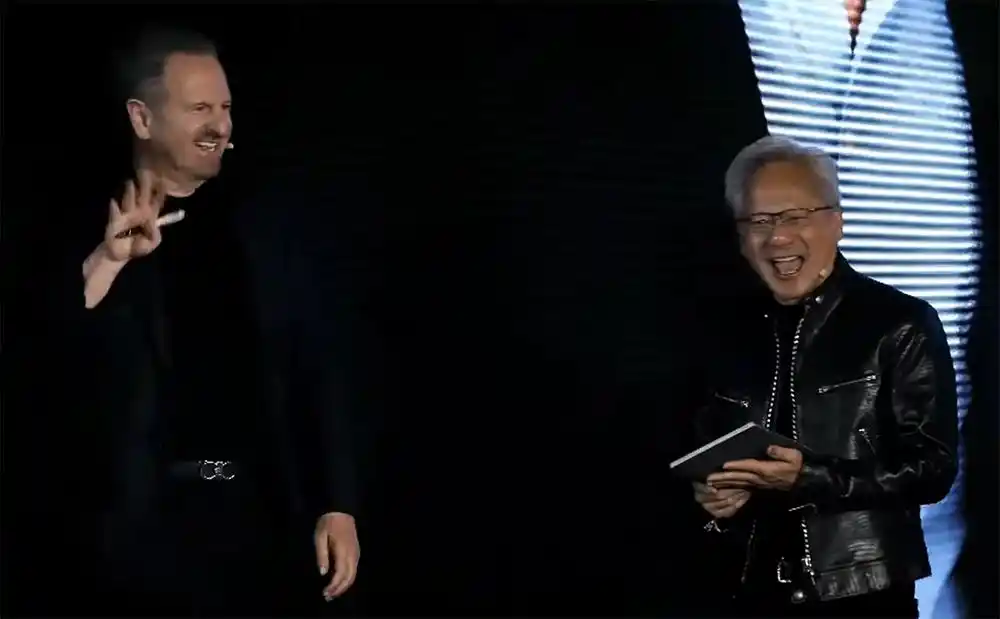
NVIDIA founder and CEO Jensen Huang also popped into Rene Haas's Tuesday speech. Taking the stage, he joked, 'Look at his stock price. Every time I release a product, his stock goes up, while mine does nothing.'
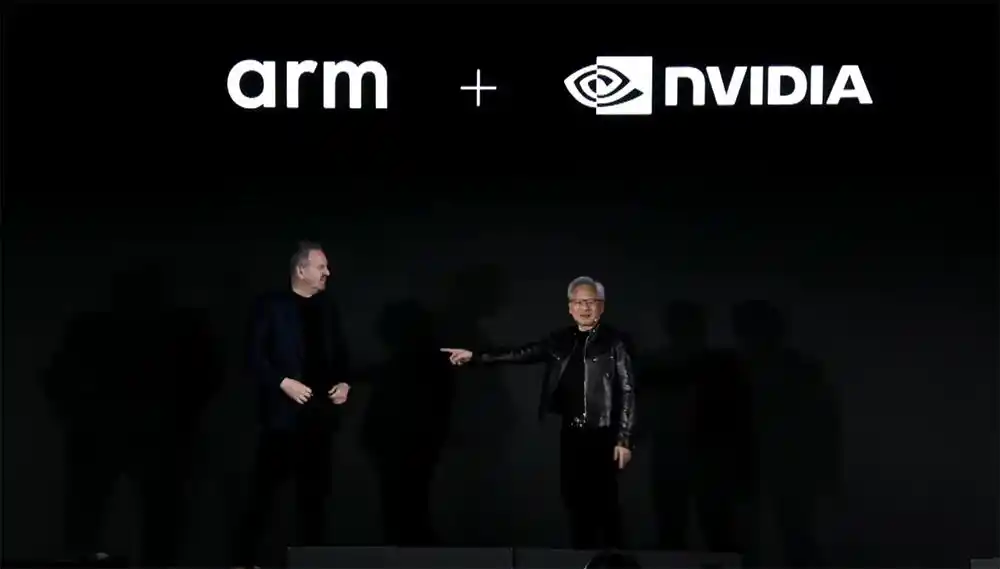
Rene Haas cleverly retorted, 'You were a shareholder, and then you sold your shares.'
Jensen Huang immediately took the bait, 'Yes, yes, oh man, I needed cash.'
The two, evidently old friends, chatted warmly for 15 minutes, frequently improvising comedic sketches, throwing and catching jokes that had the audience roaring with laughter, both often laughing wide enough to show all their teeth.
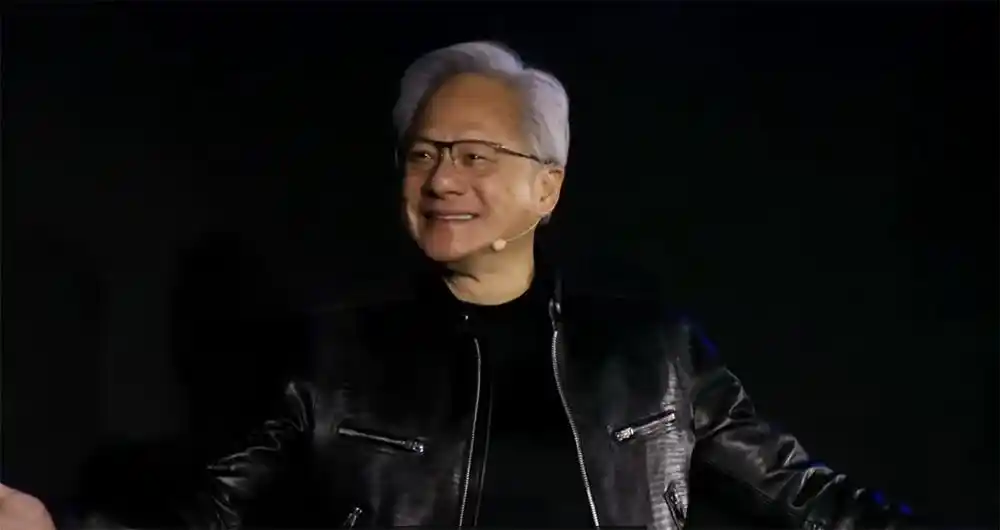
This was truly the liveliest atmosphere I've seen in a recent tech industry conversation.
For example, after lavishing praise on Arm CPUs, Jensen Huang summarized, 'The keywords are 'Arm is perfect.'
Rene Haas responded, 'Another keyword is 'thank you.''
Jensen Huang immediately switched to Mandarin, 'Nǎlǐ, nǎlǐ, bùyào kèqi la.' (Meaning 'Not at all, not at all, don't be polite.')
Then Rene Haas quipped, 'Now this competition is unfair.' (Implying it's unfair for Jensen to speak Mandarin)
Jensen Huang then considerately added in English, 'You're welcome.'
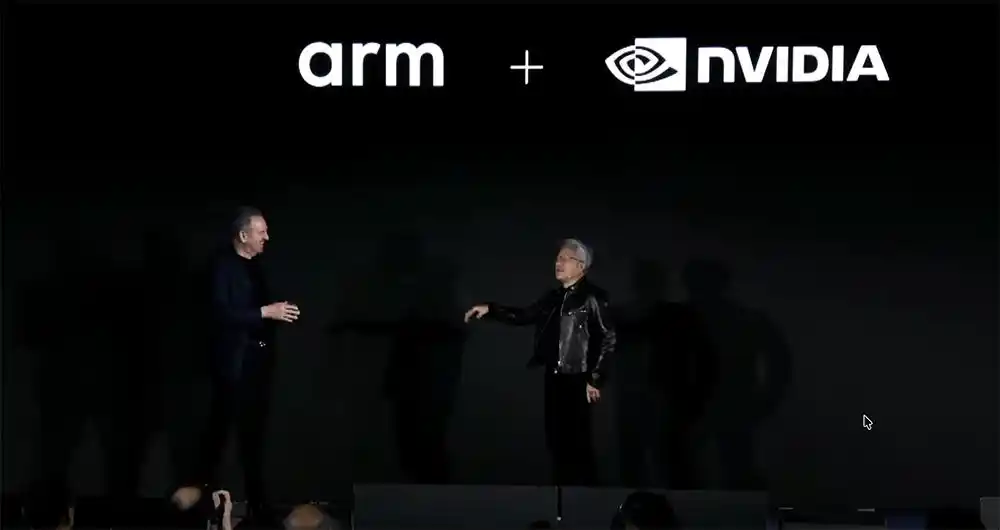
Jensen Huang also joked that 'One of Arm's greatest advantages is not having to worry about supply chain issues.' The supply chain for IP is electrons, and you can have as many electrons as you want.
'So I love their business model,' Jensen Huang began reminiscing. 'You know, I tried. I tried to become Arm. Rene and I worked together before, and then we tried to partner again, but that's no big deal. I'm still very sad.'
Rene Haas said, 'If the two companies merged, we would become the world's largest company.'
'I like that,' Jensen Huang laughed. 'That's a great idea.'
It seems both are full of regret about NVIDIA's failed acquisition of Arm.
Finally, during the gift-giving segment, Rene Haas played a 'nostalgia card,' giving Jensen Huang a Microsoft Surface RT laptop equipped with an NVIDIA Tegra 3 chip, even mimicking Jensen Huang's signature on it.

The NVIDIA Tegra 3 was the world's first Arm mobile quad-core processor launched by NVIDIA years ago.
Jensen Huang pointed at the photo on the big screen and boasted, 'What happened when we were young? I have to say, I think I look younger. Do you agree? I think I've aged rather well.'
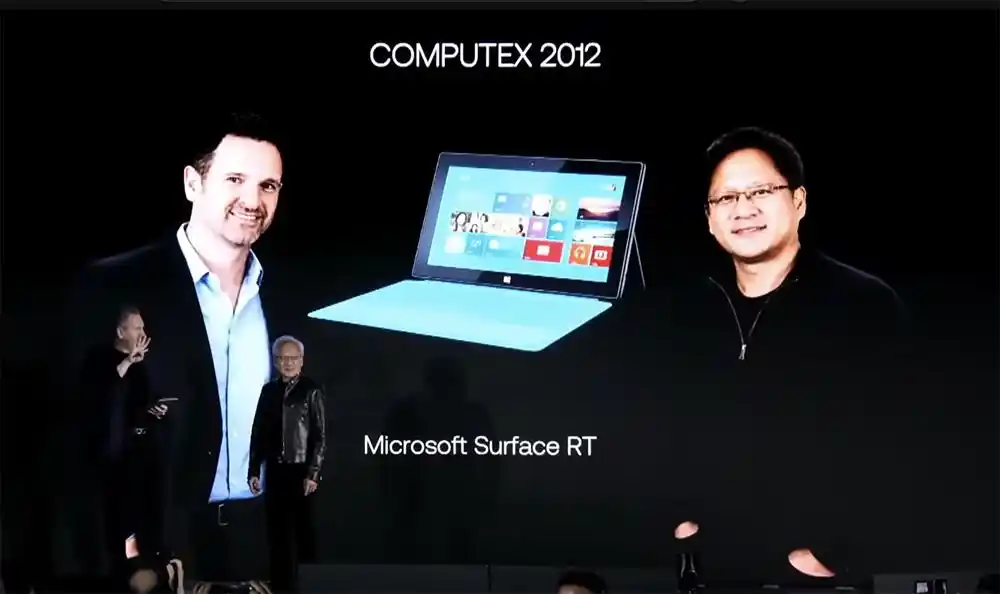
Rene Haas laughed until his image blurred.

Then Jensen Huang snatched the gift, his tone rising, 'This is for me? If I sign it and give it back, it becomes a treasure.'
Rene Haas said, 'No, you sign it and give it back to me, there's a contract, an invoice here, we can't do that. We know that game.'
Returning to serious industry topics, during this speech, Rene Haas asked Jensen Huang several key questions:
1. Why make the RTX Spark?
2. How to balance local agents and cloud agents?
3. Can agents truly work independently, detached from the underlying OS?
4. What does Jensen Huang see as growth constraints in the coming years?
Jensen Huang also painted a grand picture for market development: currently, the computer industry is limited by the number of people using computers. With agents that can autonomously use computers, we will no longer have a billion people using computers, but tens of billions, possibly even more agents, robots, and autonomous vehicles using computers than humans.
So the question is, how big can the computer product scale become?
'I feel that, by now, the outcome is decided. This multi-trillion-dollar industry might be ten times larger; we are on our way.' Jensen Huang said.
Rene Haas also shared the latest progress and future plans for Arm in the Agent PC and data center CPU fields.
He mentioned in passing that he chatted with TSMC Chairman and CEO C.C. Wei and Senior Vice President & COO C.J. Chou this week, and they said they have never seen the semiconductor industry cycle so prosperous for four consecutive years.
01. Jensen Huang's Mini-Lecture: How to Design Agent PCs?
Jensen Huang answered Rene Haas's key questions one by one. These insights are quite instructive for the upcoming development of AI PCs and chip design thinking.
1. Why make the RTX Spark product?
PCs and operating systems have existed for 40 years. Manual programming will be replaced by agent applications that will use tools on the PC. So, how should we restructure the architecture, change the OS, and reinvent the computer in the future?
NVIDIA realized that agent systems need excellent CPUs, which is why Arm was adopted.
The RTX Spark superchip comes with a 20-core CPU, excellent single-thread performance, and memory needs to store many parameters.
So, NVIDIA created a new data format called NVFP4 to compress the massive language, build as many models as possible, and integrate very intelligent AI into the system memory.
NVIDIA also wanted to combine CUDA and CUDA Tile for accelerated computing, integrating tensor core processing into a single processor.
2. How to balance locally running agents and cloud-running agents?
These Arm PCs will become autonomous agents that run continuously.
Today, if you leave your laptop at home or in a hotel, you can't use it.
But in the future, you can just pick up your phone, remotely talk to your PC, and command the agent to work.
Jensen Huang said, 'The essence of personal computing devices is that you can do anything with that device without spending time.'
If you need to use some cloud APIs, just call the cloud APIs. Whatever can be done locally, do it on the computer.
3. Is the operating system important for running agents? If we view the agent as the OS, can it truly work independently and not heavily rely on the underlying OS?
The importance of the operating system is not diminished at all; it might even be more important than before.
This is also a controversial point often mentioned when AI appears—'software is dead.' Jensen Huang thinks nothing could be further from the truth.
People might only know 10-20% of many tool functions.
But now, you can tell the agent what you want.
The agent knows very well how to use these tools because it has read the Skills file. Skills essentially involve reading the user manual for that tool, so it now uses the MCP or CLI connected to this tool, unlocking all these tools to meet your needs.
These tools will be more valuable than ever. They run on an OS, so we need Windows, we need these APIs and tools for a long time to come.
4. What are the constraints on growth in the coming years?
'We see constraints in almost every direction.' Jensen Huang said NVIDIA planned ahead, did supply chain planning well, grew nearly 100% year-over-year this year, will achieve very rapid growth next year, and the supply chain can support NVIDIA's growth.
But demand is actually higher.
Jensen Huang talked about how the new computing application paradigm truly requires a new architecture. Now, a major breakthrough is that agents can produce practical AI, which is why everyone's growth is so incredible.
When AI becomes practical, the tokens generated can bring profit. When token generation is profitable, everyone wants to generate trillions more tokens.
Now, AI is not just a chatbot that can answer questions; it can think, use tools, read, continue thinking, plan, try—the number of tokens that need to be generated has increased massively. The profitability of tokens is driving compute demand, creating a compounding effect.
02. Arm PC Chips: Apple, Google, Qualcomm All Say Good, Close Collaboration with NVIDIA and MediaTek
In the PC field, Google, Apple, NVIDIA, Qualcomm, etc., have developed PC chips based on the Arm architecture. Arm has collaborated with Apple, Google, Microsoft, and others for decades.
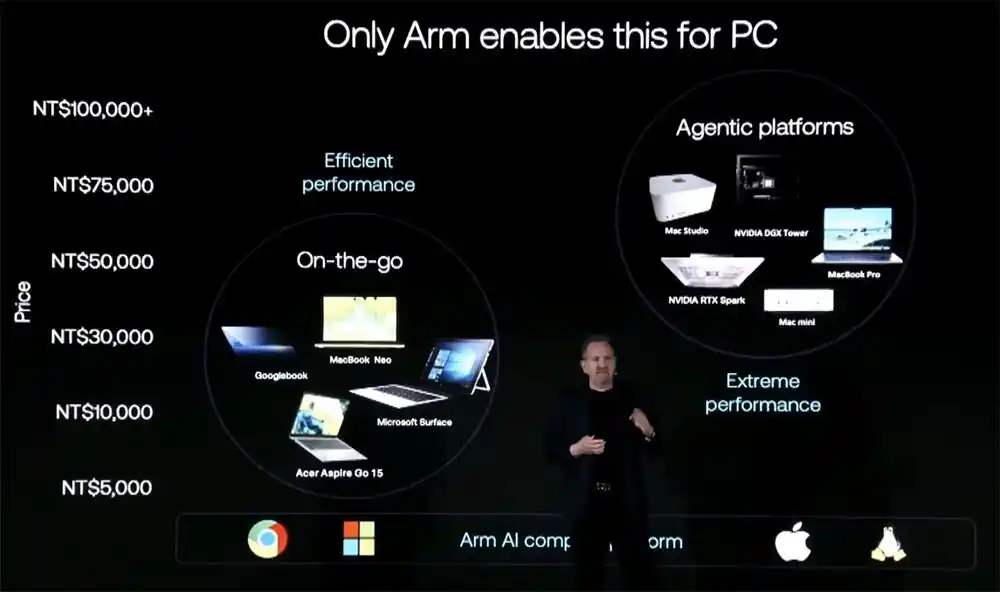
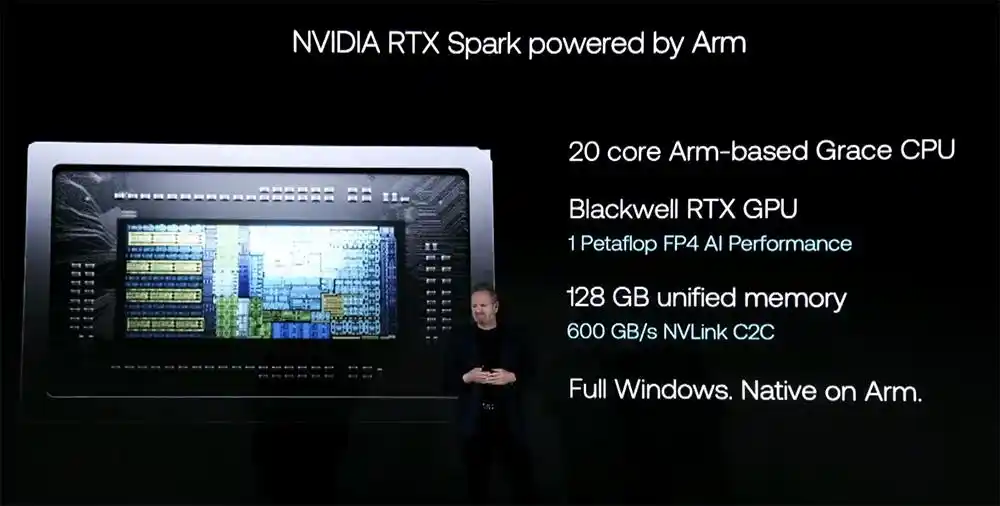
Rene Haas discussed that Arm is honored to collaborate with NVIDIA on developing the Arm-based RTX Spark superchip. The custom Grace CPU in this chip has 20 cores, each based on the Arm architecture.
'I believe this is the highest number of CPU cores in any laptop on the market today.' Rene Haas said that when you pair it with the Blackwell GPU, this chip achieves 1 PFLOPS of FP4 AI performance, along with 128GB of unified memory capacity, full native support for the Arm platform's Windows OS.
Arm's role here is to closely collaborate with NVIDIA and MediaTek using Arm's Compute Subsystem (CSS) strategy.
The Compute Subsystem combines all the components needed to build a custom SoC (CPU, GPU, system IP, memory controller) to form a complete end-solution system.
Arm collaborated with MediaTek to accomplish this, and MediaTek can provide the complete solution.
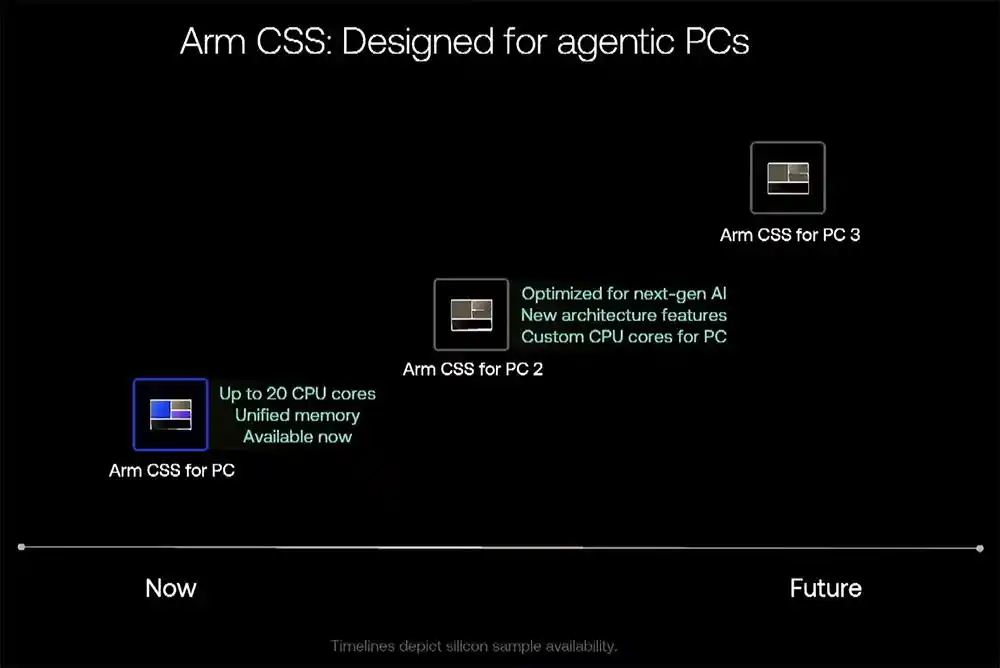
Rene Haas also displayed Arm's CSS roadmap for Agent PCs. The next generation will optimize custom CPU cores specifically designed for PCs.
03. Arm's Self-Developed Agent CPU: OpenAI, ByteDance Are Partners
Rene Haas said over 25 billion Arm chips have been made in Taiwan. The Arm AGI, Arm's first self-developed CPU launched in March this year, is produced by Taiwan's TSMC.
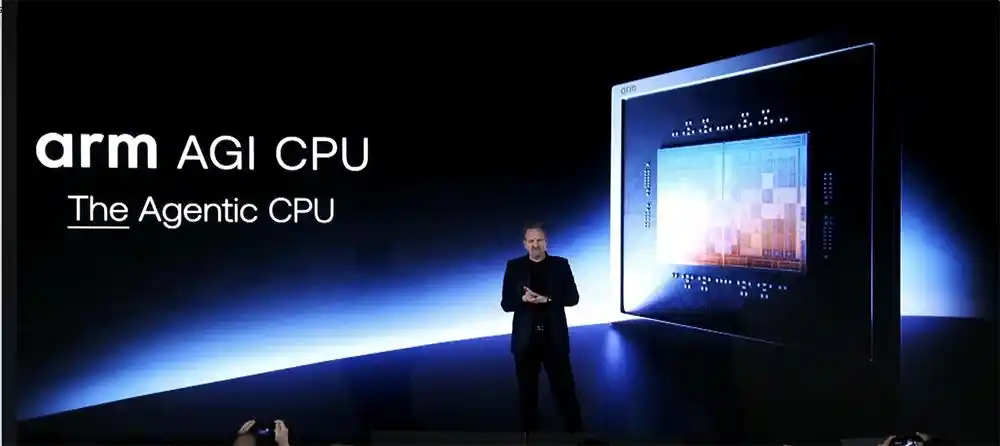
The Arm AGI CPU is specifically built for AI agent infrastructure. It uses TSMC's 3nm process, a dual-chiplet design, with a single CPU integrating 136 high-performance Arm Neoverse V3 cores, equipped with 2MB L2 cache per core, supporting up to 3.7 GHz frequency, providing 6GB/s memory bandwidth per core, memory latency below 100ns, featuring 96 lanes of PCIe Gen 6 interface, supporting CXL 3.0 protocol, with a TDP of 300W.
Arm AGI CPU partners include OpenAI, Meta, Cerebras, SAP, SK telecom, Rebellions, etc. Rene Haas announced that market demand for this chip is stronger than at launch, with Oracle and ByteDance also joining the family, validating that the Arm AGI CPU can solve real-world problems.
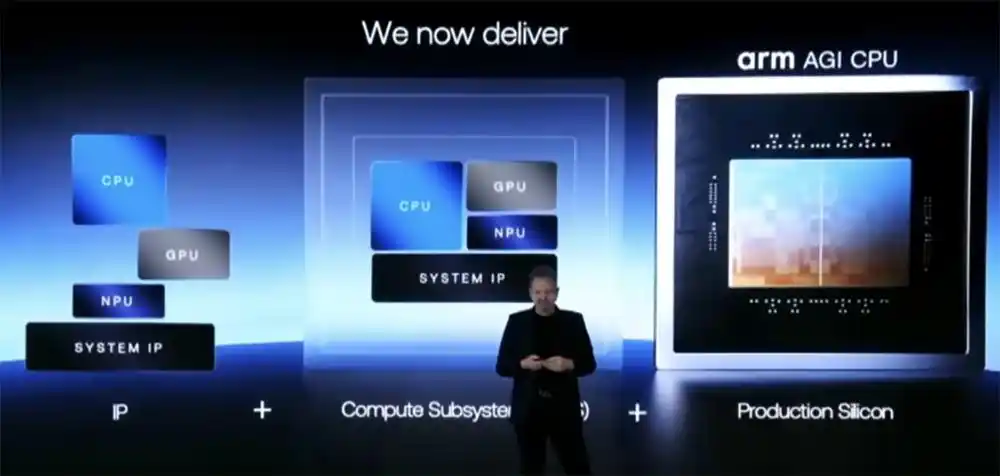
Of course, not all companies want to buy the Arm AGI CPU. For companies interested in developing their own chips, Arm offers a variety of IP and Compute Subsystems (CSS), committed to providing any solution customers would like to see succeed.
In the data center, the Axion CPU connected to Google's latest AI chips TPU 8t and TPU 8i is a chip using Arm Neoverse technology, reducing power consumption by up to 60% compared to x86 CPUs with equivalent performance.
Amazon's self-developed CPU, Graviton, also uses Arm architecture. Amazon CEO Andy Jassy once revealed, 'Two large customers asked if they could buy all our Graviton instances for 2026.'
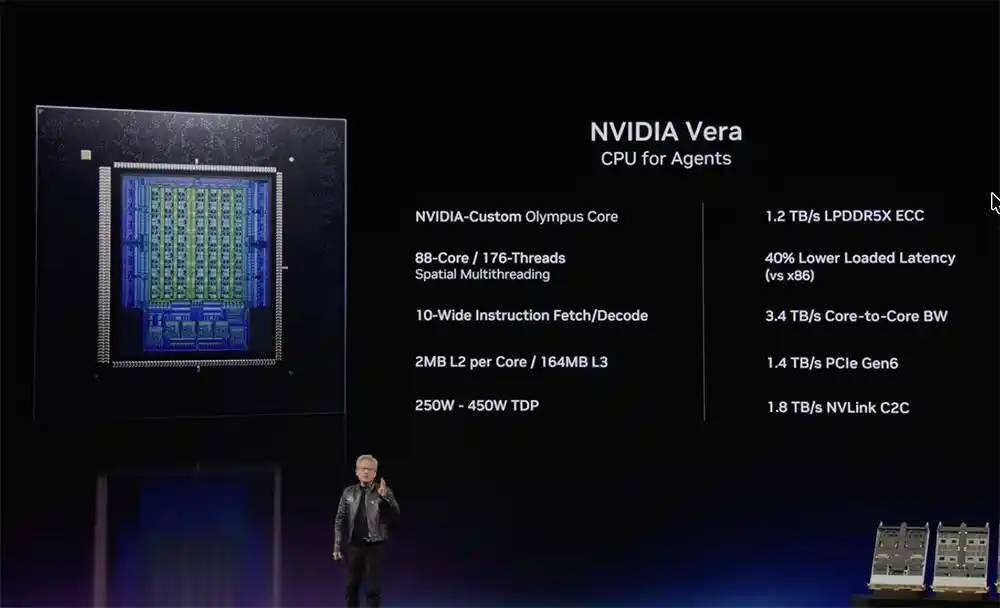
NVIDIA also just released the new Vera CPU based on Arm this week.
Arm plans to make self-developed CPUs a long-term endeavor and displayed a three-year roadmap.
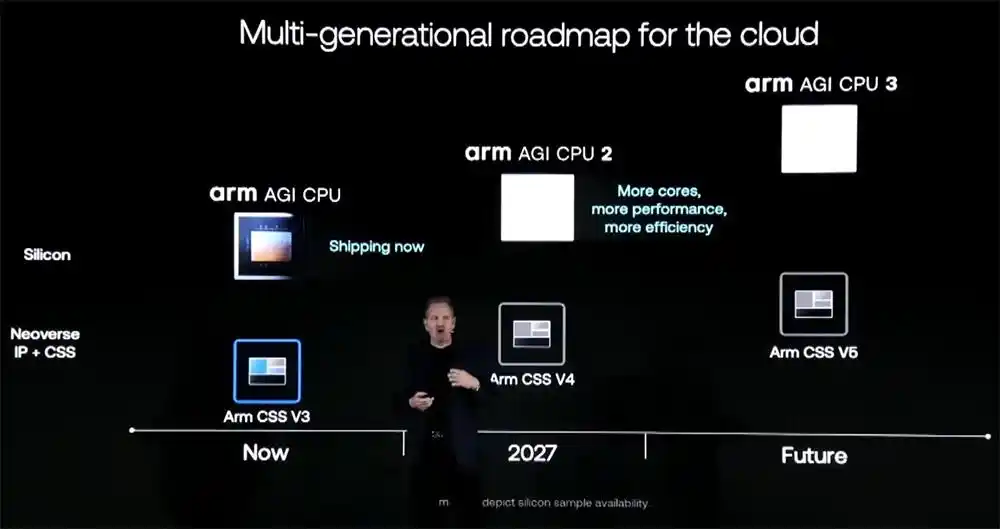
The second-generation Arm AGI CPU is already in development, featuring more cores, higher energy efficiency, and better performance than the previous generation.
The third-generation Arm AGI CPU is also coming soon.
All of these are based on the Compute Subsystem Arm intends to deliver alongside the chips.
04. Conclusion: After Agent Explosion, Compute Competition Spotlight Turns to CPU
This week's speeches by chip industry leaders like Jensen Huang, Lip-Bu Tan, and Rene Haas reflect some common trends in the CPU industry—agents are changing computing logic, opening a brand new door of market opportunities for CPUs.
In recent years, the focus of compute competition has mainly been on GPUs, indispensable for AI training. However, with the explosion of agent applications this year, agent inference demand is booming, requiring massive state management, tool calling, and process orchestration—these are CPU-intensive tasks.
Intel and AMD continue to consolidate x86 processors' advantages in the data center. Emerging players, including Amazon, Google, NVIDIA, etc., are largely betting on the Arm CPU route. Even Arm made a decision 'against its ancestors,' formally entering the data center CPU market this year.
A very interesting phenomenon is the formation of a new vertical integration trend in the chip industry.
Chip giants with rich product lines like NVIDIA, Intel, and AMD are increasingly emphasizing their full-stack nature. The advantages they tout for their solutions also converge: higher energy efficiency, having everything you need, and saving more money.
Leading companies across industries are also 'crossing boundaries': cloud giants extend downwards to self-develop chips, chip companies extend upwards to make system solutions, and semiconductor IP companies extend upwards to develop chips.
In the context where tokens become the new competitive currency and compute demand grows explosively, how to generate more effective compute per watt will be the main theme of chip competition going forward.
This article is from the WeChat public account 'Chip World' (芯东西), author: ZeR0, editor: Mo Ying