The Revelation from the Raydium Theft Incident: New DeFi Vulnerabilities Lurking in Forgotten Old Contracts

Foresight News2026-06-13 tarihinde yayınlandı2026-06-13 tarihinde güncellendi

Özet

**Raydium Exploit Reveals DeFi's Hidden Risk: Forgotten "Zombie" Contracts** A recent attack on Raydium's deprecated V3 AMM pools resulted in a loss of approximately $1.34 million. The hacker exploited pools that were no longer supported by Raydium's current UI or SDK but remained fully functional and accessible on-chain. This incident highlights a critical, often overlooked category of risk in DeFi: inactive or legacy smart contracts that projects fail to properly decommission. Since March 2025, there have been at least 8 publicly reported attacks targeting such abandoned contracts, with total losses around $10.8 million. Including older pools and deprecated features, the count rises to 10 incidents with roughly $22.5 million in losses. These "zombie contracts" represent a lifecycle management failure rather than a code vulnerability, yet they are typically misclassified under general "code bug" categories in security reports, masking the true scale of the problem. The root cause is that projects often merely document a contract as "deprecated" without taking essential technical steps to secure it: withdrawing remaining assets, disabling external call functions, and implementing ongoing monitoring. These forgotten, under-monitored components become prime targets for attackers. To address this, the industry needs to recognize "zombie contracts" as a distinct risk category and establish standardized decommissioning protocols. Essential steps should include: 1) a formal ret...


Author: Gino Matos

Compiler: Luffy, Foresight News


TL;DR:


  • Hackers stole approximately $1.34 million in assets by exploiting Raydium's long-discontinued V3 Automated Market Maker liquidity pools.
  • This incident exposes a widespread issue: Old contracts decommissioned by DeFi projects are still operational on-chain. These forgotten underlying infrastructures have become easily overlooked attack targets.
  • Public reports indicate that since March 2025, there have been at least 8 similar theft incidents targeting old contracts within the industry, suggesting that a vast amount of unattended legacy code remains externally callable.


Recently, a vulnerability in Raydium's AMM V3 resulted in a loss of $1.34 million. This incident involved five liquidity pools outside the project's current product ecosystem. These pools were unsupported by Raydium's UI or SDK and inaccessible to ordinary users, yet they were ultimately exploited by hackers.


This attack targeted the neglected old contracts and underlying infrastructures within the industry, revealing major flaws in the full lifecycle management of smart contracts. This type of problem is not unique to this one Solana-based decentralized exchange.


The Overlooked Risk Category


According to publicly available security incident reports, from March 2025 to the present, there have been at least 8 confirmed attack cases explicitly due to abandoned, phased-out, or old contracts, with cumulative losses of approximately $10.8 million.


If attacks involving old liquidity pools and outdated supporting products are included in the statistics, the number of related incidents reaches 10 (including this Raydium theft), with total losses amounting to about $22.5 million.


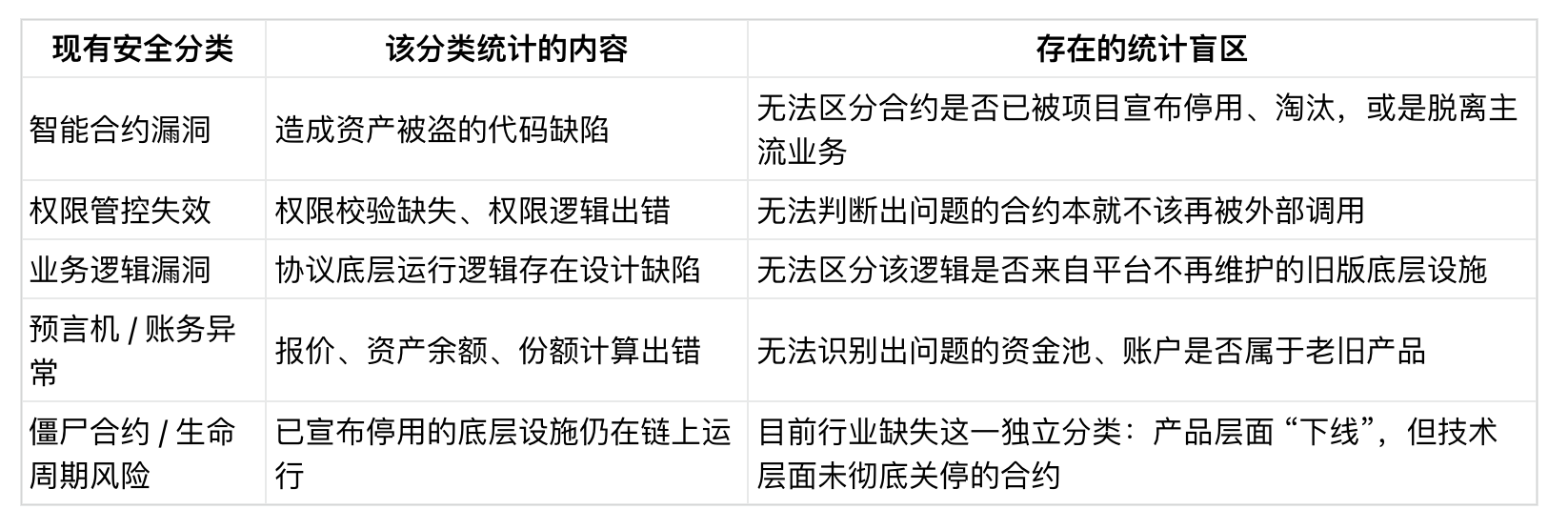
Most current industry security incident tracking platforms categorize attack types based on technical causes. Common classifications include: smart contract code vulnerabilities, permission control failures, oracle manipulation, private key leakage, cross-chain bridge defects, etc.


Zombie contracts (i.e., old contracts declared discontinued by projects but still normally callable on-chain) belong to a completely different risk dimension. They are security incidents caused by failures in contract lifecycle management, yet they have always been buried within the statistical entries of various conventional vulnerabilities and have not been classified separately.


The reason Raydium's V3 AMM liquidity pools were abandoned stems from the formal shutdown of the Serum project they relied on, rendering this set of old contracts completely non-functional. The corresponding liquidity assets have been idle on-chain ever since.


Raydium's currently used new version of the contract performs dual verification of two key pieces of information: first, it checks asset proportions through a total supply verification mechanism; second, it verifies the minting address of liquidity tokens and various associated account information.


However, this outdated V3 contract completely omitted these two verification processes. Hackers exploited this vulnerability by forging new liquidity tokens and impersonating legitimate certificates, directly bypassing all risk control rules.


In this incident, a total of approximately 150,177 RAY, 5,603 SOL, and 893,700 USDC were stolen. These assets had been stored in the platform's old liquidity pools for a long time. Although detached from mainstream operations, their on-chain call permissions were never deactivated.


Eight Cases Reveal Common Problems


Since 2025, several well-known DeFi projects have stumbled over old contracts. All incidents share the same characteristics: the project team claimed that the current version of the product and active users were unaffected, but because the old contracts were not completely shut down, the project treasury ultimately bore the full losses.
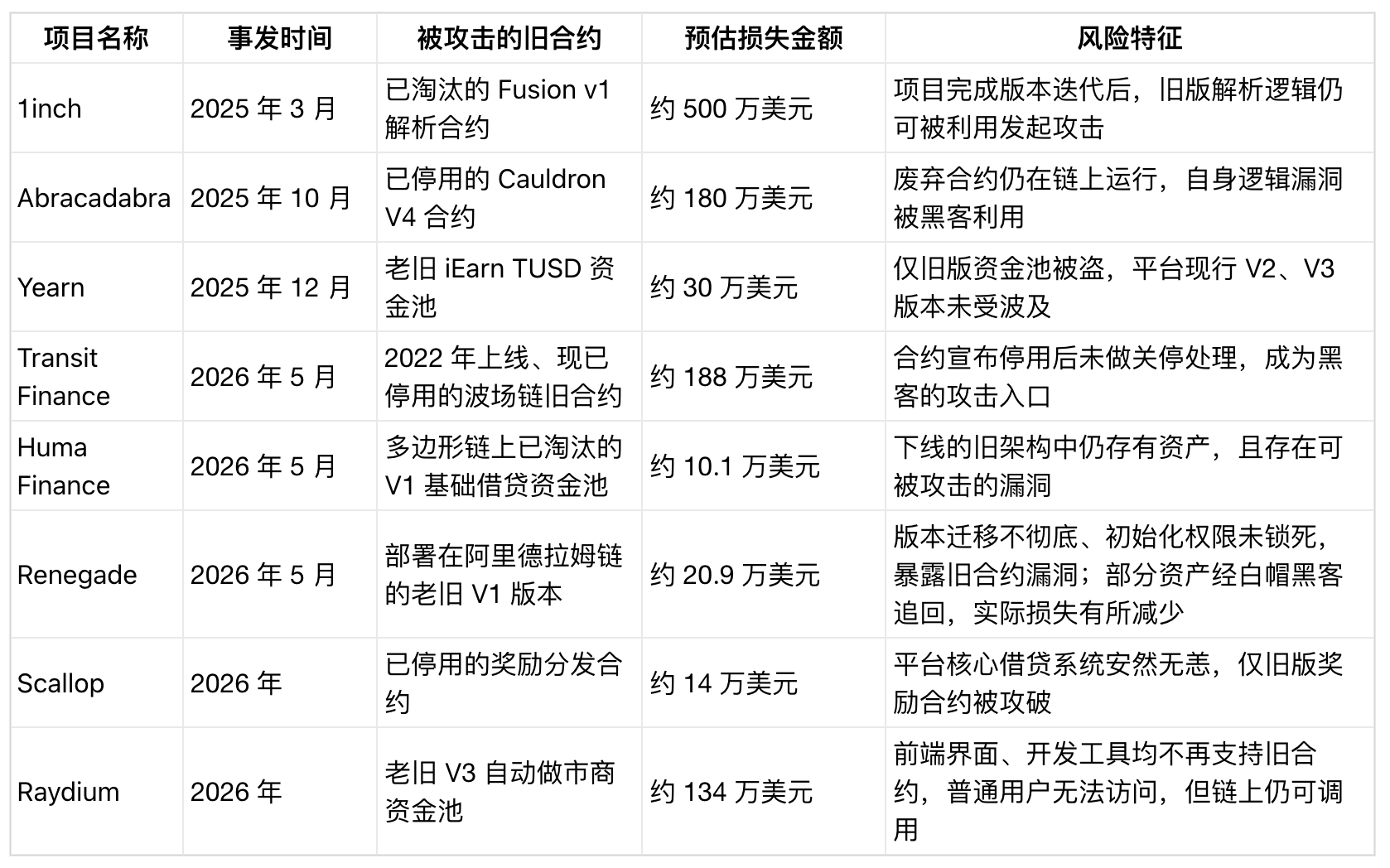


Why Old Contract Risks Are Overlooked


Currently, the vast majority of industry security incident classification systems focus on attack methods, tampering targets, and code failure points, representing an analytical perspective "starting from technical vulnerabilities." This also leads to the masking of zombie contract incidents. The core of such problems is never coding errors, but the failure of projects to execute the necessary complete shutdown of old contracts.


A 2025 industry research paper analyzed 50 major global crypto security incidents between 2022 and 2025, with cumulative losses exceeding $1 billion. The study pointed out that high-harm on-chain attacks are often the result of chain risk superposition, simultaneously involving human operations, daily maintenance, economic models, contract lifecycle management, community governance, and other levels.


The paper proposed a four-layer root cause analysis framework, clearly classifying contract lifecycle management vulnerabilities and community governance vulnerabilities as independent risk categories separate from code writing vulnerabilities. The zombie contract problem is a typical lifecycle management vulnerability. However, in existing security statistics systems, such incidents are uniformly categorized as "code vulnerabilities," and the corresponding loss data is concealed under other classifications, failing to attract sufficient industry attention.


Beware the "Contract Graveyard": Old Infrastructure Becomes a New Attack Hotspot


If DeFi projects continue to treat "contract shutdown" as an optional, trivial matter—merely annotating "this contract is discontinued" in product documentation without transferring idle assets, disabling call functions, or continuously monitoring status—then hackers will persistently target this "contract graveyard."


Every large DeFi project's historical deployment records have now become attack targets that hackers can search and exploit. The currently counted $22.5 million in losses is merely the value from publicly exposed cases; the real risk is far higher.


Those old liquidity pools holding assets but detached from mainstream user workflows, historical authorization interfaces, and early partnership integration modules receive far less operational monitoring than current business systems, making them precisely the preferred targets for hackers.


To change the status quo, "zombie contracts" must first be listed as an independent risk category with separate incident statistics. Secondly, the contract decommissioning process must be incorporated into standardized security procedures, placed on equal footing with code audits. Only by implementing full lifecycle operations and maintenance can the attack surface be effectively reduced.


Currently, the industry's handling methods are largely similar. Raydium used its project treasury to cover the $1.34 million loss. Transit Finance and Huma Finance also bore user losses through the project side.


This also means that contract decommissioning is no longer just a documentation annotation task; it is an essential security control link.


Seven Security Control Standards for Contract Decommissioning


For the shutdown of old contracts, the industry can establish standardized control processes. The specific requirements and their functions are as follows:
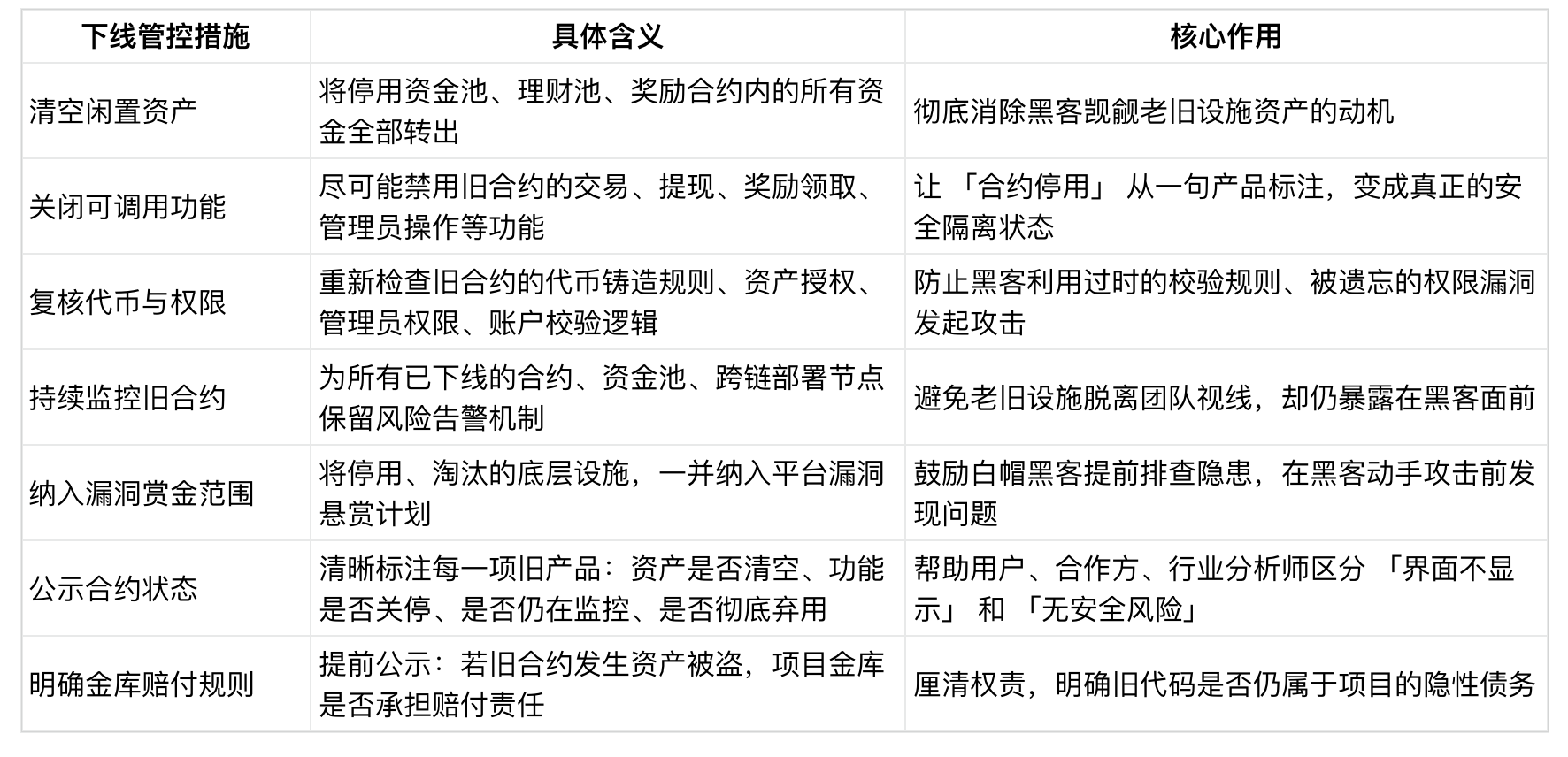


Simply annotating "contract discontinued" in documentation merely shifts the security risk to the project treasury, while the attack vulnerability remains. Announcing a shutdown only at the product level without a complete technical deactivation leaves old contracts perpetually callable: project teams neglect oversight, while hackers watch closely at all times.


The value of a DeFi project is not only reflected in its current total value locked (TVL) but also in the historical code and underlying architectures accumulated along its journey. And this forgotten history has now become a new security突破口 (breakthrough point).


İlgili Sorular

QWhat is the main vulnerability exploited in the recent Raydium hack, and what was the estimated loss?

AThe main vulnerability was in Raydium's deprecated V3 Automated Market Maker (AMM) liquidity pools. Hackers exploited these old, inactive contracts to steal approximately $1.34 million worth of assets.

QAccording to the article, what new risk category does the Raydium incident and similar attacks highlight for the DeFi industry?

AThe incident highlights the risk category of 'zombie contracts' or outdated smart contracts that have been deprecated but remain operational and callable on the blockchain, becoming overlooked attack surfaces.

QHow many similar attacks targeting outdated or deprecated contracts have been reported since March 2025, and what is the total estimated loss mentioned?

ASince March 2025, there have been at least 8 reported attacks specifically targeting deprecated or old contracts, with a cumulative loss of about $10.8 million. Including older liquidity pools and related products, the total is 10 incidents with losses around $22.5 million.

QWhy are these 'zombie contract' risks often overlooked in current security incident classifications?

ACurrent security classifications focus on technical vulnerabilities (like code bugs, oracle manipulations). 'Zombie contract' issues stem from lifecycle management failures—contracts not being properly decommissioned—and are therefore often mis-categorized under general 'code vulnerability' labels, obscuring their specific nature.

QWhat does the article suggest as a key action to properly address the risk of outdated contracts?

AThe article suggests establishing standardized security control processes for contract decommissioning. This includes measures like withdrawing all idle assets, permanently disabling key functions, revoking permissions, and continuous monitoring, treating contract sunsetting as a critical security task on par with code auditing.

İlgili Okumalar

Robots Begin to 'Consume Data': The Hidden Production Chain from Indian Data Factories to Billion-Dollar Humanoid Robots

Robots have started to 'consume data,' driving the formation of a new industrial supply chain focused on producing training data for embodied AI. Unlike large language models, which are trained on vast internet text corpora, embodied AI models face a 'data desert' in the physical world. This has created a massive demand for first-person perspective video data (Ego Data), captured by workers wearing cameras in places like Indian garment factories. Companies like Neocambrian AI are establishing 'data factories' where workers perform standardized tasks (e.g., sorting clothes, kitchen organization) to generate thousands of hours of video. Research, such as NVIDIA's EgoScale, demonstrates that scaling this human demonstration data predictably improves robot performance, particularly for dexterous manipulation. This has validated a training path combining large-scale human data for pre-training with smaller amounts of robot-specific data for fine-tuning. The value of different data types varies significantly, forming a 'data pyramid.' The base consists of low-cost, large-scale internet and Ego Data. Higher layers include more expensive motion-capture data (e.g., from data gloves), simulation/synthetic data, and the most costly and scarce layer: real robot teleoperation data. This demand has spawned a layered ecosystem of data suppliers: low-cost data factories, motion capture and alignment specialists, robot-native teleoperation service providers, simulation data companies, and platforms aiming for data standardization. Robot companies themselves are adopting a 'layered procurement' strategy: outsourcing generic Ego Data while building in-house capabilities for robot-specific adaptation data and the critical deployment/failure data generated in real-world applications. The industry is shifting focus from hardware and basic mobility to the data pipelines required for general-purpose capability. While parallels exist to data labeling companies like Scale AI in the LLM boom, the physical complexity of robot data—involving action success ambiguity and sim-to-real gaps—requires more integrated solutions for data collection, annotation, and a continuous feedback loop. The race is on to build the data engines that will teach robots to operate reliably in the unstructured real world.

marsbit4 saat önce

Robots Begin to 'Consume Data': The Hidden Production Chain from Indian Data Factories to Billion-Dollar Humanoid Robots

marsbit4 saat önce

Spicy Commentary | Michael Saylor's 'Player Talk'; 60-Year-Old Aunt Liquidated After 'Scamming a Young Man'

**"Spicy Commentary": Three Tales of Crypto's Wild Week** This week's "Spicy Commentary" column highlights three dramatic stories from the cryptocurrency world. First, **MicroStrategy's Michael Saylor** addressed the controversy over his company potentially selling Bitcoin. At the BTC Prague event, he clarified, "I never said the company can't sell Bitcoin. I told *you* never to sell *your* Bitcoin." This "do as I say, not as I do" stance was criticized by netizens as peak linguistic gymnastics, noting a history of him previously stating the company would "never" sell. Second, a **bizarre fraud case** emerged from Beijing. A 60-year-old woman, obsessed with getting rich from crypto but unwilling to risk her own savings, posed online as the 20-something "god-daughter" of a high-ranking official. She catfished a young man, convincing him to give her over 200,000 yuan for fabricated emergencies. She then invested all the stolen money into cryptocurrency with 10x leverage, only to lose everything in a market crash. The woman was sentenced to four years in prison for fraud. Finally, a **sobering trader's tale** surfaced on Reddit. A user posted "Tale of a crypto trader," confessing their net worth had plummeted from a peak of $45 million to roughly $17,200, primarily due to holding meme coins too long. The post, described as a crypto "book of confessions," sparked reactions ranging from sympathy to critique about greed, poor risk management, and the perils of treating meme coins as long-term investments instead of taking profits. The column concludes that this week featured masterful rhetoric, elaborate scams, and extreme financial volatility, stitching together another chapter in crypto's unpredictable theater.

Foresight News4 saat önce

Spicy Commentary | Michael Saylor's 'Player Talk'; 60-Year-Old Aunt Liquidated After 'Scamming a Young Man'

Foresight News4 saat önce

Tremble Humans, AI Continues Its Accelerated Sprint

Trembling, Humans: AI Continues Its Accelerated Sprint Yes, AI is still rapidly accelerating. While deep learning seemed to stall quickly in its early years, large models after years of development show no sign of hitting their ceiling. At the Zhiyuan Conference 2026, the focus is on enabling AI to move from the digital world into the physical world. Scaling Law remains effective, continuing to drive advancements in both large language models and multimodal models. The industry is now entering a phase of pursuing World Models, though unresolved technical paths and data issues mean this exploration may take 3-5 more years. Concurrently, breakthroughs in Agents are accelerating AI's real-world application in fields like healthcare and meetings. Making Agents truly useful requires key hardware-software co-design, evident from the strong presence of chip vendors at the conference. We stand at a new historical threshold where AI is becoming a foundational force reshaping the world. The first day of the conference highlighted AI's evolution from "knowing how to chat" to "knowing how to work." Scaling Law persists, World Models are the next key battleground, and Agents are transitioning from usable to好用 (user-friendly). Scaling Law is not ending but diversifying. New models like Anthropic's Fable 5 demonstrate scaling through parameter size, synthetic data, and reinforcement learning. Advancements in AI Coding and Agent deployment are enabling a trend of AI self-evolution, potentially allowing AI to take over digital world iterations. World Models represent the next frontier for large models extending into the physical realm, but no current model is truly impressive at solving real-world problems. Technical consensus is lacking, with debates on data sources (video, simulation, real-world). Different approaches are emerging: language-centric, pixel-centric, 3D-structure-centric, and visual-representation-centric models. Zhiyuan Institute is exploring a fifth path: unified latent space modeling fusing language and visual representations, and introduced its own under-development World Model, Physis-v0.1. On the product side, Agents are key to bringing AI into daily life. Since 2025, the "Year of the Agent," products have become more proactive and capable of complex tasks. Zhiyuan showcased four vertical Agents for cardiac diagnosis, autonomous research, meeting summarization, and protein risk discovery. However, technical challenges remain, particularly in context engineering like memory and orchestration. "Harness" – the engineering framework around an Agent – is crucial for maximizing its capabilities by clarifying intent, designing workflows, and incorporating validation and feedback. In summary, AI's breakneck pace continues on multiple fronts: foundational model scaling, the ambitious pursuit of World Models for physical understanding, and the ongoing refinement of practical Agents. The journey from capable to truly reliable and useful AI systems is well underway.

marsbit4 saat önce

Tremble Humans, AI Continues Its Accelerated Sprint

marsbit4 saat önce

The Backside of Musk's Trillion-Dollar Fortune: 85% Can't Be Sold

Elon Musk becomes the world's first trillionaire, driven by SpaceX's IPO valuing the company at $1.77 trillion. However, his vast wealth is largely illiquid: he holds over 85% voting control, likely through super-voting shares that are subject to lock-ups and selling restrictions. While his net worth surpasses $1 trillion across SpaceX, Tesla, and private holdings, only a tiny fraction (potentially under 2% annually) could be converted to cash without jeopardizing control and market confidence. SpaceX's IPO also creates paper millionaires for roughly 4,400 employees, but their holdings face lock-up periods, exercise costs, and taxes, delaying and reducing actual cash proceeds. Only 4.2% of total shares are initially available for public trading, making the stock price highly sensitive to limited net buying or selling pressure. A major test will come when lock-ups expire for the remaining 96% of shares. The article contrasts SpaceX's wealth distribution with potential AI IPOs. Anthropic and OpenAI could generate employee wealth pools 20 times larger than SpaceX's in paper value, due to their higher valuations relative to revenue and potentially more distributed ownership. However, sustaining those high price-to-sales multiples post-IPO is uncertain. A key financial puzzle for SpaceX investors is its xAI unit. While it has locked in an estimated $26 billion in annual compute revenue from clients like Anthropic and Google, the unit reported a $6.4 billion loss in 2025. More critically, estimated annual capital expenditures of ~$30.8 billion exceed that revenue. The long-term viability of SpaceX's AI narrative hinges on whether this compute income can eventually cover the unit's massive ongoing investments and losses.

链捕手4 saat önce

The Backside of Musk's Trillion-Dollar Fortune: 85% Can't Be Sold

链捕手4 saat önce

İşlemler

Spot
Futures
活动图片




