Bloomberg Terminal Earns Billions Annually from Data Intermediation, Now 6 Institutions Are Putting Data Directly On-Chain

marsbit2026-04-16 tarihinde yayınlandı2026-04-16 tarihinde güncellendi

Özet

Six major financial institutions — Fidelity, Euronext, Tradeweb, OTC Markets Group, Singapore Exchange (Forex), and Exchange Data International — have begun publishing proprietary market data directly on-chain via Pyth Network. This move bypasses traditional data intermediaries like Bloomberg, which has long dominated the financial data market with annual revenues of approximately $10 billion from its terminal business alone. The shift enables developers on over 100 blockchains to access high-quality, real-time financial data — including ETF valuations, fixed income data, FX rates, and OTC securities — without long-term contracts, steep fees, or proprietary hardware. This development is critical for the scalability of real-world asset (RWA) tokenization in DeFi, as reliable, institutional-grade data must be available on-chain before assets can be traded or used as collateral in decentralized protocols. Pyth’s model differs from earlier oracle solutions like Chainlink by sourcing data directly from institutional traders and exchanges rather than aggregating from third-party sources. While this approach offers higher speed and accuracy, it also involves a more centralized network of known publishers. The move challenges the decades-old monopoly of data middlemen and could significantly reduce barriers to entry for developers building DeFi products tied to traditional financial markets.

Author: Thejaswini M A

Compiled by: Deep Tide TechFlow

Deep Tide Introduction: Six mainstream Wall Street institutions, including Fidelity, Euronext, and Tradeweb, have begun publishing market data directly onto the blockchain through Pyth, allowing any developer to access it for free. This breaks the 44-year monopoly model of data intermediaries like Bloomberg—no more two-year contracts, no more annual fees of $27,000, and no more dedicated keyboards. More importantly, this is a prerequisite for the true scaling of RWA (Real World Assets) in DeFi: data must be on-chain before assets.

In 1981, Michael Bloomberg was fired from Salomon Brothers. He was 39 years old at the time, had worked there for 15 years, and left with a $10 million severance package, deeply dissatisfied with how Wall Street handled information. His reaction to being fired, by any reasonable standard, was insane: he started showing up at Merrill Lynch's office every morning with coffee, wandering the halls, handing coffee to strangers, and explaining that he was going to build them a computer that knew everything. The traders took the coffee but were less certain about the computer.

Forty-four years later, each of these computers costs $27,000 per year. There are 350,000 of them globally, and Bloomberg earns approximately $10 billion annually from this business. Its entire structural genius lies in this: it inserted itself between the institutions that own the data and the people who need it, charging a toll for everything that passes through. The data was never Bloomberg's—Merrill Lynch had the data, Goldman Sachs had the data, every trading firm on Wall Street had the data. Bloomberg just built a tollbooth, convinced everyone that the tollbooth was the destination, and then raised prices every year because what could you do, go back to calling your broker?

This model withstood every technological change over four decades because no one could figure out a better distribution mechanism. Until last Wednesday.

On April 9, six institutions that had been feeding data into the tollbooth began publishing elsewhere: Euronext, Fidelity, Tradeweb, OTC Markets Group, Singapore Exchange's foreign exchange division, and Exchange Data International started publishing directly on-chain through Pyth's new data marketplace, accessible to any developer on 100 blockchains. You don't need a contract, a two-year minimum commitment, or a dedicated keyboard with yellow-green buttons.

Remember this: the funny thing about building a monopoly on other people's data is that those other people eventually notice.

The financial data industry is worth about $30 billion annually, one of the least discussed monopolies in the world, probably because the only people who care about it are the ones already paying for it.

Bloomberg controls about 33% of the global financial data market, with terminal business alone generating over $10 billion in annual revenue. Refinitiv, now acquired by the London Stock Exchange Group for $27 billion, holds about 20%. ICE Data Services reports market data revenue of $2.8 billion. Then there's FactSet, S&P Global, Morningstar, and some regional players serving niche markets. The top four suppliers combined control the vast majority of how financial data flows from generating institutions to demanding companies.
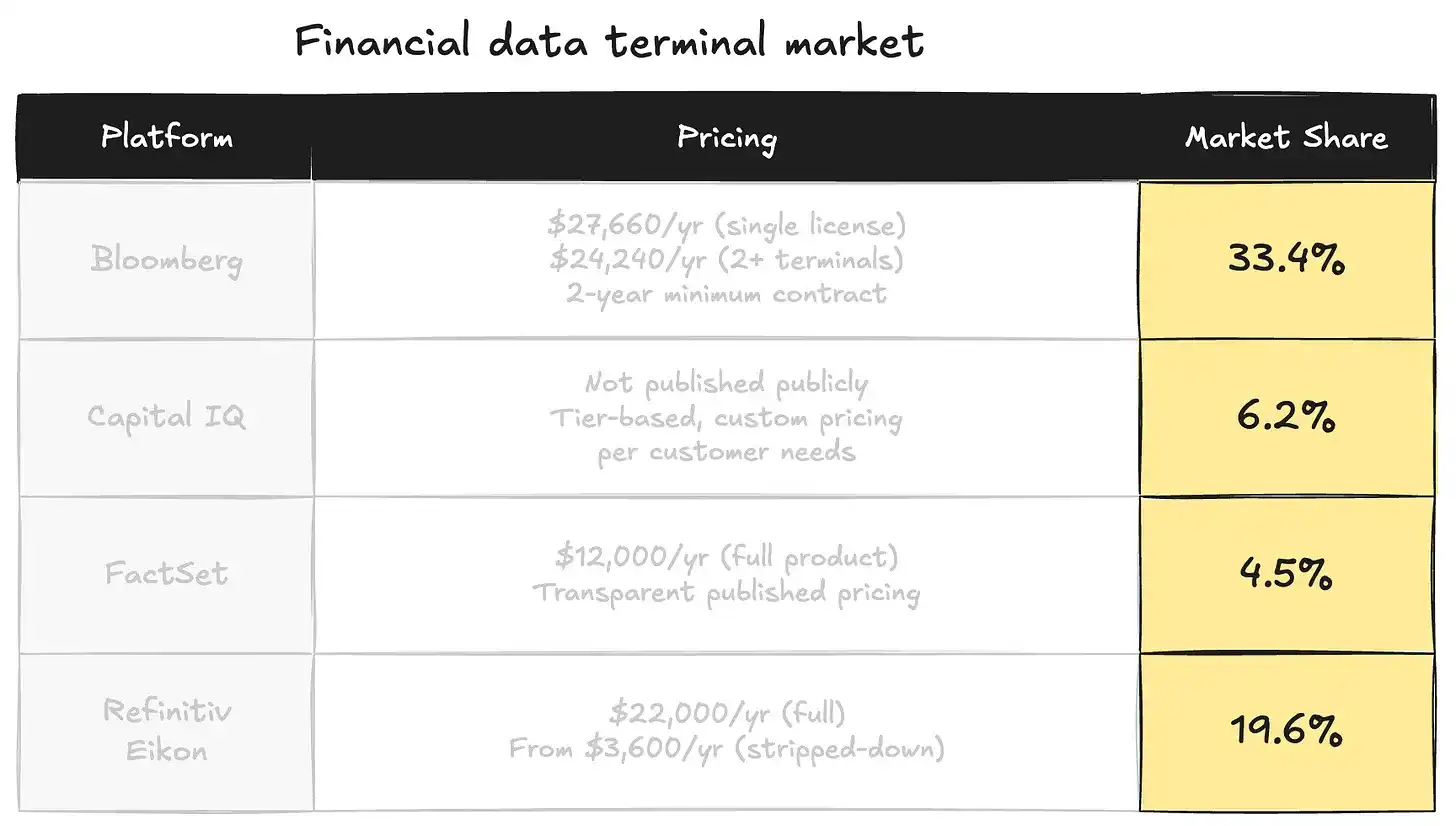
All these companies follow the same model. Institutions like exchanges, trading firms, banks, and asset managers generate pricing data as a byproduct of their work. They sell or license this data to suppliers. The suppliers package, standardize the data, add analytical tools on top, and then sell it to everyone else at a significant markup, with long-term contracts and proprietary access methods that make switching painful. Bloomberg subscriptions lock you in for two years. Canceling early costs 50% of the remaining contract value. And everything about the Bloomberg experience is designed to make leaving feel harder than staying. The keyboard is different. The data format is different. Even the messaging system that half of Wall Street uses to communicate with each other runs on Bloomberg, meaning switching terminals also means abandoning your contact list.

This has lasted forty years because suppliers solved a genuinely difficult problem: getting data from hundreds of sources, cleaning and standardizing it, and delivering it with low latency through global infrastructure. Bloomberg earned its place.

But blockchain is a better distribution mechanism. Maybe not for everything, and not yet at full scale. But for the specific problem of connecting institutions that have data with developers who want to build with it, a programmable, publicly accessible on-chain infrastructure is structurally superior to a proprietary terminal with a two-year contract. By turning data into an API without switching costs, you provide permissionless, self-service access to any developer on any chain. This is what Pyth is doing.

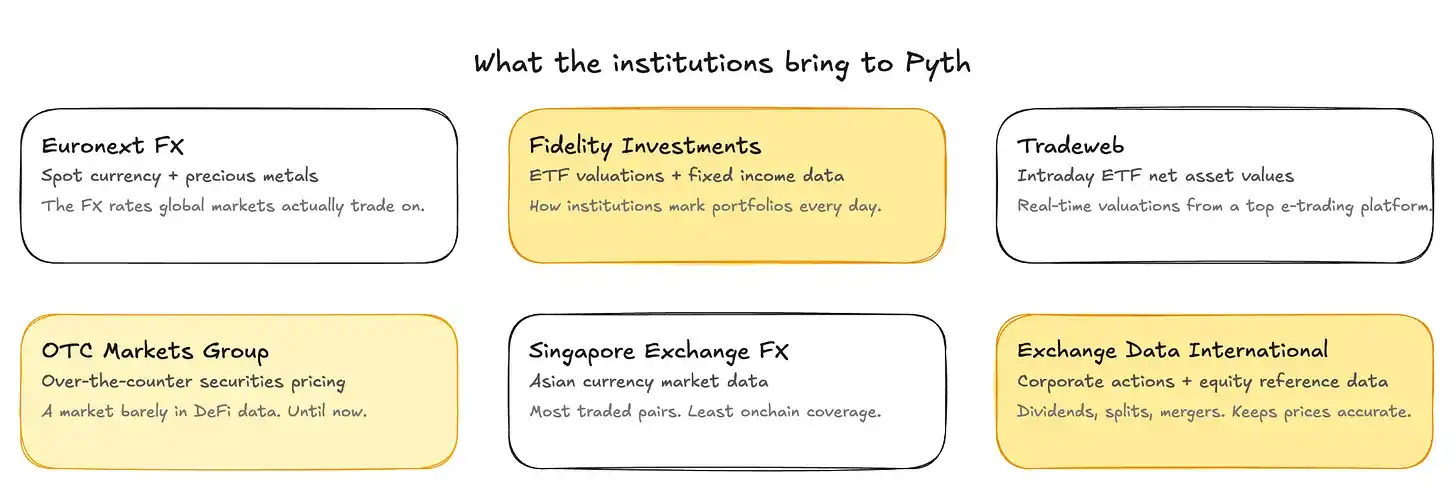
Euronext, Exchange Data International, Fidelity Investments, OTC Markets Group, Singapore Exchange's foreign exchange division, and Tradeweb are starting to publish their proprietary market data directly on-chain through Pyth's new data marketplace.

Euronext FX: Spot currencies and precious metals. Foreign exchange rates used for actual trading in global markets.

Fidelity: ETF valuations and fixed income data. Data used by institutions daily to mark their portfolios to market.

Tradeweb: Intraday ETF pricing. Real-time valuations from one of the largest electronic trading platforms.

OTC Markets Group: Over-the-counter securities. A market almost absent in today's DeFi data.

Singapore Exchange FX: Asian currency pairs. The largest but least on-chain covered foreign exchange market by trading volume.

Together, these six institutions cover a significant portion of asset classes that DeFi has never been able to reliably build because the data feeding these assets wasn't institutional-grade.
Why Data Must Precede Assets

Everyone in crypto has been talking about the tokenization wave for two years now: tokenized treasuries, tokenized bonds, tokenized stocks. The entire discussion assumes the hard part is putting the assets on-chain.

But the hard part is the data. Before you can trade tokenized treasuries in a DeFi protocol, you need to know what they are worth right now, down to the second, with the same accuracy that a Goldman Sachs trading desk uses to price this instrument. Before you can build lending protocols around real-world assets, you need continuously running price feeds from institutions that actually market-make, not scraped from a website and updated every few minutes.

DeFi protocols need accurate, real-time traditional financial data for derivatives, loans, and structured products, but have historically relied on limited or slower data sources. This is why DeFi has been mostly crypto-to-crypto since its inception. The data feeding these products wasn't reliable enough, fast enough, or from institutions with enough credibility in compliance conversations.

Pyth Pro, an institutional subscription tier launched by Pyth in September 2025, offers price feeds with 1-millisecond latency on over 2,200 instruments. Polymarket integrated Pyth Pro in April 2026 to settle new markets for traditional assets including major stock indices, commodities, and U.S. stocks, replacing manual or exchange-specific data sources with standardized data aggregated from over 125 trading firms. Hyperliquid now uses Pyth's price feeds to run perpetual contracts for oil and gold. Data quality is reaching a level where serious financial products can be built on top without apology.

The tokenization wave needs this layer to operate at scale. Without reliable fixed income price feeds, you cannot build reliable fixed income products on-chain.

The Oracle War

The original oracle problem in cryptocurrency was simple: smart contracts live on-chain, prices live off-chain. Something needed to connect the two. Chainlink was the dominant oracle for most of DeFi's history, solving this by running a large network of independent nodes that fetch prices from third-party sources (exchanges, aggregators, data APIs) and submit them on-chain. Many independent sources, many independent nodes, reasonable decentralization, acceptable latency.

Pyth took a different approach from the start, going directly to the institutions that are actually trading. Now over 120 institutions publish data through Pyth, including global exchanges, trading firms, and market makers. Jane Street doesn't secondhand describe the Bitcoin price to Pyth; it becomes a publisher. Data comes from the source, not from someone describing the source.

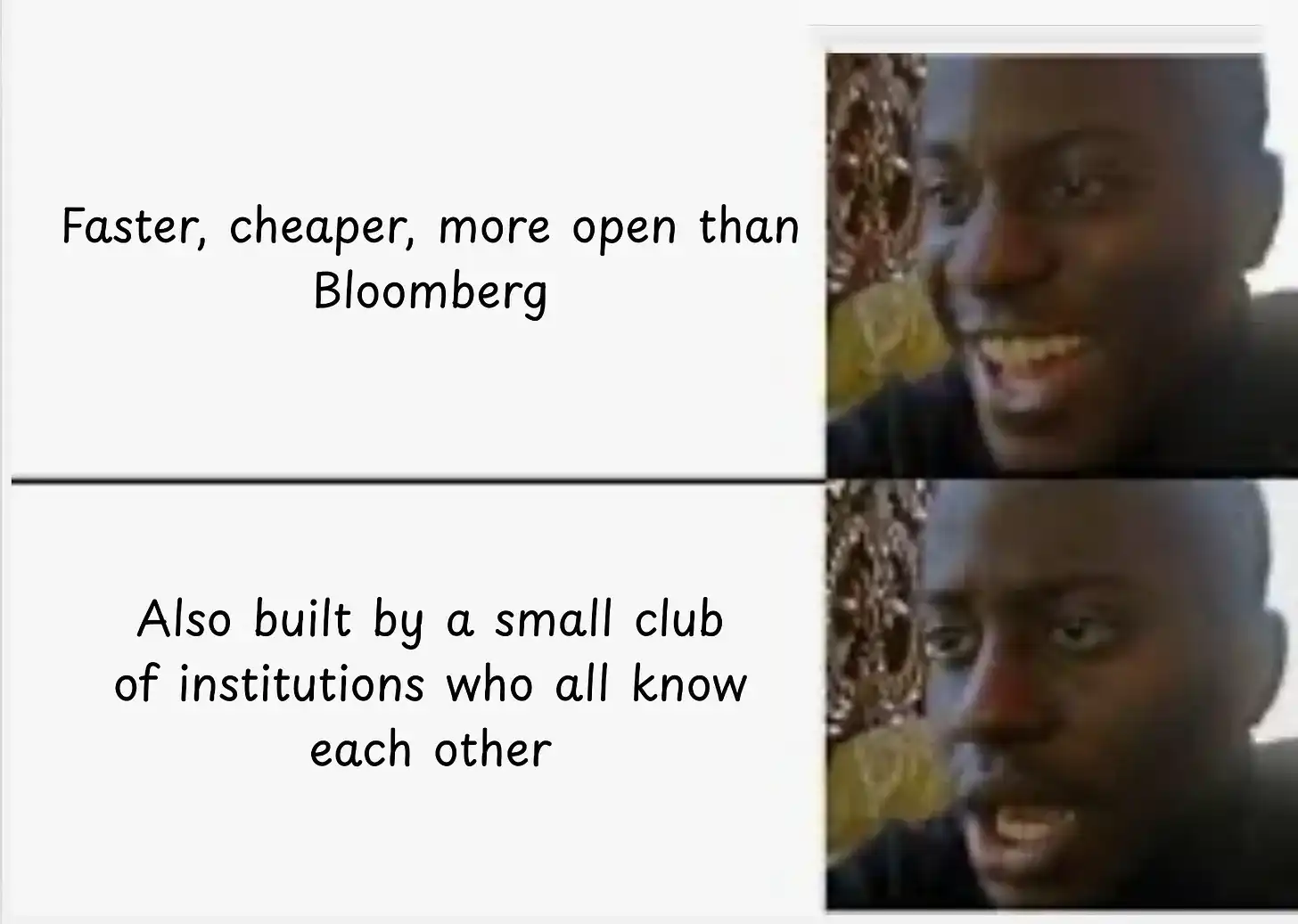
This is faster, more accurate, and more directly tied to real market activity than aggregated price feeds. In a structural sense, it's also more centralized: a smaller club of publishers who mostly know each other and validate their own data. Pyth has staking and slashing mechanisms designed to create economic incentives around accuracy. But a better way to put it is that Pyth chose speed and data quality over maximizing decentralization. For institutional finance, this might be the right trade-off.
The Cost of Centralization

Pyth was created with significant involvement from Jump Crypto, an organization that played a major role in the events of 2022, which most people in crypto prefer not to revisit. The publisher network is a small club, institutions mostly know each other and validate data amongst themselves. Staking and slashing mechanisms create economic incentives for accuracy, but Pyth is both faster and higher quality than what came before, and also more centralized than the marketing suggests. You are not replacing a monopoly with a commons. You are replacing one centralized system with another that happens to run on a blockchain.

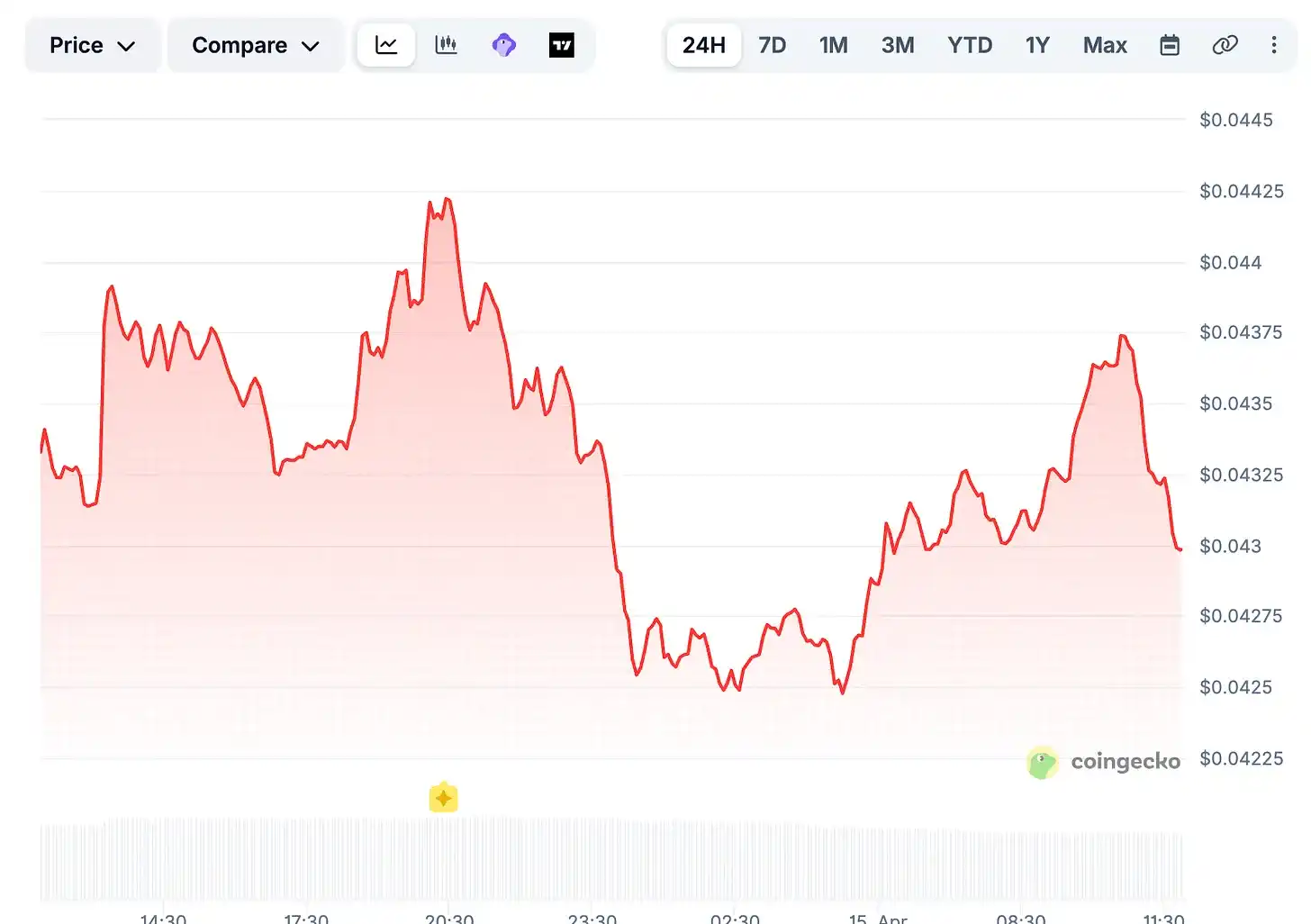
The PYTH token hit an all-time high of $1.20 in March 2024 and is currently trading around $0.046, down about 96% from its peak. The obvious reason: using Pyth's data does not require holding or buying PYTH. The network can grow significantly while the token remains range-bound, a known problem that Pyth's reserve plan is attempting to address, allocating a portion of protocol revenue for open market buybacks of PYTH.
The End of the Tollbooth

Getting data from the generating institution to the desk of the person who needs it requires hardware, proprietary networks, sales relationships, and ongoing support. Bloomberg solved all of this and charged accordingly. Data producers had no alternative distribution mechanism, so they sold their data to middlemen, who kept the profits. Blockchain eliminates that specific friction. Not the analysis, not the workflow, not the keyboard. Just the part where someone had to move data from one place to another and charge for the privilege.

But Bloomberg sells workflow. The terminal, the keyboard, the messaging system, the analysis, the support team. Traders build entire careers around it. Pyth sells none of that. It's the data layer that protocols plug into. The only overlapping part is the underlying data itself, and that part just moved.

This matters because if Fidelity publishes its ETF valuations on-chain, any developer anywhere can read that data without negotiating a license agreement, without paying $32,000 a year, without waiting for a supplier to standardize the format. Data becomes programmable infrastructure rather than a proprietary product. Institutions retain control over what they publish and keep the attribution. The middleman's job—moving data from source to user—becomes unnecessary.

These six institutions are choosing Pyth as a primary distribution channel, which is a different category of commitment than a pilot. Pilots get turned off when the advocate changes jobs. Primary distribution channels become operational dependencies.

Tokenized bonds, tokenized stocks, tokenized everything. Most of these are months or years away from meaningful scale. But the raw material that makes real-world asset products possible in DeFi is now available without contracts, without terminals, without two-year minimum commitments.

Michael Bloomberg spent months handing out free coffee in the halls of Merrill Lynch because the data he needed was locked inside institutions that had no reason to give it to him. He built an entire business on that friction.

The tollbooths won't disappear overnight. Every monopoly in data distribution ends the same way. Not with a fight, not with laws, not with a revolution. Mostly, someone somewhere asks why they are paying for something they already have.


Trend Kriptolar

İlgili Sorular

QWhat is the core innovation that Pyth introduces to challenge Bloomberg's data monopoly?

APyth enables financial institutions to publish market data directly on-chain, allowing any developer to access it freely without contracts, fees, or proprietary hardware, replacing the centralized data distribution model with a permissionless, blockchain-based infrastructure.

QWhich six major institutions have started publishing data directly on-chain via Pyth's new data marketplace?

AThe six institutions are Euronext, Fidelity, Tradeweb, OTC Markets Group, Singapore Exchange Foreign Exchange, and Exchange Data International.

QWhy is high-quality, real-time data critical for the tokenization of real-world assets (RWA) in DeFi?

AAccurate, institutional-grade data is essential for pricing and trading tokenized assets like bonds or stocks reliably in DeFi protocols. Without real-time data from credible sources, building scalable and trustworthy financial products for traditional assets on-chain is impossible.

QHow does Pyth's approach to oracle data differ from Chainlink's model?

APyth sources data directly from institutional traders and exchanges (e.g., Jane Street) who are active market participants, ensuring data comes from the source. Chainlink aggregates data from multiple third-party sources and relies on a decentralized node network to submit prices on-chain.

QWhat challenges does the PYTH token face despite the growth of the Pyth network?

AThe PYTH token has declined significantly in value because using Pyth's data does not require holding or purchasing the token. Protocol usage can grow without directly impacting token demand, though Pyth's reserve plan aims to address this by allocating protocol revenue for token buybacks.

İlgili Okumalar

Base Under Pressure

**Title: The Pressure Mounts for Base** Base, the Ethereum Layer 2 scaling solution backed by Coinbase, is facing significant pressure and public scrutiny from its leadership following the launch of Robinhood Chain. Base co-founder Jesse Pollak recently acknowledged strategic missteps, admitting that the chain's past focus on social and creator tokens (e.g., through Farcaster, Zora) failed to deliver sustainable adoption. He has refocused on core infrastructure, handing leadership of the Base App back to Coinbase's Cobie. While Base remains a top L2 contender alongside OP Mainnet and Arbitrum, and boasts the highest TVL (nearly $12B), its weaknesses are being highlighted by the new competitor. Key criticisms include its slow progress on decentralization. Base has faced issues with its single sequencer causing block production halts, and L2BEAT is reportedly considering downgrading its decentralization rating from Stage 1 to Stage 0. This contrasts sharply with the rapid initial success of Robinhood Chain, whose DEX quickly entered the top five by volume. The leadership styles of the parent companies are also being compared: Robinhood's CEO actively engages with new projects, while a recent incident where Coinbase's Brian Armstrong briefly changed his profile picture—sparking and then crashing a related meme token—drew community ire and mockery. Pollak stated Base is working with Coinbase on tokenized stocks backed 1:1 by real equity, differentiating it from Robinhood's derivatives model. However, the article argues that Base's most urgent task is to address its long-standing technical and trust issues. With more traditional finance players likely to emulate Robinhood's path, Base must use this competitive pressure to solidify its position as long-term financial infrastructure.

Foresight News10 dk önce

Base Under Pressure

Foresight News10 dk önce

White House Concession Removes Ethical Hurdle, Clarity Act Races Against Final Window Before Recess?

On July 21st, industry sources reported that the Trump administration has agreed to include an ethics provision in the "Clarity Act" (Digital Asset Market Clarity Act of 2025). This concession addresses the long-standing conflict-of-interest concerns regarding government officials and the crypto industry, potentially removing the final major obstacle to the bill's progress. Additionally, Patrick Witt, the executive director of the White House's Digital Asset Advisory Committee, confirmed he will remain in his role to help finalize the bill, alleviating previous concerns about his potential departure. The Clarity Act aims to establish a unified federal regulatory framework for the U.S. digital asset market. Its core objective is to resolve regulatory ambiguity by defining different types of digital assets (digital commodities, investment contract assets, and permitted payment stablecoins) and clarifying the respective oversight roles of the SEC and CFTC. This would end the long-running jurisdictional dispute between the two agencies and provide clearer compliance paths for the industry. With the ethics issue moving toward resolution, the most urgent challenge now is time. The U.S. Congress is set to begin its August recess in mid-August, leaving only a few working weeks to finalize the text and advance the bill through the Senate. Industry advocates, like the Blockchain Association's Kristin Smith, stress that this is a critical moment. If negotiations conclude successfully in the coming weeks, the Clarity Act could pass a key hurdle before the recess; otherwise, it may face significant delays. If enacted, the Clarity Act could mark a historic turning point in crypto regulation. By providing a clearer and more predictable legal framework, it aims to reduce uncertainty for businesses, developers, and traditional financial institutions looking to enter the digital asset space, potentially setting a global benchmark for market structure regulation.

Odaily星球日报16 dk önce

White House Concession Removes Ethical Hurdle, Clarity Act Races Against Final Window Before Recess?

Odaily星球日报16 dk önce

AI Era, Industrial Revolution, and Future Civilization Interview — Zhang Dingwen: The Future Does Not Belong to Chasers

"AI Era, Industrial Revolution and Future Civilization: An Interview with Zhang Dingwen – The Future Does Not Belong to Those Who Chase" In this interview, entrepreneur Zhang Dingwen reflects on his entrepreneurial journey and philosophy, moving beyond discussions of financing or success to emphasize understanding the "era" itself. He argues that true entrepreneurs should not chase short-term trends ("winds"), but position themselves in the direction of long-term technological and societal evolution. Zhang shares key lessons from his early days, including the realization that user value does not automatically translate to commercial value. For him, the core of entrepreneurship is not building a company but constantly upgrading one's own "cognition" – the ability to interpret information, ask the right questions, and understand the underlying "causes" behind business outcomes, not just the effects. His thinking has evolved from a focus on creating good products to a strategic focus on building "entrances" – platforms that naturally connect users to digital services. He sees smart wearables, like watches, not merely as hardware but as potential future gateways combining technological, financial, social, and even fashion attributes to create sustained user relationships and ecosystems. Ultimately, Zhang's vision transcends individual products or companies. He discusses business competition in three stages: product, platform, and finally, "civilization" – where the greatest companies influence how society operates by defining new rules and ways of life. He believes the mission of a truly great enterprise is to solve problems of its time, build enduring trust, and contribute lasting value, leaving behind not just wealth but a positive impact on how the world works. The future, he concludes, belongs not to the fastest, but to those with the correct long-term direction and a commitment to continuous learning and evolution.

marsbit27 dk önce

AI Era, Industrial Revolution, and Future Civilization Interview — Zhang Dingwen: The Future Does Not Belong to Chasers

marsbit27 dk önce

Cryptocurrency & Stock Market Barometer丨Strategy Cash Reserves Increase to $3.23 Billion, Halting BTC Purchases; Vanguard and Other Asset Managers Increase Holdings in Strategy Stock (July 21)

Market Overview & Warnings: The article warns of high volatility in South Korean stocks and continued dependence on U.S. stocks on geopolitics. Chinese A-shares remain under pressure. It advises against using leverage in current equity markets. For crypto-linked stocks, most have limited growth except Robinhood, with caution advised. U.S. Stock Market: Bearish bets on U.S. stocks, particularly targeting AI-related companies, have reached record highs since 2010, signaling deep skepticism about the sustainability of the AI-driven rally. Tech and chip stocks led a market decline, with the Philadelphia Semiconductor Index potentially entering a bear market. Increased expectations for Federal Reserve interest rate hikes and geopolitical tensions contributed to the negative sentiment. Bitcoin Treasury Company Updates: * Strategy: Increased its cash reserves to $3.23 billion and paused Bitcoin purchases. Several major asset managers, including Vanguard Group and Capital Group, increased their holdings of Strategy (MSTR) stock. * Global corporate Bitcoin buying slowed significantly to just $1.33 million last week. * Other notable activity: Strive purchased 21 BTC; ORANGE JUICE raised $40 million for Bitcoin acquisitions; Bitcoin Japan Corp. raised $60 million, allocating $4.08 million for its first BTC purchase. Other Crypto Treasury Holdings: * Ethereum: BitMine increased its ETH holdings to 5.78 million, nearing its 5% of supply goal. Its total crypto assets, cash, and securities are valued at $11.5 billion. * Solana: No significant corporate treasury activity reported. * Altcoins: HypeStrat made no adjustments to its treasury; its mNAV ratio fell to a long-term low. (Note: This summary is for informational purposes only and does not constitute investment advice.)

marsbit28 dk önce

Cryptocurrency & Stock Market Barometer丨Strategy Cash Reserves Increase to $3.23 Billion, Halting BTC Purchases; Vanguard and Other Asset Managers Increase Holdings in Strategy Stock (July 21)

marsbit28 dk önce

İşlemler

Spot

Popüler Makaleler

$S$ Nedir

SPERO'yu Anlamak: Kapsamlı Bir Genel Bakış SPERO'ya Giriş İnovasyonun manzarası gelişmeye devam ederken, web3 teknolojilerinin ve kripto para projelerinin ortaya çıkışı dijital geleceği şekillendirmede önemli bir rol oynamaktadır. Bu dinamik alanda dikkat çeken projelerden biri SPERO, $$s$$ olarak adlandırılmaktadır. Bu makale, SPERO hakkında ayrıntılı bilgi toplamak ve sunmak amacıyla, meraklılar ve yatırımcıların web3 ve kripto alanlarındaki temellerini, hedeflerini ve yeniliklerini anlamalarına yardımcı olmayı amaçlamaktadır. SPERO,$$s$$ Nedir? SPERO,$$s$$, kripto alanında merkeziyetsizlik ve blok zinciri teknolojisi ilkelerini kullanarak etkileşimi, faydayı ve finansal kapsayıcılığı teşvik eden bir ekosistem yaratmayı amaçlayan benzersiz bir projedir. Proje, kullanıcıların yenilikçi finansal çözümler ve hizmetler sunarak eşler arası etkileşimleri yeni yollarla kolaylaştırmayı hedeflemektedir. SPERO,$$s$$'nin temel amacı, bireyleri güçlendirmek ve kripto para alanındaki kullanıcı deneyimini artıran araçlar ve platformlar sağlamaktır. Bu, daha esnek işlem yöntemlerini mümkün kılmayı, topluluk odaklı girişimleri teşvik etmeyi ve merkeziyetsiz uygulamalar (dApp'ler) aracılığıyla finansal fırsatlar yaratmayı içermektedir. SPERO,$$s$$'nin temel vizyonu kapsayıcılık etrafında dönmekte olup, geleneksel finansal sistemlerdeki boşlukları kapatmayı ve blok zinciri teknolojisinin faydalarından yararlanmayı hedeflemektedir. SPERO,$$s$$'nin Yaratıcısı Kimdir? SPERO,$$s$$'nin yaratıcısının kimliği bir miktar belirsizdir, çünkü kurucusu(ları) hakkında ayrıntılı arka plan bilgisi sağlayan sınırlı kamuya açık kaynaklar bulunmaktadır. Bu şeffaflık eksikliği, projenin merkeziyetsizlik taahhüdünden kaynaklanabilir—birçok web3 projesinin paylaştığı bir etik anlayışı, bireysel tanınmanın yerine kolektif katkıları önceliklendirmektedir. Topluluk ve onun kolektif hedefleri etrafında tartışmaları merkezileştirerek, SPERO,$$s$$, belirli bireyleri öne çıkarmadan güçlendirme özünü taşımaktadır. Bu nedenle, SPERO'nun etik anlayışını ve misyonunu anlamak, tek bir yaratıcının kimliğini belirlemekten daha önemlidir. SPERO,$$s$$'nin Yatırımcıları Kimlerdir? SPERO,$$s$$, kripto sektöründe yeniliği teşvik etmeye adanmış girişim sermayedarlarından melek yatırımcılara kadar çeşitli yatırımcılar tarafından desteklenmektedir. Bu yatırımcıların odak noktası genellikle SPERO'nun misyonuyla uyumlu olup, toplumsal teknolojik ilerlemeyi, finansal kapsayıcılığı ve merkeziyetsiz yönetimi vaat eden projeleri önceliklendirmektedir. Bu yatırımcı temelleri, yalnızca yenilikçi ürünler sunan projelere değil, aynı zamanda blok zinciri topluluğuna ve ekosistemlerine olumlu katkılarda bulunan projelere de ilgi duymaktadır. Bu yatırımcıların desteği, SPERO,$$s$$'yi hızla gelişen kripto projeleri alanında dikkate değer bir rakip haline getirmektedir. SPERO,$$s$$ Nasıl Çalışır? SPERO,$$s$$, onu geleneksel kripto para projelerinden ayıran çok yönlü bir çerçeve kullanmaktadır. İşte benzersizliğini ve yeniliğini vurgulayan bazı temel özellikler: Merkeziyetsiz Yönetim: SPERO,$$s$$, kullanıcıların projenin geleceğiyle ilgili karar alma süreçlerine aktif olarak katılmalarını sağlayan merkeziyetsiz yönetim modellerini entegre etmektedir. Bu yaklaşım, topluluk üyeleri arasında sahiplik ve hesap verebilirlik duygusunu teşvik etmektedir. Token Kullanımı: SPERO,$$s$$, ekosistem içinde çeşitli işlevler sunmak üzere tasarlanmış kendi kripto para token'ını kullanmaktadır. Bu token'lar, işlemleri, ödülleri ve platformda sunulan hizmetlerin kolaylaştırılmasını sağlayarak genel etkileşimi ve faydayı artırmaktadır. Katmanlı Mimari: SPERO,$$s$$'nin teknik mimarisi, modülerlik ve ölçeklenebilirliği destekleyerek projenin evrimi sırasında ek özelliklerin ve uygulamaların sorunsuz bir şekilde entegrasyonuna olanak tanımaktadır. Bu uyum sağlama yeteneği, sürekli değişen kripto manzarasında geçerliliği sürdürmek için hayati öneme sahiptir. Topluluk Katılımı: Proje, işbirliği ve geri bildirim teşvik eden mekanizmalar kullanarak topluluk odaklı girişimlere vurgu yapmaktadır. Güçlü bir topluluk oluşturarak, SPERO,$$s$$, kullanıcı ihtiyaçlarını daha iyi karşılayabilir ve piyasa trendlerine uyum sağlayabilir. Kapsayıcılığa Odaklanma: Düşük işlem ücretleri ve kullanıcı dostu arayüzler sunarak, SPERO,$$s$$, daha önce kripto alanında yer almamış bireyler de dahil olmak üzere çeşitli bir kullanıcı tabanını çekmeyi hedeflemektedir. Bu kapsayıcılık taahhüdü, erişilebilirlik yoluyla güçlendirme misyonuyla uyumludur. SPERO,$$s$$ Zaman Çizelgesi Bir projenin tarihini anlamak, gelişim yolculuğu ve kilometre taşları hakkında kritik bilgiler sağlar. Aşağıda, SPERO,$$s$$'nin evriminde önemli olayları haritalayan önerilen bir zaman çizelgesi bulunmaktadır: Kavram Geliştirme ve Fikir Aşaması: SPERO,$$s$$'nin temelini oluşturan ilk fikirler, blok zinciri endüstrisindeki merkeziyetsizlik ve topluluk odaklılık ilkeleriyle yakından uyumlu olarak geliştirildi. Proje Beyaz Kağıdının Yayınlanması: Kavramsal aşamayı takiben, SPERO,$$s$$'nin vizyonunu, hedeflerini ve teknolojik altyapısını ayrıntılı bir şekilde açıklayan kapsamlı bir beyaz kağıt yayımlandı ve topluluk ilgisini ve geri bildirimini toplamak amacıyla sunuldu. Topluluk Oluşturma ve Erken Katılımlar: Projenin hedefleri etrafında tartışmalar yürüterek destek toplamak ve erken benimseyenler ile potansiyel yatırımcılar için bir topluluk oluşturmak amacıyla aktif iletişim çabaları gerçekleştirildi. Token Üretim Etkinliği: SPERO,$$s$$, yerel token'larını erken destekçilere dağıtmak ve ekosistem içinde başlangıç likiditesini sağlamak amacıyla bir token üretim etkinliği (TGE) gerçekleştirdi. İlk dApp'in Yayınlanması: SPERO,$$s$$ ile ilişkili ilk merkeziyetsiz uygulama (dApp) faaliyete geçti ve kullanıcıların platformun temel işlevleriyle etkileşimde bulunmalarını sağladı. Sürekli Gelişim ve Ortaklıklar: Projenin tekliflerine sürekli güncellemeler ve iyileştirmeler yapılmakta olup, blok zinciri alanındaki diğer oyuncularla stratejik ortaklıklar, SPERO,$$s$$'yi rekabetçi ve gelişen bir oyuncu haline getirmiştir. Sonuç SPERO,$$s$$, web3 ve kripto paranın finansal sistemleri devrim niteliğinde dönüştürme ve bireyleri güçlendirme potansiyelinin bir kanıtıdır. Merkeziyetsiz yönetime, topluluk katılımına ve yenilikçi tasarlanmış işlevselliğe olan bağlılığıyla, daha kapsayıcı bir finansal manzaraya doğru bir yol açmaktadır. Hızla gelişen kripto alanındaki herhangi bir yatırımda olduğu gibi, potansiyel yatırımcılar ve kullanıcılar, SPERO,$$s$$ içindeki devam eden gelişmelerle ilgili olarak kapsamlı bir araştırma yapmaları ve düşünceli bir şekilde katılmaları teşvik edilmektedir. Proje, kripto endüstrisinin yenilikçi ruhunu sergileyerek, sayısız olasılığını keşfetmeye davet etmektedir. SPERO,$$s$$'nin yolculuğu hala devam ederken, temel ilkeleri, teknoloji, finans ve birbirimizle etkileşim biçimimizi etkileyebilir.

188 Toplam GörüntülenmeYayınlanma 2024.12.17Güncellenme 2024.12.17

$S$ Nedir

AGENT S Nedir

Agent S: Web3'te Otonom Etkileşimin Geleceği Giriş Web3 ve kripto para dünyasında sürekli gelişen manzarada, yenilikler bireylerin dijital platformlarla etkileşim biçimlerini sürekli olarak yeniden tanımlıyor. Bu tür öncü projelerden biri olan Agent S, açık ajans çerçevesi aracılığıyla insan-bilgisayar etkileşimini devrim niteliğinde değiştirmeyi vaat ediyor. Otonom etkileşimlerin yolunu açarak, Agent S karmaşık görevleri basitleştirmeyi ve yapay zeka (AI) alanında dönüştürücü uygulamalar sunmayı hedefliyor. Bu detaylı inceleme, projenin karmaşıklıklarına, benzersiz özelliklerine ve kripto para alanındaki etkilerine dalacaktır. Agent S Nedir? Agent S, bilgisayar görevlerinin otomasyonunda üç temel zorluğu ele almak üzere özel olarak tasarlanmış çığır açıcı bir açık ajans çerçevesidir: Alan Spesifik Bilgi Edinimi: Çerçeve, çeşitli dış bilgi kaynaklarından ve iç deneyimlerden akıllıca öğrenir. Bu çift yönlü yaklaşım, alan spesifik bilgi açısından zengin bir veri havuzu oluşturmasını sağlar ve görev yürütmedeki performansını artırır. Uzun Görev Ufukları Üzerinde Planlama: Agent S, karmaşık görevlerin verimli bir şekilde parçalanmasını ve yürütülmesini kolaylaştıran deneyim artırımlı hiyerarşik planlama kullanır. Bu özellik, çoklu alt görevleri etkili ve verimli bir şekilde yönetme yeteneğini önemli ölçüde artırır. Dinamik, Homojen Olmayan Arayüzlerle Başlama: Proje, ajanlar ve kullanıcılar arasındaki etkileşimi geliştiren yenilikçi bir çözüm olan Ajan-Bilgisayar Arayüzü'ni (ACI) tanıtmaktadır. Çok Modlu Büyük Dil Modellerini (MLLM'ler) kullanarak, Agent S çeşitli grafik kullanıcı arayüzlerini sorunsuz bir şekilde gezinebilir ve manipüle edebilir. Bu öncü özellikler aracılığıyla, Agent S, makinelerle insan etkileşimini otomatikleştirmede karşılaşılan karmaşıklıkları ele alan sağlam bir çerçeve sunarak, AI ve ötesinde birçok uygulama için zemin hazırlıyor. Agent S'nin Yaratıcısı Kimdir? Agent S'nin kavramı temelde yenilikçi olsa da, yaratıcısı hakkında spesifik bilgiler belirsizliğini koruyor. Yaratıcı şu anda bilinmiyor, bu da projenin yeni aşamasını veya kurucu üyeleri gizli tutma stratejik tercihini vurguluyor. Anonimlikten bağımsız olarak, odak çerçevenin yetenekleri ve potansiyeli üzerinde kalıyor. Agent S'nin Yatırımcıları Kimlerdir? Agent S, kriptografik ekosistemde oldukça yeni olduğundan, yatırımcıları ve finansal destekçileri hakkında ayrıntılı bilgiler açıkça belgelenmemiştir. Projeyi destekleyen yatırım temelleri veya organizasyonları hakkında kamuya açık bilgilerdeki eksiklik, finansman yapısı ve gelişim yol haritası hakkında sorular doğuruyor. Destekleyicilerin anlaşılması, projenin sürdürülebilirliğini ve potansiyel pazar etkisini değerlendirmek için kritik öneme sahiptir. Agent S Nasıl Çalışır? Agent S'nin temelinde, çeşitli ortamlarda etkili bir şekilde çalışmasını sağlayan son teknoloji bir sistem yatmaktadır. İşleyiş modeli birkaç ana özellik etrafında inşa edilmiştir: İnsan Benzeri Bilgisayar Etkileşimi: Çerçeve, bilgisayarlarla etkileşimleri daha sezgisel hale getirmeyi amaçlayan gelişmiş AI planlaması sunar. Görev yürütmedeki insan davranışını taklit ederek, kullanıcı deneyimlerini yükseltmeyi vaat eder. Anlatı Belleği: Yüksek düzeyde deneyimlerden yararlanmak için kullanılan Agent S, görev geçmişlerini takip etmek amacıyla anlatı belleğini kullanarak karar verme süreçlerini geliştirir. Episodik Bellek: Bu özellik, kullanıcılara adım adım rehberlik sağlayarak, çerçevenin görevler gelişirken bağlamsal destek sunmasına olanak tanır. OpenACI Desteği: Yerel olarak çalışabilme yeteneği ile Agent S, kullanıcıların etkileşimleri ve iş akışları üzerinde kontrol sağlamasına olanak tanır ve Web3'ün merkeziyetsiz felsefesiyle uyumlu hale gelir. Dış API'lerle Kolay Entegrasyon: Çeşitli AI platformlarıyla uyumluluğu ve çok yönlülüğü, Agent S'nin mevcut teknolojik ekosistemlere sorunsuz bir şekilde entegre olmasını sağlar ve geliştiriciler ile organizasyonlar için cazip bir seçenek haline getirir. Bu işlevsellikler, Agent S'nin kripto alanındaki benzersiz konumuna katkıda bulunarak, karmaşık, çok aşamalı görevleri minimum insan müdahalesi ile otomatikleştirir. Proje geliştikçe, Web3'teki potansiyel uygulamaları dijital etkileşimlerin nasıl gelişeceğini yeniden tanımlayabilir. Agent S'nin Zaman Çizelgesi Agent S'nin gelişimi ve kilometre taşları, önemli olaylarını vurgulayan bir zaman çizelgesinde özetlenebilir: 27 Eylül 2024: Agent S'nin kavramı, “Bilgisayarları İnsan Gibi Kullanan Açık Bir Ajans Çerçevesi” başlıklı kapsamlı bir araştırma makalesi ile tanıtıldı ve projenin temelini sergiledi. 10 Ekim 2024: Araştırma makalesi arXiv'de kamuya açık olarak yayınlandı ve çerçevenin derinlemesine bir incelemesini ve OSWorld benchmark'ına dayalı performans değerlendirmesini sundu. 12 Ekim 2024: Agent S'nin yetenekleri ve özellikleri hakkında görsel bir içgörü sağlayan bir video sunumu yayımlandı ve potansiyel kullanıcılar ve yatırımcılarla daha fazla etkileşim sağlandı. Bu zaman çizelgesindeki işaretler, sadece Agent S'nin ilerlemesini değil, aynı zamanda şeffaflık ve topluluk katılımına olan bağlılığını da göstermektedir. Agent S Hakkında Ana Noktalar Agent S çerçevesi gelişmeye devam ederken, birkaç ana özellik öne çıkmakta ve yenilikçi doğasını ve potansiyelini vurgulamaktadır: Yenilikçi Çerçeve: İnsan etkileşimine benzer bir bilgisayar kullanımı sağlamak üzere tasarlanan Agent S, görev otomasyonuna yeni bir yaklaşım getiriyor. Otonom Etkileşim: GUI aracılığıyla bilgisayarlarla otonom olarak etkileşim kurabilme yeteneği, daha akıllı ve verimli hesaplama çözümlerine doğru bir sıçrama anlamına geliyor. Karmaşık Görev Otomasyonu: Sağlam metodolojisi ile karmaşık, çok aşamalı görevleri otomatikleştirerek süreçleri daha hızlı ve daha az hata payı ile gerçekleştirebilir. Sürekli İyileştirme: Öğrenme mekanizmaları, Agent S'nin geçmiş deneyimlerden öğrenmesini sağlar ve sürekli olarak performansını ve etkinliğini artırır. Çok Yönlülük: OSWorld ve WindowsAgentArena gibi farklı işletim ortamlarında uyumlu olması, geniş bir uygulama yelpazesine hizmet edebilmesini sağlar. Agent S, Web3 ve kripto alanında kendini konumlandırırken, etkileşim yeteneklerini artırma ve süreçleri otomatikleştirme potansiyeli, AI teknolojilerinde önemli bir ilerlemeyi temsil etmektedir. Yenilikçi çerçevesi aracılığıyla, Agent S dijital etkileşimlerin geleceğini örneklemekte ve çeşitli sektörlerde kullanıcılar için daha sorunsuz ve verimli bir deneyim vaat etmektedir. Sonuç Agent S, AI ve Web3'ün birleşiminde cesur bir sıçramayı temsil ediyor ve teknoloji ile etkileşim biçimimizi yeniden tanımlama kapasitesine sahip. Henüz erken aşamalarında olmasına rağmen, uygulama olanakları geniş ve çekici. Kritik zorlukları ele alan kapsamlı çerçevesi ile Agent S, otonom etkileşimleri dijital deneyimin ön plana çıkmasına taşımayı hedefliyor. Kripto para ve merkeziyetsizlik alanlarına daha derinlemesine girdikçe, Agent S gibi projelerin teknoloji ve insan-bilgisayar işbirliğinin geleceğini şekillendirmede önemli bir rol oynayacağı kesin.

661 Toplam GörüntülenmeYayınlanma 2025.01.14Güncellenme 2025.01.14

AGENT S Nedir

S Nasıl Satın Alınır

HTX.com’a hoş geldiniz! Sonic (S) satın alma işlemlerini basit ve kullanışlı bir hâle getirdik. Adım adım açıkladığımız rehberimizi takip ederek kripto yolculuğunuza başlayın. 1. Adım: HTX Hesabınızı OluşturunHTX'te ücretsiz bir hesap açmak için e-posta adresinizi veya telefon numaranızı kullanın. Sorunsuzca kaydolun ve tüm özelliklerin kilidini açın. Hesabımı Aç2. Adım: Kripto Satın Al Bölümüne Gidin ve Ödeme Yönteminizi SeçinKredi/Banka Kartı: Visa veya Mastercard'ınızı kullanarak anında Sonic (S) satın alın.Bakiye: Sorunsuz bir şekilde işlem yapmak için HTX hesap bakiyenizdeki fonları kullanın.Üçüncü Taraflar: Kullanımı kolaylaştırmak için Google Pay ve Apple Pay gibi popüler ödeme yöntemlerini ekledik.P2P: HTX'teki diğer kullanıcılarla doğrudan işlem yapın.Borsa Dışı (OTC): Yatırımcılar için kişiye özel hizmetler ve rekabetçi döviz kurları sunuyoruz.3. Adım: Sonic (S) Varlıklarınızı SaklayınSonic (S) satın aldıktan sonra HTX hesabınızda saklayın. Alternatif olarak, blok zinciri transferi yoluyla başka bir yere gönderebilir veya diğer kripto para birimlerini takas etmek için kullanabilirsiniz.4. Adım: Sonic (S) Varlıklarınızla İşlem YapınHTX'in spot piyasasında Sonic (S) ile kolayca işlemler yapın.Hesabınıza erişin, işlem çiftinizi seçin, işlemlerinizi gerçekleştirin ve gerçek zamanlı olarak izleyin. Hem yeni başlayanlar hem de deneyimli yatırımcılar için kullanıcı dostu bir deneyim sunuyoruz.

1.8k Toplam GörüntülenmeYayınlanma 2025.01.15Güncellenme 2026.06.02

S Nasıl Satın Alınır

Tartışmalar

HTX Topluluğuna hoş geldiniz. Burada, en son platform gelişmeleri hakkında bilgi sahibi olabilir ve profesyonel piyasa görüşlerine erişebilirsiniz. Kullanıcıların S (S) fiyatı hakkındaki görüşleri aşağıda sunulmaktadır.

活动图片