Bitnomial gains CFTC approval to launch prediction markets in the US

cointelegraph2025-12-12 tarihinde yayınlandı2025-12-12 tarihinde güncellendi

Özet

Bitnomial Clearinghouse LLC has obtained approval from the U.S. CFTC to clear fully collateralized swaps, enabling its parent company, Bitnomial, to launch prediction markets and provide clearing services to external platforms. The prediction markets will cover crypto and economic events, allowing traders to take positions on outcomes like token prices and macroeconomic data. This expands Bitnomial’s existing suite of Bitcoin and crypto derivatives products. The company’s operates as an infrastructure-only clearing provider, offering margin and settlement systems with support for both USD and cryptocurrency collateral. The approval follows recent regulatory clearance for Bitnomial to operate a CFTC-regulated spot crypto exchange. The article also notes the growing momentum of prediction markets in the U.S., highlighting platforms like Kalshi and Polymarket, the latter of which recently received CFTC approval for intermediated trading platform operations.

Bitnomial Clearinghouse LLC received approval from the US Commodity Futures Trading Commission (CFTC) to clear fully collateralized swaps, enabling its parent company, Bitnomial, to launch prediction markets and offer clearing services to other platforms.

According to Friday’s announcement, Bitnomial’s prediction market will cover crypto and economic events, alongside its existing Bitcoin (BTC) and crypto derivatives products. The contracts are designed to allow traders to take positions on outcomes, such as token price levels and macroeconomic data.

The approval expands the umbrella of the trading products offered by Bitnomial. Based in Chicago, the company’s exchange and clearing arms offer perpetuals, futures, options contracts and leveraged spot trading. The company’s clearinghouse also supports crypto-based margin and settlement, allowing approved products to be margined and settled directly in digital assets.

Bitnomial president Michael Dunn said the approval allows the company to serve “both our own exchange and external partners, building a clearing network that strengthens the entire prediction market ecosystem.”

Bitnomial Clearinghouse operates as an infrastructure-only clearing provider, rather than a retail competitor, giving approved partners access to its margin and settlement systems and allowing collateral to be converted between US dollars and cryptocurrency.

The approval follows a recent green light to launch a CFTC-regulated spot cryptocurrency trading platform in the US, allowing customers to buy, sell and trade leveraged and non-leveraged crypto products on a federally supervised exchange.

Event contracts on Polymarket. Source: Polymarket

Related: Coinbase may debut prediction markets, tokenized stocks on Wednesday: Report

Polymarket gains momentum in the US

Prediction markets have emerged as a major trend in 2025. According to DefiLlama data, prediction market Kalshi has generated $5.27 billion in trading volume over the last 30 days, while blockchain-based Polymarket recorded just under $2 billion over the same time period.
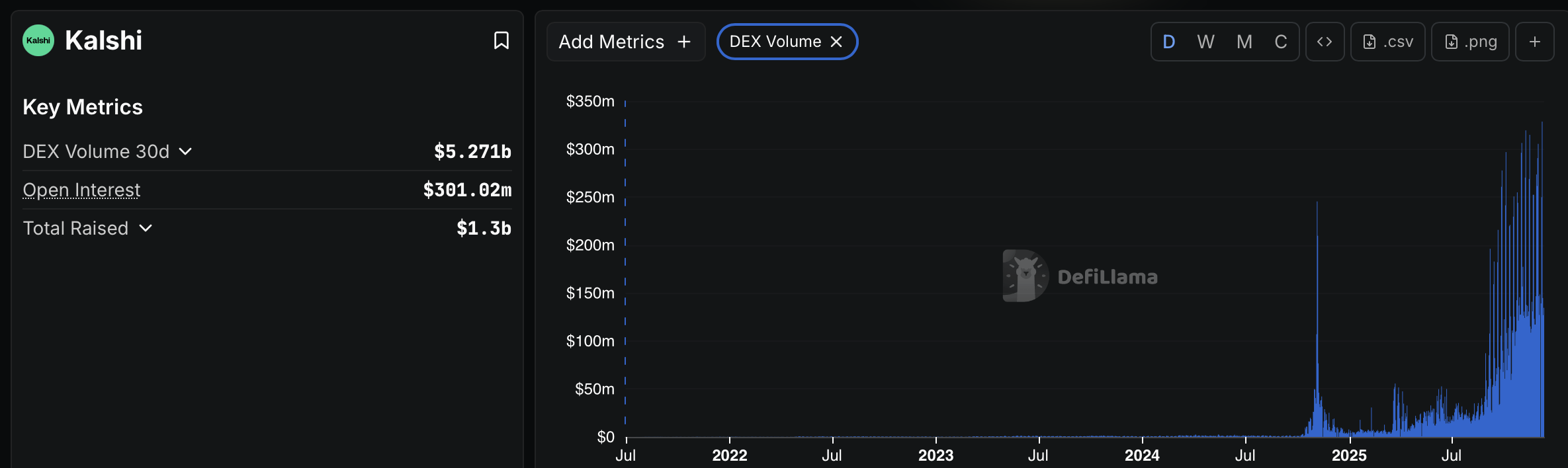
Kalshi trading volume. Source: DefiLlama

In November, Polymarket received regulatory approval from the CFTC to operate an intermediated trading platform, allowing access through registered brokers under the rules governing US markets.

The approval followed the closure of an investigation in July led by the CFTC and US Department of Justice into whether Polymarket had allowed trading by US users, a probe that included an FBI search of founder Shayne Coplan’s home.

Polymarket, which settles contracts on the Polygon blockchain using the USDC (USDC) stablecoin, has also secured several partnerships in recent months, including the UFC and Zuffa boxing and fantasy sports operator PrizePicks in November.

Magazine: Meet the onchain crypto detectives fighting crime better than the cops

Trend Kriptolar

İlgili Okumalar

Rubin Ultra Makes Major Cuts, Even Nvidia Can't Handle Memory Price Hikes?

NVIDIA's Rubin Ultra, the top-tier variant of the newly announced Rubin AI accelerators, has reportedly seen significant specification downgrades, according to an industry report from SemiAnalysis. Initially designed with four compute dies (4-die), the Rubin Ultra is now said to be reduced to a 2-die design. Key changes highlighted in the report include: * **No increase in peak theoretical compute performance**, remaining at 35 PFLOPs like the standard Rubin. * **Severe reduction in memory capacity** to 192GB using 8-Hi HBM stacks, which is less than the standard Rubin's 288GB using 12-Hi stacks. * **Negligible memory bandwidth improvement** of only 1 TB/s. * **Slightly higher chip-level power consumption**. * The **primary upgrade is a massive increase in scale-up interconnect capacity**, supporting connections for up to 576 GPUs via NVLink, compared to 72 for the standard Rubin. The report suggests the redesign is primarily a cost-optimization move driven by the sharp rise in HBM (High-Bandwidth Memory) prices. By reducing the expensive HBM content and shifting investment towards enhanced system-scale networking, NVIDIA aims to maintain the platform's value for large-scale AI training clusters while managing soaring material costs. The news reportedly triggered a sell-off in South Korean memory stocks, with SK Hynix and Samsung shares falling around 8%, as markets grew concerned that NVIDIA—a major HBM buyer—might be reducing its reliance on high-capacity memory, potentially capping future pricing power for memory makers.

Odaily星球日报11 dk önce

Rubin Ultra Makes Major Cuts, Even Nvidia Can't Handle Memory Price Hikes?

Odaily星球日报11 dk önce

Can Generative Models Finally Be Trained End-to-End? The Core Is a For Loop

This article introduces a novel training paradigm for generative models called Explorative Modeling (XM), which enables true end-to-end training. Traditionally, powerful generative models like autoregressive and diffusion models are not trained end-to-end. They are trained to predict a single small step but require iterative multi-step sampling for inference. This "exposure bias" leads to error accumulation and limits performance. The core challenge XM addresses is "mode blurring." In generative tasks, a single input (e.g., "generate a dog") corresponds to many valid outputs (multiple modes). Standard training objectives like reconstruction loss force the model to average these modes, producing unrealistic, blurry outputs. To avoid this, existing models break generation into many small, almost deterministic steps, sacrificing end-to-end training. XM tackles this by restructuring the training loop itself. Its key insight is to amplify "generative expressivity." For each training input, instead of generating one sample, the model generates K candidate outputs. Only the candidate closest to the real data is used for computing the loss and updating the model via backpropagation. This simple "best-of-K" mechanism is implemented as a short for-loop. By exploring multiple possibilities, the model learns to distribute its guesses across different modes rather than collapsing to their uninformative average. The paper demonstrates that "exploration" acts as a new, powerful scaling axis. Gains from XM increase with model size, data scale, and compute. Experiments show improvements in FID scores for image generation and significant efficiency gains, sometimes outperforming larger models without exploration. When pushed to the limit, XM enables fully single-step, end-to-end generative models. In robotics tasks, an "Explorative Policy" matched the performance of a 100-step Diffusion Policy with a single forward pass, drastically improving inference speed. While the best-of-K concept is not entirely new, the authors' contribution lies in formally understanding it as a direct method to boost generative expressivity without fragmenting the generation process. This work suggests that as models scale, enhancing exploration during training may become crucial for overcoming fundamental performance bottlenecks.

marsbit1 saat önce

Can Generative Models Finally Be Trained End-to-End? The Core Is a For Loop

marsbit1 saat önce

İşlemler

Spot

Popüler Makaleler

US Nasıl Satın Alınır

HTX.com’a hoş geldiniz! Talus Network (US) satın alma işlemlerini basit ve kullanışlı bir hâle getirdik. Adım adım açıkladığımız rehberimizi takip ederek kripto yolculuğunuza başlayın. 1. Adım: HTX Hesabınızı OluşturunHTX'te ücretsiz bir hesap açmak için e-posta adresinizi veya telefon numaranızı kullanın. Sorunsuzca kaydolun ve tüm özelliklerin kilidini açın. Hesabımı Aç2. Adım: Kripto Satın Al Bölümüne Gidin ve Ödeme Yönteminizi SeçinKredi/Banka Kartı: Visa veya Mastercard'ınızı kullanarak anında Talus Network (US) satın alın.Bakiye: Sorunsuz bir şekilde işlem yapmak için HTX hesap bakiyenizdeki fonları kullanın.Üçüncü Taraflar: Kullanımı kolaylaştırmak için Google Pay ve Apple Pay gibi popüler ödeme yöntemlerini ekledik.P2P: HTX'teki diğer kullanıcılarla doğrudan işlem yapın.Borsa Dışı (OTC): Yatırımcılar için kişiye özel hizmetler ve rekabetçi döviz kurları sunuyoruz.3. Adım: Talus Network (US) Varlıklarınızı SaklayınTalus Network (US) satın aldıktan sonra HTX hesabınızda saklayın. Alternatif olarak, blok zinciri transferi yoluyla başka bir yere gönderebilir veya diğer kripto para birimlerini takas etmek için kullanabilirsiniz.4. Adım: Talus Network (US) Varlıklarınızla İşlem YapınHTX'in spot piyasasında Talus Network (US) ile kolayca işlemler yapın.Hesabınıza erişin, işlem çiftinizi seçin, işlemlerinizi gerçekleştirin ve gerçek zamanlı olarak izleyin. Hem yeni başlayanlar hem de deneyimli yatırımcılar için kullanıcı dostu bir deneyim sunuyoruz.

340 Toplam GörüntülenmeYayınlanma 2025.12.11Güncellenme 2026.06.02

US Nasıl Satın Alınır

Tartışmalar

HTX Topluluğuna hoş geldiniz. Burada, en son platform gelişmeleri hakkında bilgi sahibi olabilir ve profesyonel piyasa görüşlerine erişebilirsiniz. Kullanıcıların US (US) fiyatı hakkındaki görüşleri aşağıda sunulmaktadır.

活动图片