Bitcoin ETF inflows hit $1.9B in strongest week since October 2025

cointelegraph2026-08-24 tarihinde yayınlandı2026-08-24 tarihinde güncellendi

Özet

US spot Bitcoin ETF inflows surged to $1.92 billion for the week ending Friday, their strongest week since October 2025, according to SoSoValue data. This resurgence coincided with Bitcoin's price jumping over 20%, briefly surpassing $79,000. Spot Ether ETFs also saw about $700 million in inflows. Despite the strong week, US spot Bitcoin ETFs remain in net outflows of roughly $2.91 billion for 2026, though August has brought $2.38 billion in net inflows, making it the year's best month so far. BlackRock's iShares Bitcoin Trust (IBIT) led last week's inflows, attracting approximately $1.33 billion over five consecutive days, with analysts noting a bullish pattern in its daily flow data.

US spot Bitcoin exchange-traded fund (ETF) inflows surged last week after months of uneven flows, with investors pouring nearly $2 billion into the products amid a surge in Bitcoin’s price.

Bitcoin ETFs recorded $1.92 billion in net inflows during the week ending Friday, marking their strongest weekly performance in nearly 10 months, according to SoSoValue data.

ETF analyst Nate Geraci said Sunday that spot Ether ETFs also attracted about $700 million. He added that Bitcoin and Ether funds each posted their strongest weekly inflows since October 2025.

The renewed ETF demand came amid Bitcoin jumping more than 20% last week, briefly surging past $79,000 on Friday after starting the week near $63,000, according to CoinGecko.

Bitcoin ETFs remain in the red for 2026

Despite the latest surge, US spot Bitcoin ETFs have recorded about $2.91 billion in net outflows so far in 2026.

The funds saw their heaviest monthly outflows in June at $4.51 billion, following $2.43 billion in withdrawals in May. August has brought $2.38 billion in net inflows through Friday, making it the strongest month for inflows so far this year.
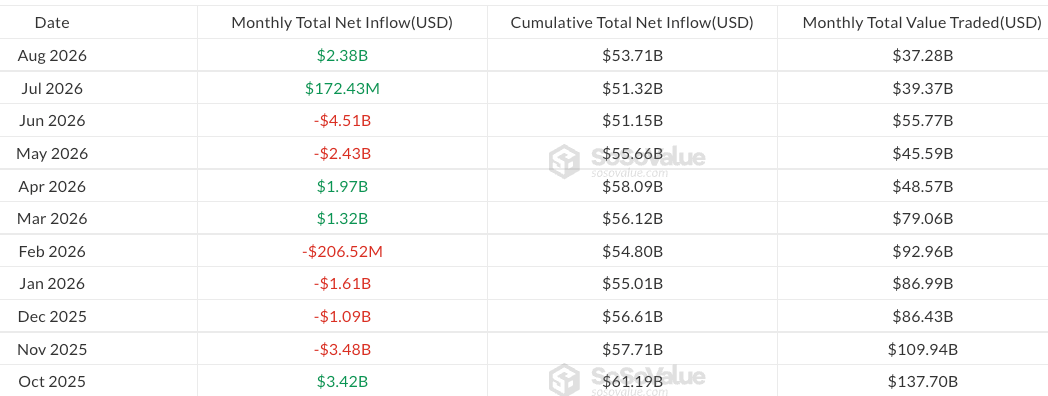
Monthly spot Bitcoin ETF flows since October 2025. Source: SoSoValue

During the last major inflow wave in October 2025, the funds attracted $3.42 billion. The October inflows preceded the Oct. 10 crypto market crash, which triggered the largest liquidation event in the industry’s history, wiping out roughly $19 billion in leveraged positions within 24 hours.
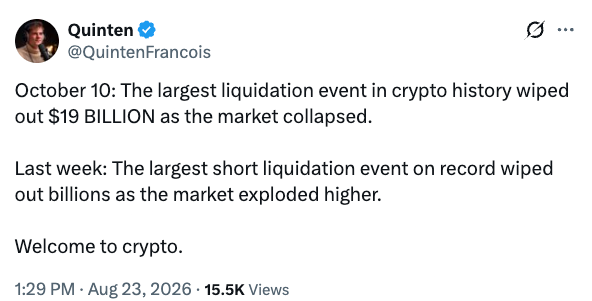
Source: Quinten

Since Oct. 6, when Bitcoin traded near $124,700, its price has plummeted roughly 38%.

BlackRock’s IBIT flashes a “bullish signal”

BlackRock’s iShares Bitcoin Trust ETF (IBIT) was responsible for much of last week’s resurgence, attracting about $1.33 billion in net inflows across five consecutive trading days, according to Farside Investors data.

IBIT’s daily inflows rose from $160.2 million on Monday to $503 million on Thursday, before easing to $239.3 million on Friday.
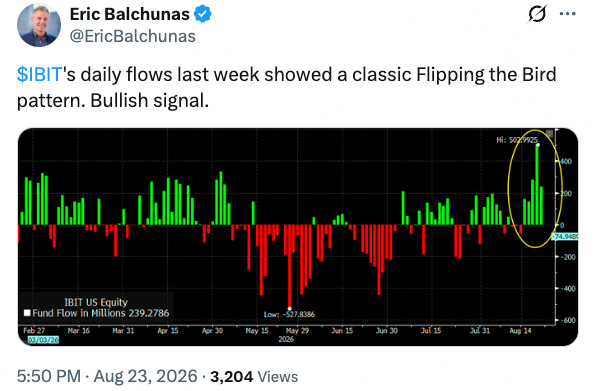
Source: Eric Balchunas

Bloomberg ETF analyst Eric Balchunas took to X to highlight what he described as a “classic Flipping the Bird pattern” in IBIT’s daily flows, adding that he viewed it as a bullish signal.

Magazine: We are so back! Bitcoin’s 23% rally on US debt policy: Hodler’s Digest

İlgili Sorular

QWhat was the total net inflow for US spot Bitcoin ETFs in the strongest week since October 2025?

AUS spot Bitcoin ETFs recorded $1.92 billion in net inflows during that week.

QAccording to the article, what were the net inflows for spot Ether ETFs during the same strong week?

ASpot Ether ETFs attracted about $700 million in net inflows during that week.

QWhat is the total net outflow for US spot Bitcoin ETFs so far in 2026, despite the recent strong week?

ADespite the recent surge, US spot Bitcoin ETFs have recorded about $2.91 billion in net outflows so far in 2026.

QWhich specific ETF was primarily responsible for last week's resurgence in Bitcoin ETF inflows, and how much did it attract?

ABlackRock's iShares Bitcoin Trust ETF (IBIT) was responsible, attracting about $1.33 billion in net inflows across five consecutive trading days.

QWhat significant market event followed the major ETF inflow wave in October 2025?

AThe October 2025 inflow wave preceded the Oct. 10 crypto market crash, which triggered the largest liquidation event in the industry's history, wiping out roughly $19 billion in leveraged positions within 24 hours.

İlgili Okumalar

Foreign Capital Sells Off $29 Billion in Short-Term US Treasuries, Why is the US Betting on Stablecoins to "Take Over"?

In June, foreign investors netted $133.5 billion into U.S. financial markets but simultaneously sold $29 billion in short-term U.S. Treasury bills. This divergence highlights a strong preference for U.S. equities over government debt. While overseas buyers purchased $181.4 billion in stocks, demand for Treasuries weakened significantly. This trend explains why the U.S. is looking to stablecoins as a potential new source of demand for its debt. Stablecoin issuers like Tether and Circle back their tokens primarily with highly liquid assets, including short-term Treasuries. As users buy stablecoins, issuers convert that dollar demand into Treasury purchases. Recent U.S. legislative efforts, such as the proposed rules under the *GENIUS Act*, formalize this by mandating stablecoin reserves be held in assets like cash and short-term Treasuries. Currently, stablecoins represent a substantial existing buyer base. For instance, Tether alone held nearly $115 billion in direct T-bill exposure in Q2. However, recent stablecoin supply growth has been minimal and does not account for the $29 billion sell-off by foreign investors in June. For stablecoins to act as a meaningful counterbalance to waning foreign demand, their circulating supply would need to expand significantly. The next TIC report will be crucial to monitor whether foreign selling continues and if stablecoin growth begins to fill the demand gap. Ultimately, the U.S. is strategically positioning the regulated stablecoin sector as a potential new pillar of demand for its government debt.

marsbit4 dk önce

Foreign Capital Sells Off $29 Billion in Short-Term US Treasuries, Why is the US Betting on Stablecoins to "Take Over"?

marsbit4 dk önce

Unitree Investors Jointly Heavy Bet on an Embodied Team

Unibot's early investors, including Meituan, Sequoia Capital, and Matrix Partners, have jointly invested in MiaoDong Technology, another humanoid robotics startup. Founded by former DJI employees—CEO Gao Jianrong, a 9-year DJI veteran who led multiple core business units, and CTO Yang Shuo, who previously worked in Tesla's Optimus team—MiaoDong is known for its combined expertise in hardware productization and advanced robotics cognition. Their core strategy centers on in-house motor R&D and full-stack software-hardware capabilities. The company recently made headlines with its first product, Beni, a wheel-legged "camera robot" designed for low-angle, ground-level filming and personal companionship. Successfully launched on Kickstarter, Beni set a record for the highest fundraising amount in the platform's robotics category. It received a perfect 10/10 rating from influential tech reviewer Marques Brownlee (MKBHD). Beni features capabilities like autonomous obstacle avoidance, the ability to jump 25cm, and self-righting after a fall. MiaoDong plans to leverage the technological and user data feedback from Beni's consumer launch to inform the development of future home-use humanoid robots. The company emphasizes a product-first, user-centric approach, prioritizing real-world applications and reliability over rapid, demo-focused scaling. With Beni set for global release in October and an internal target to sell millions of units, MiaoDong aims to establish itself as a significant player in the embodied AI space through steady, product-driven growth.

marsbit18 dk önce

Unitree Investors Jointly Heavy Bet on an Embodied Team

marsbit18 dk önce

Interview with Robinhood CEO: Memecoin Boom was Unplanned, My Portfolio is Quite Diversified

In an interview with The Iced Coffee Hour podcast, Robinhood CEO Vlad Tenev discussed the company's initiatives, market views, and personal insights. He highlighted the unexpected success of meme coins on the newly launched Robinhood Chain, which he described as a key part of the financial future. The chain supports tokenized stocks tradable globally and enables innovative DeFi activities not initially anticipated by the team. Regarding market concerns, Tenev noted signs of potential bubbles, specifically in AI and semiconductor stocks, but expressed confidence in Robinhood's younger user base, who often view market downturns as opportunities. He identified optimizing the unified user experience across Robinhood's expanding product lines as the company's current major challenge. Addressing criticism over the prediction markets feature, which some equate to gambling, Tenev emphasized the company's focus on personalization, allowing users to hide the feature or access it more easily. On a personal note, Tenev shared that he enjoys cryptocurrency trading and holds a diversified portfolio. He is optimistic about Bitcoin's long-term prospects due to its unique status as the first crypto asset. Outside work, he focuses on teaching his children math and has adopted wellness routines like sauna, cold baths, and a pre-sleep journaling habit to curb screen time.

marsbit35 dk önce

Interview with Robinhood CEO: Memecoin Boom was Unplanned, My Portfolio is Quite Diversified

marsbit35 dk önce

İşlemler

Spot
活动图片