Podcast from The Iced Coffee Hour
Compiled by / Odaily Planet Daily Golem(@web 3_golem)
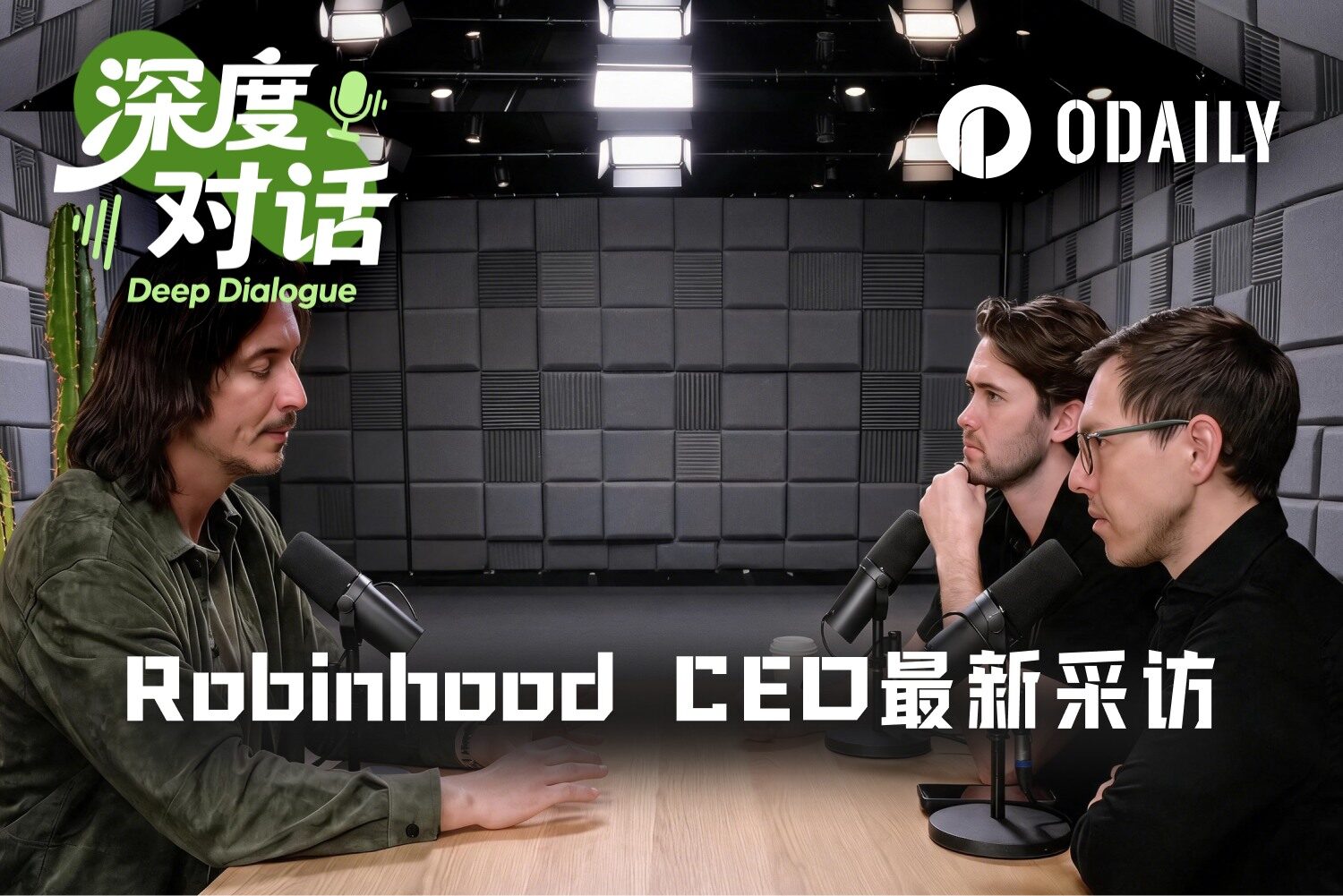
Editor's Note: On August 24, Robinhood CEO Vlad Tenev participated in a video interview with the foreign podcast The Iced Coffee Hour. In the interview, Vlad Tenev shared his vision for the future of Robinhood Chain, his views on the current stock market, the biggest challenges Robinhood currently faces, and responded to market criticism regarding the launch of prediction markets. Vlad Tenev emphasized that the memecoin explosion on Robinhood Chain was unexpected by the team, but he personally enjoys cryptocurrencies, having engaged in crypto trading for a while and liking the feeling of fighting alongside everyone. Vlad Tenev also expressed long-term optimism towards Bitcoin.
During this interview, Vlad Tenev also shared aspects of his personal life. Outside of work, he is currently focused on teaching his children mathematics, has recently become fascinated with saunas, cold showers, and contrast therapy. To break the habit of endlessly scrolling through his phone before bed, he is persisting with writing a diary and reading physical books before sleep......Odaily Planet Daily has compiled and edited the core content of the interview below, enjoy~
Robinhood Chain is the Future of Finance
Host: What will the future of finance look like?
Vlad Tenev: I think Robinhood Chain is it. I don't know if you are familiar with Robinhood Chain, but it is currently one of the hottest chains in the crypto space. We launched it a few weeks ago, and it has consistently ranked among the top five in DEX trading volume, with TVL growing rapidly. One of the advantages of Robinhood Chain is its support for stock tokens, which are tokenized versions of stocks. Even though they are currently only available to users outside the US, they can still be traded in over 120 countries/regions globally.
If you hold stock tokens for Tesla, Nvidia, or other companies on Robinhood Chain, you can essentially do everything with them that you can do with on-chain cryptocurrencies. You can send them to other on-chain addresses just like you would Bitcoin or Ethereum, trade them in liquidity pools. Uniswap has some very active pools on Robinhood Chain where users can stake and borrow.
Although the tax policies in these 120+ countries/regions vary slightly, as long as someone creates a pool for swapping stock tokens and cryptocurrencies, users can swap directly. We initially used stablecoins like USDG, but later developers built all sorts of niche pools we never anticipated would exist and created various protocols.
For example, if a user holds a certain memecoin, they directly receive stock token airdrops. They linked memecoins, major cryptocurrencies, and stock tokens to create some unique products, products we never expected to be made, and if it were up to us, we probably wouldn't have thought to make them either.
Robinhood Chain is a combination of a developer platform with high-yield financial primitives like stock tokens, and we will continue to add more of these features.
The problem with other brokerages today is that they are too large. There are many competitors in this field, old giants with massive scale, managing trillions in assets, but Robinhood delivers products faster and more modernly, which means we can attract a younger customer base. Over the coming decades, their wealth will continue to grow. So, in a way, Robinhood is also a beneficiary of this ongoing generational wealth transfer.
Views on AI and Stock Market Bubbles?
Host: Are you concerned about an AI or stock market bubble bursting? And would that negatively impact Robinhood?
Vlad Tenev: I think alarm bells have started ringing in some ways. We constantly receive a lot of feature requests from customers. There was indeed a segment of users wanting features related to overseas stock trading, but for a long time, this demand didn't crack the top ten. Then, about a month or two ago, the most common question I got in every interview became "When are you launching Korean stocks?"
Investors wanted to trade Korean stocks. No one was asking for prediction markets or crypto, although we will launch Korean stocks, the fact that so many people asked for it simultaneously was indeed a bit concerning, and sure enough, the Korean stock market experienced significant volatility.
However, our customers have always prioritized innovation. So in the past, we were among the first to invest in electric vehicles. Now they are clearly interested in crypto and AI as well, although directly investing in AI companies is quite difficult, and we are addressing that through Robinhood Ventures. Previously everyone focused on semiconductors, and now many are talking about energy. So I think in these two categories—chips and energy—investors need to manage a very complex balance.
On one hand, the demand for AI continues to grow, which will inevitably impact chips and all production stages in its underlying technology stack. On the other hand, traders are also buying chips, including some hedge funds, who buy them knowing that even if they don't need the chips, they can resell them at a higher price. Whether something is undervalued depends on many factors, but if a large portion of supply is bought by speculators, even in areas with huge growth potential like AI chips, problems can arise.
Host: Do you think the current high stock market is disadvantageous for people in their twenties and thirties?
Vlad Tenev: I think opportunities exist at any time. In 2020, around the COVID-19 pandemic, the stock market crashed, but our customers were buying while customers of other brokerages were selling. Ultimately, our customers bought because they are younger, focus on long-term investing, and saw an opportunity. They remain fundamentally optimistic about the national economy, positive about the various projects being developed then, and the opportunities the stock market offered.
Many people have asked me if I worry about a market correction. Honestly, I'm not too worried because our past experience shows that the younger customer base views market corrections as opportunities.
But that doesn't mean I hope for a correction. I don't even want prices to continuously fall; that would be unfortunate for both the economy and investors. Everyone wants prices to rise steadily, but that's not reality. I believe for traders, opportunities can be found in any market environment, though predicting and timing these opportunities is not easy.
Optimizing User Experience is Robinhood's Biggest Challenge Now
Host: What was your biggest mistake in the past year?
Vlad Tenev: To be honest, I've made many small mistakes, but my approach has always been about how to move forward. I don't like dwelling on the past much. Constantly revisiting past decisions just holds you back. What really matters is where we are now. Sometimes I even prefer being in the trailing position, being the underdog, because I feel it gives us a clear target to sprint towards.
Over the past year, we launched the prediction market business for active traders. This is an interesting new field for us, but we weren't the first player to launch such a product.
Stock trading existed for decades before Robinhood, even electronic trading was widespread. We just optimized it, brought it to smartphones, and made it commission-free. We also weren't early for crypto trading; we launched related services in 2018. Compared to traditional finance firms that's early, but many crypto-native companies started as early as 2012 or even earlier. For example, Bitstamp, which we acquired, is one of the longest-running crypto exchanges.
So in prediction markets, we weren't the first to enter either. However, when such businesses gained legal status in the US, we were among the first to launch related products, rolling it out within a few weeks, then continuously iterating and expanding. Now this business line generates hundreds of millions in annual revenue, becoming our fastest-growing business line ever.
The challenge I spend the most time thinking about now is: Since we have so many business lines, how do we ensure a unified and coherent core user experience? We are also investing more in personalization and refining the app experience to make the interface cleaner.
Host: Facing market criticism, how will Robinhood improve in the future?
Vlad Tenev: Some criticize our products for lacking coherence, and the company's purpose and stance not being clear and understandable. This criticism is valid, and we've received similar feedback. People always want new features, like supporting Korean stocks. That request is fine; I even think we should support not just Korean stocks but stocks from various regional markets. It's just that there are too many things we haven't had time to address because new features to build are endless. Our work broadly falls into three directions.
The first category is infrastructure optimization to enhance existing experiences, like faster speeds, more beautiful and concise UI, more reliable UX, so we can better handle situations like traffic spikes. Just in the past year, we've made significant progress in this area.
The second category of products are those other brokerages have but Robinhood doesn't, like trust accounts, overseas stocks available on some competitor platforms, and fixed-income products. We still have many products not yet launched, and these are quite important components of a customer's investment portfolio.
Beyond that, there's a third category. Currently, not many companies operate in this space, but the core question is: Can we innovate? Can we be the first among our peers to launch new products to market? Prediction markets, Robinhood Ventures, Robinhood Chain, and Robinhood Earn belong to this category.
We also want to add some completely unexpected products to Robinhood, like AI agent trading. Currently, there are no major, truly significant institutions or teams working on this research, except for us.
Users Who Don't Want to See Prediction Market Features Can Choose to Turn Them Off
Host: Some also criticize Robinhood for being too focused on prediction markets, which are seen as not much different from gambling. What's your response to that?
Vlad Tenev: Actually, the criticism we receive is bidirectional. There is a segment of users who don't want to see prediction market features at all. To address this demand, we introduced personalization settings and a series of related measures. It's not just about letting users directly turn off the feature, but more importantly, ensuring we can show users the content they want to see in the App when they want to see it.
So this is a major focus for us, not just for prediction markets, but for many of our different products and features. The core problem to solve is that users simply don't know we've launched a great feature that could benefit them.
So there are two voices. One is "I don't want to see this product (prediction market)"; the other is "I want to see it more easily, it's buried too deep in the product pages, I don't want to click three times to find it, I want to see the current dynamics immediately." And we believe personalization settings are the solution.
Additionally, we are trying another approach. In some cases, if the experience difference is significant enough, we split the related features into standalone Apps, like for banking. So if a user wants a banking and debit card-focused experience, they can use the banking App. If a user wants a trading-first experience, they can use the green Robinhood App. If a user wants the full suite of crypto-related features, the Robinhood Wallet provides a native DeFi experience.
Personal Investing: Love Crypto Trading, Optimistic on Bitcoin
Host: Do you personally trade on Robinhood? Or do you keep all your Robinhood shares on the Robinhood platform?
Vlad Tenev: The Robinhood shares I hold are not stored on the Robinhood platform. That's because my own shares, and the shares of all our employees, are managed by specialized institutions. There are specific requirements for managing employee stock ownership plans and so-called 10b5-1 plans. I cannot freely trade my Robinhood shares arbitrarily; I must trade according to a specific plan filed in advance. This is a regulatory requirement.
But I do use Robinhood for personal trading. However, I have to be extra careful trading individual stocks now; I find ETFs more straightforward. I used to trade cryptocurrencies for a while because I genuinely like cryptocurrencies. I love crypto trading and enjoy fighting alongside everyone. Unfortunately, I don't post on Reddit much anymore. I used Reddit when I first started using Robinhood too.
Host: Which cryptocurrencies do you hold?
Vlad Tenev: I think cryptocurrency is a very interesting asset class to trade. But I must state again, I am not recommending any cryptocurrencies. My investment portfolio is quite diversified.
Bitcoin is unique in many ways. It was the first crypto asset, the original memecoin. Its brand power is quite strong. Followers can create many Bitcoin imitators, but no one can ever replace its status as the first and most trusted crypto asset. When companies build crypto asset reserves to hedge against inflation and conduct various related operations, the first crypto asset they think of is also Bitcoin. So, long-term, I am optimistic about Bitcoin. I think its uniqueness gives it an advantage over similar coins. But specific price numbers like it reaching $1 million, I cannot predict.
Personal Life: Focused on Teaching Kids Math, Sticking to Pre-sleep Diary and Reading
Host: Besides Robinhood, what other personal goals do you have?
Vlad Tenev: I have been focusing recently on teaching my children mathematics. I have always believed math is important, to make them love learning and stay curious. So whenever I have time with them—though far less than I wish—I try to talk about history with them, encourage them to do math problems, and understand what's going on at school.
They have advantages I didn't have as a child. For example, they have access to top-tier tutors and can communicate with anyone they want. What I always worry about is how to let them enjoy these benefits without creating too many negative side effects. Growing up as my children, things will likely seem easy, and perhaps they won't have the same drive to advance that I had.
If I didn't work hard back then, my parents would have told me very bluntly: we don't have money for your college, you'll probably need a scholarship, you have to get everything right yourself. And we were on visas back then, so our status in this country was very precarious. There was always a tension: if you don't perform well, maybe the whole family has to move back to Bulgaria.
That pressure is less now, which is good in a way, but conversely, forcing children without that inherent urgency isn't good. But honestly, I'm really proud of them. Even without that pressure, they've turned out to be wonderful people.
As for other goals, I focus on my health. As I get older, I need to ensure both body and mind stay in good shape. I've had a full-body MRI, I get regular blood tests, try to exercise regularly, and recently got into saunas, cold showers, and contrast therapy.
I've also been trying to establish a fixed pre-sleep routine because I easily pick up my phone or iPad, scroll through the company Slack, read documents until the moment I close my eyes, almost dropping the phone on my face. So now before bed, I write in my diary for 10 to 15 minutes, then read a physical book for 15 to 20 minutes, to slowly wind down.
Recommended Reading:
13 Business Lines with Annualized Revenue Over $100M, Robinhood is Moving Towards a "Super Financial App"