Big Banks Go Stablecoins: Capital One Buys Brex For $5.15 Billion

bitcoinist2026-01-23 tarihinde yayınlandı2026-01-23 tarihinde güncellendi

Özet

Capital One is acquiring fintech company Brex for $5.15 billion in a cash and stock deal, pending regulatory approval with an expected close by mid-2026. Brex, known for corporate cards and expense software, has expanded into stablecoin payments, enabling automatic conversion of dollar-pegged tokens. This acquisition provides Capital One with faster settlement technology and access to Brex's business clients. The deal reflects a reset in venture valuations from previous peaks. The stablecoin market has grown significantly, reaching $315 billion following recent regulation. Brex's CEO will remain to lead the unit, and market reaction has been tempered by strong earnings from Capital One.

Reports say Capital One will buy stablecoin fintech Brex for $5.15 billion in a deal that mixes cash and stock. According to the bank’s release, roughly half of the price will be paid in cash and the other half in Capital One stock.

Regulators must still sign off. The two companies expect the transaction to finish by mid-2026, though that timing could shift if approvals take longer.

Brex Brings Cards, Software — And Stablecoin Plans

Brex began as a corporate card and expense tool for startups and has added services for larger firms.

Reports note the company moved quickly into payment tech last year when it announced plans to offer native stablecoin payments, letting customers send and accept dollar-pegged tokens with automatic conversion back into USD balances.

That bit of tech is a major part of why the deal matters to a bank that wants faster settlement options.

A Mix Of Old And New

This is not just about software. It is also a play for customers. Brex runs business accounts, serves big names in tech, and has built a set of tools that many businesses use daily.

Some of those clients moved business deposits to Brex after the 2023 banking turmoil, and those relationships are part of the package Capital One is buying.

The price tag looks smaller than Brex’s peak private valuation years ago, which shows how venture valuations have reset across the sector.

BTCUSD trading at $89,184 on the 24-hour chart: TradingView

Why This Matters For Payments

Banks have been testing token-based rails and faster settlement for a while. By folding Brex into its operations, Capital One gains a ready platform that already experiments with stablecoin rails.

Real-time settlement for businesses can lower friction and could cut the waiting time for funds to clear. At the same time, regulators in the US and abroad are paying closer attention to token projects, so the new setup will run under tighter scrutiny.
Source: Coingecko

The Growing Stablecoin Market

Stablecoins have drawn growing attention across traditional finance after Congress approved major rules for the tokens last year.

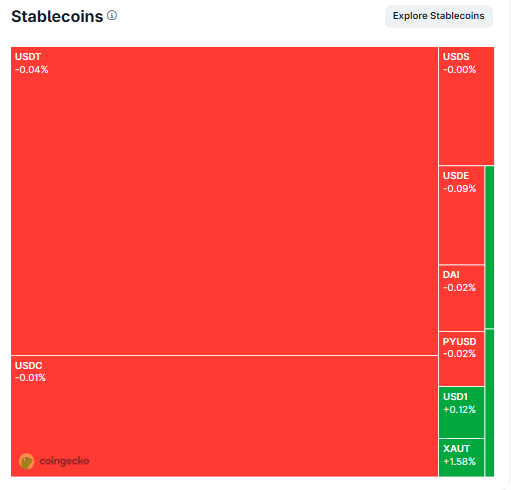
Based on data from Coingecko, the total value of stablecoins has climbed over 18% to an all-time high of $315 billion since the GENIUS Act was passed in July 2025. USDT takes the lion share of the overall stablecoin market.

Leadership And Market Reaction

Reports note that Pedro Franceschi, Brex’s CEO, will continue to lead the unit after the sale, now inside Capital One.

Investors reacted calmly overall; Capital One’s shares dipped early but were supported by robust quarterly results announced at the same time. That earnings strength helped soften any sharp market moves.

Featured image from YouHodler, chart from TradingView

İlgili Sorular

QWhat is the total acquisition price of Brex by Capital One and how is it structured?

AThe total acquisition price is $5.15 billion, with roughly half paid in cash and the other half in Capital One stock.

QWhat key technology did Brex develop that made it an attractive acquisition target for a bank like Capital One?

ABrex developed native stablecoin payment technology, allowing customers to send and accept dollar-pegged tokens with automatic conversion back to USD, which offers faster settlement options.

QWhat was a significant factor that led some clients to move their business deposits to Brex, as mentioned in the article?

ASome clients moved their business deposits to Brex following the banking turmoil in 2023.

QHow has the total value of the stablecoin market changed since the passage of the GENIUS Act, and what is its current all-time high?

ASince the GENIUS Act was passed in July 2025, the total value of the stablecoin market has climbed over 18% to an all-time high of $315 billion.

QWho will lead the Brex unit after the acquisition is completed, and what was the overall market reaction to the deal?

APedro Franceschi, Brex's CEO, will continue to lead the unit. The market reaction was calm overall; Capital One's shares dipped early but were supported by strong quarterly earnings.

İlgili Okumalar

From Survival to Accelerated Growth: The Journey of Zcash's Three-Year Rise as Told by the Founder of ZODL

**From Survival to Accelerated Growth: Zcash Founder Details the 3-Year Rise** Three years ago, Zcash (ZEC) was a struggling pioneer in privacy technology, with a price near $30, low shielded supply (11%), and a community mired in governance disputes. Today, ZEC trades around $600, with over 31% of its supply (~$3B) in user-controlled shielded pools. This transformation resulted from breaking key constraints. First, **governance shackles were removed**. The old model guaranteed funding to two entities (ECC and ZF) regardless of performance, creating a monopoly. In 2024, ECC rejected further direct funding, forcing a change. The NU6 upgrade ended direct funding, allocating 8% to community grants and 12% to a protocol-controlled treasury for retroactive rewards, expiring in 2028 unless renewed by overwhelming consensus. The entities also relinquished their trademark-based veto power, freeing community governance. Second, the **product focus shifted** from pure cryptography to user growth. Previously, engineering excelled at privacy tech but failed to attract users. In early 2024, the team (later ZODL) pivoted to building products users wanted, like the Zodl wallet (default privacy, hardware support, cross-asset swaps). This drove shielded supply to grow over 400% in ZEC terms, with 86.5% of recent transactions being shielded, representing real user adoption. Third, the **narrative evolved** from the limiting "privacy coin" label to "unstoppable private money." This clarified Zcash's value proposition: a Bitcoin-like monetary policy with verifiable private payments via advanced cryptography. This structural narrative—protocol (Zcash), asset (ZEC), gateway (Zodl)—enabled broader exchange listings, institutional interest, and ETF filings. Finally, **organizational constraints were broken**. In early 2026, the ECC team left its non-profit structure after disputes over control, forming Zcash Open Development Lab (ZODL). ZODL raised $25M from top VCs (Paradigm, a16z, etc.), gaining the capital and agility of a startup to scale consumer products. Current metrics show strong momentum: social discussion volume for ZEC surged 15,245% in a year, with 81% positive sentiment. The focus is now on enhancing user experience (Zodl wallet), scalability (Tachyon project targeting Visa-level throughput with 25-second blocks), and post-quantum security (quantum-recoverable wallets coming soon). Zcash is positioned to become faster, more usable, scalable, and quantum-resistant.

marsbit6 dk önce

From Survival to Accelerated Growth: The Journey of Zcash's Three-Year Rise as Told by the Founder of ZODL

marsbit6 dk önce

Five Counterparty Risk Architectures: A Settlement-Layer Methodology for Classifying TradFi Models in Crypto Exchanges

**Summary:** This companion piece reframes the five TradFi-on-crypto exchange architectures, previously classified by "architectural fingerprint," through the lens of counterparty risk. The core question is: whose balance sheet bears the loss first in a stress scenario, and has it historically done so? Each of the five models corresponds to a distinct risk holder with its own documented failure modes. * **Model 1 (Stablecoin-Settled CEX Perpetuals):** Risk is held by the stablecoin issuer (e.g., reserve composition, bank connectivity) and the CEX's own book. History includes Tether's banking disconnections (2017) and reserve misrepresentations (CFTC 2021 Order). * **Model 2 (CFD Brokers):** Risk resides on the broker's balance sheet (B-book model). Regulatory differences (e.g., ESMA's mandatory negative balance protection vs. Mauritius FSC's lack thereof) define loss allocation rules, as seen in the 2015 SNB event (Alpari UK insolvency). * **Model 3 (Off-Chain Custody & Transfer Agent Chain):** Risk lies with the off-chain custodian/platform. User asset recovery depends on Terms of Use and corporate structure, exemplified by the Celsius bankruptcy ruling (2023) where Earn Account assets were deemed property of the estate. * **Model 4 (DEX Perpetual Protocols):** No single balance sheet bears risk. Loss absorption relies on a protocol's insurance fund and Auto-Deleveraging (ADL) mechanism, as demonstrated in the GMX V1 (2022) and dYdX v3 YFI (2023) incidents. * **Model 5 (Regulated CCP - DCM-DCO-FCM):** The most institutionalized model concentrates risk in the Central Counterparty (CCP). However, history shows CCPs can employ non-standard tools under extreme stress, such as mass trade cancellation (LME Nickel, 2022) or enabling negative price settlements (CME WTI, 2020). The report argues that regulatory choices and counterparty risk structures are co-extensive, not in an upstream-downstream relationship. It concludes with five separate observation checklists (not predictions) for monitoring the structural vulnerabilities of each risk model.

marsbit23 dk önce

Five Counterparty Risk Architectures: A Settlement-Layer Methodology for Classifying TradFi Models in Crypto Exchanges

marsbit23 dk önce

İşlemler

Spot
Futures

Popüler Makaleler

ONE Nasıl Satın Alınır

HTX.com’a hoş geldiniz! Harmony (ONE) satın alma işlemlerini basit ve kullanışlı bir hâle getirdik. Adım adım açıkladığımız rehberimizi takip ederek kripto yolculuğunuza başlayın. 1. Adım: HTX Hesabınızı OluşturunHTX'te ücretsiz bir hesap açmak için e-posta adresinizi veya telefon numaranızı kullanın. Sorunsuzca kaydolun ve tüm özelliklerin kilidini açın. Hesabımı Aç2. Adım: Kripto Satın Al Bölümüne Gidin ve Ödeme Yönteminizi SeçinKredi/Banka Kartı: Visa veya Mastercard'ınızı kullanarak anında Harmony (ONE) satın alın.Bakiye: Sorunsuz bir şekilde işlem yapmak için HTX hesap bakiyenizdeki fonları kullanın.Üçüncü Taraflar: Kullanımı kolaylaştırmak için Google Pay ve Apple Pay gibi popüler ödeme yöntemlerini ekledik.P2P: HTX'teki diğer kullanıcılarla doğrudan işlem yapın.Borsa Dışı (OTC): Yatırımcılar için kişiye özel hizmetler ve rekabetçi döviz kurları sunuyoruz.3. Adım: Harmony (ONE) Varlıklarınızı SaklayınHarmony (ONE) satın aldıktan sonra HTX hesabınızda saklayın. Alternatif olarak, blok zinciri transferi yoluyla başka bir yere gönderebilir veya diğer kripto para birimlerini takas etmek için kullanabilirsiniz.4. Adım: Harmony (ONE) Varlıklarınızla İşlem YapınHTX'in spot piyasasında Harmony (ONE) ile kolayca işlemler yapın.Hesabınıza erişin, işlem çiftinizi seçin, işlemlerinizi gerçekleştirin ve gerçek zamanlı olarak izleyin. Hem yeni başlayanlar hem de deneyimli yatırımcılar için kullanıcı dostu bir deneyim sunuyoruz.

267 Toplam GörüntülenmeYayınlanma 2024.12.12Güncellenme 2025.03.21

ONE Nasıl Satın Alınır

Tartışmalar

HTX Topluluğuna hoş geldiniz. Burada, en son platform gelişmeleri hakkında bilgi sahibi olabilir ve profesyonel piyasa görüşlerine erişebilirsiniz. Kullanıcıların ONE (ONE) fiyatı hakkındaki görüşleri aşağıda sunulmaktadır.

活动图片