Andrew Kang: Abandon Short-Termism, Embrace Exponential Growth

marsbit2026-02-12 tarihinde yayınlandı2026-02-12 tarihinde güncellendi

Özet

Andrew Kang, founder of Mechanism Capital, argues that we are at a profoundly unique asymmetric moment in history, requiring a shift away from short-term thinking toward a long-term, exponential growth mindset. Having witnessed multiple market cycles, many investors become overly cautious during rapid price increases. However, Kang emphasizes that concerns about bubbles or attempts at market timing are misguided in the current environment. We are nearing a technological "singularity," driven by breakthroughs in AI, robotics, energy, and other innovative fields. In the coming decade, advancements such as billions of AI agents, humanoid robots, space data centers, multi-planetary colonization, and revolutionary medical therapies will compress more progress into twenty years than all of prior human history combined. Companies leveraging AI are already experiencing order-of-magnitude improvements in productivity. For instance, Anthropic now has Claude writing 100% of its product code. Traditional valuation models fail to capture the potential scale of growth, which could represent a 20-sigma event in terms of economic expansion. Wealth creation will accelerate dramatically. Those without exposure to these transformative trends risk being left behind as asset prices surge vertically. While short-term volatility is inevitable, Kang advises embracing long-term risk exposure rather than attempting to trade short-term fluctuations. The value of the embedded "call option" on the sin...

Original author: Andrew Kang, Founder of Mechanism Capital

Compiled by: Ken, Chaincatcher

For those who have experienced at least one full market cycle, you develop an instinct to be wary of price increases that far exceed historical growth rates. Witnessing the dot-com bubble, the 2008 global financial crisis, and the rise and fall of cryptocurrencies triggers pattern recognition alarms in your brain. You hesitate to enter the market because prices are too high, and you want to sell your holdings for fear of being at a peak.

But it is important to recognize that we are in one of the most profound and unique asymmetric moments in history. The only move now is to lengthen your time horizon and completely abandon short-termism.

Excessive worry about bubbles is foolish. Trying to time the market is also foolish. Short-term fluctuations and pullbacks will always occur, but given how close we are to the "singularity," these fluctuations are merely noise. Artificial intelligence, robotics, energy, and innovation are about to experience runaway explosive growth.

Within the next decade, we will have billions (or more) of AI agent workforces, humanoid robots, space data centers, multi-planetary colonization, and significantly improved medical therapies; we will fundamentally change the speed and output of technological breakthroughs in all fields. The technological progress and economic growth we compress into the next twenty years will exceed the sum total of all human civilization history.

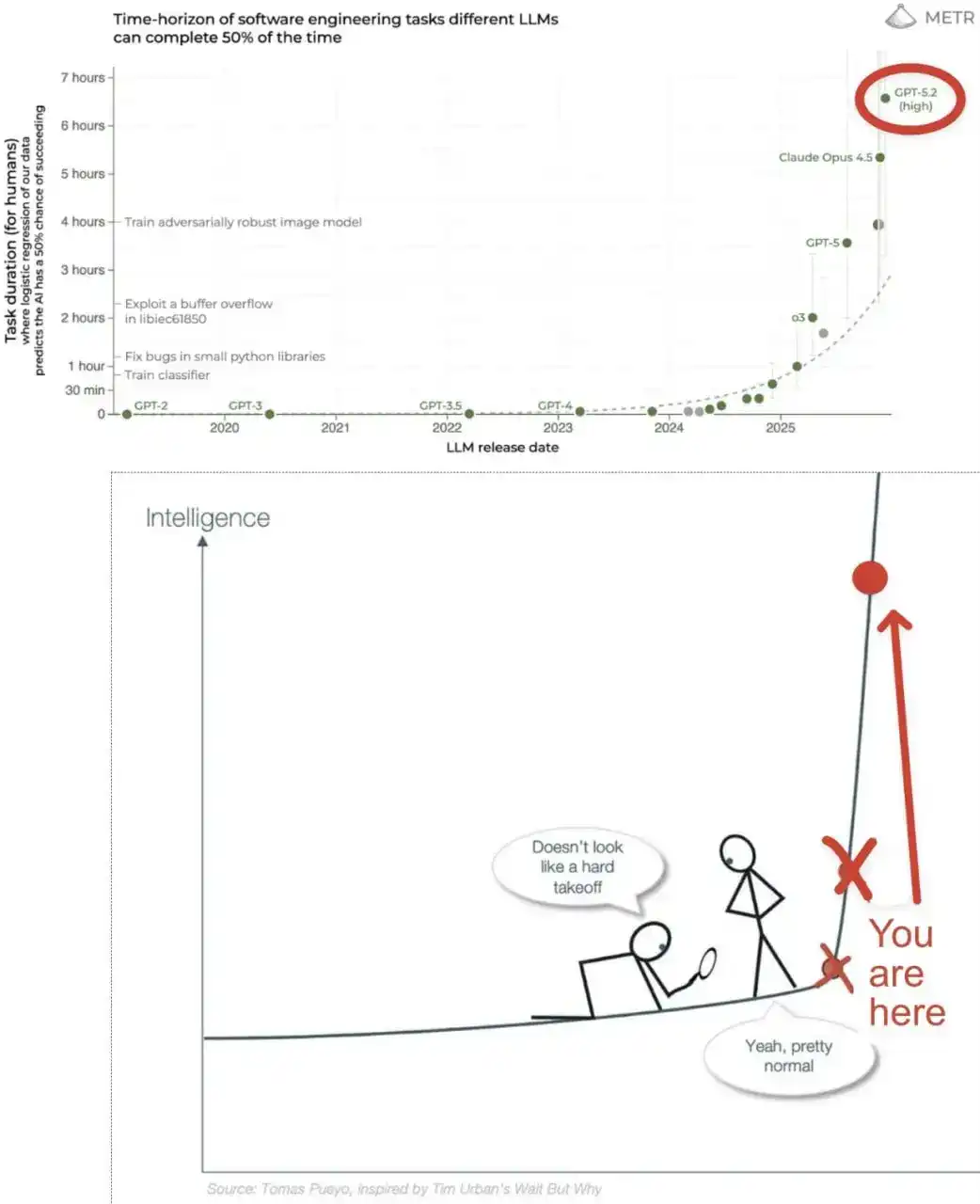
We are already in an extremely steep phase of the J-curve, but this is hard to perceive when we zoom in to the micro level of daily or weekly views. Anthropic now has 100% of its product code written by Claude. Product managers have a virtual team of software engineers so efficient it feels like they can bend time. Companies that effectively utilize AI are seeing product iteration speed improvements not in single digits, not double digits, but triple digits.

Moreover, the capabilities of these tools are still evolving at an accelerating pace. Whether we officially achieve Artificial Superintelligence (ASI) in 2027 or 2029 doesn't really matter. It will happen. By the time it's officially announced, the assets you want to own will have already multiplied in value countless times.

It is highly likely that the actual economic growth over the next 3-10 years will be on the order of 20 standard deviations (20-sigma) in any historical distribution model. This growth, once considered nearly impossible, will be driven by unprecedented second and third-order changes. Traditional valuation models are incapable of pricing these transformations. The potential upside is so vast that traditional present value calculations struggle to capture them.

The rate of wealth appreciation will be staggering, similar to how cryptocurrencies initially created numerous billionaires and millionaires in a short period, but this time the magnitude will be far more extreme. If you have no exposure, it will be difficult to pull the trigger and buy into such vertically rising asset prices; but unlike previous bubbles, the creation of real economic value will better keep pace with the vertical rise in asset prices. Over the past three years, those operating in the market with the cognition of an "exponential horizon" have reaped significant rewards. If you haven't adopted this mindset yet, it's not too late.

While it's important to always be mindful of downside risks, this is the largest upside risk in world history. Learn to bear risk over longer time horizons. Now is not the time for swing trading. For the vast majority of people, long-term investing typically outperforms short-term trading, but the gap in expected value between "trading" and "investing" will be wider than ever before. Ask yourself, what is the value of the call option embedded in the singularity?
İlgili Sorular

QAccording to Andrew Kang, why is it important to abandon short-termism in the current market environment?

ABecause we are at one of the most profound and unique asymmetric moments in history, with unprecedented exponential growth in AI, robotics, energy, and innovation. Short-term volatility is just noise compared to the long-term potential.

QWhat does Andrew Kang predict will happen in the next decade regarding technological progress?

AHe predicts we will have billions of AI agent workforces, humanoid robots, space data centers, multi-planetary colonization, and vastly improved medical therapies, compressing more technological progress and economic growth than the entire history of human civilization.

QHow does Andrew Kang describe the current stage of the J-curve in technological advancement?

AHe describes it as an extremely steep phase of the J-curve, where companies effectively using AI are seeing triple-digit percentage improvements in product iteration speed, though this is hard to notice on a daily or weekly scale.

QWhat does Kang suggest about the relationship between asset prices and the announcement of Artificial Superintelligence (ASI)?

AHe suggests that by the time ASI is officially announced, the prices of assets you would want to own will have already increased exponentially, making early exposure crucial.

QHow does Andrew Kang compare the future wealth creation to the early days of cryptocurrency?

AHe says the speed of wealth creation will be staggering, similar to how cryptocurrency quickly created billionaires and millionaires, but the scale will be far more extreme, with real economic value creation better keeping up with vertical asset price rises.

İlgili Okumalar

Goldman Sachs: July Smashes Through Crowded Trades, U.S. Stock Bull Market Not Broken but Harder to Navigate

Goldman Sachs: July Sees Crowded Trades Unwound, U.S. Bull Market Intact but Getting Tougher. The U.S. stock market in July did not see an index-level crash, but rather a significant unwinding of speculative positions. While the S&P 500 remained stable—trading within a narrow 3.5% range and staying within 2% of its high—underlying market dynamics were volatile. Heavily crowded trades, particularly in high-momentum tech, AI-linked stocks, and Asian strategies, faced severe pressure and forced deleveraging. Data indicates this was a meaningful cleanse, not a minor adjustment. Global tech exposure saw its largest sell-off in over five years, leverage in Korean equity ETFs plummeted, and Goldman's prime brokerage recorded the largest gross exposure reduction since late 2022. Leverage on momentum factors among fundamental long/short clients fell to the 28th percentile of its one-year range. The AI trade narrative shifted from pure potential to a focus on tangible returns. While Meta failed to show clear AI monetization, Microsoft and Amazon provided evidence that massive capital expenditure is translating into scalable revenue and product growth, preventing a blanket sell-off of the AI sector. The Federal Reserve's more opaque communication style and volatility in long-end Treasury yields have introduced new friction, particularly for rate-sensitive growth and tech stocks. The broader outlook for U.S. equities remains favorable, supported by a strong economy, robust earnings, and substantial AI capital expenditure. However, risk/reward is no longer cheap, and the market's upward elasticity has weakened. The Nasdaq 100's trajectory—up 12% year-to-date despite significant pullbacks—illustrates that the bull trend persists but the path is becoming more difficult. The key lesson from July is that the market no longer rewards crowded, highly leveraged trades, requiring more disciplined and liquid portfolio approaches.

marsbit1 saat önce

Goldman Sachs: July Smashes Through Crowded Trades, U.S. Stock Bull Market Not Broken but Harder to Navigate

marsbit1 saat önce

Interview with Robinhood Executive: Meme + Tokenized US Stocks as "Barbell" Customer Acquisition Strategy, All Business Lines Achieve Hundreds of Millions in Revenue

Interview with Robinhood executive Johann Kerbrat reveals the company's "barbell" customer acquisition strategy for its new Robinhood Chain, combining meme tokens with tokenized stocks. Three weeks after mainnet launch, the chain has seen over $3B in weekly DEX volume and 105M transactions. Kerbrat explains the logic behind the permissionless chain: meme tokens attract DeFi users, while tokenized real-world assets (RWA), currently over 90 US stocks and ETFs accessible in 120+ countries, serve global users. The goal is to bring Robinhood's 27 million funded accounts on-chain by simplifying DeFi with a user-friendly interface, exemplified by features like Robinhood Earn which offers yield without requiring wallet management. Built on Arbitrum's technology stack for its speed, low cost, and Ethereum's security, the chain focuses on financial products like Earn, spot trading, and perpetuals. Kerbrat downplays direct competition with platforms like Base, emphasizing the goal of expanding the overall market for on-chain assets. He details selective partnerships (e.g., Morpho, Lighter) based on compliance, unique UX, and differentiation. While regulatory clarity is pending for US perpetuals, the expansion continues via Bitstamp in Europe. Finally, Kerbrat positions Robinhood as a "super app" integrating stocks, options, crypto, banking, and AI trading, with all major business lines generating hundreds of millions in revenue. For the chain, current priority is driving adoption over maximizing gas fee revenue.

marsbit3 saat önce

Interview with Robinhood Executive: Meme + Tokenized US Stocks as "Barbell" Customer Acquisition Strategy, All Business Lines Achieve Hundreds of Millions in Revenue

marsbit3 saat önce

Fidelity Q3 Report: BTC, ETH, and SOL Continue to Build Bottoms; How Much Further Will This Crypto Bear Market Go?

Fidelity's Q3 Crypto Signal Report analyzes the current bear market, noting Bitcoin (BTC), Ethereum (ETH), and Solana (SOL) are in a prolonged bottoming phase. Key indicators like the weighted Net Unrealized Profit/Loss (NUPL) have turned negative (-0.01), signaling the market is slightly below its aggregate cost basis, with BTC acting as the primary stabilizing asset. BTC's dominance has risen to 68%, indicating a lack of capital rotation to other digital assets. Performance has been weak across the board, with BTC, ETH, and SOL down significantly year-to-date. Market sentiment is depressed, exacerbated by substantial outflows from spot ETPs and a challenging macro environment. The report compares the current ~203-day downtrend to historical ~300-day bottoming cycles, suggesting the process may be two-thirds complete, with late 2026 as a potential timeframe to monitor. For Bitcoin, NUPL at 0.09 indicates cautious sentiment, while momentum signals remain negative. The Yardstick metric points to potential undervaluation relative to network security (hashrate). Ethereum's NUPL is deep in the "capitulation" zone at -0.43, a historically positive signal for future returns, though its momentum and network fee revenue are negative. Solana shows the deepest NUPL at -0.72 but demonstrates relative resilience in on-chain activity and stablecoin transfer volume. The report concludes that while several metrics are near historical capitulation levels, a definitive market bottom has not yet been established. The path forward likely involves continued consolidation, with BTC's relative strength and fundamental on-chain usage for ETH and SOL providing key areas for investor observation.

marsbit3 saat önce

Fidelity Q3 Report: BTC, ETH, and SOL Continue to Build Bottoms; How Much Further Will This Crypto Bear Market Go?

marsbit3 saat önce

İşlemler

Spot
活动图片