Written by: Curry, Shenchao TechFlow
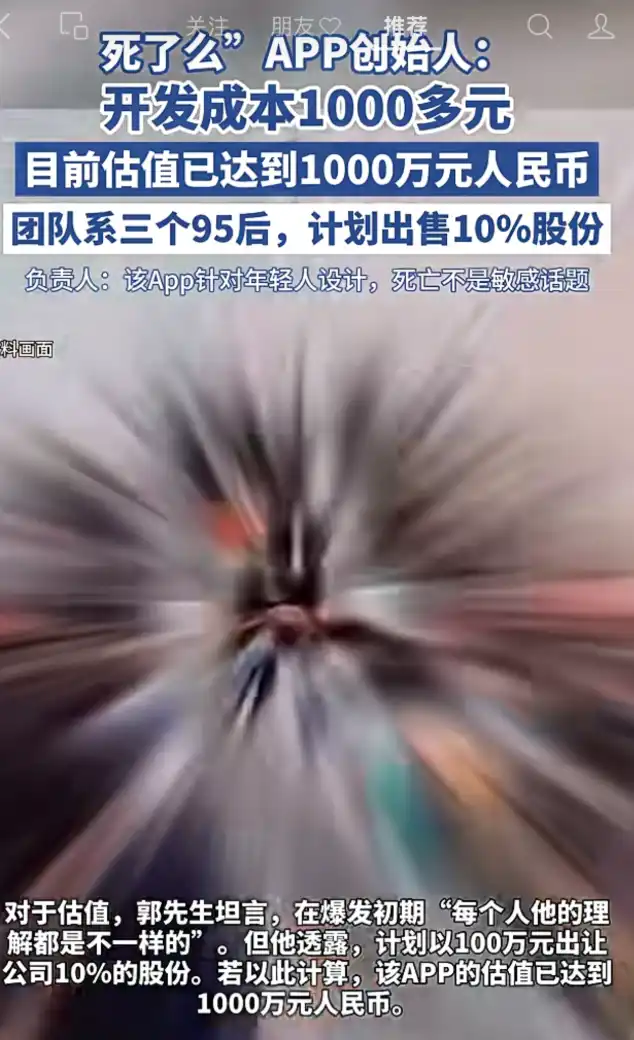
Three post-95s spent 1000 RMB and took less than a month to create an App.
Now it's valued at 10 million. A ten-thousand-fold increase.
This App is called "Is He Dead", and its function is ridiculously simple: open it every day and check in to prove you're still alive. If you don't check in for two consecutive days, the system automatically sends an email to your emergency contact.
That's it?
Yeah, that's it.
On January 8th, it topped the Apple paid charts, costing 8 RMB to download. Founder Mr. Guo said that the number of paying users has increased 200-fold in the past few days and is still rising.
Capital came knocking. Mr. Guo said he plans to sell 10% of the shares for 1 million RMB. Doing the math, that's a valuation of 10 million.
The name "Is He Dead" comes from a viral internet meme a few years ago.
Someone asked on a social platform: What App does everyone need and will definitely download?
A highly upvoted answer: Is He Dead.
Mr. Guo and his team saw this discussion and thought it had potential. They went to trademark the name and found that surprisingly, no one had registered it.
So they made it.
Why did something so simple become popular?
China's solo-living population exceeded 120 million in 2024. By 2030, it's projected to be 150 to 200 million. These people live in rental apartments in cities like Beijing, Shanghai, Guangzhou, and Shenzhen, sharing a common, very real anxiety:
If something happens to me at home one day, how long will it take for someone to find out? So, 8 RMB buys the confirmation that "someone knows I'm still alive."
Less than 24 hours after "Is He Dead" went viral, a copycat appeared.
An App called "Is He Alive" was listed on the Apple App Store, with exactly the same function, free to download.
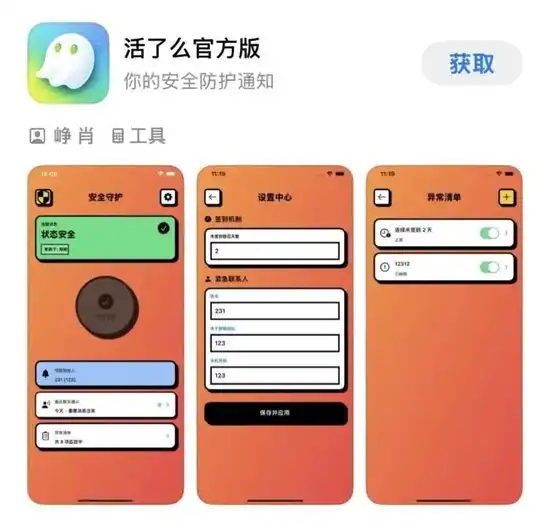
In response, Mr. Guo was very calm: The advantage of this product is not its technical barrier, but its discovery of user needs.
Translation: You can copy the function, but you can't copy my name.
Indeed. The three words "Is He Dead" are the most valuable part of this product. If it had been called "Solo Living Safety Guard," it would probably still be gathering dust in a corner of the App Store.
Looking back, an APP with no technical barrier, costing 1000 RMB, valued at 10 million, is that expensive?
Well, you might want to look at the valuation methods once used in the crypto industry?
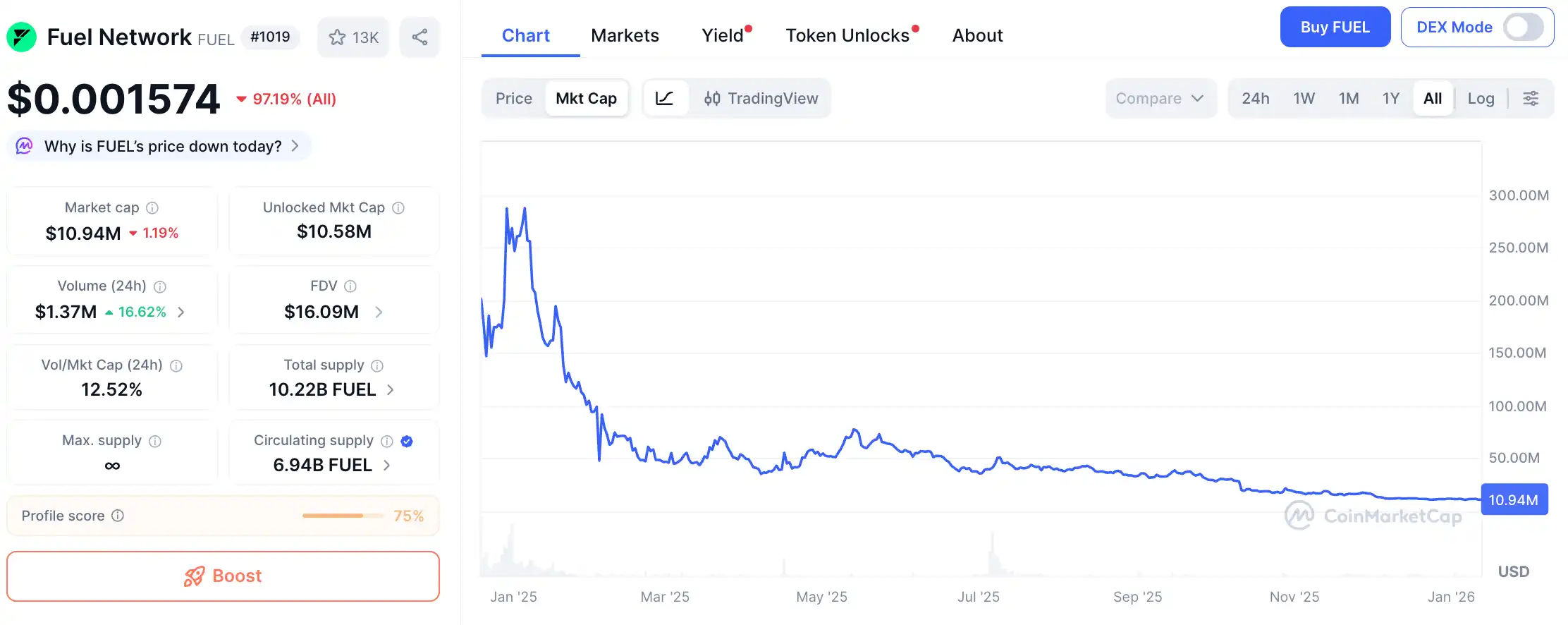
In 2025, there was a crypto project called Fuel Network, working on a "modular blockchain execution layer." VCs gave it a valuation of 1 billion USD, roughly over 7 billion RMB.
700 times the valuation of "Is He Dead".
What does Fuel Network have?
A whitepaper, a roadmap, endorsements from a bunch of Tier1 institutions, videos of the founders speaking at major conferences.
But not many people actually using it.
What is Fuel Network's market cap now? Around 16 million USD. Down about 99% from its peak.
I'm not saying all crypto projects are scams.
I'm saying:
In the crypto world, a project can have no users, no revenue, no one actually using it, and still get a valuation of 1 billion USD.
In the world of "Is He Dead", you need people to actually pay 8 RMB to download it for it to count.
One gives a valuation first and then looks for users. The other has users first and then discusses valuation.
Which is more reasonable? I don't know.
What's more absurd is that the logic of "Is He Dead" is almost heresy in the crypto world.
You tell everyone: We have real users, real payments, solving a real need.
People will definitely ask: What's the narrative? The token economic model? What's the FDV?
You say: No token, just selling the App, 8 RMB each.
Everyone: Then why would I invest in you?
This isn't a joke. The crypto industry's valuation system operates like this.
Users aren't important, revenue isn't important; what's important is whether the story is sexy enough, whether the token can list on major exchanges, and whether the unlock schedule is long enough for early investors to have time to dump.
If "Is He Dead" issued a token, created a "Solo Living Chain", and painted a big picture of the "global loneliness economy", its valuation might really increase tenfold.
But then, it might not have real users anymore.
Perhaps the reason "Is He Dead" became popular is precisely because it serves people who have this anxiety but don't actually need it that badly.
The people who truly need it probably can't use it.
This is actually quite similar to the crypto industry:
Those who truly need "financial inclusion" are often the ones who can least use DeFi.
In the end, whether 10 million is expensive depends on what ruler you use.
Using the internet ruler: one month of development, a team of three, no funding, no burning cash, reaching number one on the paid charts, 10 million is not expensive.
Using the crypto ruler: no token, no narrative, no FDV, only 10 million? That's too cheap. How about issuing a token?
I think the most ironic point is the divide between Web2 and Web3:
In one world, "having users" is a prerequisite for valuation. In another world, "having users" is an accident of valuation.
After writing this, I actually downloaded "Is He Dead" and checked in.
8 RMB for peace of mind.
At least it's more reliable than most of the shitcoins I've bought.