Airwallex Invests in Metal: How Stablecoins Reconnect with the Real Financial System?

Foresight News2026-07-03 tarihinde yayınlandı2026-07-03 tarihinde güncellendi

Özet

Airwallex Invests in Metal: How Stablecoins Connect Back to the Real Financial System? Airwallex, a global financial platform for businesses, has completed a $3.2 billion Series H funding round at an $11 billion valuation. Concurrently, it co-led the seed round for Metal, a "tokenized financial products infrastructure" project, becoming its first design partner. This move signals Airwallex's strategic shift beyond traditional cross-border payments. It aims to leverage its decade of experience in licenses, local payment networks, and API infrastructure to address a new challenge: facilitating the entry of stablecoins, tokenized assets, and AI agents into enterprise financial systems. This involves handling critical functions like authorization, compliance, currency exchange, fiat on/off-ramps, and final settlement. Metal positions itself not merely as another stablecoin payment solution but as a compliant settlement layer (Layer 1 blockchain) designed for regulated financial institutions. It targets a broader scope of tokenized financial products, including stablecoins, tokenized deposits, and securities. The core challenge it addresses is connecting efficient on-chain assets with the complex realities of corporate finance, such as multi-currency bank accounts, securities, compliance checks, and local regulations. Airwallex's investment, alongside its founder-backed fund Capital49, provides Metal with crucial real-world infrastructure: access to local payment networks cove...


Written by: KarenZ, Foresight News


Moving money from New York to Singapore, the hardest part might not be 'moving fast.' It also needs to know who can move this money, which currency to convert it into, what compliance rules to follow, and finally, which bank account it should land in. As AI Agents start placing orders, making payments, and managing accounts for businesses, these problems will only be magnified.


On June 25th, Airwallex (Airwallex) completed a $320 million Series H financing round, reaching a valuation of $11 billion, and announced that the funds would be directed towards financial intelligence, agent commerce, global infrastructure, and compliance expansion.


On the same day, Metal announced that Airwallex and Capital49 (an independent venture capital fund founded by the Airwallex founding team) jointly led its seed round, with Airwallex becoming Metal's first design partner.


From a Web3 perspective, putting these two pieces of news together, the focus is not just on a strategic investment by Airwallex in Metal. More noteworthy is that Airwallex is placing the licenses, local payment networks, and API infrastructure it has accumulated over the past decade into a new proposition: when stablecoins, tokenized assets, and AI Agents are all to enter the enterprise financial system, who will be responsible for authorization, compliance, currency exchange, on/off-ramping, and final settlement?


From Cross-Border Payments to Agent Finance, Airwallex Aims to Get Closer to the Foundation


Airwallex's story has always been related to cross-border finance. In 2015, Jack Zhang and several entrepreneurs encountered the inefficiency, delays, and high costs of traditional banks and foreign exchange systems firsthand while running a cafe in Melbourne, leading to the founding of Airwallex.


Today, Airwallex positions itself as a modern financial platform for global businesses, connecting banks, payments, software, and AI.


This company has evolved from 'helping businesses receive and send cross-border payments cheaper and faster' to a more complex position. According to Airwallex's website, it currently supports over 200 countries, covers over 120 countries for local transfers, has processed over $287 billion in global payments cumulatively, with 92% of transfers settled on the same day and 50% processed instantly. The company also holds over 85 licenses and registrations, has over 2,300 employees, and 27 international offices.


The Series H financing round on June 25th made this direction even clearer. Airwallex officially announced that this round was led by existing shareholder Addition, with participation from existing and new investors including Baillie Gifford, Hummingbird, QED Investors, T. Rowe Price, Hedosophia, Haun Ventures, Washington University in St. Louis, and Amex Ventures.


The funds will be used to accelerate the research and development of financial intelligence and agent commerce products, expand global infrastructure and compliance in new markets, and grow the team to build next-generation AI-native financial software.


Jack Zhang's statement in the announcement is key. He said we are at a crucial juncture in the history of global financial development; ten years ago, the company could not clearly foresee the shape of the agent economy, but the financial licenses, local network integrations, and API-first financial infrastructure built over the past decade happen to fit the needs of today's agent economy.


This statement also explains why Airwallex is interested in Metal. Agent commerce is not as simple as getting AI to click a few more buttons. Once AI Agents start handling procurement, payments, reimbursements, foreign exchange, subscriptions, and revenue management for businesses, they require financial infrastructure that can be authorized, have limits set, settle across currencies, and undergo compliance reviews. Airwallex's licenses, local payment networks, and API capabilities are the entry point for this system in the real world.


What Metal Aims to Do Is Not 'Just Another Stablecoin Payment'


Six months ago, Loong Wang (co-founder of Metal) met Jack Zhang through a mutual friend and investor. Loong wrote in Metal's official blog that the two quickly began discussing a new type of financial infrastructure: it needed to be global, neutral, and institution-ready, capable of serving the next phase of finance represented by AI Agents, stablecoins, and tokenized financial products.


Metal defines itself as 'tokenized financial products infrastructure.' It is betting not on a single stablecoin payment scenario, but on a broader range of tokenized financial products, including stablecoins, tokenized bank deposits, money market products, US short-term treasuries, stocks, and securities. The application directions listed on Metal's website also include: tokenized financial products, stablecoin payments, inter-institutional settlement, micropayments, AI Agents, and embedded finance.


Stablecoins have already proven the efficiency of on-chain US dollars. They can make dollars cheaper, faster, and liquid 24/7. The judgment cited in Metal's official blog is that stablecoins have been growing at about 100% annually in recent years and are expected to reach a circulation of about $500 billion and a transaction volume of about $17.5 trillion by the end of 2026.


But corporate finance is far more complex than 'transfers.' Real-world settlement also involves bank deposits, securities, money market funds, foreign exchange conversion, accounts receivable, anti-money laundering reviews, regional rules, internal institutional risk control, and local on/off-ramps. Stablecoins are like a highway, but businesses need the highway, toll booths, customs, warehouses, and city roads to operate together.


This is also why Metal chose to build a compliant settlement network. Jack Zhang, when reposting Metal's announcement on June 25th, stated that Metal is a Layer 1 blockchain designed for 'large-scale compliant global settlement,' filling the infrastructure gap for licensed financial institutions to move and settle stablecoins securely, efficiently, and within a regulatory framework.


Catherine Porter, another co-founder and president of Metal, previously led partnerships for the Libra project and served as an advisor to Mysten Labs and Aptos.


The Position of Airwallex, Capital49, and Jack Zhang


The combination of Airwallex and Capital49 in Metal's seed round is very informative.


Metal stated that through the partnership with Airwallex, the Metal infrastructure will gain support from a local payment network covering 200 countries and 90 currencies.


This means Airwallex brings Metal not just brand endorsement, but a crucial piece of the puzzle for 'how on-chain assets enter the real world.' If tokenized financial products cannot enter bank accounts, local currencies, and corporate financial systems, it's difficult for them to evolve from on-chain narratives to institution-grade settlement tools. Airwallex's strengths lie exactly here: local payment networks, foreign exchange capabilities, licenses, APIs, and corporate finance scenarios.


The role of Capital49 is more like an early-stage capital extension of the Airwallex founders' network. Capital49 is a new venture capital fund backed by Airwallex founders, investing in fintech, e-commerce, artificial intelligence, and B2B software. One of its advantages is enabling portfolio companies to access potential clients, service providers, and advisory resources within Airwallex's global network.


Interpreting Airwallex and Capital49 jointly leading the investment in Metal simply as 'a payment company investing in a Web3 project' would be inaccurate. More precisely, it's a company with existing global financial infrastructure, together with the founder capital network behind it, betting on the next-generation settlement layer. This settlement layer must handle stablecoins, but also AI Agents, tokenized assets, compliance authorization, and local on/off-ramping.


Jack's change in attitude can also be viewed within this framework. On June 7, 2025, Jack publicly questioned the claim that 'stablecoins can reduce foreign exchange fees.' His core point at the time was that if a user sends money from USD to EUR, and the recipient ultimately needs to receive euros in their bank account, the cost of off-ramping stablecoins to local currency might be higher than the interbank forex market.
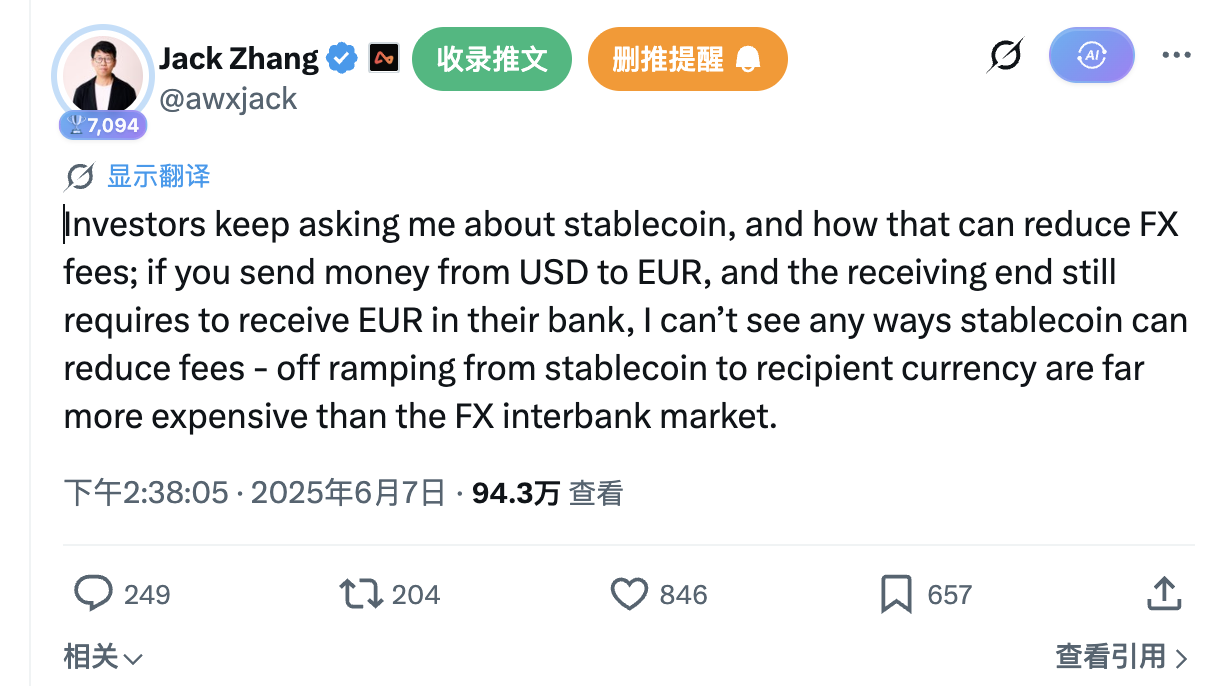


A year later, he publicly supports Metal, emphasizing its capabilities for compliant global settlement for licensed financial institutions. The change here is not simply 'from doubting stablecoins to being optimistic about stablecoins.' What he supports now is an infrastructure solution that integrates stablecoins, compliance, on/off-ramping, local currencies, institutional settlement, and agent commerce.


In addition, Airwallex's same-day announcements of T:0 and Airi can also be observed together. T:0 is an AI-native financial platform aiming to handle financial functions like bookkeeping, financial forecasting, tax processing, compliance control, and financial report generation from a company's first day. Airi is positioned as the wallet infrastructure for agent commerce. Early test data provided by Airwallex shows its one-click settlement feature can help merchants increase conversion rates by up to 14%. In the future, it will also cover capabilities like smart agent authorized payments, spending limit controls, permission management, and multi-currency balance management.


This indicates that Airwallex is not just observing AI Agents and on-chain finance from the sidelines. It is actively incorporating corporate finance and agent commerce into its product roadmap. Metal may become another piece of the puzzle: when agents need to complete payments and settlements cross-border, cross-currency, and cross-institution, the underlying network must simultaneously handle speed, fees, authorization, privacy, compliance, and on/off-ramping.


The Real Test is Reconnecting On-Chain Assets to the Real World


Metal's public materials have not yet disclosed its fundraising amount, mainnet launch timeline, full technical whitepaper, or actual customer list. Therefore, judging Metal's potential success now cannot rely solely on vision.


What it truly needs to prove are three things: Can compliance and privacy coexist within the same system? Are institutions willing to connect their real settlement processes? Can a reusable product loop be formed between Airwallex's payment network and the flow of on-chain assets?


Whoever can integrate licenses, local payments, APIs, compliance, AI Agents, and tokenized assets into the same infrastructure will have the opportunity to evolve on-chain finance from 'faster dollars' towards a truly usable global settlement system.

İlgili Sorular

QWhat are the key directions for Airwallex's $320 million Series H funding?

AThe funding will be used to accelerate the development of financial intelligence and intelligent agent commerce products, expand global infrastructure and compliance layouts into new markets, and expand the team to build next-generation AI-native financial software.

QWhat is Metal building, and what problem does it aim to solve for enterprise finance?

AMetal is building a compliant settlement network, specifically a Layer 1 blockchain designed for 'large-scale compliant global settlement'. It aims to fill the infrastructure gap for licensed financial institutions to move and settle stablecoins safely, efficiently, and within regulatory frameworks, addressing the complexities of real-world enterprise settlements beyond simple transfers.

QWhat key infrastructure does Airwallex bring to its partnership with Metal?

AAirwallex brings its global network covering 200 countries and 90 currencies, including local payment networks, foreign exchange capabilities, numerous licenses and registrations (over 85), API infrastructure, and enterprise financial scenarios. This provides a crucial bridge for how on-chain assets can enter the real-world banking and corporate finance systems.

QAccording to the article, what is the significance of the combined investment from Airwallex and Capital49 in Metal?

AIt represents more than just a payment company investing in a Web3 project. It signifies that a company with established global financial infrastructure (Airwallex) and its founders' capital network (Capital49) are jointly investing in the next-generation settlement layer designed to handle not just stablecoins, but also AI Agents, tokenized assets, compliance authorization, and local on/off-ramping.

QWhat three things does Metal ultimately need to prove, according to the article's conclusion?

AMetal needs to prove: 1) Whether compliance and privacy can co-exist within its system. 2) Whether institutions are willing to connect their real settlement processes to it. 3) Whether Airwallex's payment network and the flow of on-chain assets can form a reusable, closed-loop product.

İlgili Okumalar

Solana Ecosystem Shows Signs of Recovery: On-Chain Governance Upgrade, Tokenized Stocks and Meme Coins Heat Up

Solana Ecosystem Shows Signs of Revival: Governance Upgrades, Tokenized Stocks, and Memecoins Heat Up While the broader crypto market faces a downturn, Solana has shown relative strength with its price rising nearly 15% recently. This resilience is attributed to warming ecosystem activity, particularly in tokenized stocks and memecoins, coupled with a major upgrade to its on-chain governance. In the Real World Assets (RWA) sector, Solana now leads all public chains in both the number of unique holder wallets and the quantity of RWA assets. Its tokenized stock weekly trading volume has surged to a record $1.42 billion, capturing about 96% of the market share, largely driven by the Backpack exchange. Simultaneously, the Solana memecoin sector has reignited, fueled by the rapid ascent of the ANSEM token following endorsements from a prominent crypto influencer. This has boosted activity across platforms like Pump.fun and increased fee revenue for several Solana-based exchanges. A key development is the launch of Solana Governance Proposals (SGP), a new on-chain mechanism. It allows validators with at least 100,000 SOL delegated to submit proposals for community vote, enhancing decentralized decision-making. SGP will operate alongside the existing technical proposal process (SIMD), focusing on broader ecosystem governance. Despite these positive signals in specific areas, overall on-chain activity and transaction volumes still lag behind previous bull market peaks, indicating the recovery remains partial rather than ecosystem-wide.

marsbit10 dk önce

Solana Ecosystem Shows Signs of Recovery: On-Chain Governance Upgrade, Tokenized Stocks and Meme Coins Heat Up

marsbit10 dk önce

While Semiconductor Stocks Plunge, Anthropic Plans to Develop a 2nm Chip

Anthropic, the AI company behind Claude, is exploring the development of its own custom AI chip, according to a report from The Information. The company is in early discussions with Samsung Electronics to manufacture the chip using Samsung's most advanced 2-nanometer process and packaging technology. While the project is still in preliminary stages, including defining chip specifications, and could be abandoned, it marks a strategic step for Anthropic. The move comes as the company seeks greater control over its computing costs and hardware optimization, particularly for inference tasks to run its models more efficiently and cheaply. Samsung's potential involvement follows its participation as a strategic investor in Anthropic's recent $65 billion funding round. For Samsung, partnering with a major AI lab represents a significant opportunity for its foundry business to compete with market leader TSMC in advanced semiconductor manufacturing. Anthropic's CEO, Dario Amodei, has previously highlighted the immense financial challenge of securing enough computing power for anticipated growth, making cost-effective inference a critical focus. The company would join other tech giants like Google, Amazon, Microsoft, Meta, and OpenAI in pursuing custom AI silicon. However, analysts note this trend creates deeper interdependencies rather than independence, as US AI labs become more tightly woven into Asian semiconductor supply chains. Despite this move, Anthropic remains heavily reliant on a multi-cloud, multi-vendor strategy for its immediate computing needs. It has secured massive, long-term commitments for capacity from Amazon Web Services (Trainium chips), Google (TPUs), and even leased a large GPU cluster from xAI. For now, Nvidia continues to dominate the AI chip market, with its share reportedly growing to 74%.

链捕手12 dk önce

While Semiconductor Stocks Plunge, Anthropic Plans to Develop a 2nm Chip

链捕手12 dk önce

Korean Companies Following Strategy in Accumulating Cryptocurrency: From Bull Market to Delisting?

Title: Korean DAT Companies Following "Strategy" Bitcoin Hoarding Model Face Delisting Amid Bear Market Summary: Several Korean KOSDAQ-listed companies, known as Digital Asset Trusts (DATs), are at risk of being delisted due to a combination of stricter regulatory thresholds and a downturn in crypto markets. These firms, inspired by models like Strategy and Japan's Metaplanet, raised capital to buy Bitcoin, relying on a cycle of rising crypto prices to boost their stock value. However, recent reforms in Korea have raised the minimum market capitalization required to stay listed from 150 billion won to 200 billion won (approx. $1.3M), with a further increase to 300 billion won set for next January. The new rules also close loopholes like reverse stock splits used to artificially inflate share prices. The situation is exacerbated by a significant drop in Bitcoin's price from its 2025 peak and a weak KOSDAQ market. While the main KOSPI index has surged nearly 95% year-to-date, KOSDAQ has fallen about 10%, draining liquidity from smaller companies. Many DATs now hover near or below the new market cap thresholds and must also book substantial valuation losses on their Bitcoin holdings. Analysts suggest that without a sustained recovery in both crypto prices and broader market interest in KOSDAQ stocks, these companies have limited options to avoid delisting, marking a precarious moment for Korea's crypto-linked public companies.

marsbit22 dk önce

Korean Companies Following Strategy in Accumulating Cryptocurrency: From Bull Market to Delisting?

marsbit22 dk önce

Korean Companies That Learned to Hoard Coins from MicroStrategy: From Bull Market to Delisting?

South Korean companies that adopted the “Digital Asset Treasury” (DAT) strategy—issuing shares to buy and hold Bitcoin, inspired by MicroStrategy—now face delisting risks on the KOSDAQ market. New regulations effective July 1, 2026, tightened listing maintenance rules, notably raising the minimum market capitalization threshold from 150 billion KRW to 200 billion KRW (about $1.3 million), with a further increase to 300 billion KRW scheduled for January 2027. Companies failing to meet both the share price and market cap requirements for specified periods risk being designated for delisting, with fewer options for financial engineering like stock splits to artificially boost prices. The downturn in cryptocurrency prices has severely impacted these firms. Bitcoin, which peaked above $120,000 in mid-2025, has fallen below $60,000, forcing DAT companies to report large valuation losses. Compounding this, the KOSDAQ index has dropped about 10% year-to-date, while the main KOSPI index surged nearly 95%, diverting investor interest away from smaller-cap stocks. Examples like BitPlanet (holding 300 BTC) and Parataxis Ethereum currently hover just above the new market cap limits, but face heightened scrutiny and potential delisting starting in 2027. Industry analysts warn that the combination of weak crypto markets, a struggling KOSDAQ, and stricter regulations creates a significant survival challenge for these companies, highlighting the risks of business models overly reliant on volatile digital asset prices.

链捕手26 dk önce

Korean Companies That Learned to Hoard Coins from MicroStrategy: From Bull Market to Delisting?

链捕手26 dk önce

İşlemler

Spot
活动图片