Korean Companies That Learned to Hoard Coins from MicroStrategy: From Bull Market to Delisting?

链捕手2026-07-03 tarihinde yayınlandı2026-07-03 tarihinde güncellendi

Özet

South Korean companies that adopted the “Digital Asset Treasury” (DAT) strategy—issuing shares to buy and hold Bitcoin, inspired by MicroStrategy—now face delisting risks on the KOSDAQ market. New regulations effective July 1, 2026, tightened listing maintenance rules, notably raising the minimum market capitalization threshold from 150 billion KRW to 200 billion KRW (about $1.3 million), with a further increase to 300 billion KRW scheduled for January 2027. Companies failing to meet both the share price and market cap requirements for specified periods risk being designated for delisting, with fewer options for financial engineering like stock splits to artificially boost prices. The downturn in cryptocurrency prices has severely impacted these firms. Bitcoin, which peaked above $120,000 in mid-2025, has fallen below $60,000, forcing DAT companies to report large valuation losses. Compounding this, the KOSDAQ index has dropped about 10% year-to-date, while the main KOSPI index surged nearly 95%, diverting investor interest away from smaller-cap stocks. Examples like BitPlanet (holding 300 BTC) and Parataxis Ethereum currently hover just above the new market cap limits, but face heightened scrutiny and potential delisting starting in 2027. Industry analysts warn that the combination of weak crypto markets, a struggling KOSDAQ, and stricter regulations creates a significant survival challenge for these companies, highlighting the risks of business models overly reliant on vo...

Author: Chloe, ChainCatcher

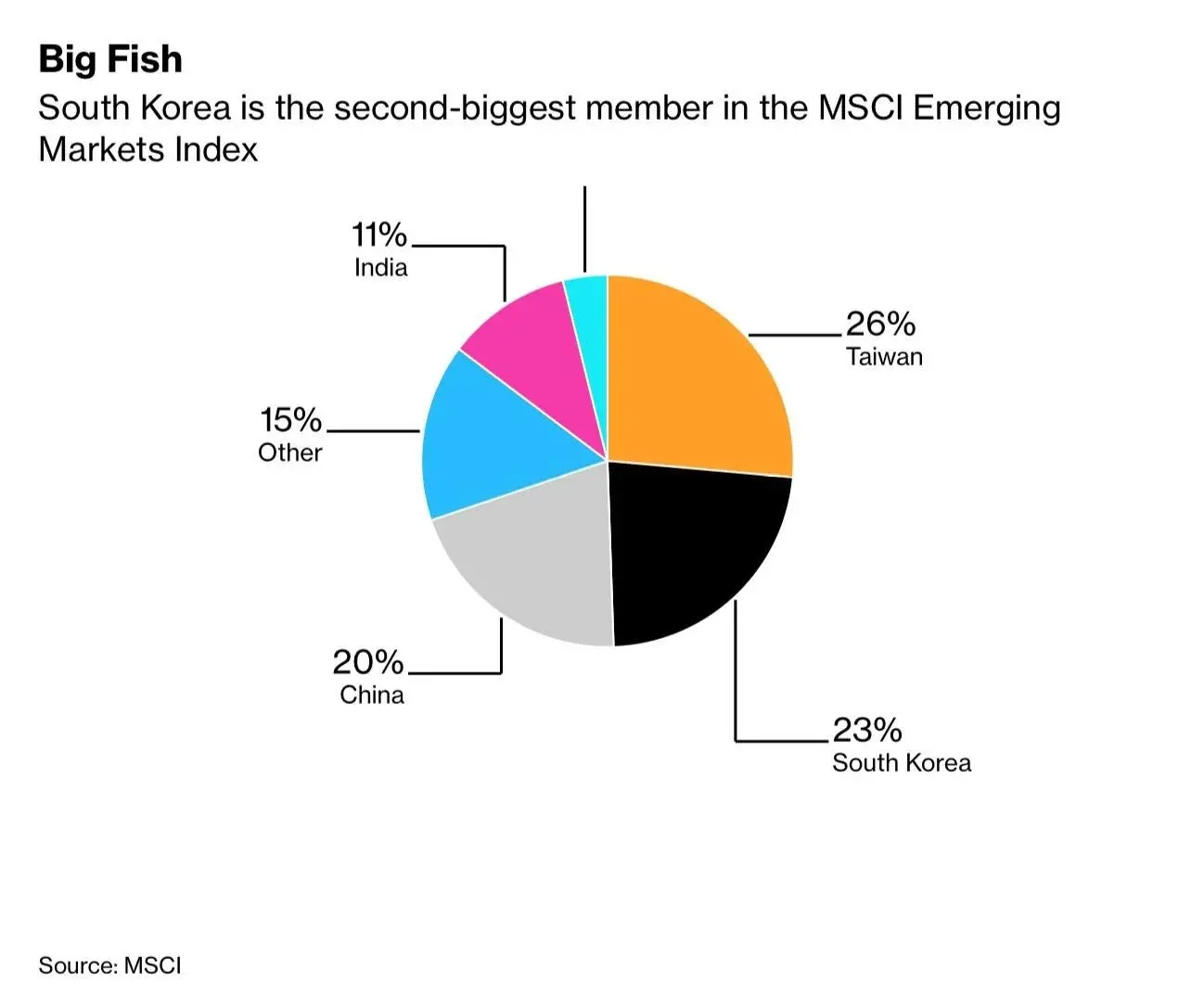
The KOSPI index has surged nearly 95% year-to-date, almost doubling. Just as the South Korean stock market is riding high, another group of Korean listed companies is gradually being squeezed out of the market.

According to The Chosun Ilbo, the revised listing regulations raising the threshold for maintaining a stock market presence in South Korea took effect on July 1. Some KOSDAQ-listed DAT companies that profited by investing in crypto assets now face delisting risks. They are caught between plummeting coin prices on one side and capital flight from the KOSDAQ market on the other. Their market capitalization continues to fall below new thresholds, putting them at imminent risk of being kicked out of the market.
South Korean Government Tightens Policies, Making it Difficult to Maintain Listed Status

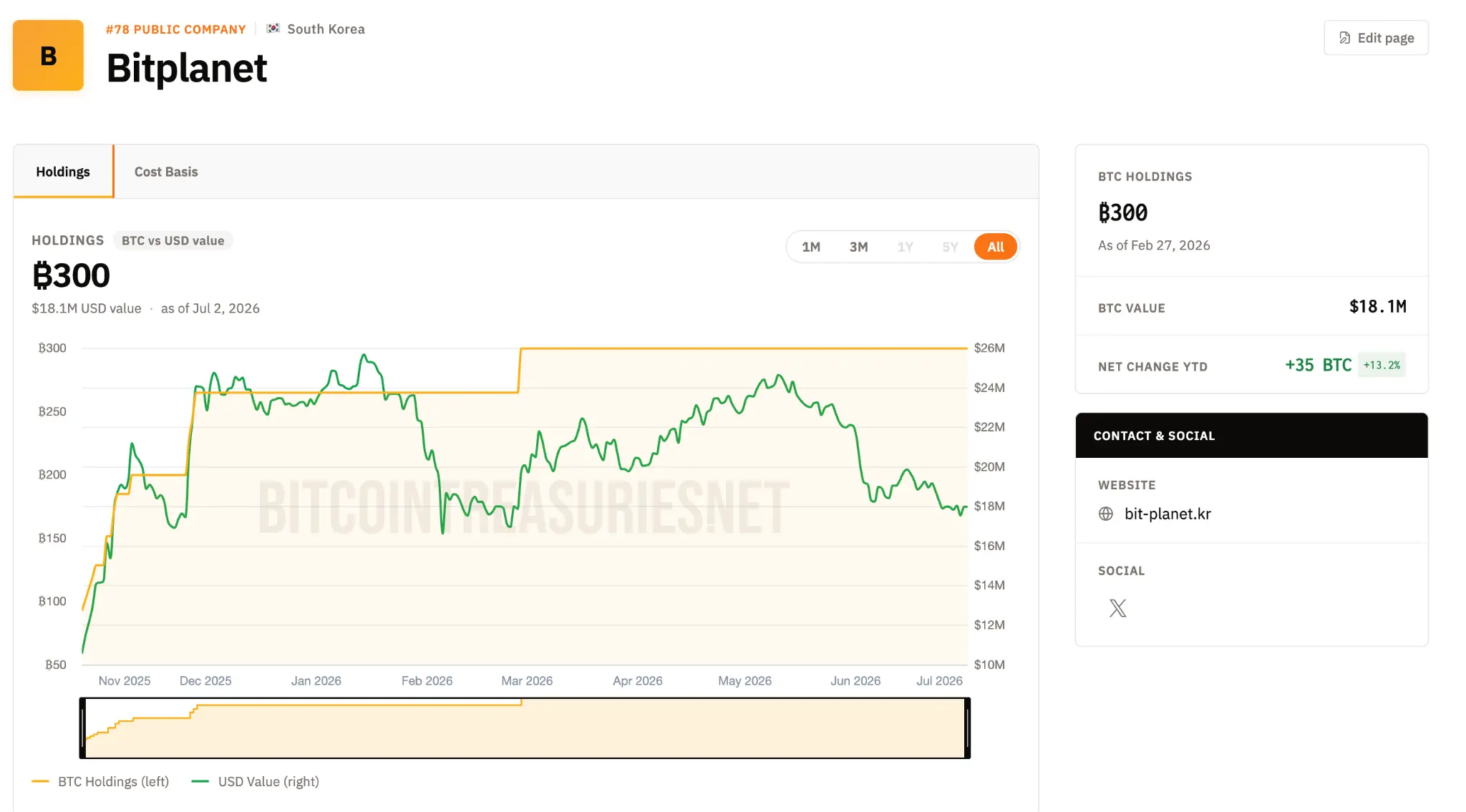
The DAT trend was pioneered by MicroStrategy, with Japan's Metaplanet following suit in the capital markets. Korean DAT companies are essentially replicating the same playbook. Take BitPlanet as an example. This company was formed in July 2025 from the acquisition of KOSDAQ-listed company SGA by a consortium led by Asia Strategy and Sora Ventures. It currently holds 300 Bitcoin, with a long-term goal of accumulating 10,000 BTC. Its CEO, Lee Seong-hoon, publicly stated that the inspiration for the company's model came from MicroStrategy and Metaplanet.
The problem is that this "issue shares, raise funds, buy coins, stock price rises" flywheel is highly dependent on rising coin prices. Once the coin price reverses, these mostly small and medium-sized Korean DAT companies face not a financing hurdle, but the hurdle of "whether they can maintain their listed status."

According to The Herald Business, this reform comprehensively tightens four major delisting requirements, with the market capitalization threshold posing the greatest threat to DAT companies. The market capitalization standard for maintaining a KOSDAQ listing has been raised from the current 15 billion won to 20 billion won (over 13 million USD), and will jump again to 30 billion won next January.

The new system's evaluation mechanism is quite tight: If a stock's price stays below 1,000 won or its market capitalization stays below 20 billion won for 30 consecutive trading days, it will be designated as a "Caution" stock. After designation, there is a 90-trading-day recovery period. If it fails to meet the standards for 45 consecutive trading days during this period, it officially enters delisting procedures. Crucially, the stock price and market capitalization criteria must be met "simultaneously"; failure in just one of them is sufficient grounds for delisting.

At the same time, past "stock price manipulation tricks" used by companies are being blocked. Previously, when stock prices were too low and nearing the delisting line, companies could consolidate several shares into one, immediately boosting the price per share, though the company's overall value remained unchanged. The Herald Business explains that the new rules aim to close this loophole. For example, a company with a share price of 300 won, even if it consolidates shares to raise the price to 1,200 won, will still be listed for delisting review if the per-share value after conversion remains low. Furthermore, companies that have already conducted a consolidation or capital reduction within the past year, once placed on the watchlist, are not allowed to use the same trick again; even if allowed, the consolidation ratio cannot exceed 10 to 1.

Other requirements have also been tightened: The timing for checking whether a company's capital is fully eroded has expanded from reviewing only year-end financial reports to also reviewing semi-annual reports. The threshold for delisting penalty points accumulated due to false or irregular disclosures has been lowered from 15 points to 10 points, and a single major or intentional violation is enough to trigger review. After being placed under delisting review, the maximum improvement period a company can request has been shortened from 18 months to 1 year.

KOSDAQ's Own Weakness, Compounded by a Weakening Crypto Market

According to The Chosun Ilbo, delisting risk is no longer hypothetical. Many companies are currently in a situation of being temporarily "compliant but unsafe": Parataxis Ethereum's market cap is about 26.8 billion won, BitPlanet's is about 33.1 billion won — both above the 20 billion won threshold for the second half of the year. However, Parataxis Ethereum faces potential risks compared to the 30 billion won standard taking effect next January. The worst situation is Parataxis Korea, which was already placed under substantive listing eligibility review in April due to capital erosion, and its stock has been suspended. The Chosun Ilbo points out that if the market capitalization decline trend continues, these DAT companies may face delisting procedures starting with BitMax early next year.

Looking back, the direct trigger for this crisis was weakening coin prices. According to Bloomingbit, Bitcoin once broke through $120,000 in July last year, driven by the start of Donald Trump's second U.S. administration and pro-crypto policies. However, it has retreated since the U.S.-China trade friction became a turning point last October, falling to the low $50,000 range this month. With coin prices falling in both the first and second quarters of this year, DAT companies have had to book large-scale valuation losses on their books. The impact on stock prices during the earnings season could be even greater.

Making matters worse is KOSDAQ's own weakness. While the KOSPI has almost doubled this year (up about 95%), the KOSDAQ has actually declined about 10%. Capital has concentrated on KOSPI blue-chip stocks like Samsung Electronics and SK Hynix, marginalizing the KOSDAQ and the DAT companies within it. These companies have tried to fill funding gaps by issuing convertible bonds (CB) and preferred shares, but have been unable to withstand the overall decline in crypto asset prices.

KOSDAQ's overall weakness is evident in the numbers. The Herald Business reports that the KOSDAQ index fell from 945.57 at the beginning of January to 851.37 last Friday, a drop of nearly 10%, dragging down the market capitalization of its component stocks. As of last week, excluding SPACs and preferred stocks, the number of KOSDAQ companies with market capitalizations below 20 billion won reached 178, accounting for about 10% of the total 1,748 companies. This is a nearly threefold increase from 66 at the beginning of the year. There were also 180 "penny stocks" trading below 1,000 won, with a combined market capitalization of 6.14 trillion won.

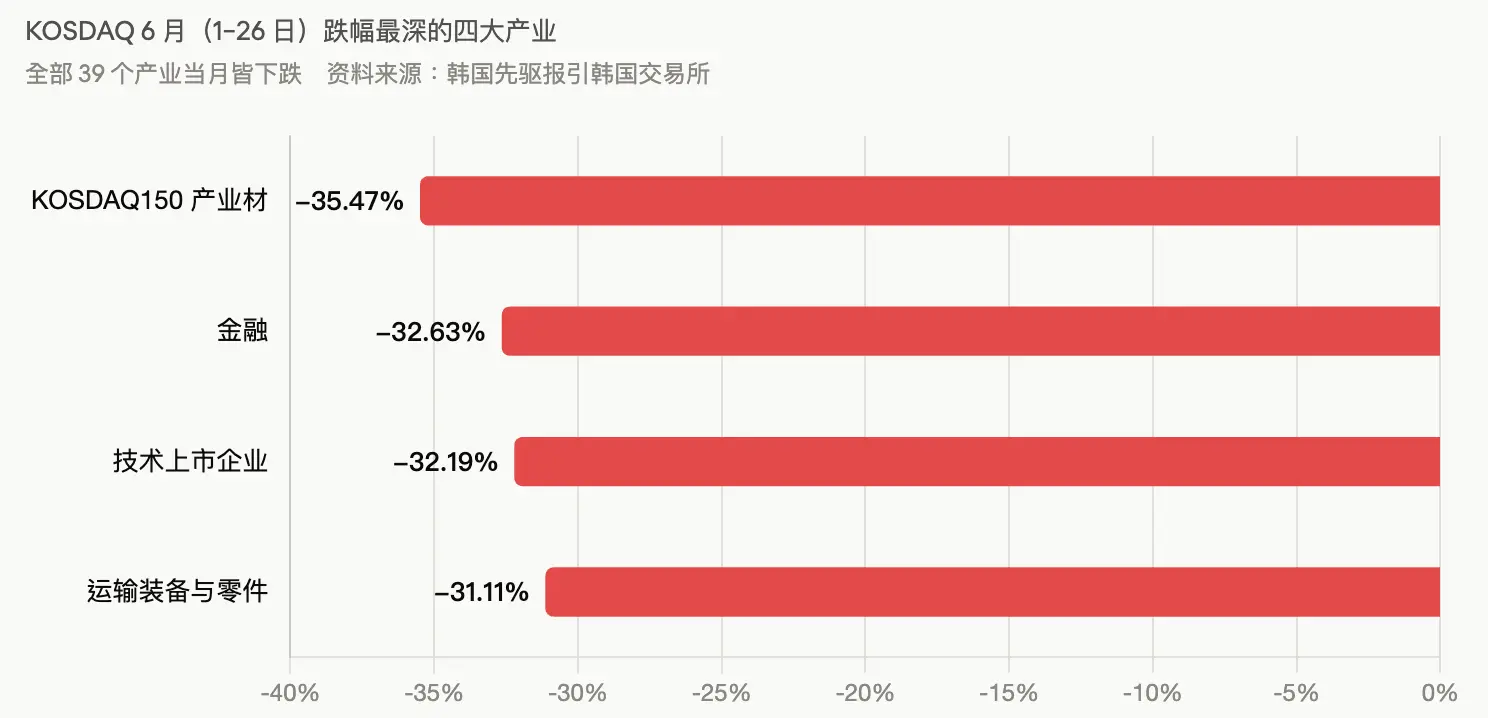
The Herald Business also cited Korea Exchange data, indicating that all 39 KOSDAQ sectors closed lower in June (1st to 26th), with the KOSDAQ150 Industrial Materials sector leading the decline at -35.47%. Sectors like Finance (-32.63%), Technology-Listed Companies (-32.19%), and Transportation Equipment & Parts (-31.11%) also fell more than 30%.
Conclusion

For these ultra-small companies, the room for self-rescue through financial engineering is being compressed. The Herald Business cites industry views suggesting that the "market cap requirement" under the new system will be harder to meet than the "stock price requirement." A source at a KOSDAQ-listed company admitted that while penny stocks can at least be propped up through capital reduction without compensation or share consolidation, it's difficult to meet the market cap target without a substantial increase in stock price. Relying on M&A for a quick fix isn't easy either. As long as KOSDAQ's downturn continues, more and more companies will fail to meet the market capitalization threshold.

A representative example is Hyungji I&C. In March, it conducted a 10-to-1 capital reduction without compensation, raising its share price to nearly 4,000 won. However, its market cap remained around 10.6 billion won, far below the new threshold. This illustrates that even if the stock price temporarily meets the standard, the market cap hurdle remains insurmountable. The Chosun Ilbo also emphasized that the revised listing regulations include provisions "restricting capital reduction and share consolidation after being designated as a caution stock," making it more difficult for companies without substantial stock price recovery to continue lingering in the market.

A Korea Exchange official downplayed the impact, stating that a delisting wave would not immediately occur in July, as companies placed on the caution stock list still have an improvement period before moving to the next step. However, securities analysts' judgment is more pessimistic. Lee Jae-won, a researcher at Yuanta Securities Korea, said that the current environment is favorable for the KOSPI in terms of capital supply and demand, earnings, and interest rates. KOSDAQ's relative weakness is likely to persist until the return of individual capital and the confirmation of an earnings forecast rebound.

In other words, while the overall Korean stock market is riding high, this group of crypto-themed stocks flying the banner of "Korean Version MicroStrategy" finds itself at a critical juncture of survival, caught in a three-pronged attack from coin prices, market capital, and new regulatory rules.


İlgili Sorular

QWhat new listing regulations are putting South Korean DAT companies at risk of delisting from KOSDAQ?

AThe revised listing regulations, effective July 1st, raise the market capitalization threshold for maintaining a listing on KOSDAQ from 15 billion won to 20 billion won (over $13 million), and further to 30 billion won starting next January. The new rules also close loopholes, such as preventing companies from artificially inflating share prices through reverse stock splits if the underlying value remains low.

QWhat is the 'flywheel' business model adopted by Korean DAT companies, and why is it currently under stress?

AThe 'flywheel' model, inspired by companies like Strategy and Metaplanet, involves issuing shares to raise capital, using that capital to buy cryptocurrencies (like Bitcoin), and relying on rising crypto prices to boost the company's share price. This model is currently under severe stress due to the recent sharp decline in cryptocurrency prices and the simultaneous weakness of the KOSDAQ market, which erodes their market capitalization.

QHow has the performance of the broader KOSDAQ market contributed to the difficulties faced by these crypto-related companies?

AWhile the main KOSPI index has surged approximately 95% year-to-date, the KOSDAQ index has fallen about 10%. This weakness is due to capital flowing heavily into large KOSPI blue-chip stocks, marginalizing smaller companies on KOSDAQ. The overall decline in the KOSDAQ index and its constituent companies' market caps directly pressures DAT companies trying to meet the new, higher market cap listing requirements.

QWhich specific DAT companies are mentioned as being at immediate risk of delisting according to the article?

AThe article mentions Parataxis Ethereum (market cap ~26.8 billion won, at risk under the future 30 billion won threshold), BitPlanet (~33.1 billion won), and Parataxis Korea, which has already had its shares suspended due to capital impairment. It suggests that BitMax could be one of the first to face delisting procedures starting early next year if trends continue.

QWhat are the two key criteria under the new regulations that can trigger a 'Caution' designation and potential delisting?

AUnder the new regulations, a stock can be designated as a 'Caution' (management) stock if its share price remains below 1,000 won for 30 consecutive trading days, OR if its market capitalization stays below 20 billion won (increasing to 30 billion won next year) for 30 consecutive days. Crucially, a company must meet BOTH criteria simultaneously to avoid the designation; failing either one is sufficient to initiate the delisting review process.

İlgili Okumalar

How Far Are We from the End of the Crypto Bear Market?

How Much Longer Until the Crypto Bear Market Ends? A persistent negative Coinbase Bitcoin Premium Index, reaching a record 46 consecutive days of negative values, underscores the ongoing crypto bear market. The downturn accelerated in late May/early June when MicroStrategy (referred to as "Strategy" in the text), a major BTC holder, sold a small amount of Bitcoin (32 BTC), shattering market confidence and triggering sharp declines in BTC, ETH, and SOL. This was compounded by sustained net outflows from US spot Bitcoin ETFs. June saw Bitcoin briefly fall below $60,000, its worst weekly performance since 2022, breaking below the critical 200-week moving average—a signal some analysts consider confirmation of a bear market. While some institutional analyses in mid-June suggested the bottom might be near (e.g., around $53,600 based on realized price, or a potential end during the 2026 World Cup summer), further price drops quickly disproved these optimistic forecasts. Key bear market indicators include: the severe de-pegging of MicroStrategy's preferred shares (STRC) from their $100 NAV, which later recovered partly due to company stabilization plans; a record number of BTC (over 10.83 million) and a significant portion of long-term ETH holders now in unrealized loss; and Bitcoin's price trading below its 200-week moving average. Predictions for the bear market's end vary. Some, like investor Yilihua, suggest July-August 2026 could present a final buying opportunity. Others, like miner Jiang Zhu'o'er, predict a bottom between $42,000-$44,000 in October-December 2026, based on the historical lag between MicroStrategy's mNAV ratio bottom and Bitcoin's price bottom. Technical indicators like the BTC 4-year average price index dipped briefly below 1, and the Coinbase Premium Index remains negative, suggesting a need for a price rebound to around $77,000 for a return to positive territory. In the absence of major external catalysts, the consensus leans toward the bear market persisting for another 2-3 months, with late September to early October 2026 being a potential turning point window.

Odaily星球日报51 dk önce

How Far Are We from the End of the Crypto Bear Market?

Odaily星球日报51 dk önce

Solana Ecosystem Shows Signs of Recovery: On-Chain Governance Upgrade, Tokenized Stocks and Meme Coins Heat Up

Solana Ecosystem Shows Signs of Revival: Governance Upgrades, Tokenized Stocks, and Memecoins Heat Up While the broader crypto market faces a downturn, Solana has shown relative strength with its price rising nearly 15% recently. This resilience is attributed to warming ecosystem activity, particularly in tokenized stocks and memecoins, coupled with a major upgrade to its on-chain governance. In the Real World Assets (RWA) sector, Solana now leads all public chains in both the number of unique holder wallets and the quantity of RWA assets. Its tokenized stock weekly trading volume has surged to a record $1.42 billion, capturing about 96% of the market share, largely driven by the Backpack exchange. Simultaneously, the Solana memecoin sector has reignited, fueled by the rapid ascent of the ANSEM token following endorsements from a prominent crypto influencer. This has boosted activity across platforms like Pump.fun and increased fee revenue for several Solana-based exchanges. A key development is the launch of Solana Governance Proposals (SGP), a new on-chain mechanism. It allows validators with at least 100,000 SOL delegated to submit proposals for community vote, enhancing decentralized decision-making. SGP will operate alongside the existing technical proposal process (SIMD), focusing on broader ecosystem governance. Despite these positive signals in specific areas, overall on-chain activity and transaction volumes still lag behind previous bull market peaks, indicating the recovery remains partial rather than ecosystem-wide.

marsbit1 saat önce

Solana Ecosystem Shows Signs of Recovery: On-Chain Governance Upgrade, Tokenized Stocks and Meme Coins Heat Up

marsbit1 saat önce

While Semiconductor Stocks Plunge, Anthropic Plans to Develop a 2nm Chip

Anthropic, the AI company behind Claude, is exploring the development of its own custom AI chip, according to a report from The Information. The company is in early discussions with Samsung Electronics to manufacture the chip using Samsung's most advanced 2-nanometer process and packaging technology. While the project is still in preliminary stages, including defining chip specifications, and could be abandoned, it marks a strategic step for Anthropic. The move comes as the company seeks greater control over its computing costs and hardware optimization, particularly for inference tasks to run its models more efficiently and cheaply. Samsung's potential involvement follows its participation as a strategic investor in Anthropic's recent $65 billion funding round. For Samsung, partnering with a major AI lab represents a significant opportunity for its foundry business to compete with market leader TSMC in advanced semiconductor manufacturing. Anthropic's CEO, Dario Amodei, has previously highlighted the immense financial challenge of securing enough computing power for anticipated growth, making cost-effective inference a critical focus. The company would join other tech giants like Google, Amazon, Microsoft, Meta, and OpenAI in pursuing custom AI silicon. However, analysts note this trend creates deeper interdependencies rather than independence, as US AI labs become more tightly woven into Asian semiconductor supply chains. Despite this move, Anthropic remains heavily reliant on a multi-cloud, multi-vendor strategy for its immediate computing needs. It has secured massive, long-term commitments for capacity from Amazon Web Services (Trainium chips), Google (TPUs), and even leased a large GPU cluster from xAI. For now, Nvidia continues to dominate the AI chip market, with its share reportedly growing to 74%.

链捕手1 saat önce

While Semiconductor Stocks Plunge, Anthropic Plans to Develop a 2nm Chip

链捕手1 saat önce

İşlemler

Spot
活动图片