Summary:
The factory construction speed and capital investment speed of upstream component companies far outpace the commercialization and landing speed of downstream robot systems.
Produced by Phoenix Net Technology's "Fengyan Observation"
Without Yushu Technology, probably few people would have noticed Beite Technology.
This is a typical Chinese manufacturing company: it has been making automotive parts for over 20 years, its clients and products are hidden deep within the automotive supply chain, with annual revenues exceeding 2 billion RMB, yet it rarely enters the view of ordinary consumers.
But Yushu's upcoming IPO changed that. In the past two days, Beite Technology's stock has surged continuously, and it has been pushed to the forefront in the market-compiled list of Yushu robot concept stocks.
What's even more intriguing is that behind these consecutive surges: this company, which seems to have nothing to do with robots, has quietly made a massive 1.85 billion RMB bet on robots.
What exactly did it see?

Yushu Pushed an Old Company Back into the Spotlight
On the eve of Yushu Technology's IPO, the humanoid robot sector heated up again. On August 11th, Beite Technology hit the daily limit up; in the market-compiled list of Yushu robot concept stocks, Beite Technology was once again pushed to the very front.
But it might be the strangest robot concept stock recently.
Because for over twenty years, it has been doing something completely unrelated to robots: making parts for cars. So why did an auto parts company suddenly become the 'face' of humanoid robot concept stocks?
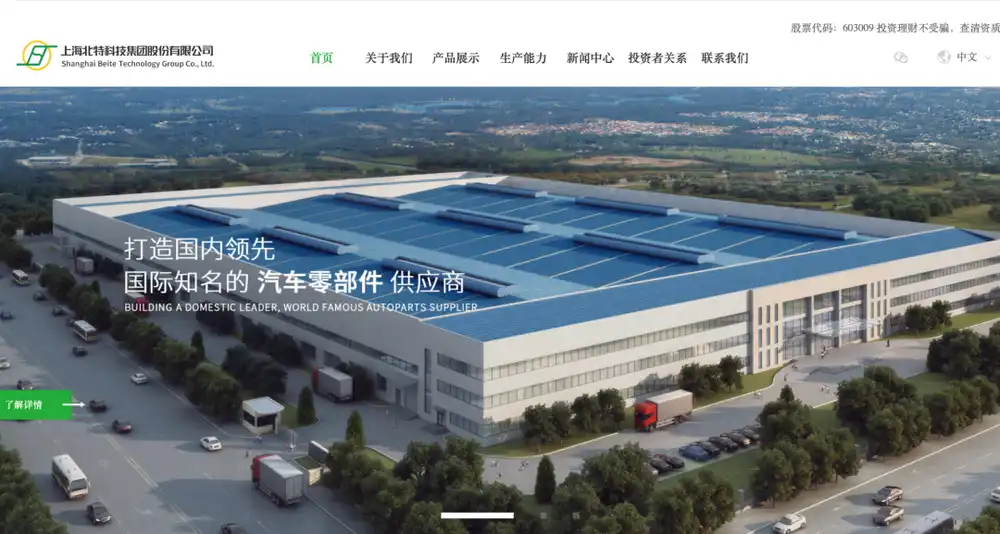
Image|From company official website
The reason isn't complicated. In the past, when the robot track was still in its infancy, system integrators were the industry's hallmark, so everyone only saw companies like Yushu, Zhiyuan, Ubtech, Figure, Tesla, etc. As humanoid robots gained popularity, the market started tracing downstream: who is making the robot joints?
Because what really determines whether robots can be mass-produced is not just the 'brain,' but also the body. Beite is precisely such an old manufacturing company rediscovered by the robot wave.
In the past, it long produced steering rack bars, shock absorber piston rods, automotive chassis components—things that seem to be from a completely different world than robots. But there is a common capability behind them: metal materials + precision machining + heat treatment + precision control + mass manufacturing.
After robots arrived, Beite suddenly realized that its decades of accumulated expertise could also find application in robots.
However, Phoenix Net Technology noted that Beite's total revenue for 2025 was 2.3 billion RMB, with a net profit of only 120 million RMB, yet it allocated 1.85 billion RMB to bet on planetary roller screws.
In 2024, it invested 1.85 billion RMB to build a planetary roller screw R&D and production base in Kunshan, completed by the end of 2025, with mass production expected in 2026, reaching an annual capacity of 2.6 million sets. Combined with its overseas layout in Thailand of 800,000 sets, the total capacity upon completion will reach 3.4 million sets.
But the problem is, it is currently only collaborating with industry chain clients like Yushu on sample R&D; it hasn't been formally designated or formed batch deliveries. Simply put, right now, it hasn't sold a single screw.
This is almost equivalent to betting an entire year's net profit, plus the family savings of the past few years, all on a new track that currently shows no immediate returns.
This is a huge gamble.

68-Year-Old Jin Kun, Betting Once Again
What's truly interesting about this 1.85 billion RMB is not just the money, but the person who decided to make this bet—Jin Kun, 68 years old this year.
If you were 68 years old, already had a listed company, and had proven over the past 20+ years that you could stand firm in the automotive supply chain, would you still have the courage to bet on a not-yet-mature industry again?
Most people's answer would probably be no. But Jin Kun chose to gamble once more. This time, he's betting on robots.

Beite Technology founder Jin Kun, Image|From the internet
Early on, Jin Kun worked at a steel enterprise in Anda, Heilongjiang, rising from Purchasing Department Head to Factory Director, and later entered enterprise management.
It wasn't until 2002 that 44-year-old Jin Kun, with 4.5 million RMB in hand, co-founded Shanghai Beite Metal Products Co., Ltd. In its initial stage, Beite bet on the automotive industry, making metal components like automotive steering rack bars and shock absorber piston rods.
Over the next decade-plus, China's automotive industry experienced rapid growth. In 2002, car sales were less than 4 million units, but by 2015, annual car sales in China had exceeded 24 million units, making it the world's largest automotive market for many consecutive years.
Beite also expanded continuously during this industrial expansion. By its 2014 listing on the Shanghai Stock Exchange, Beite's revenue had exceeded 630 million RMB. In the niche markets of steering rack bars and shock absorber piston rods, Beite captured over 30% market share, becoming a core supplier for giants like FAW and Bosch.
By this time, Jin Kun held an absolute controlling stake of 52.82% in the company. During the 2015 bull market wave, his paper wealth also rose with the stock price.
If the automobile was one of the most important manufacturing increments in China over the past two decades, then will it be the robot's turn in the next ten years?
And the screw just happens to be a type of component connecting these two industries.
During the automotive era, Beite accumulated capabilities in manufacturing precision metal components; in the robot era, it also hopes to extend this capability to higher-precision transmission components, to reap the benefits of the new robot era.
That's why Jin Kun dared to invest 1.85 billion RMB to build the planetary roller screw R&D and production base.
Simultaneously, a second-generation figure began to appear in Beite's management. Jin Kun's son, Jin Xiaotang, entered the company's core management as early as the year of its IPO, serving successively as Deputy General Manager, General Manager of a subsidiary, and currently holds the positions of Director and General Manager.
Father and son are currently also the actual controllers and concerted actors of Beite. As of the end of Q1 this year, Jin Kun holds 30.86% of Beite's shares, Jin Xiaotang holds 8.01%, with the father-son duo holding a combined 38.87%.
This represents a very interesting intergenerational change. The older generation, Jin Kun, chased the automobile; during China's automotive industry growth from several million to tens of millions of units, he built a metal parts company into a listed firm.
And the question for the new generation taking over is: can he create another story for Beite by betting on emerging industries like robots?

The Market Sees the Second Growth Curve, the Financial Report Does Not
Although the market has already started talking about Beite's second growth curve, putting aside the noise, how far has Beite itself actually come?
An undeniable fact is that Beite has indeed entered the discussion scope of the robot industry chain and has publicly disclosed collaborating with clients like Yushu on related product development. But so far, the robot business is far from becoming a major revenue source for the company.
In Q1 this year, Beite Technology achieved a net profit attributable to shareholders of 27.1781 million RMB. Looking at the revenue structure, the company still heavily relies on traditional automotive businesses like chassis components and air conditioning compressors. According to 2025 annual report data, these three businesses account for over 98% of revenue.
At the same time, the company frankly stated in an institutional research meeting on June 23rd: So far, the screw products have not yet had a significant impact on the company's performance.
That is to say, Yushu merely illuminated Beite, but robots have not yet truly sustained it.
This leads to a somewhat critical suspense: can the Kunshan base, for which Jin Kun invested 1.85 billion RMB, actually turn into real orders, and when?
It's important to know that in the planetary roller screw track, Beite is not the only one placing bets. A host of A-share players like Hengli Hydraulics, Wuzhou Xinchun, Baist, Shuanglin Co., Ltd. are also rushing in. According to statistics, the combined screw investment plans of just a few leading companies already exceed 6 billion RMB, and capital investment across the industry continues to increase at a visible pace.
More importantly, the end market that Beite Technology faces is not yet mature. According to data from third-party market research firm IDC, the global shipment volume of humanoid robots in 2025 was approximately 18,000 units, defining that year as the 'starting point of scale';
Furthermore, from the shipment structure, the application scenarios for humanoid robots in 2025 were mainly concentrated in entertainment/commercial performances, education/research, data collection, tour guiding/shopping, etc.; large-scale applications for industrial scenarios like manufacturing, warehousing, and logistics are still in the early stages.
This leads to a rather surreal misalignment: the factory construction speed and capital investment speed of upstream component companies far outpace the commercialization and landing speed of downstream robot systems.
While factories with hundreds of thousands of screw capacity spring up, there might only be tens of thousands of robots downstream that can actually absorb this capacity. In this extreme game of 'capacity waiting for orders,' Beite Technology's 1.85 billion RMB gamble is destined to be a perilous leap accompanied by enormous uncertainty.
"Fengyan Observation" pierces through the storm's eye of trends and IPOs, locking onto the next capital detonation point in advance.
(The title image of this article is AI-generated)
This article is from the WeChat public account: Phoenix Net Technology , Author: Phoenix Net Technology, Editor: Dong Yuqing