After OpenMind's Token Launch: A Quick Guide to Unreleased Token Projects in the Robotics Sector

Odaily星球日报2026-03-01 tarihinde yayınlandı2026-03-01 tarihinde güncellendi

Özet

Following the recent token launch by OpenMind, a leading project in the crypto robotics sector, which generated significant community discussion and airdrop rewards, the broader robotics narrative is gaining momentum. This was further amplified by the high-profile showcase of embodied intelligence companies during the 2026 Spring Festival Gala. Against this backdrop of increased capital and public attention, the article highlights several promising, yet-to-launch token projects in the robotics space for potential early interaction and airdrop opportunities. Key projects featured include: - **PrismaX**: An open coordination layer connecting remote operators, users, and robot companies. It completed a $11 million funding round and offers an interactive platform where users can earn points through daily logins, quizzes, and even paid access to control robots remotely. - **Konnex**: A decentralized platform enabling robots to act as independent economic agents, collaborating on tasks and settling payments with stablecoins. It recently secured $15 million and has launched a points program for user engagement. - **BitRobot Network**: A decentralized, incentive-driven platform focused on Embodied AI research. It raised $8 million and is currently accepting applications for early access to its network. - **Axis Robotics**: A project aiming to bridge diverse human intelligence with Robotics General Intelligence (RGI), moving from "AI that chats" to "AI that acts." It provides...

Original | Odaily Planet Daily (@OdailyChina)

Author | Asher (@Asher_ 0210)

Although the overall crypto market performance has been relatively cold recently, the recent TGE of the leading robotics project OpenMind has generated significant discussion within the community, with many early community users receiving substantial token airdrops through "social mining."

Meanwhile, the just-concluded 2026 Spring Festival Gala exhibited a clear "silicon-based" characteristic. Embodied intelligence manufacturers such as Unitree and Galaxy General made concentrated appearances, showcasing the phased achievements of the robotics industry and propelling the robotics sector into a cycle of high exposure and attention.

Catalyzed by both capital interest and public awareness, the narrative strength of the robotics sector has significantly increased. Therefore, in the first half of this year, besides the prediction market sector, the robotics direction also holds value for continuous tracking and exploration. Next, Odaily Planet Daily will guide everyone through an overview of unreleased token projects in the robotics sector and potential early interaction opportunities.

PrismaX

Project Introduction

PrismaX is building an open coordination layer connecting remote operators, robot users, and robot companies. Operators can connect with users to remotely control robots, complete practical tasks, and simultaneously collect valuable data. They can also request actual services such as logistics and advertising.

In June 2025, PrismaX announced the completion of an $11 million funding round, with investors including a16z CSX, Volt Capital, Blockchain Builders Fund, Stanford Blockchain Accelerator, and Virtuals.

Interaction Tutorial

STEP 1. Visit the interaction website (Link: https://app.prismax.ai/), log in via a Web3 wallet (Solana ecosystem), and bind your personal X account and email.
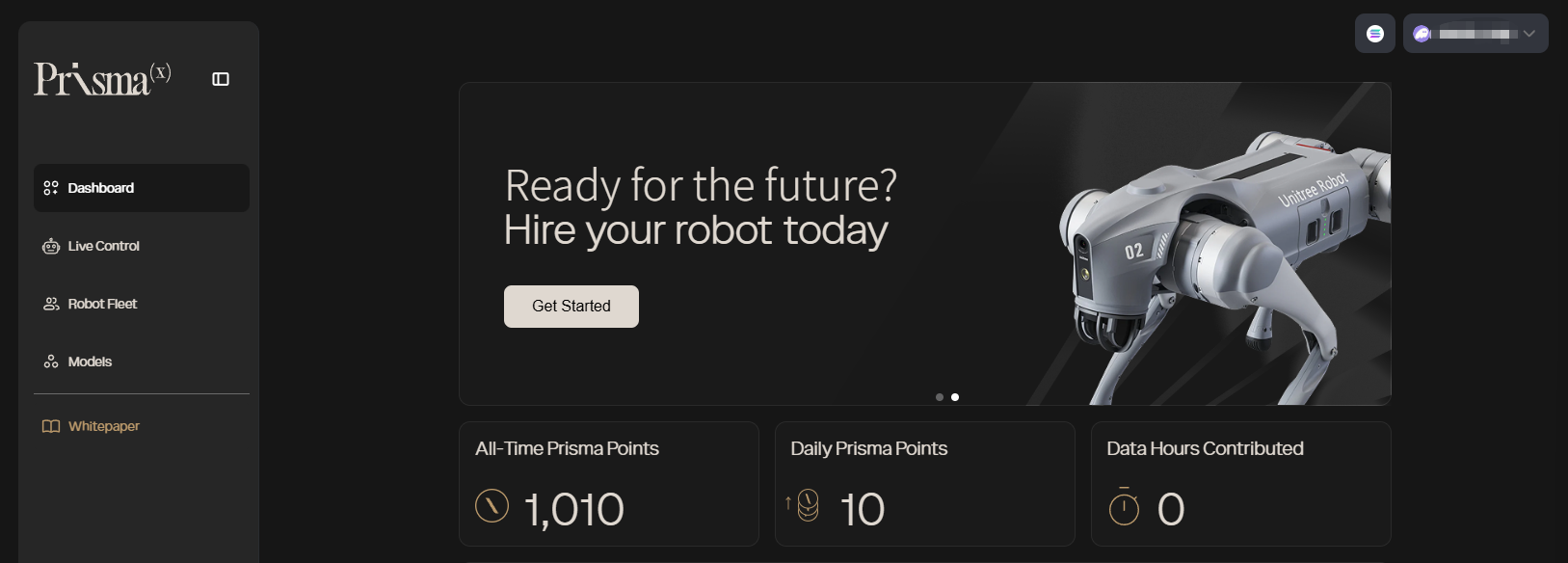
STEP 2. Daily logins earn 10 points, online chatting earns 50 points (daily task), and the whitepaper quiz earns 3500 points (one-time).

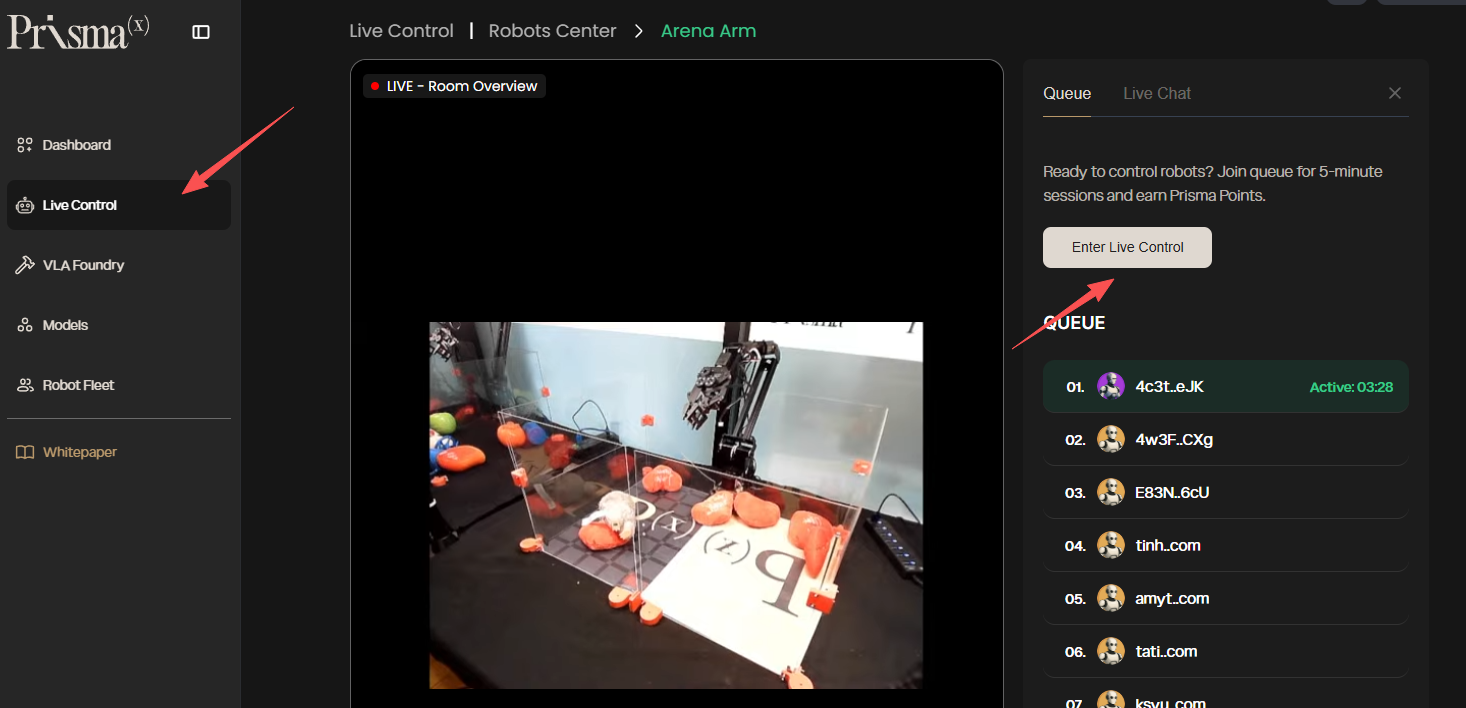
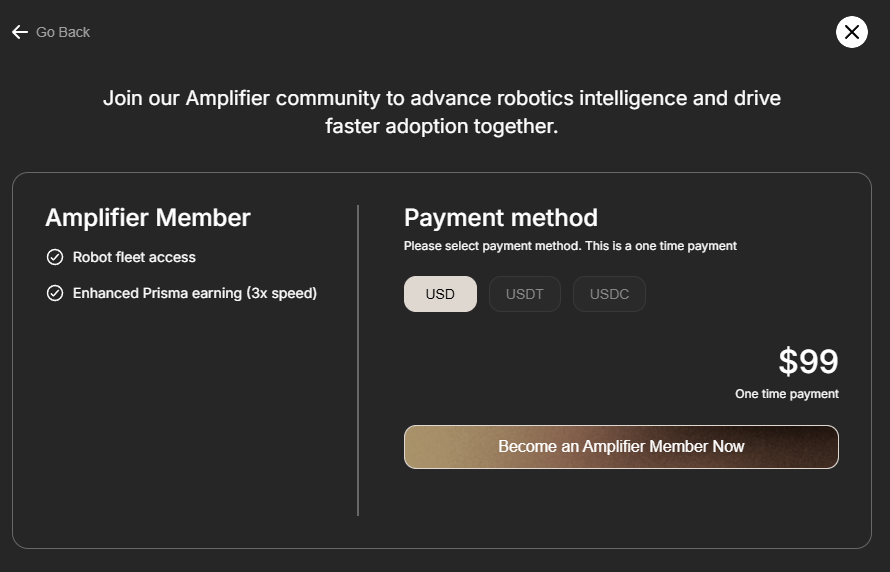
STEP 3. Additionally, to earn more points, you can select "Enter Live Control" in the "Live Control" section and pay $99 to purchase the right to use the remote operation of the robot.
Konnex

Project Introduction

Konnex is a decentralized robotics platform that enables robots (such as drones, robotic arms, mobile robots, etc.) to operate as independent "economic agents": contracting with each other to collaboratively execute tasks, competitively licensing AI models on-demand, automatically settling payments using stablecoins, and ensuring task completion through verifiable evidence. On January 15th, Konnex announced it secured $15 million in funding from strategic partners.

On January 20th, Konnex announced on platform X the launch of its points task platform.

Interaction Tutorial

STEP 1. Visit the website (Link: https://hub.konnex.world/points), click "Connect Wallet" to log into your personal account.

STEP 2. Bind your wallet, complete the mandatory social tasks to receive a 1.2x points multiplier.
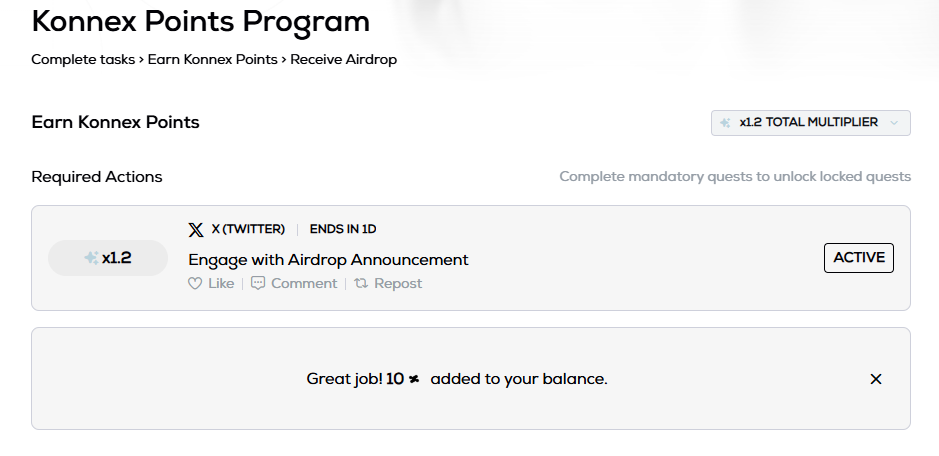
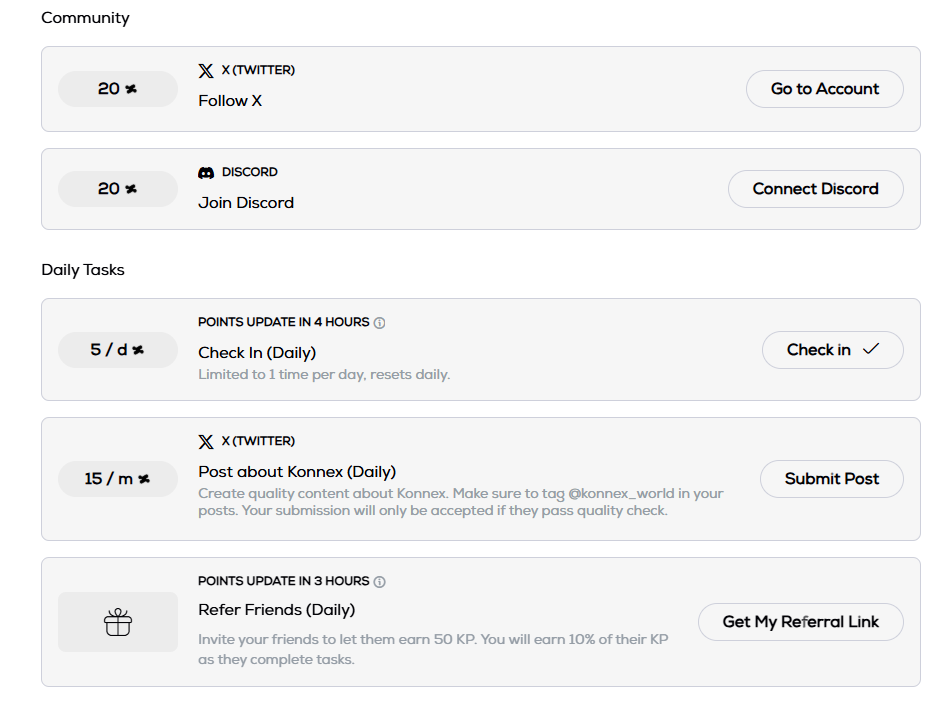
STEP 3. Continue completing the social tasks below and the daily check-in tasks.
BitRobot Network

Project Introduction

BitRobot Network is a decentralized, crypto-incentivized platform focused on advancing Embodied AI research. It coordinates global resources to build an open robotics R&D network, aiming to break robots out of single laboratories into distributed collaboration, achieving large-scale data collection, model training, and validation in the real world.

On February 13, 2025, BitRobot Network announced the completion of an $8 million total funding round, led by Protocol VC, with participation from Big Brain Holdings, Fabric Ventures, and others.

On February 27th, BitRobot Network announced on platform X that a new round of early access qualification applications is now open.

Interaction Tutorial

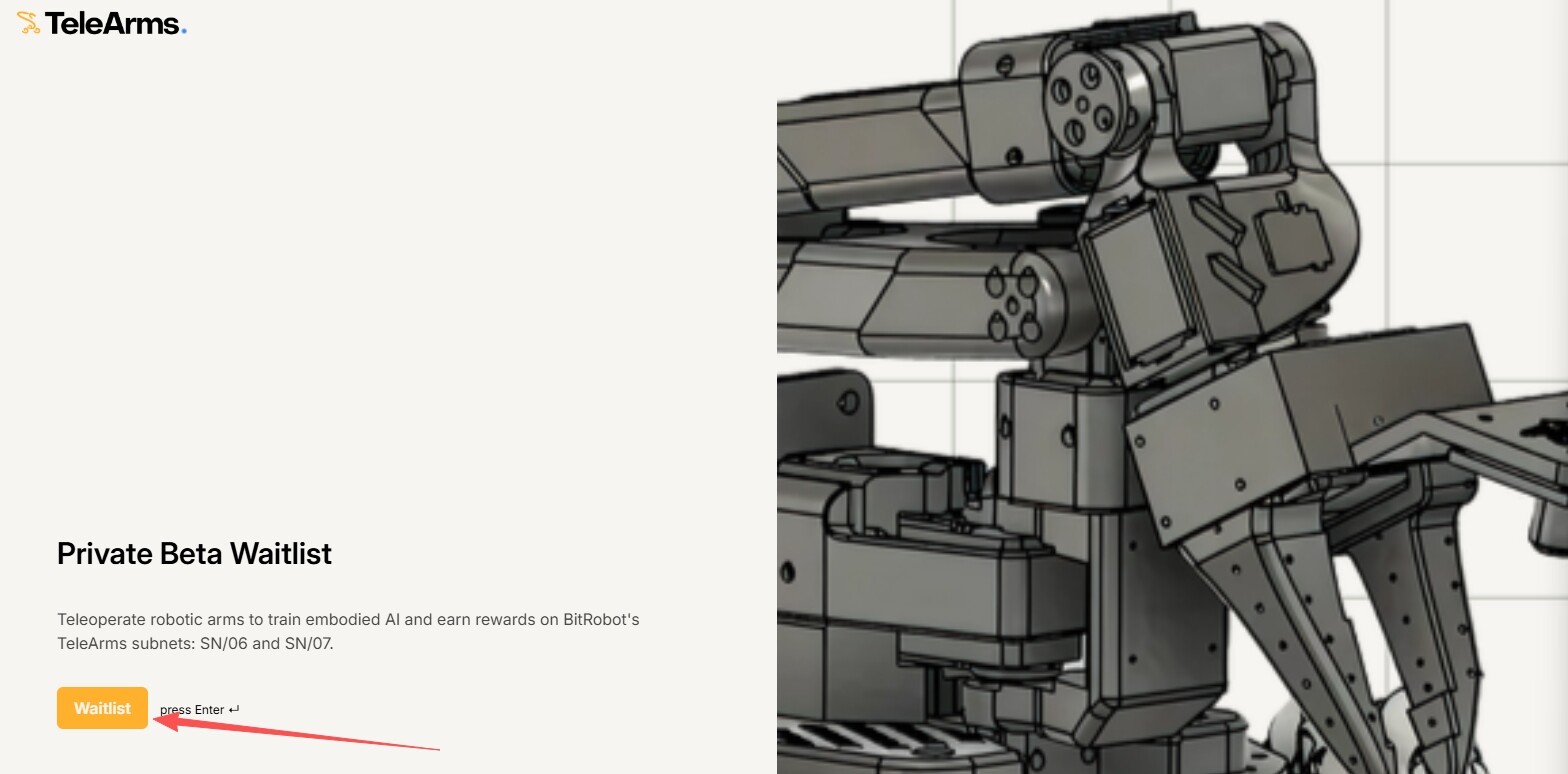
STEP 1. Go to the early whitelist application (Link: https://app.youform.com/forms/kce82fwu): Click "Waitlist" and then enter your Google Play account, TG account, Discord account (join the official Discord channel first: https://discord.gg/sDCAn879), X account, and other information to complete the application.

Axis Robotics

Project Introduction
Axis Robotics is an innovative distributed robotics intelligence project aiming to bridge diverse human intelligence to Robotics General Intelligence (RGI), enabling the transition from "AI that can chat" to "AI that can act."

Interaction Tutorial

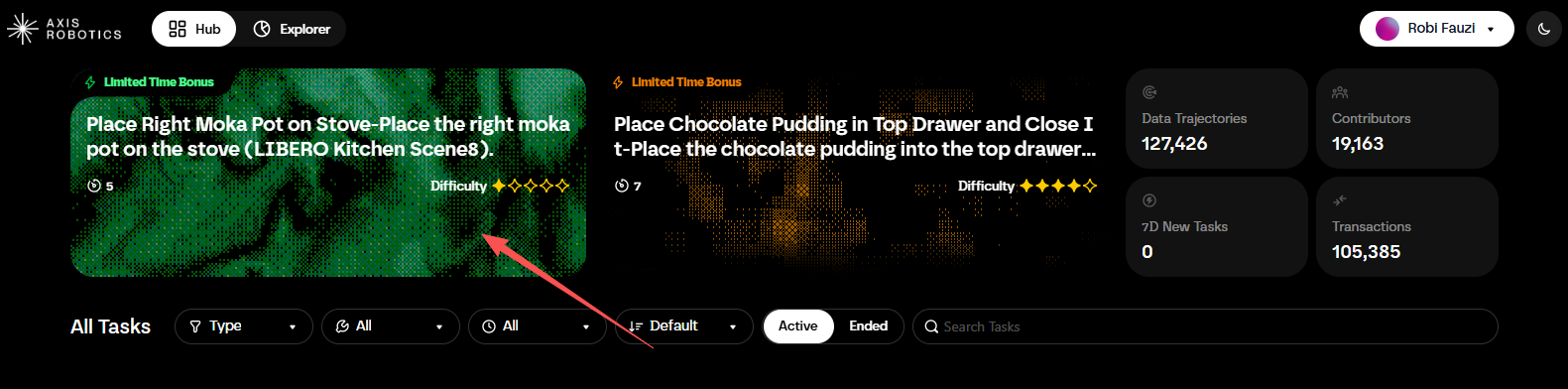
STEP 1. Visit the interaction website (Link: https://hub.axisrobotics.ai/?tab=hub), click "Log in" to log into your account.

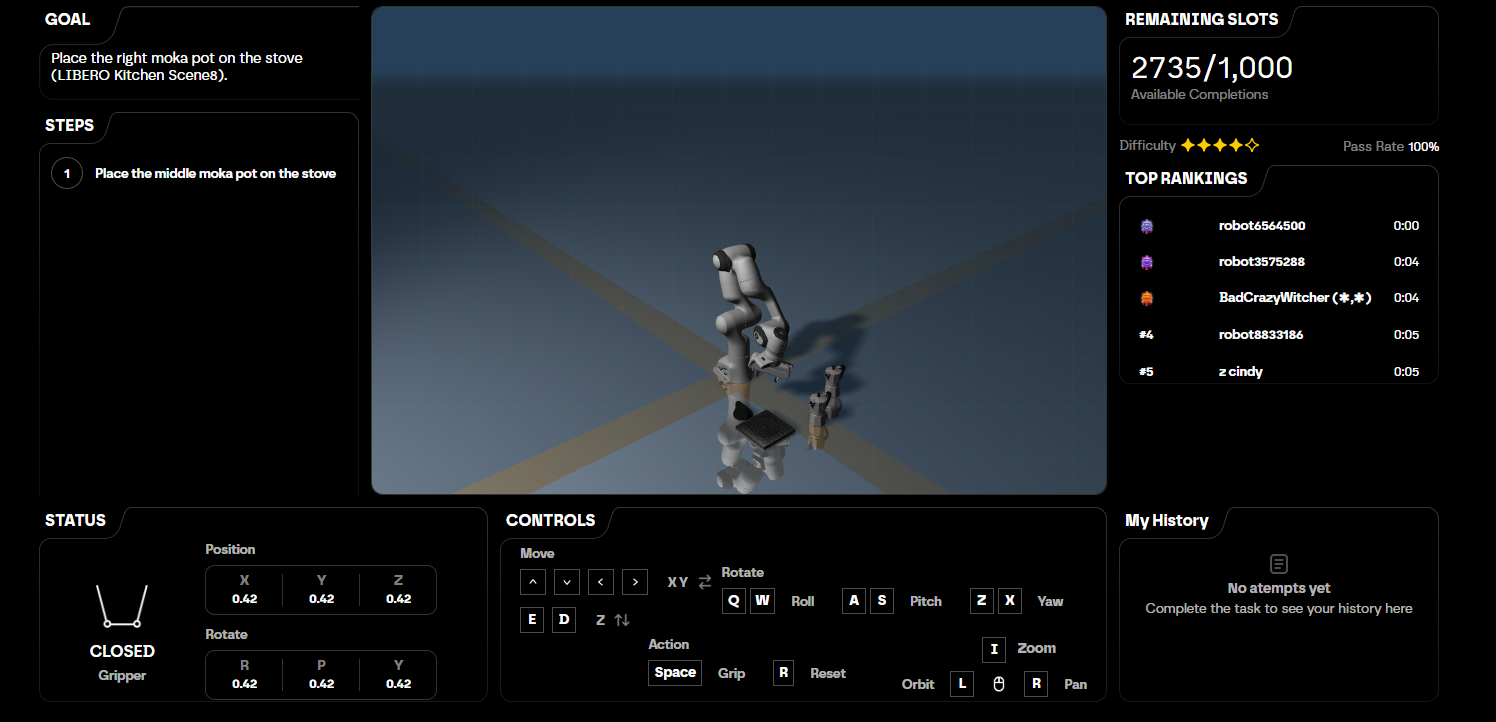
STEP 2. Click on the two tasks below to operate the robot for an experience; the shorter the completion time, the higher the ranking.
İlgili Sorular

QWhat is the main focus of the article regarding the crypto and robotics sectors?

AThe article focuses on the growing narrative strength in the robotics sector, driven by capital attention and public awareness, and provides an overview of several unreleased token projects in the robotics赛道 (robotics track) with potential early interaction opportunities.

QWhich project mentioned in the article raised $11 million in funding from investors like a16z CSX and Volt Capital?

APrismaX is the project that raised $11 million in funding from investors including a16z CSX, Volt Capital, Blockchain Builders Fund, Stanford Blockchain Accelerator, and Virtuals.

QWhat is the primary function of the Konnex platform as described in the article?

AKonnex is a decentralized robotics platform that enables robots (such as drones, robotic arms, and mobile robots) to operate as independent 'economic agents' by contracting with each other to perform tasks, competitively licensing AI models, settling payments automatically using stablecoins, and ensuring task completion through verifiable evidence.

QHow much funding did BitRobot Network secure, and which venture capital firm led the investment round?

ABitRobot Network secured $8 million in total funding, with Protocol VC leading the investment round and participation from Big Brain Holdings and Fabric Ventures, among others.

QWhat is the goal of Axis Robotics according to the article?

AThe goal of Axis Robotics is to bridge diverse human intelligence to Robotics General Intelligence (RGI), facilitating a transition from 'AI that can chat' to 'AI that can act' through innovative distributed intelligence.

İlgili Okumalar

Who Decides the Rules of Bitcoin? BIP-110 Ignites Governance Debate

Bitcoin's governance is once again at the center of a heated debate, this time ignited by BIP-110, the "Reduced Data Temporary Softfork." This proposal aims to curb non-monetary data (like inscriptions and Runes) by introducing seven new consensus-layer restrictions over a year, such as limiting new output scripts to 34 bytes and restoring the OP_RETURN cap to 83 bytes. The controversy stems from BIP-110's fundamental shift: it moves the battle against "spam" from node relay and miner policies to the consensus layer, rendering currently valid transactions invalid. Supporters, arguing that default policy governance has failed (highlighted by Bitcoin Core v30's relaxation of OP_RETURN limits), see this as necessary to protect node resources and Bitcoin's monetary focus. Opponents, led by figures like Michael Saylor and Adam Back, warn it dangerously centralizes governance. Saylor listed 110 reasons against it, criticizing its low 55% miner activation threshold and potential for chain splits. Back emphasized Bitcoin's "permissionless" ethos, arguing no single group should impose value judgments via consensus rules. Further complicating matters, technical critiques suggest BIP-110 may be technically circumventable, and a "BlockSlop" vulnerability in its upgrade path poses a consensus risk. The debate has drawn in diverse stakeholders: miners (with pools like Ocean signaling support and Foundry polling clients), node operators (like Bitcoin Knots), and new players like corporate treasury holder MicroStrategy (Saylor), whose market influence adds a novel dimension. Ultimately, BIP-110 acts as a governance stress test, exposing the unresolved question: who decides Bitcoin's rules? It pits the authority of miners, node operators, developers, and capital holders against each other, with each side claiming to defend Bitcoin's core principles of neutrality and security.

marsbit10 dk önce

Who Decides the Rules of Bitcoin? BIP-110 Ignites Governance Debate

marsbit10 dk önce

Who Decides Bitcoin's Rules? BIP-110 Ignites Governance Debate

Title: Who Decides Bitcoin's Rules? BIP-110 Ignites Governance Debate A new technical proposal, BIP-110 (Reduced Data Temporary Softfork), has sparked a fundamental governance debate within the Bitcoin community. It aims to impose new consensus rules for one year to limit non-financial data (like inscriptions and Runes) on-chain, moving beyond simple node and miner policy filters to invalidate currently valid transactions. Supporters argue that default policies have failed due to workarounds, necessitating consensus-layer changes to protect Bitcoin's core monetary function from data spam. Critics, including Michael Saylor and Adam Back, contend this dangerously centralizes judgment, undermines permissionlessness, and sets a risky governance precedent. They advocate for market-based solutions like fees or Layer 2s instead. The debate exposes deeper tensions: miners are divided on activation; node operators assert their sovereignty; Bitcoin Core developers influence defaults without direct accountability; and large corporate holders like MicroStrategy now wield narrative influence. Technically, BIP-110 may not fully block data and carries a disclosed consensus bug risk. Ultimately, BIP-110 acts as a stress test, forcing the community to confront the unresolved question: who legitimately decides what Bitcoin is and how it evolves, amidst competing claims from miners, nodes, developers, and capital holders.

链捕手22 dk önce

Who Decides Bitcoin's Rules? BIP-110 Ignites Governance Debate

链捕手22 dk önce

Zcash's New Node Zakura Goes Live: Privacy Payments Can Reach 50,000 TPS, Aiming to Rival Visa and Mastercard

Zcash, a privacy-focused cryptocurrency, has launched a new full node software called Zakura version 1.0.0. Developed by Zcash co-founder Sean Bowe and Dev Ojha, with private ZEC donations, its goal is to enable Zcash to process over 50,000 transactions per second (TPS)—matching the scale of Visa and Mastercard—while maintaining full transaction privacy and verifiability. This addresses a key bottleneck, as Zcash currently handles only about 1 private transaction per second. Zakura is a fork of the Zcash Foundation's Zebra node. It features chain pruning and snapshots, reducing disk usage and allowing new nodes to sync in under two minutes. It also offers compatibility with the legacy `zcashd` client interface. The scalability challenge stems from the large data size of privacy proofs. Bowe's Tachyon project aims to use recursive proofs to reduce consensus-layer data needs from ~500 MB/s to ~100 MB/s. For wallet scalability, Valar Group is researching Private Information Retrieval (PIR) tech to allow wallets to fetch their data privately. Zakura supports fast block propagation and the upcoming "Ironwood" network upgrade (NU6.3), scheduled for activation around July 28th. Ironwood was created to contain a critical inflation bug discovered in the Orchard shielded pool in May 2024. The fix uses "turnstiles" to trap any counterfeit ZEC created during the vulnerability period within the shielded pool, preventing it from entering circulation and restoring supply integrity.

marsbit37 dk önce

Zcash's New Node Zakura Goes Live: Privacy Payments Can Reach 50,000 TPS, Aiming to Rival Visa and Mastercard

marsbit37 dk önce

Replicating the "DeepSeek Moment"? Wall Street Unanimously Says: Kimi K3 Instead Strengthens Computing Power Demand

Title: Wall Street Sees Kimi K3 as a Catalyst for Compute Demand, Not a "DeepSeek Moment 2.0" Summary: Following the release of Moonshot AI's powerful open-source model Kimi K3, initial market reaction mirrored the "DeepSeek moment" that sparked a sell-off in compute stocks earlier in 2025, fearing reduced demand for AI infrastructure. However, major Wall Street banks including UBS, Nomura, BofA, and Citi argue the opposite: K3 will accelerate, not weaken, demand for compute, memory, storage, and networking. Their analysis centers on K3's specifications—2.8 trillion parameters, 1M token context, and MoE architecture—which represent a "scale" story rather than a pure "efficiency" one like DeepSeek R1. These features increase pressure on inference, memory (especially KV cache), and storage. Analysts invoke Jevons Paradox: as high-quality models become more affordable (K3 is cheaper than top closed models but not the cheapest), usage and token volumes expand, ultimately increasing total compute consumption. The reports highlight that competition will force leading US AI labs (OpenAI, Anthropic, Google) to invest more in training and iteration to maintain their edge. Furthermore, the rise of capable open-source models like K3 is expanding the global AI developer ecosystem, with Chinese models now accounting for over 45% of developer traffic. Key beneficiaries identified across the AI infrastructure chain include memory/storage players (e.g., Micron, Samsung), compute leaders (Nvidia, TSMC), networking suppliers (due to "super-node" cluster needs for deploying K3), and cloud platforms (e.g., Alibaba) that host diverse model ecosystems. The consensus is that stronger open-source models are an entry point for the next wave of infrastructure demand diffusion, provided workload growth outpaces efficiency gains.

链捕手40 dk önce

Replicating the "DeepSeek Moment"? Wall Street Unanimously Says: Kimi K3 Instead Strengthens Computing Power Demand

链捕手40 dk önce

İşlemler

Spot
活动图片