After Laying Off 30,000 Employees, Oracle Hires a CFO Who Managed Power Plants

marsbit2026-04-08 tarihinde yayınlandı2026-04-08 tarihinde güncellendi

Özet

Oracle, the global enterprise database giant, laid off approximately 30,000 employees, sparking widespread discussion. Shortly after, the company appointed Hilary Maxson as its new CFO with a compensation package of $297 million. Maxson’s background is notable: she spent nearly a decade as group CFO at Schneider Electric, a major energy management firm, and previously worked for 12 years at AES Corporation, a U.S. power company. Her entire career has revolved around the energy sector—managing power plants, grids, and data center energy solutions. This appointment signals a strategic shift for Oracle. After 12 without a dedicated CFO, the company is pivoting from its traditional software business toward cloud and AI infrastructure. Oracle’s cloud infrastructure revenue surged 84% year-over-year, with a capital expenditure budget of around $50 billion this year—almost entirely allocated to AI data center construction. The company has secured massive contracts, including one with OpenAI exceeding $300 billion, contributing to a total backlog of $553 billion. Data centers, especially at the gigawatt scale, require enormous power—equivalent to a nuclear power plant’s output—making energy management critical. Oracle is no longer just a software company; it’s transforming into an energy-intensive infrastructure provider. While Wall Street remains optimistic, the stock has fallen about 24% this year, reflecting investor concerns over this high-cost, capital-intensive transitio...

Author: Curry, Deep Tide TechFlow

The most talked-about layoff news in the tech world recently involves Oracle, the world's largest enterprise database company; most banks and airlines worldwide run its software in their backend systems.

According to CNBC, the company laid off approximately 30,000 employees. A few days later, it appointed a new CFO with a total compensation package of $29.7 million.

30,000 people out, one person in.

Those leaving received severance pay equivalent to a few months' salary on average, while the newcomer's contract alone is worth a year's wages for a thousand people.

This sparked heated discussions on Reddit, with over 6,000 comments. Most are angry that one executive's salary equals that of many workers, feeling the new CFO is overpaid.

Executive pay being multiples or even tens of times higher than that of ordinary employees at major companies is not a new topic. But beyond the compensation itself, what caught my attention is the resume of this new CFO.
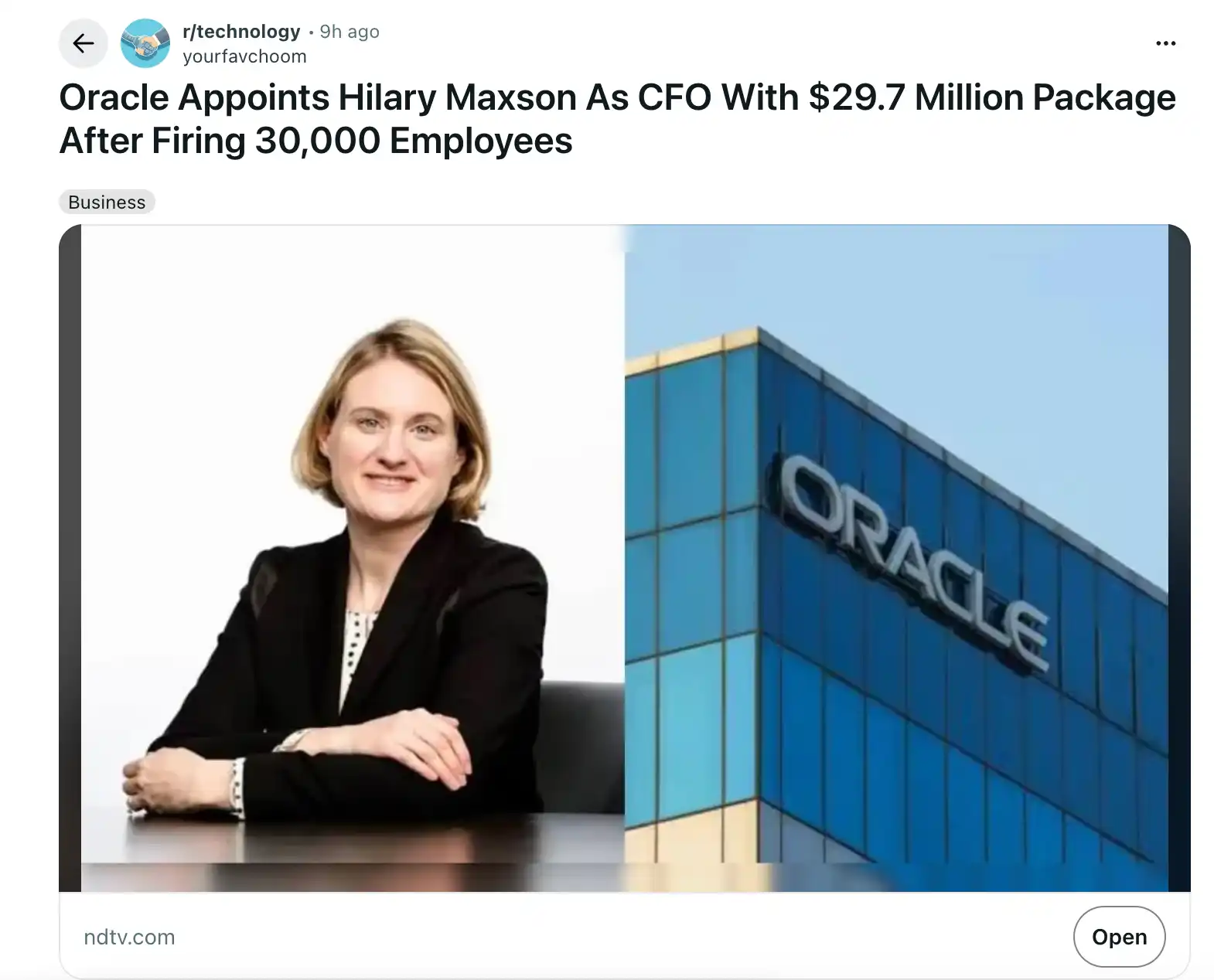
The new CFO is Hilary Maxson.

Before joining Oracle, she was the group CFO at Schneider Electric for nearly a decade. Schneider Electric is one of the world's largest energy management companies, with core businesses in power supply solutions for data centers and grids, generating over $45 billion in annual revenue.

Prior to that, she worked at AES Corporation for 12 years. AES is a longstanding U.S. power company focused on building and managing power plants and grids.

In other words, Oracle spent $29.7 million to hire someone whose entire career has revolved around electricity. She has managed power plants, grids, and companies that supply power to data centers... and now she's been hired as CFO by a company that has sold database software for 47 years?

There's another little-known fact about this choice.

Oracle has not had a dedicated CFO for the past 12 years; finances were managed concurrently by former CEO Safra Catz. According to CNBC, after Catz transitioned to executive vice chairman in late 2025, an interim financial officer temporarily filled the role for half a year.

The fact that the company is now specifically reinstating this position and recruiting from the energy industry is more significant than the salary figure itself.

Bloomberg Intelligence analysts interpret this appointment as a sign that Oracle's growth focus has shifted from databases and software to cloud infrastructure, hence hiring a CFO from an industrial company.

The numbers tell the same story.

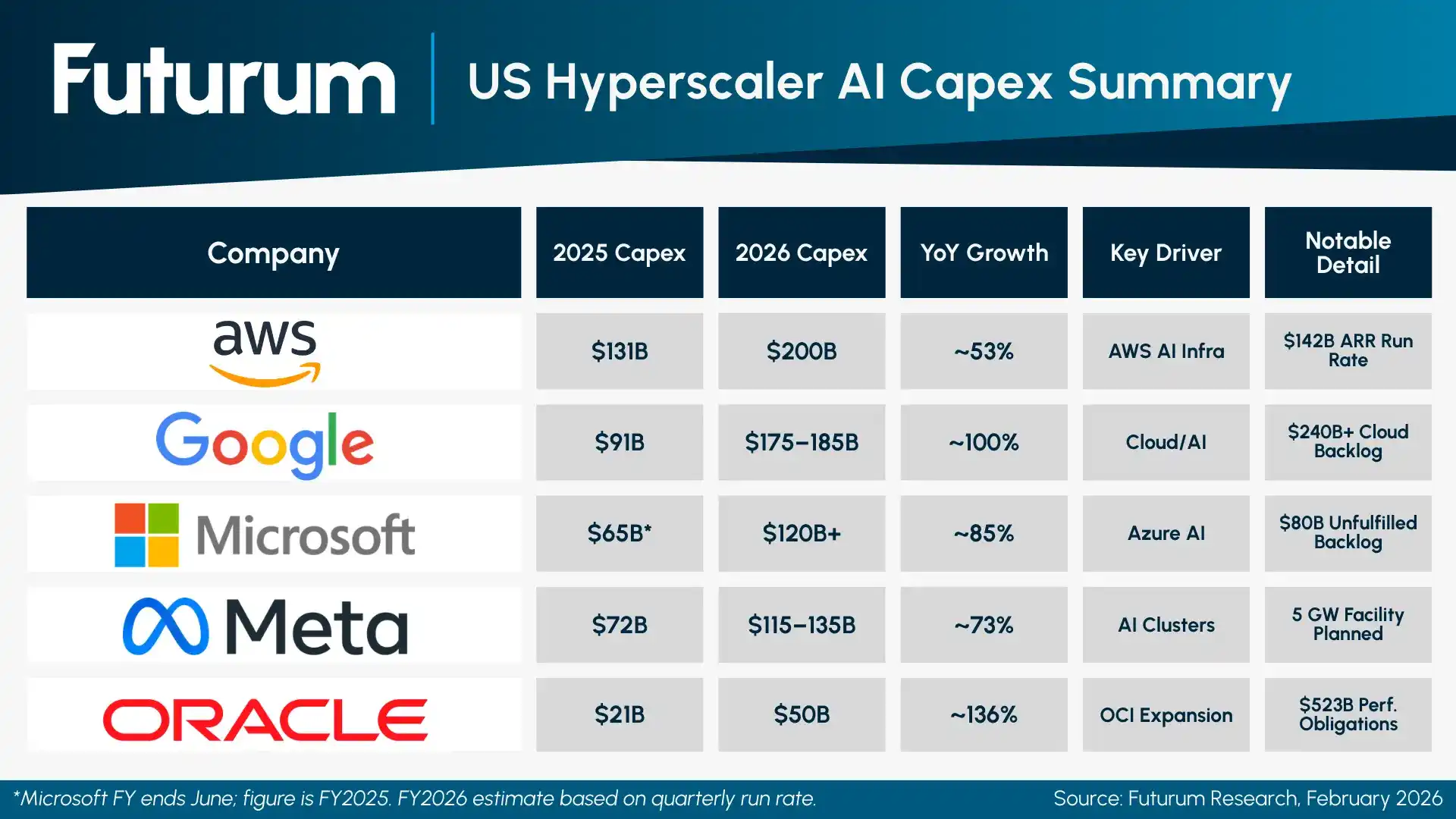
According to Oracle's latest earnings report, the company's cloud infrastructure revenue increased by 84% year-over-year. This year's capital expenditure budget is about $50 billion, almost entirely allocated to AI data center construction, more than double last year's amount. To raise funds, the company plans to secure $50 billion through debt and equity financing. The total value of pending contracts has surged to $553 billion, with one deal with OpenAI alone exceeding $300 billion, according to public information.

A company lays off 30,000 people maintaining old businesses and then entrusts money and authority to someone from the power industry. Reading this move, Oracle's management likely no longer sees itself as purely a software company.

But the capital market isn't buying it yet. Oracle's stock has fallen about 24% this year.

Investors' concerns are specific. Oracle historically made money by selling database software and enterprise applications, with high profit margins where people were the biggest cost. But AI is rewriting the business logic; large models can automatically write SQL and manage databases, gradually eroding the technological barrier Oracle has relied on for 47 years.

Oracle's response is to completely change tracks.

Instead of just selling software, it's turning to building data centers for AI companies. According to public information, Oracle previously signed an infrastructure contract with OpenAI exceeding $300 billion, part of the Stargate data center plan; similar agreements exist with Meta and xAI, pushing the total value of pending contracts to $553 billion.

This year's capital expenditure budget is about $50 billion, almost entirely poured into data center construction.
The two biggest expenses for data centers are chips and electricity. Cooling requires electricity, GPU operations require electricity; the annual electricity bill for a large AI data center can reach hundreds of millions of dollars.

Oracle is now building "gigawatt-scale" data center clusters. What is a gigawatt? Roughly equivalent to the output of a nuclear power plant.

This explains why they're hiring from the power industry.

The new CFO has managed power plants, grids, and companies that supply power to data centers. Oracle no longer needs a financial leader who understands software profit rates, but someone who knows how to spend tens of billions building power infrastructure and ultimately make these investments profitable.

Wall Street analysts are currently optimistic; 27 have given buy ratings, with an average target price of $245, implying about a 70% upside potential. But the gap between a 25% stock drop and analysts predicting a doubling hinges on the same question: whether Oracle can truly transform from a software company into an energy infrastructure company.

At least, they've taken a step in terms of personnel structure. Those leaving are people who wrote code for decades; those entering are people who managed electricity for twenty years.

Sometimes, to understand where a company is heading, you don't need to翻 its strategy PPT. Just see who it hires.


İlgili Sorular

QWhy did Oracle hire a CFO from the energy industry, specifically with a background in managing power plants and grids?

AOracle is shifting its focus from traditional software to cloud and AI infrastructure, which requires massive data centers with enormous power demands. The new CFO, Hilary Maxson, has expertise in managing large-scale energy infrastructure and costs, which aligns with Oracle's need to build and operate energy-intensive data centers efficiently.

QWhat is the significance of Oracle's new CFO having worked at companies like Schneider Electric and AES Corporation?

AHer experience at Schneider Electric (managing power supply for data centers and grids) and AES Corporation (building and managing power plants) provides her with critical skills in handling the high energy costs and infrastructure requirements of Oracle's new AI data center projects, which consume power at a scale comparable to nuclear plants.

QHow does Oracle's shift to AI data centers impact its financial strategy and capital expenditure?

AOracle plans to spend approximately $50 billion in capital expenditures, mostly on AI data center construction, doubling last year's budget. This shift requires massive funding through debt and equity financing, reflecting a move from high-margin software to capital-intensive infrastructure investments.

QWhat are the market and investor reactions to Oracle's strategic changes and new CFO appointment?

AOracle's stock has fallen about 24% this year, as investors are concerned about the transition from profitable software to lower-margin infrastructure. However, analysts are optimistic, with 27 giving a 'buy' rating and an average target price of $245, suggesting potential upside if Oracle succeeds in its transformation.

QHow does the appointment of Hilary Maxson reflect Oracle's broader business transformation?

AHiring a CFO from the energy sector, after laying off 30,000 employees mostly from traditional software roles, signals that Oracle is prioritizing infrastructure and energy management over its legacy database business. This aligns with its large contracts with AI companies like OpenAI and Meta, focusing on building power-hungry data centers.

İlgili Okumalar

When the World Cup Collides with Agents: From Web2 to Web3, How Are Wallets Evolving into Agentic Wallets?

World Cup as a Catalyst for Agentic Wallets: From Web2 to Web3 This article explores how the World Cup provides a real-world scenario for observing the evolution of digital wallets from simple asset managers towards "Agentic Wallets"—intelligent, AI-powered interfaces. Using the example of prediction markets like Polymarket, it illustrates how AI Agents can lower the barrier to Web3 interaction. Instead of navigating complex DApps, users can express intent in natural language (e.g., "I think Portugal will win") within platforms like Discord or web pages. The Agent then interprets this intent, finds the relevant market, and seamlessly guides the user through the on-chain transaction via their wallet. The core shift is from wallets as mere "function menus" for signing transactions to "intent interpreters" that understand user goals. The article highlights parallel developments in traditional finance, such as Mastercard's "Agent Pay" and WeChat Pay's AI tests, which focus on granting AI controlled, authorized, and auditable payment capabilities. This underscores a broader trend of AI entering the financial layer. However, the article emphasizes that the primary challenge for Agentic Wallets in Web3 is not automation but establishing clear security boundaries. Unlike traditional systems with chargebacks, on-chain transactions are often irreversible. Therefore, future wallets must ensure users retain ultimate control and comprehension. They need to transparently communicate an Agent's permissions, spending limits, authorized durations, and provide easy ways to pause or revoke access. The World Cup experiments represent early steps toward wallets that are not just applications but ubiquitous, intelligent interfaces that simplify Web3 while keeping users securely in control.

marsbit1 saat önce

When the World Cup Collides with Agents: From Web2 to Web3, How Are Wallets Evolving into Agentic Wallets?

marsbit1 saat önce

Options Don't Work in DeFi? Vitalik Might Not Agree

For years, the prevailing view has been that options struggle to gain traction in DeFi due to complexity, fragmented liquidity, and lack of natural demand compared to products like perpetual futures. However, a recent algorithmic stablecoin design proposed by Vitalik Buterin presents a different perspective, using options not as a standalone trading product, but as foundational infrastructure for other financial instruments. In this design, one unit of ETH is split into two components: a "stable" side (P) that retains value up to a specified strike price, and an "upside" side (N) that captures all appreciation above that strike. Combined, they always equal one ETH, eliminating debt, margin, and liquidation risks inherent in typical collateralized debt position (CDP) stablecoins. The stable component essentially mimics the payoff of a covered call option. To function as a stablecoin, this structure requires continuously rolling deep in-the-money calls, which introduces challenges like rollover slippage, predictable transaction flow vulnerable to front-running, and persistent liquidity needs. A core hurdle is finding consistent buyers for the leveraged ETH upside exposure (N). While it offers leverage without funding rates or liquidation, it must compete with simpler alternatives like direct call options or perpetuals. The system's scalability depends on a sustained demand for this specific form of leverage. The author draws parallels to their experience with Rysk, where earlier versions of DeFi options protocols struggled. The breakthrough came with Rysk V12, which aligns incentives: asset holders generate yield by selling covered calls against their holdings, while market makers efficiently acquire the desired option exposure. This demonstrates that options can find product-market fit when embedded as a risk distribution and pricing engine within structured products, stablecoins, or yield-generating assets, rather than marketed as a complex direct trading instrument. Vitalik's proposal reinforces this architectural approach—using fully collateralized, non-custodial, and physically settled options as a fundamental building block. The real opportunity for options in DeFi may lie not in becoming the next perpetual swap, but in powering the next generation of on-chain financial products.

marsbit1 saat önce

Options Don't Work in DeFi? Vitalik Might Not Agree

marsbit1 saat önce

Conversation with Investor Zheng Di: MicroStrategy's Coin Sale Experiment, AI Economy, and Opportunities in US Stocks

Frontier tech investor Zheng "Didier" Di discusses the recent Bitcoin price drop, the financial strategy shift at MicroStrategy, the AI-driven surge in U.S. stocks, and the evolving role of crypto exchanges. Didier posits that the recent BTC decline stems less from macro factors or ETF outflows, and more from market repricing due to MicroStrategy's new financial structure. Following a wave of preferred stock and debt issuance (STRC, STRZ, etc.), MicroStrategy must now manage cash flow to pay dividends, potentially leading to a market expectation of sustained, small-scale BTC sales to maintain its "per-share bitcoin neutral" principle. Didier views this as a financial "experiment" testing market capacity for such recurring sell pressure, which, while creating near-term structural headwinds, likely avoids a true "death spiral" absent major new external shocks. Shifting to AI, Didier argues that tokens are becoming the new form of labor, with AI models and compute (tokenized inputs) increasingly replacing human roles in execution and middle-management. This drives enterprise efficiency and higher margins, fueling the sustained rally in U.S. semiconductor, data center, and infrastructure stocks. He foresees an emerging "machine economy" where automated agents transact and collaborate on-chain. Regarding crypto exchanges offering U.S. equities, Didier sees this as a natural evolution. With few crypto-native assets generating lasting value, exchanges are pivoting towards real-world assets (RWAs) like stocks and bonds. This doesn't necessarily cannibalize crypto but reflects a maturing industry focusing on blockchain's core utilities: decentralized choice and efficient settlement. He notes that trading logic for crypto natives doesn't need to drastically change, as meme-driven and fundamentalist strategies find analogs in U.S. markets. The "1011 event" (likely referring to a major market crash) severely damaged crypto market liquidity, marking a probable end to the altcoin speculative cycle, with capital flowing towards the deeper liquidity of U.S. markets. For the macro outlook, Didier is cautious about near-term market pressure from potential mega-IPOs (e.g., SpaceX) and the U.S. midterm elections, which could bring more regulatory scrutiny. Long-term, he remains bullish on AI's productivity gains and its convergence with blockchain/Web3, predicting a shift from speculative frenzy to a more institutionalized, industrial phase for the crypto sector.

marsbit2 saat önce

Conversation with Investor Zheng Di: MicroStrategy's Coin Sale Experiment, AI Economy, and Opportunities in US Stocks

marsbit2 saat önce

Playnance’s $GCOIN Lists on KoinBX Amid Rapid Growth in India

Playnance's native token, $GCOIN, has been listed on the cryptocurrency exchange KoinBX as of June 18. This move aims to enhance accessibility for its rapidly growing community, particularly in India, where the blockchain-powered Web3 iGaming ecosystem has gained significant traction. Over 130 partners in Playnance's "Be the Boss" program have built communities engaging thousands of active players in the region. The "Be the Boss" model allows participants to create and manage their own gaming communities, earning rewards tied to community activity. CEO Pini Peter noted India's high engagement, with community leaders successfully building player networks. One partner, Dr. Nicolas, reported earning over $57,000 through the program in recent months, highlighting both the financial rewards and the opportunity to grow an engaged community. $GCOIN serves as the ecosystem's core utility token, incentivizing participation and aligning the interests of players and community leaders ("Bosses"). The listing on KoinBX is part of Playnance's strategy to expand globally, increasing the token's utility and accessibility by combining community ownership, gamified engagement, and blockchain-based incentives. Founded in 2020, Playnance is a Web3 iGaming infrastructure company focused on creating live, non-custodial, on-chain products to onboard mainstream users. It currently processes approximately one million transactions daily, aiming to simplify the user experience while maintaining full on-chain transparency.

TheNewsCrypto3 saat önce

Playnance’s $GCOIN Lists on KoinBX Amid Rapid Growth in India

TheNewsCrypto3 saat önce

İşlemler

Spot
Futures
活动图片