ADA in Consolidation: Bears Control Cardano, $0.40 Becomes the Make-or-Break Line

金色财经2025-12-15 tarihinde yayınlandı2025-12-15 tarihinde güncellendi

Özet

ADA is currently consolidating around the $0.40 level, with bears maintaining control as the price faces persistent selling pressure near key moving averages. Trading volume remains moderate, with Binance alone recording around 100 million ADA traded in 24 hours. The order book shows substantial mid-range sell-side liquidity, while buy-side interest persists at lower levels. The short-term trend remains vulnerable, and a break below the current support zone could accelerate the decline. Conversely, a breakout above the descending moving averages might open the path toward higher resistance levels, though such a move would likely encounter intensified selling pressure. Overall, ADA is in a low-energy consolidation phase, with prices oscillating between $0.39 and $0.41. The market lacks strong momentum, and a clear directional move may require either a dissipation of bearish sentiment or a decisive breach of key technical levels. Risk management is advised during this period of uncertainty.

Recently, the price of Cardano (ADA) has been playing "ninja hopscotch"—consistently suppressed by key moving averages, making a rebound difficult. Selling pressure is strong, with mid-range sell orders piling up, putting the short-term trend at risk. If market sentiment cools, the support below may not hold.
Market Dynamics

Spot ADA price is hovering around $0.40, with minimal daily gains. The 24-hour trading volume ranges between $500–600 million, with Binance alone accounting for approximately 100 million ADA trades. Analysts note that while the price is stabilizing slightly, the overall technical picture suggests that bearish momentum hasn't faded. Suppression below short- and medium-term moving averages keeps sellers in control, and a breakout would require more "momentum."
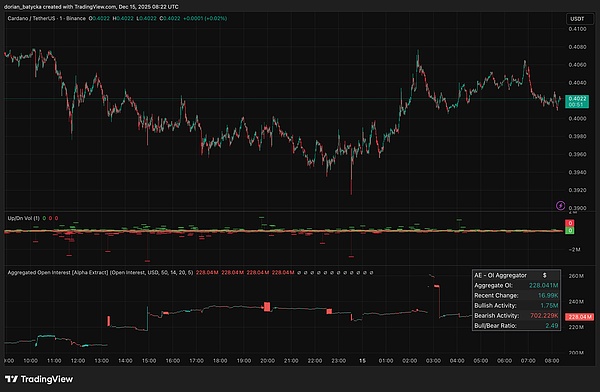
Consolidation Pattern: Mid-Range Sell Orders Under Heavy Pressure

The order book shows ample liquidity in mid-range sell orders, while buy-side interest remains below. However, if the support zone is breached, the consolidation could break immediately. In other words, ADA is currently stepping on a suspended plank—its stability entirely depends on market sentiment.
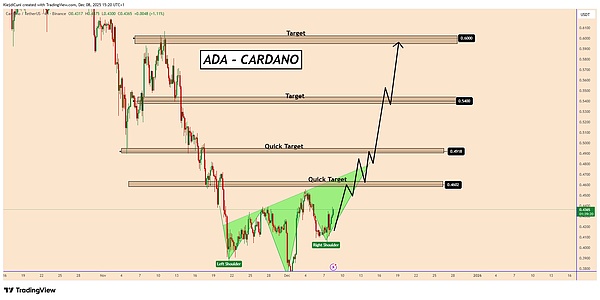
If the price can break above the declining moving averages, it may open the door to higher resistance levels in the short term. However, sellers are unlikely to give way easily, and any breakout could face selling pressure.

Support and Resistance

Daily charts indicate that the first key test for the price is near the declining moving averages. A breakdown could accelerate the downtrend, while a breakout might open the door to higher resistance levels, though selling pressure could intensify. The support zone below provides some cushion, but if market sentiment suddenly deteriorates, this "defense line" may not hold.
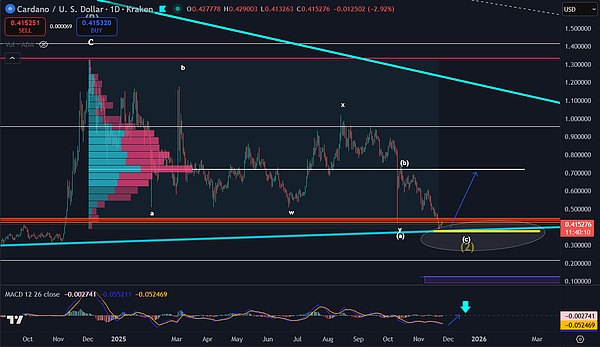
Summary

Overall, ADA is in a typical "low-energy consolidation": intraday fluctuations range between $0.39–0.41, trading volume is stable, and there are no significant liquidations or sharp price swings. The short-term outlook may require patience, waiting for bearish momentum to fade or a breakout above resistance before a clear direction emerges.

Tip: During such range-bound consolidation, steady operations and risk management are more important than chasing rallies or selling off—don't be swayed by minor fluctuations.

Like, share, and follow me to catch more market trends and ride the bull and bear waves together! Let's keep pushing!

Struggling in the crypto world? Don't tough it out alone! Xiaoyun shares real-time swing and long-term strategies, helping you stand on the shoulders of giants to quickly ascend the wealth ladder. Missing one opportunity could mean missing out on 100x gains! Join us!

---END

Trend Kriptolar

İlgili Sorular

QWhat is the current price range of Cardano (ADA) and why is the $0.40 level considered critical?

ACardano (ADA) is currently trading around $0.40, within a range of $0.39 to $0.41. The $0.40 level is considered a critical 'make-or-break' line because it is a key support. If this support is broken, the price could decline further, but if it holds and breaks above the descending moving averages, it could target higher resistance levels.

QWho is currently in control of the market according to the technical analysis of ADA?

AAccording to the technical analysis, sellers (the bears) are in control of the Cardano (ADA) market. The price is being suppressed by key moving averages, and there is significant selling pressure in the mid-range of the order book.

QWhat does the order book data reveal about the selling and buying pressure for ADA?

AThe order book data shows ample liquidity in the mid-range sell orders, indicating strong selling pressure. While there is still some buying interest in the support zone below, a break of this support region could quickly end the current consolidation phase.

QWhat is the potential outcome if ADA's price breaks above the descending moving averages?

AIf ADA's price manages to break above the descending moving averages, it could open the path to higher resistance levels in the short term. However, this breakout is likely to be met with significant selling pressure from the bears.

QWhat type of market phase is ADA in, and what is the recommended trading approach?

AADA is in a typical 'low-energy consolidation' phase with stable volume and no major liquidations or sharp price movements. The recommended trading approach is to be patient, practice sound risk management, and avoid chasing small price fluctuations until a clear market direction emerges from a key breakout or a fade in bearish momentum.

İlgili Okumalar

As Consensus Accelerates, What Are Young Investors Betting On?

Title: As Consensus Forms Faster, What Are Young Investors Betting On? In the rapid evolution of tech investment, a new generation of young investors is navigating a landscape where AI, robotics, commercial aerospace, and quantum computing are advancing simultaneously. Traditional investment logic based on financial models is giving way to a need for deep technical understanding and the ability to act before industry consensus forms. An analysis of trends from the "WAIC FUTURE TECH" list of young investment leaders reveals key shifts in focus. The first major trend is the movement of AI from the digital screen into the physical world. Investment is shifting from large language models and chatbots towards embodied AI, robotics, AI hardware, and edge computing. While demonstrations generate excitement, the real challenge lies in achieving scalable, reliable, and cost-effective delivery in complex real-world environments like factories and logistics. Success depends not just on algorithms but on the integration of sensors, actuators, and control systems. Second, the competitive focus for large models is moving beyond raw capability toward building an "intelligence flywheel." The goal is to create self-reinforcing systems where user interaction generates data, improving the model, which in turn enhances the user experience and attracts more engagement. Companies that successfully embed AI into workflows to create these closed-loop systems can build lasting value that isn't easily erased by the next model upgrade. Third, facing a potential bottleneck in high-quality human-generated data, investors are looking at new underlying technologies. Reinforcement learning and self-play, as demonstrated by AlphaGo Zero, offer paths for AI to generate its own experience. Scientific foundation models, which aim to build general AI capabilities for fields like life sciences and materials discovery, represent a non-consensus direction that could unlock new frontiers of knowledge and data. Finally, in deep-tech areas like quantum computing, commercial aerospace, and space-based infrastructure, patient capital is essential. These fields have long, uncertain development and validation cycles involving complex engineering, supply chains, and regulations. Investment here requires a long-term view, focusing on foundational team capabilities and the eventual emergence of market demand, even if commercial returns are distant. Collectively, these trends illustrate how young investors are adapting to a new era. They are learning to make earlier, technically-informed judgments, balance hype with real-world viability, and provide the patient capital needed to build the deep-tech foundations of the future.

marsbit24 dk önce

As Consensus Accelerates, What Are Young Investors Betting On?

marsbit24 dk önce

Can Japan Buy Growth with AI? Will the Bond Market Believe It?

Japan's cabinet has introduced the 2026 Basic Policy on Economic and Fiscal Management and Reform, shifting its primary fiscal target. The new framework moves away from the traditional annual primary balance goal and instead prioritizes a stable reduction of the debt-to-GDP ratio. This change is tied to a strategy of increased "responsible proactive fiscal" spending, aiming to boost long-term growth through investments in strategic sectors like AI, semiconductors, energy, and robotics. The government estimates total public and private investment in 62 key technologies could exceed 370 trillion yen by 2040. The market reaction has been mixed and cautious. While equity markets may respond to policy signals, bond markets are focused on fiscal credibility. Concerns center on whether the weakening of the clear primary balance anchor could lead to looser fiscal discipline. If investors doubt that these strategic investments will generate sufficient productivity gains, tax revenue, and nominal growth to outpace rising interest costs, they may demand higher yields on Japanese Government Bonds (JGBs). Recent volatility in the yen and JGB yields, with the 10-year yield briefly reaching 2.9%, reflects this skepticism. The success of this new framework hinges on two factors: whether Japan can achieve a nominal growth rate consistently higher than its long-term interest rates, and whether future budgets demonstrate disciplined control over bond issuance. The government's narrative is that strategic investment is essential to break Japan's cycle of low growth, aging, and labor shortages. However, the bond market will continuously assess the credibility of this plan, pricing the risk that it may represent fiscal expansion rather than a viable growth strategy.

marsbit1 saat önce

Can Japan Buy Growth with AI? Will the Bond Market Believe It?

marsbit1 saat önce

Misjudged A-Shares: Resilience, Expectations, and Confidence

China's A-share market recently faced selling pressure, especially in tech sectors, initially triggered by a global tech sell-off that began in South Korea. However, the article argues this is a case of "mistaken injury" and highlights the market's underlying resilience. This resilience stems from three main pillars: **1) Tech Sector Fundamentals:** Unlike Korea's market dominated by a few memory chip stocks, China's tech sector is diversified across computing, communications, electronics, and semiconductors, supported by dual narratives of global AI supply chains and domestic substitution. Core areas like optical modules and fiber optics continue to show strong earnings growth. **2) "National Team" Support:** State-backed institutions and large corporations have made significant market purchases and announced buybacks, providing liquidity and signaling confidence. This is seen as a stabilizing policy signal, often associated with market bottoms. **3) Broader Market Pillars:** Other major sectors are showing endogenous recovery momentum. Consumer stocks benefit from stabilizing CPI and signs of sector recovery (e.g., liquor price hikes). Cyclical sectors like aluminum have high earnings, potential price increases due to tight supply, and low valuations. The financial sector offers stable dividends and low valuations. The conclusion is that the sell-off was driven by external contagion, not a collapse in fundamentals. With strong policy support and recovering momentum across key sectors, the A-share market possesses the toughness to regain stability.

marsbit1 saat önce

Misjudged A-Shares: Resilience, Expectations, and Confidence

marsbit1 saat önce

İşlemler

Spot

Popüler Makaleler

ADA Nasıl Satın Alınır

HTX.com’a hoş geldiniz! Cardano (ADA) satın alma işlemlerini basit ve kullanışlı bir hâle getirdik. Adım adım açıkladığımız rehberimizi takip ederek kripto yolculuğunuza başlayın. 1. Adım: HTX Hesabınızı OluşturunHTX'te ücretsiz bir hesap açmak için e-posta adresinizi veya telefon numaranızı kullanın. Sorunsuzca kaydolun ve tüm özelliklerin kilidini açın. Hesabımı Aç2. Adım: Kripto Satın Al Bölümüne Gidin ve Ödeme Yönteminizi SeçinKredi/Banka Kartı: Visa veya Mastercard'ınızı kullanarak anında Cardano (ADA) satın alın.Bakiye: Sorunsuz bir şekilde işlem yapmak için HTX hesap bakiyenizdeki fonları kullanın.Üçüncü Taraflar: Kullanımı kolaylaştırmak için Google Pay ve Apple Pay gibi popüler ödeme yöntemlerini ekledik.P2P: HTX'teki diğer kullanıcılarla doğrudan işlem yapın.Borsa Dışı (OTC): Yatırımcılar için kişiye özel hizmetler ve rekabetçi döviz kurları sunuyoruz.3. Adım: Cardano (ADA) Varlıklarınızı SaklayınCardano (ADA) satın aldıktan sonra HTX hesabınızda saklayın. Alternatif olarak, blok zinciri transferi yoluyla başka bir yere gönderebilir veya diğer kripto para birimlerini takas etmek için kullanabilirsiniz.4. Adım: Cardano (ADA) Varlıklarınızla İşlem YapınHTX'in spot piyasasında Cardano (ADA) ile kolayca işlemler yapın.Hesabınıza erişin, işlem çiftinizi seçin, işlemlerinizi gerçekleştirin ve gerçek zamanlı olarak izleyin. Hem yeni başlayanlar hem de deneyimli yatırımcılar için kullanıcı dostu bir deneyim sunuyoruz.

1.5k Toplam GörüntülenmeYayınlanma 2024.12.10Güncellenme 2026.06.02

ADA Nasıl Satın Alınır

Tartışmalar

HTX Topluluğuna hoş geldiniz. Burada, en son platform gelişmeleri hakkında bilgi sahibi olabilir ve profesyonel piyasa görüşlerine erişebilirsiniz. Kullanıcıların ADA (ADA) fiyatı hakkındaki görüşleri aşağıda sunulmaktadır.

活动图片













