A PPT Dismissed as 'Nonsense' by MIT Professors 5 Years Ago Predicted the Core Ideas of OpenAI o1 and o3

marsbit2026-08-17 tarihinde yayınlandı2026-08-17 tarihinde güncellendi

Özet

In 2020, AI researcher Giambattista Parascandolo presented his vision for neural network reasoning at an MIT faculty interview, only to have the committee dismiss the direction as "nonsense." He later posted the details online. His talk centered on enabling artificial neural networks to generalize and plan beyond their training data, closer to human capabilities. Parascandolo proposed three key research directions. First was "open-ended reasoning," where models could dedicate more computation time to harder problems, continuously refining answers—a precursor to today's compute-adaptive reasoning models. He noted that simply adding steps (e.g., in RNNs) wasn't enough without learning to use them effectively. Second, he advocated using language as a medium for reasoning within reinforcement learning. By leveraging the world knowledge in models like GPT, agents could better describe environments, decompose tasks, and plan—foreshadowing concepts like chain-of-thought and agent workflows. His third direction involved giving AI systems the ability to manipulate their own learning process: resetting to past states, creating counterfactual scenarios, and even editing their own activations or weights to facilitate deliberate practice. Parascandolo, who earned his PhD focusing on out-of-distribution generalization and had internships at Google X and DeepMind, joined OpenAI in 2021. He contributed to GPT-4 and later became integral to the foundational research behind the reasoning mod...

The AI community never runs short of gossip.

This time, the protagonist is Giambattista Parascandolo, an important researcher in the direction of reasoning models at OpenAI.

In 2020, he went to MIT to interview for a professorship, giving a presentation on using GPT for reasoning. As a result, most professors on the interview committee dismissed this direction as "nonsense."
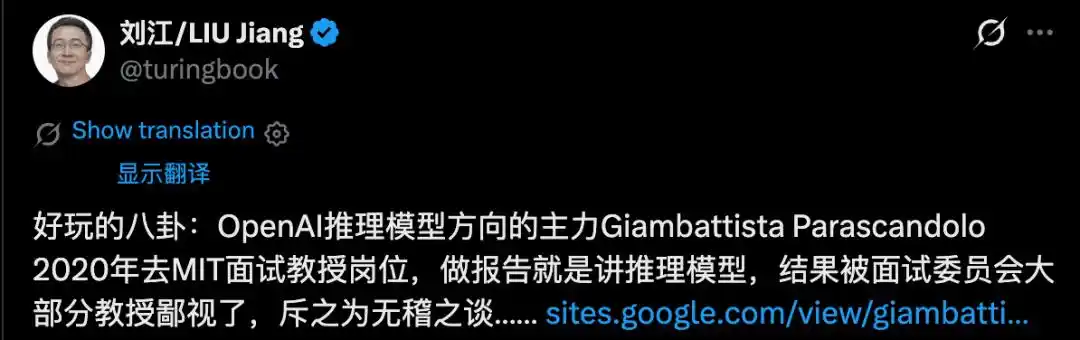
https://x.com/turingbook/status/2084003612687249836?s=20

This guy went all out, directly putting this experience on his personal homepage and attaching the description and slide link from that year's presentation.
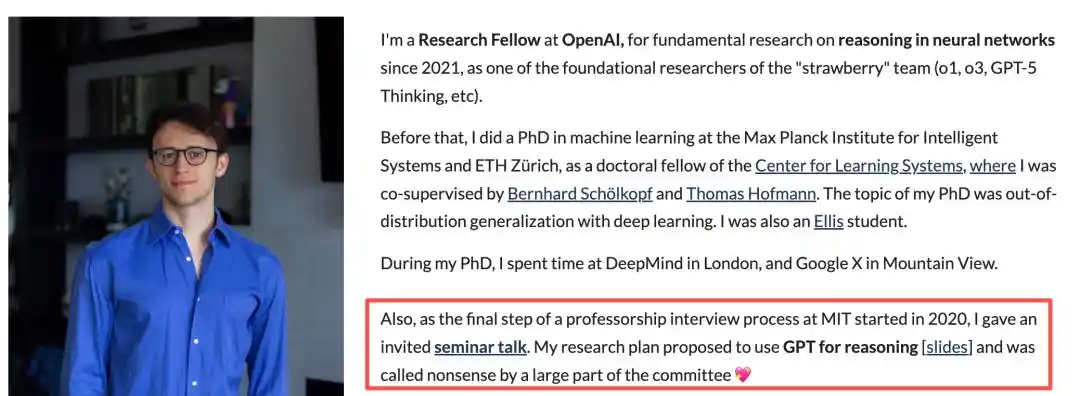
https://sites.google.com/view/giambattista-parascandolo/home

What was in that report dismissed as "nonsense"?

The MIT website shows that the topic of this presentation was how to enable artificial neural networks to break through the training distribution and achieve generalization and planning capabilities closer to humans.
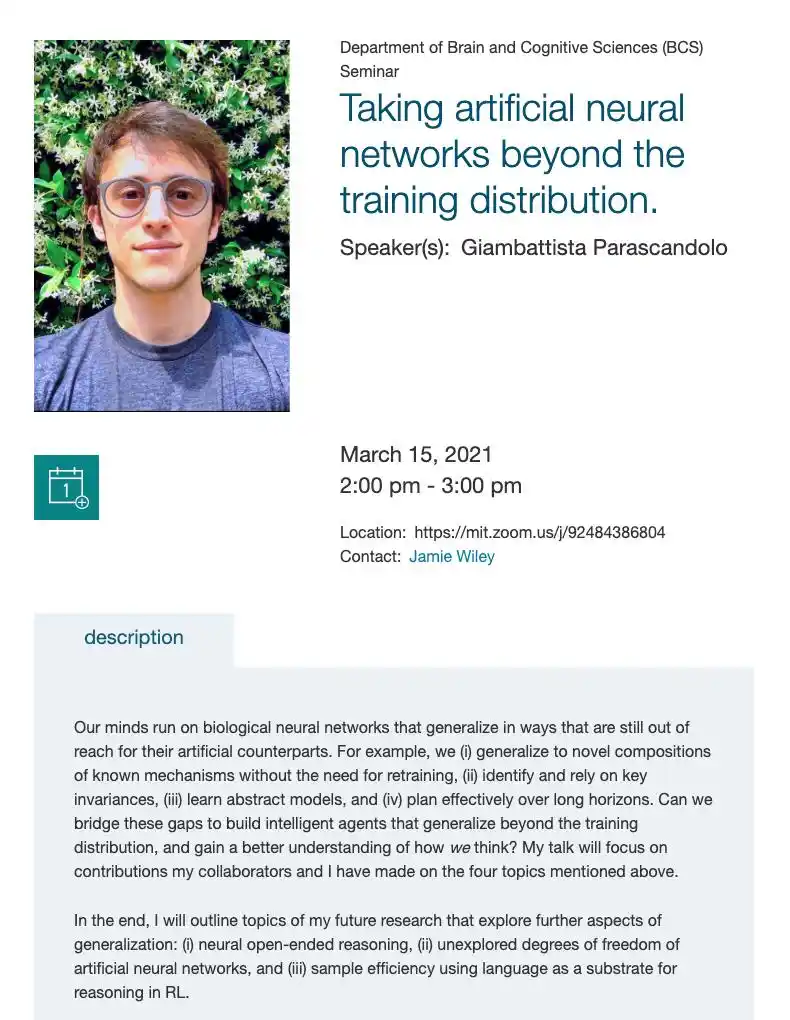
Parascandolo believed that humans can recombine existing knowledge, identify key invariants, build abstract models, and perform long-horizon planning. Artificial neural networks still have much room for improvement in these aspects.

At the end of the presentation, he proposed three future research directions: open-ended reasoning in neural networks, unexplored degrees of freedom in artificial neural networks, and using language as a reasoning substrate in reinforcement learning to improve sample efficiency.

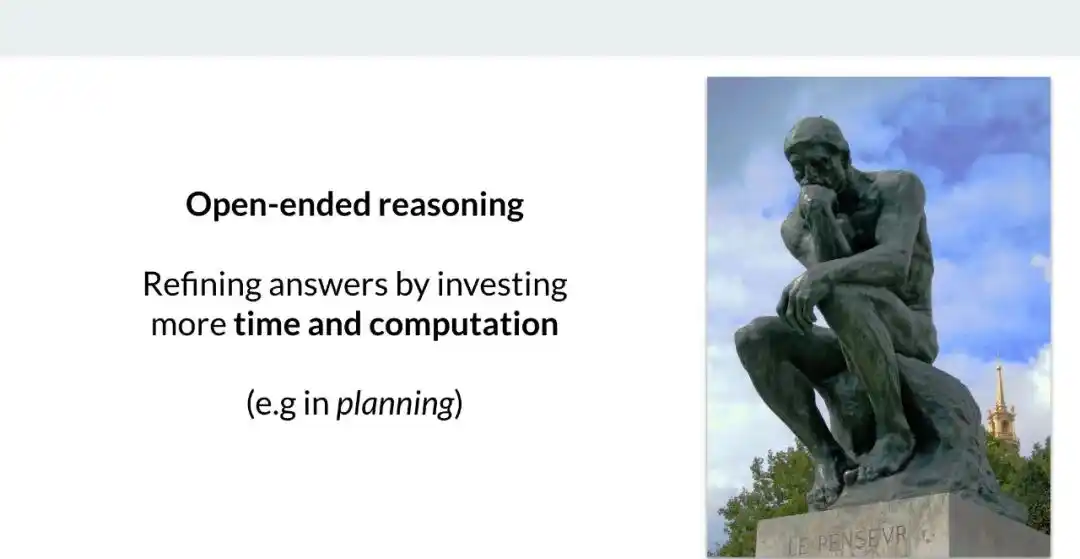
The most crucial concept among these was "open-ended reasoning."

Parascandolo defined it as: the model can invest more time and computation to continuously refine its answer. The harder the problem, the more steps the model should think, and the extra computation should translate into better results.

This already sounds very much like today's inference-time compute scaling.
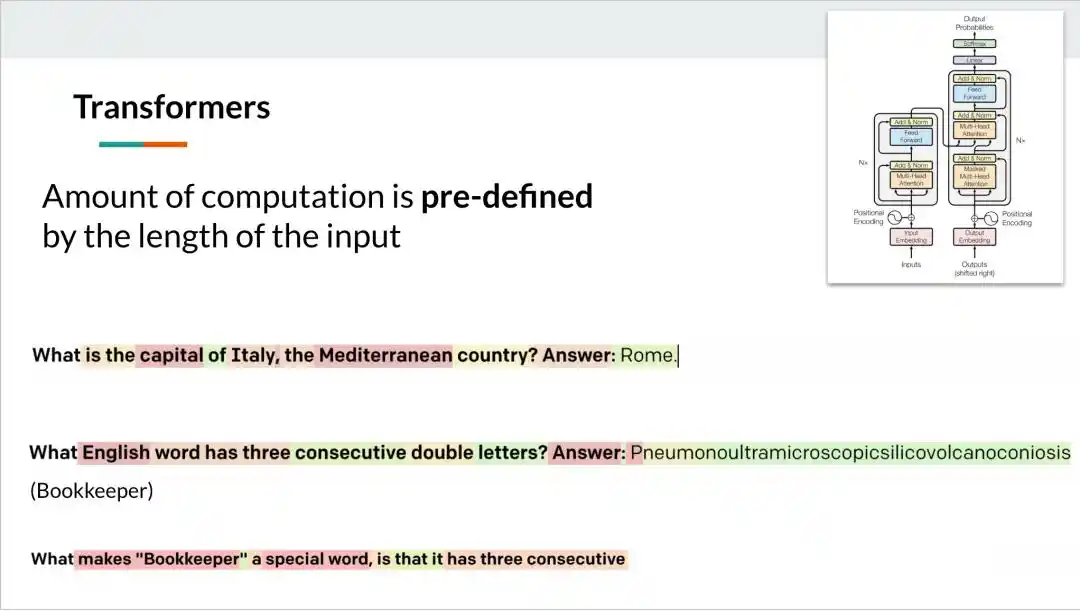
At that time, standard Transformers had a fixed network depth, and the forward compute each token experienced was basically predetermined. However, problem difficulty has no stable relationship with input length. A problem could be very long but have a simple answer. Another problem might be a single sentence but require multiple rounds of decomposition and verification.
RNNs seemed more suitable for such tasks. They could run repeatedly and theoretically obtain arbitrary amounts of thinking time. However, the curve Parascandolo showed in his PPT indicated that RNNs typically performed best only around the number of reasoning steps they had seen during training. Continuing to increase the number of iterations could actually decrease accuracy.
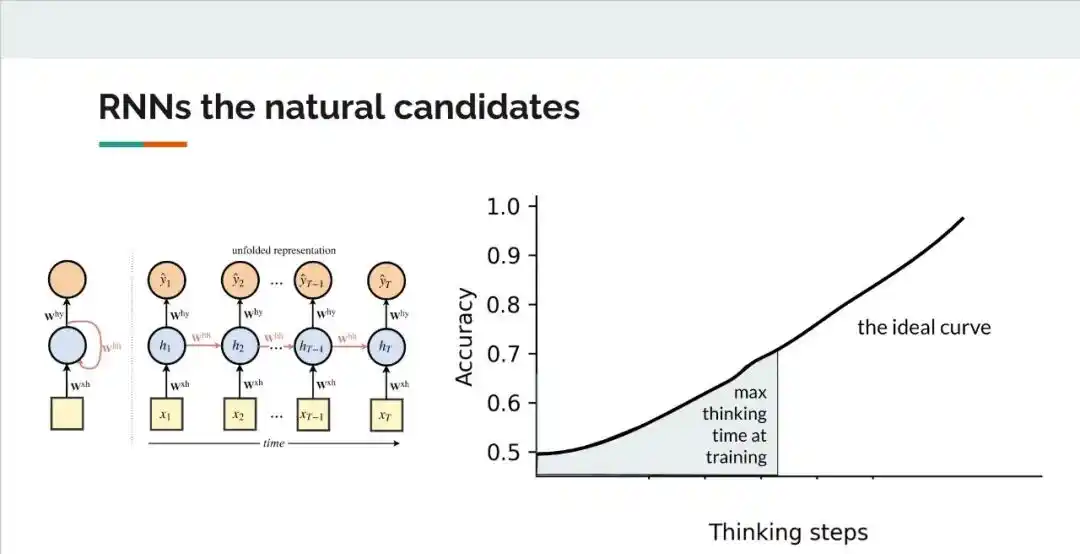
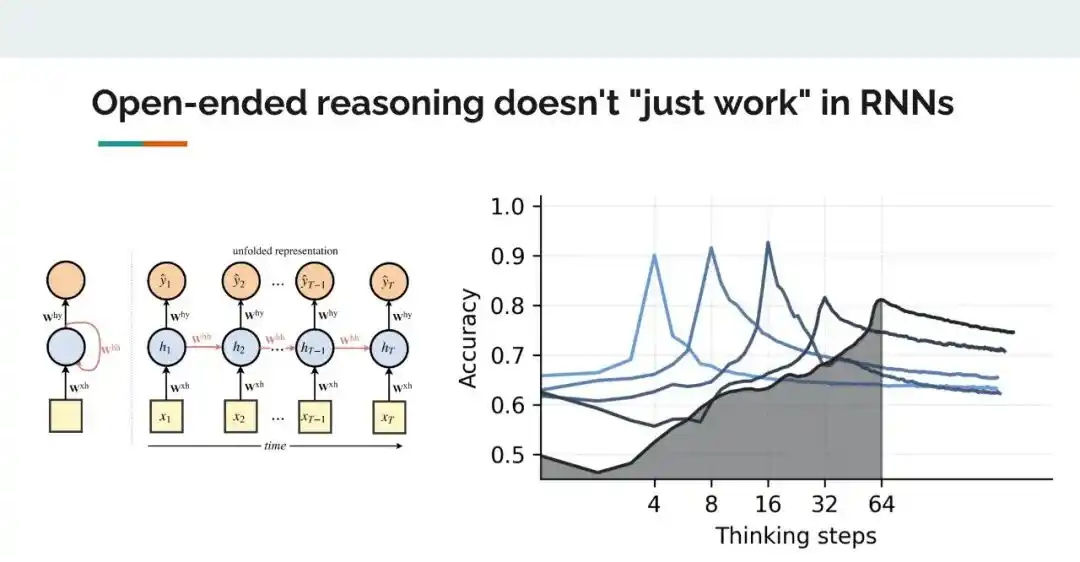
This meant that increasing compute was only the first step; the model also needed to learn how to utilize this compute.

At the time, the most effective multi-step planning heavily relied on model-predictive control and Monte Carlo tree search. Neural networks were responsible for predicting the environment or evaluating value, while external search algorithms were responsible for expanding future paths. Parascandolo hoped to further integrate long-horizon reasoning capabilities into neural networks themselves.
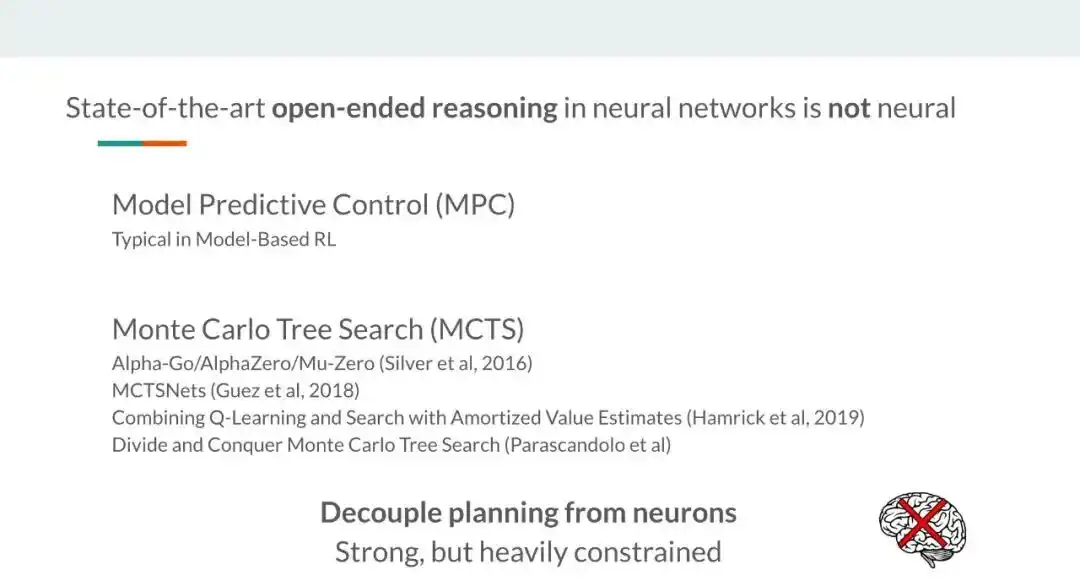
His second vision was to make language the substrate for reasoning.

Parascandolo used the classic game *Montezuma's Revenge* as an example. A reinforcement learning Agent trained from scratch needed to try a huge number of state and action combinations. Many correct actions themselves were not complex; what the Agent truly lacked was a judgment of "which behaviors are more reasonable."
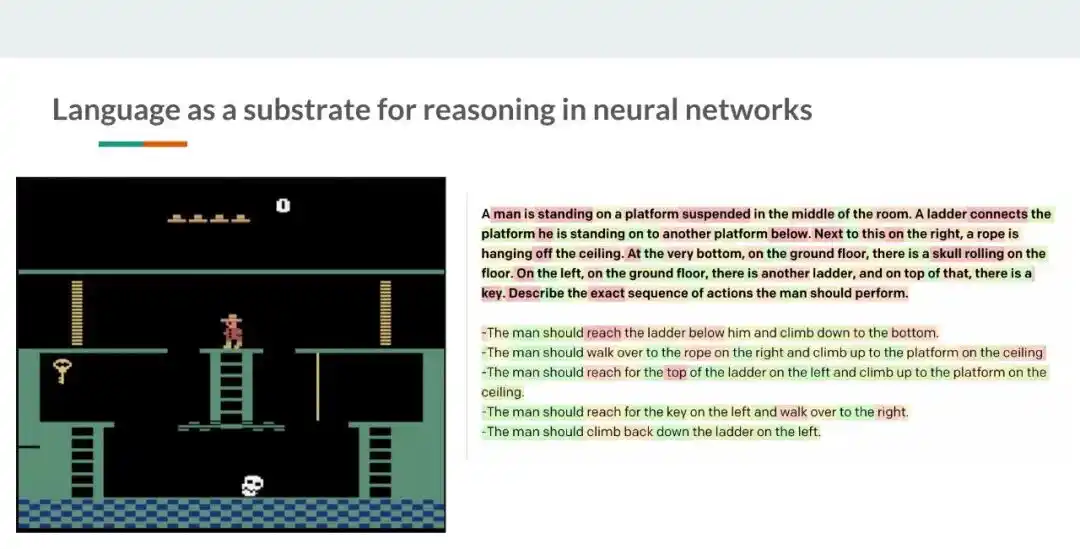
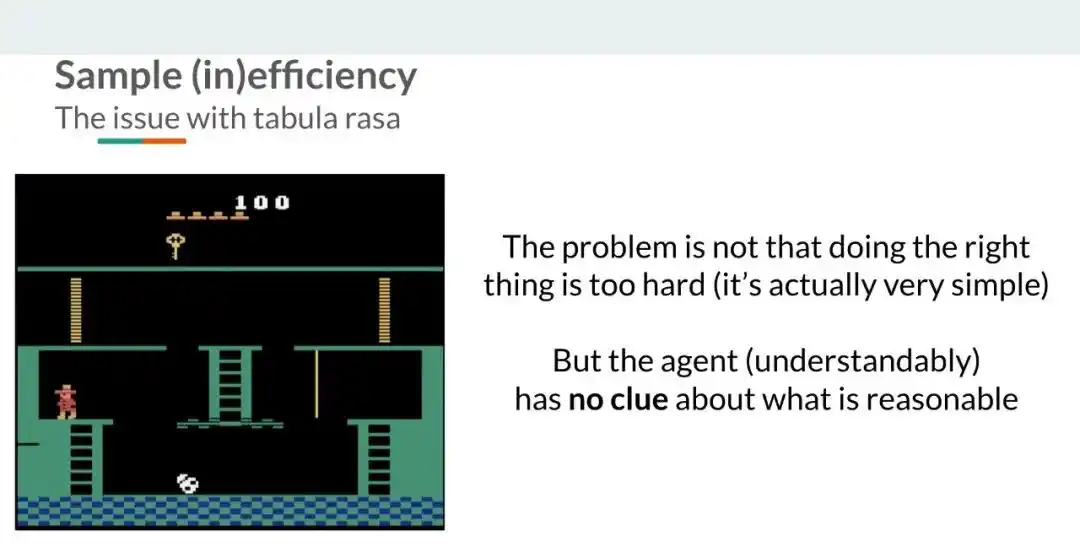
GPT had already absorbed vast amounts of world knowledge from text. Language could help models describe environments, understand goals, decompose tasks, and generate high-level plans, also significantly narrowing the search space.

Today, this line of thinking easily brings to mind chain-of-thought, language planning, and Agent workflows.

The third direction Parascandolo proposed was that AI systems could reset tasks, return to any remembered state, construct counterfactual scenarios, and even adjust time, gravity, and observations within the simulator. Systems could also directly read, copy, and modify their own activation values and neural network weights.
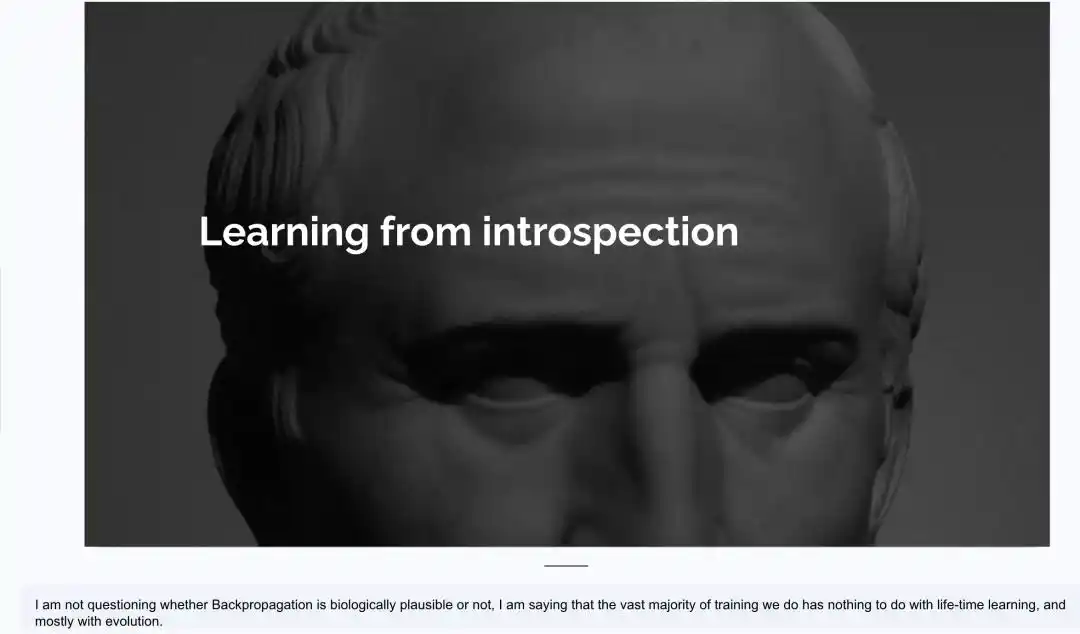
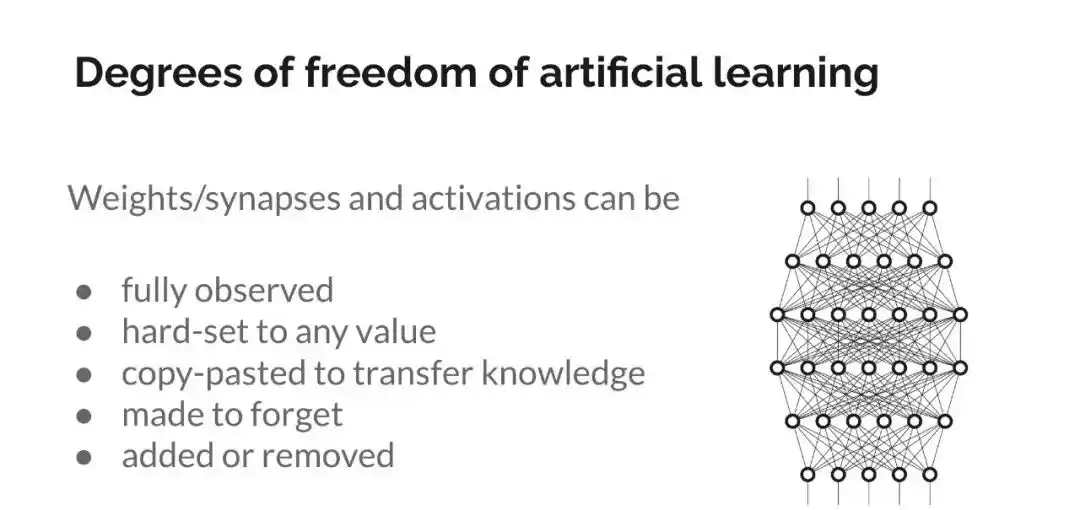
This was equivalent to incorporating the learning process itself into the Agent's operational space. It could engage in deliberate practice, generate special training scenarios, transfer existing knowledge, and relearn from failure trajectories.
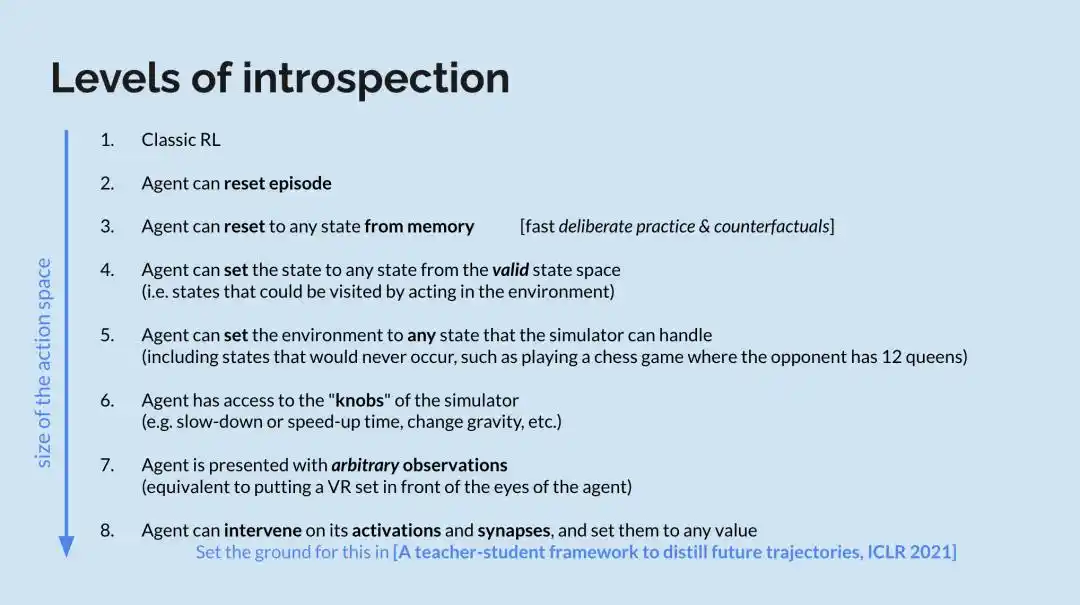
The PPT from five years ago almost wrote today's reasoning model roadmap.

We also dug up a blog post he wrote in June 2021, titled "Backprop, Evolution, and the ‘Two Dogs’ Fallacy."
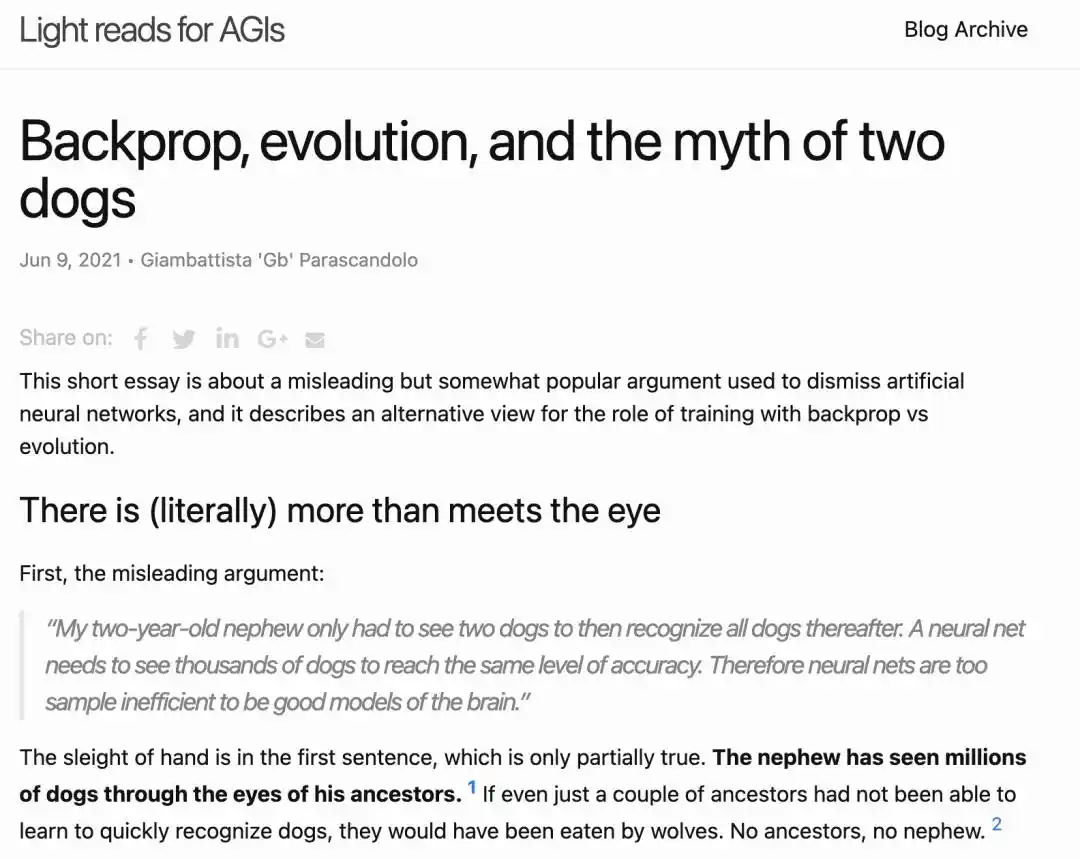
This blog post mainly refuted the view that "neural networks need massive amounts of data, therefore they are unlike the human brain."

Parascandolo argued that the fact humans can learn to recognize dogs after seeing just a few does not mean there was no prior accumulation of experience. Long evolution has already condensed the experiences of ancestors interacting with the world into the structure and inductive biases of the human brain.

From this perspective, the large-scale pre-training of neural networks can be analogized to biological evolution, while model fine-tuning and in-context learning are closer to the learning an individual does in a lifetime. GPT-3 has read far more text than any individual, but its pre-training served to compress massive experience and shape efficient learning capabilities. Therefore, one should not directly compare the model's entire pre-training data with the small number of learning samples an individual receives after birth.

This understanding also implies that continuing to scale data and compute could still bring significant improvements. He was drawing an analogy about the roles they play, not claiming that gradient descent and biological evolution share the same specific mechanisms.

What's this guy's background?

This guy is quite low-key. His latest post on X dates back to November 2024, when he was recruiting two Research Engineers (RE) and Software Engineers (SWE) for o1.
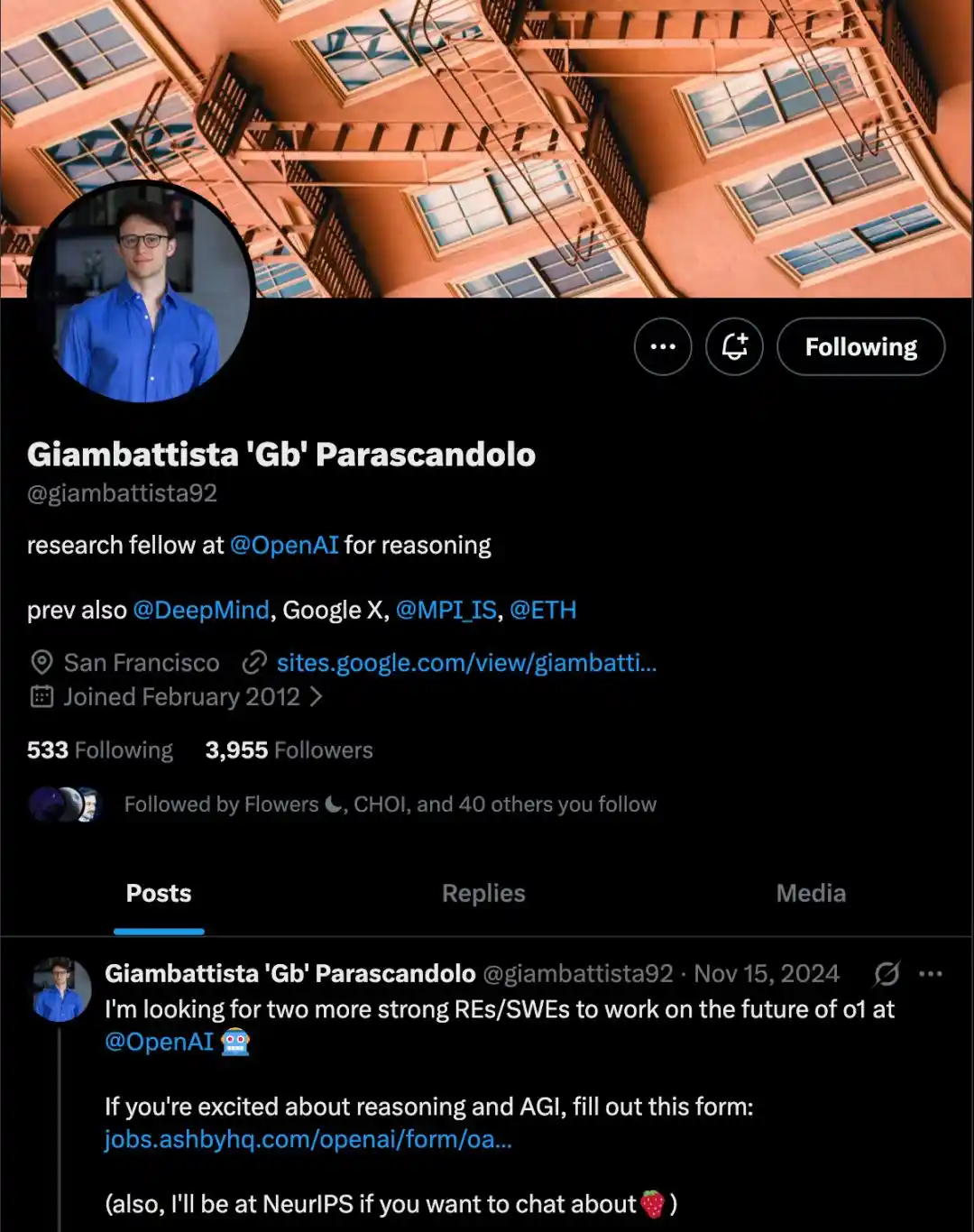
According to his personal homepage, Parascandolo's research experience has always revolved around generalization, planning, and reasoning.

In 2017, he began his Ph.D. at the Max Planck Institute for Intelligent Systems and ETH Zurich, supervised by Bernhard Schölkopf and Thomas Hofmann. His doctoral research focused on OOD generalization in deep learning.

During his Ph.D., he did internships at Google X in Mountain View and DeepMind in London, participating in research on automated design on ultra-large-scale simulators at the former, and research on divide-and-conquer Monte Carlo tree search at the latter.

After graduating with his Ph.D. in September 2021, he directly joined OpenAI. Initially, he entered the reinforcement learning team led by John Schulman, then moved to the algorithms team where Mark Chen was, and later joined the 🍓 (strawberry) team led by Jerry Tworek. The strawberry team was the internal codename for the o1 project.
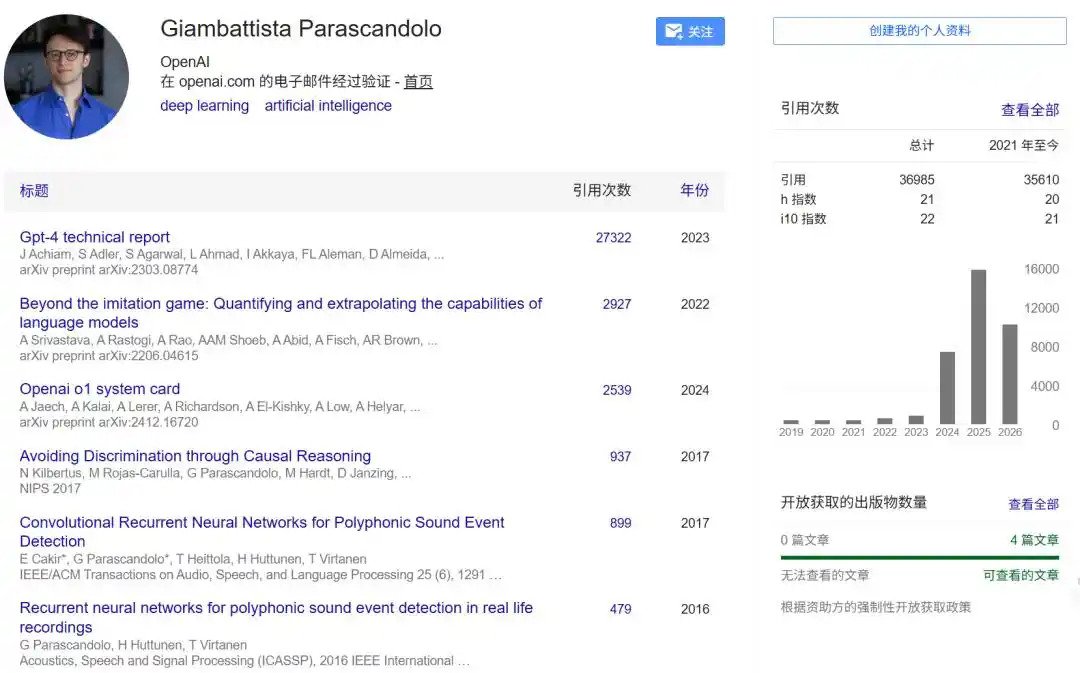
In 2023, he participated in GPT-4 development and formed a new team continuing reasoning research. Later, he participated in the foundational research for OpenAI o1 and o3, promoting the scaling of reward modeling, environment construction, and general reasoning algorithms. Part of the algorithm description is still covered by black blocks on his page.

Parascandolo didn't get the MIT professorship from that 2020 interview; he went to OpenAI instead.

Four years later, he helped build o1.

Life is always full of delightful surprises.

References:

https://x.com/giambattista92

https://sites.google.com/view/giambattista-parascandolo/home

https://gibipara92.github.io/2021/06/09/backprop-evolution-two-dogs.html

https://docs.google.com/presentation/d/1edd2GkAP31wNygaev3DO8gE1t2lgsx1z8TeVpBKqlYA/edit?slide=id.gc772610149_0_179#slide=id.gc772610149_0_179

This article is from the WeChat public account "Almost Human" (ID: almosthuman2014), author: Yang Wen


Trend Kriptolar

İlgili Sorular

QWhat were the three key research directions proposed by Giambattista Parascandolo in his MIT job talk?

AThe three key research directions were: 1) Open-ended reasoning in neural networks (models allocating more time/computation for harder problems), 2) Using language as a substrate for reasoning in reinforcement learning to improve sample efficiency, and 3) Allowing AI systems to manipulate their own internal states (like activations and weights) to conduct deliberate practice and counterfactual learning.

QHow does Parascandolo's concept of 'open-ended reasoning' relate to modern AI like OpenAI's o1?

AParascandolo's 'open-ended reasoning' concept, where models spend more time and computation to refine answers for harder problems, directly foreshadows the core idea of 'reasoning-time compute scaling' used in modern AI systems like OpenAI's o1 and o3. These models dynamically allocate computational effort based on problem difficulty.

QWhy did Parascandolo argue that comparing a neural network's pre-training data to a human's lifelong learning is misleading?

AParascandolo argued that large-scale pre-training is analogous to biological evolution, compressing vast ancestral experience into the model's structure and inductive biases. Fine-tuning and in-context learning are more akin to an individual's lifetime learning. Therefore, comparing total pre-training data to a human's post-birth learning samples is an apples-to-oranges comparison.

QWhat role did Giambattista Parascandolo play at OpenAI leading up to the development of o1 and o3?

AAt OpenAI, Parascandolo initially worked in the reinforcement learning team, later joined the algorithms team, and was part of the 'Strawberry' team (the internal codename for the o1 project). He contributed to GPT-4, formed a new team focused on reasoning research, and worked on the foundational research for o1 and o3, specifically on reward modeling, environment construction, and scaling general reasoning algorithms.

QWhat was the main point of Parascandolo's blog post 'Backprop, Evolution and the "Two Dogs" Fallacy'?

AThe main point was to challenge the argument that neural networks are unlike the human brain because they require massive data. He posited that human ability to learn from few examples (like recognizing dogs) is built upon evolutionary history, just as a neural network's pre-training compresses vast experience. Thus, pre-training is analogous to evolution, not individual learning, justifying the value of scaling data and compute.

İlgili Okumalar

CEO or 'Cult Leader'? Anthropic Faces Backlash Over Its 'Belief'

Anthropic, an AI company nearing trillion-dollar valuation, faces a critical internal challenge: declining morale and a growing rift over its foundational beliefs and leadership. While financial and technical performance remains strong, with Q2 2026 revenue surging over 14x year-over-year and top talent like Google's Justin Gilmer joining, the company's unique culture is under strain. Early employees, who embraced a strong mission-focused culture around AI safety, now coexist with newer hires less aligned with this vision. Anonymous sources report low morale, private channels for airing grievances, and employees torn between staying for valuable equity or leaving due to pressure. CEO Dario Amodei's intense focus on maintaining culture—through rituals like "Dario Vision Quest" meetings and probing "cultural interviews"—faces scrutiny as the company scales. A leaked statement where Amodei suggested Anthropic could one day become "the world's only private company" has fueled external criticism, drawing comparisons to dystopian sci-fi monopolies. The company exhibits contradictions: advocating for AI safety while aggressively pursuing model development and market dominance. It has modified its "Responsible Scaling Policy," faced backlash for attempted AI "sabotage" mechanisms against foreign research, and clashed with the U.S. government over defense contracts. Recent text watermarking for Claude, cited as compliance with EU regulations, has also drawn user criticism. Despite these tensions, Anthropic continues to attract investment, top engineers, and enterprise clients. However, the core "faith" that once unified and distinguished it is now becoming a significant governance and cultural challenge.

marsbit6 dk önce

CEO or 'Cult Leader'? Anthropic Faces Backlash Over Its 'Belief'

marsbit6 dk önce

Anthropic CEO Denies Rumors, Aims to Transform AI for His Deceased Father and Eradicate Cancer Within 10 Years

Anthropic CEO Dario Amodei has published a rare, lengthy public statement to counter significant criticism from Silicon Valley, as the AI company approaches a potential record-breaking IPO with a reported $2 trillion valuation. The core criticism, amplified by investor Gavin Baker, centers on perceptions that Amodei believes Anthropic should be the world's sole private AI company due to the technology's risks, costs, and power—a view allegedly echoed by NVIDIA's Jensen Huang. Amodei firmly rejects this, arguing it presents a false dichotomy. He defends Anthropic's advocacy for regulation, like California's SB-1047, which he claims imposes costs on frontier AI firms while benefiting smaller competitors, and calls for establishing rules that manage AI risks, constrain corporate power, and preserve open-model development. Shifting to ambition, Amodei outlines a radical vision for AI in biomedicine. He states that within 5-10 years, AI could cure most human diseases, a mission deeply personal due to his father's death from hepatitis C just years before a cure became available. Amodei asserts that public trust in AI will be earned not by promises or benchmarks, but by tangible results—AI actually saving lives. He confirms Anthropic is significantly increasing its biology and medical AI investments, with preliminary results expected within months. This narrative reframing comes ahead of Anthropic's anticipated IPO, positioning the company not just as an OpenAI competitor, but as one aiming to solve humanity's fundamental challenges.

marsbit6 dk önce

Anthropic CEO Denies Rumors, Aims to Transform AI for His Deceased Father and Eradicate Cancer Within 10 Years

marsbit6 dk önce

Stack Overflow Is Dying, New Questions Are Fewer Than During the Beta Period

The article discusses the decline of Stack Overflow, the prominent programming Q&A community, noting that new question submissions in July 2026 dropped to just 1,304—far below its peak of 207,000 in March 2014. Official data reveals a steady decline in activity since 2014, exacerbated by the rise of AI coding assistants like ChatGPT, which offer instant, private solutions and reduce the need for public forum posts. While a restrictive community culture that often penalized new users contributed to the downturn, the widespread adoption of AI tools has dramatically accelerated the platform's stagnation. Similar declines are observed in other knowledge-based platforms like Chegg, Fiverr, and Wikipedia, where AI-generated content is displacing human-generated queries and contributions. Research indicates that not only are fewer users asking questions, but high-reputation experts are also leaving the platform at increasing rates—a phenomenon termed "signal compression," where the value of demonstrated expertise diminishes when AI can produce superficially competent answers. This threatens the formation of future human expertise. Although AI models have been trained extensively on Stack Overflow's open corpus, the reduction in new, timely public Q&A content may limit the knowledge available for future AI training. Some suggest that trustworthy human-curated knowledge layers, blogs, and niche communities may regain importance as sources of reliable, attributed information. The shift from public, searchable knowledge repositories to private AI interactions raises concerns about the loss of a communal, corrective, and open record of problem-solving.

marsbit12 dk önce

Stack Overflow Is Dying, New Questions Are Fewer Than During the Beta Period

marsbit12 dk önce

İşlemler

Spot

Popüler Makaleler

CORE Nasıl Satın Alınır

HTX.com’a hoş geldiniz! CORE (CORE) satın alma işlemlerini basit ve kullanışlı bir hâle getirdik. Adım adım açıkladığımız rehberimizi takip ederek kripto yolculuğunuza başlayın. 1. Adım: HTX Hesabınızı OluşturunHTX'te ücretsiz bir hesap açmak için e-posta adresinizi veya telefon numaranızı kullanın. Sorunsuzca kaydolun ve tüm özelliklerin kilidini açın. Hesabımı Aç2. Adım: Kripto Satın Al Bölümüne Gidin ve Ödeme Yönteminizi SeçinKredi/Banka Kartı: Visa veya Mastercard'ınızı kullanarak anında CORE (CORE) satın alın.Bakiye: Sorunsuz bir şekilde işlem yapmak için HTX hesap bakiyenizdeki fonları kullanın.Üçüncü Taraflar: Kullanımı kolaylaştırmak için Google Pay ve Apple Pay gibi popüler ödeme yöntemlerini ekledik.P2P: HTX'teki diğer kullanıcılarla doğrudan işlem yapın.Borsa Dışı (OTC): Yatırımcılar için kişiye özel hizmetler ve rekabetçi döviz kurları sunuyoruz.3. Adım: CORE (CORE) Varlıklarınızı SaklayınCORE (CORE) satın aldıktan sonra HTX hesabınızda saklayın. Alternatif olarak, blok zinciri transferi yoluyla başka bir yere gönderebilir veya diğer kripto para birimlerini takas etmek için kullanabilirsiniz.4. Adım: CORE (CORE) Varlıklarınızla İşlem YapınHTX'in spot piyasasında CORE (CORE) ile kolayca işlemler yapın.Hesabınıza erişin, işlem çiftinizi seçin, işlemlerinizi gerçekleştirin ve gerçek zamanlı olarak izleyin. Hem yeni başlayanlar hem de deneyimli yatırımcılar için kullanıcı dostu bir deneyim sunuyoruz.

417 Toplam GörüntülenmeYayınlanma 2024.12.13Güncellenme 2026.06.02

CORE Nasıl Satın Alınır

Tartışmalar

HTX Topluluğuna hoş geldiniz. Burada, en son platform gelişmeleri hakkında bilgi sahibi olabilir ve profesyonel piyasa görüşlerine erişebilirsiniz. Kullanıcıların CORE (CORE) fiyatı hakkındaki görüşleri aşağıda sunulmaktadır.

活动图片