A Memory Reduction Report Triggers a Plunge: Is It an Overreaction?

marsbit2026-06-05 tarihinde yayınlandı2026-06-05 tarihinde güncellendi

Özet

A supply chain report regarding NVIDIA's Rubin platform's system memory configuration triggered a significant sell-off in AI memory stocks. The report suggested a potential reduction in per-rack CPU-side system memory (SOCAMM/LPDDR) from ~55TB to ~28TB, impacting the perceived value per cabinet. This led to sharp declines for Micron and SK Hynix, as the market broadly reacted to the negative headline of "memory cut," without initially distinguishing between CPU system memory and GPU-side HBM4. The article clarifies that the reported adjustment primarily affects the CPU-side system memory profit pool, not the HBM4 demand tied directly to GPUs, which remains a critical and supply-constrained component. The sell-off is interpreted as a high-position, sentiment-driven reaction in a crowded trade, rather than a fundamental reassessment of HBM. While the cost reduction per cabinet could theoretically boost overall rack shipments, this remains speculative. The key going forward is concrete data on final Rubin BOMs, actual shipment volumes, and revenue splits for companies like Micron (exposed to SOCAMM/DRAM) and SK Hynix (focused on HBM). The event highlights a market shift from buying a broad AI memory narrative to scrutinizing specific profit pools within the AI hardware chain.

A supply chain report regarding NVIDIA's Rubin rack caused a first-round decline in the AI memory sector.

The report mentioned that single-rack memory capacity might drop from approximately 55TB to about 28TB. Subsequently, Micron fell about 7.7% in a single day, and SK Hynix opened down more than 8% the next day. More subtly, the report's author, Dylan Patel, later clarified that many reposts only captured the most eye-catching part, and this was not a "catastrophic bearish" report.

The reason for such a significant reaction is that it touched the most sensitive point of the current AI hardware trend. Over the past period, the market has been trading not on an ordinary memory cycle, but on the expectation that after the Rubin platform enters mass production, AI racks will continue to drive demand for HBM and supporting memory, thereby re-elevating memory suppliers' revenue and pricing power. Since GTC earlier this year, themes like HBM4, SK Hynix's market share, and Micron catching up in AI memory have been repeatedly traded in the market.

However, the phrase "memory being cut" is too crude.

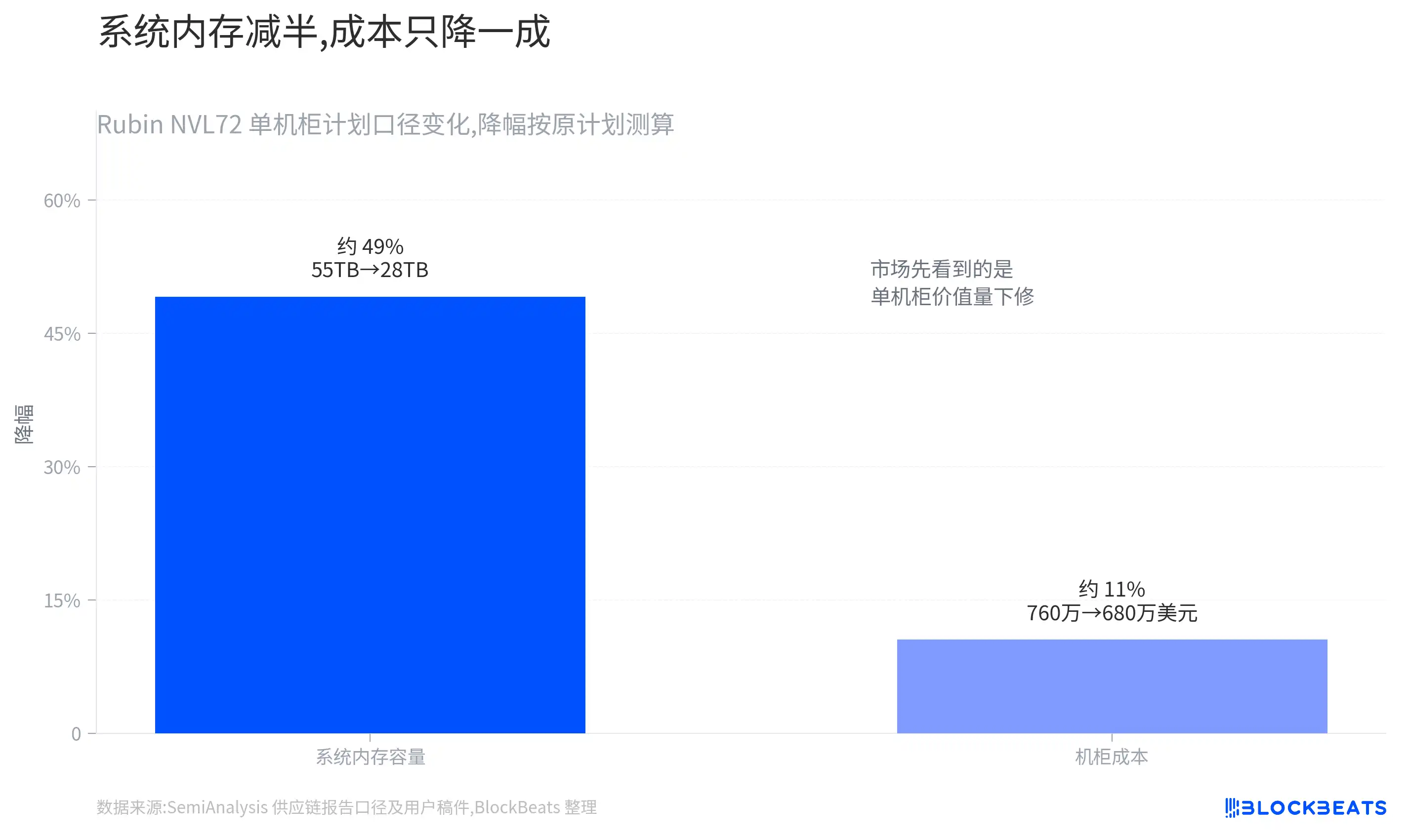
The adjustments disclosed by SemiAnalysis primarily refer to changes in the configuration of SOCAMM and LPDDR on the CPU side within the Rubin NVL72 rack. Most systems might adopt 96GB modules instead of higher-capacity 192GB modules, reducing single-rack memory capacity from a planned ~55TB to ~28TB. This change affects the system memory value per rack but cannot directly imply that HBM4 demand on the GPU side has been simultaneously downgraded.

What really needs to be dissected is which profit pool this adjustment affects and which expectation the market is currently trading on.

Why Did AI Memory Stocks Plunge Collectively?

The market sold off based on a positioning reaction when a high-flying theme encountered negative keywords.

Currently, the confirmed part is that the market reaction was heavy, but the event itself remains at the level of a supply chain report. SemiAnalysis disclosed that NVIDIA might downgrade the CPU-side SOCAMM configuration to ensure the delivery schedule for the Rubin NVL72. The numbers mentioned in the report include single-rack memory capacity dropping from ~55TB to ~28TB, and rack cost decreasing from ~$7.6 million to ~$6.8 million. These numbers should be understood as the reporting perspective of SemiAnalysis, not yet the final confirmed BOM (Bill of Materials) from NVIDIA.
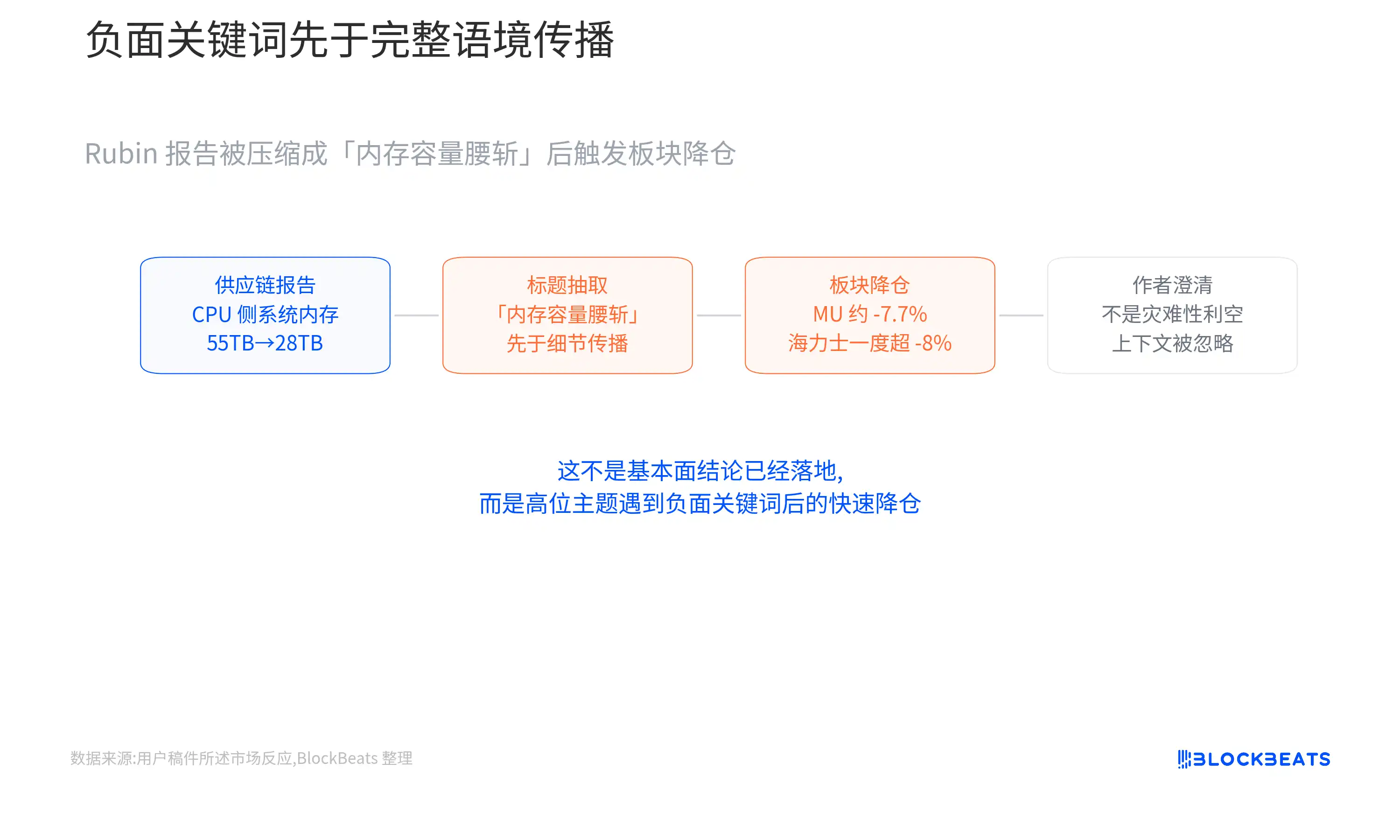
Over the past few quarters, the rise of AI memory stocks relied on a very smooth narrative: the more AI racks, the greater the shortage of advanced memory, and the thicker the profits for suppliers.

The simpler this story, the greater the killing power of a negative headline. Once "memory capacity halved" appeared, the market would first downgrade the memory value per rack, rarely distinguishing immediately which type of memory was being adjusted.

Micron's reaction is most illustrative.

It is both a traditional DRAM supplier and a beneficiary of AI server memory upgrades. Much of the upside previously priced in by the market came from the repricing notion that "AI memory is no longer just a cyclical product." If Rubin's per-rack system memory capacity declines, capital would immediately worry whether expectations for Micron's per-rack revenue from SOCAMM and LPDDR segments were set too high.

SK Hynix also followed the decline, indicating the shock has extended beyond a single supplier.

It is stronger in the HBM field, and the market had previously circulated rumors that it secured the majority of HBM orders related to Vera Rubin. But when AI memory trading becomes crowded, capital does not wait to verify all details before acting. The synchronous decline of memory stocks reflects a contraction in sector risk appetite, not that each company suffered the same fundamental shock.

Dylan Patel's subsequent clarification also points to this. He stated the report was not intended to create a "disaster" narrative, and many missed the context.

Translated into market language, capital did not fully trade on a supply chain analysis but rather on a rapid position reduction after a high-flying sector encountered negative keywords.

AI Memory Begins Redividing Profit Pools

What was primarily downgraded this time is the CPU-side system memory, not the GPU-adjacent HBM4.

Memory in a Rubin rack cannot be summarized with one word. The simplest breakdown is into two layers:

The first layer is GPU-side HBM4, serving the accelerator chip itself;

The second layer is CPU-side SOCAMM and LPDDR, more akin to the system RAM for the entire machine.
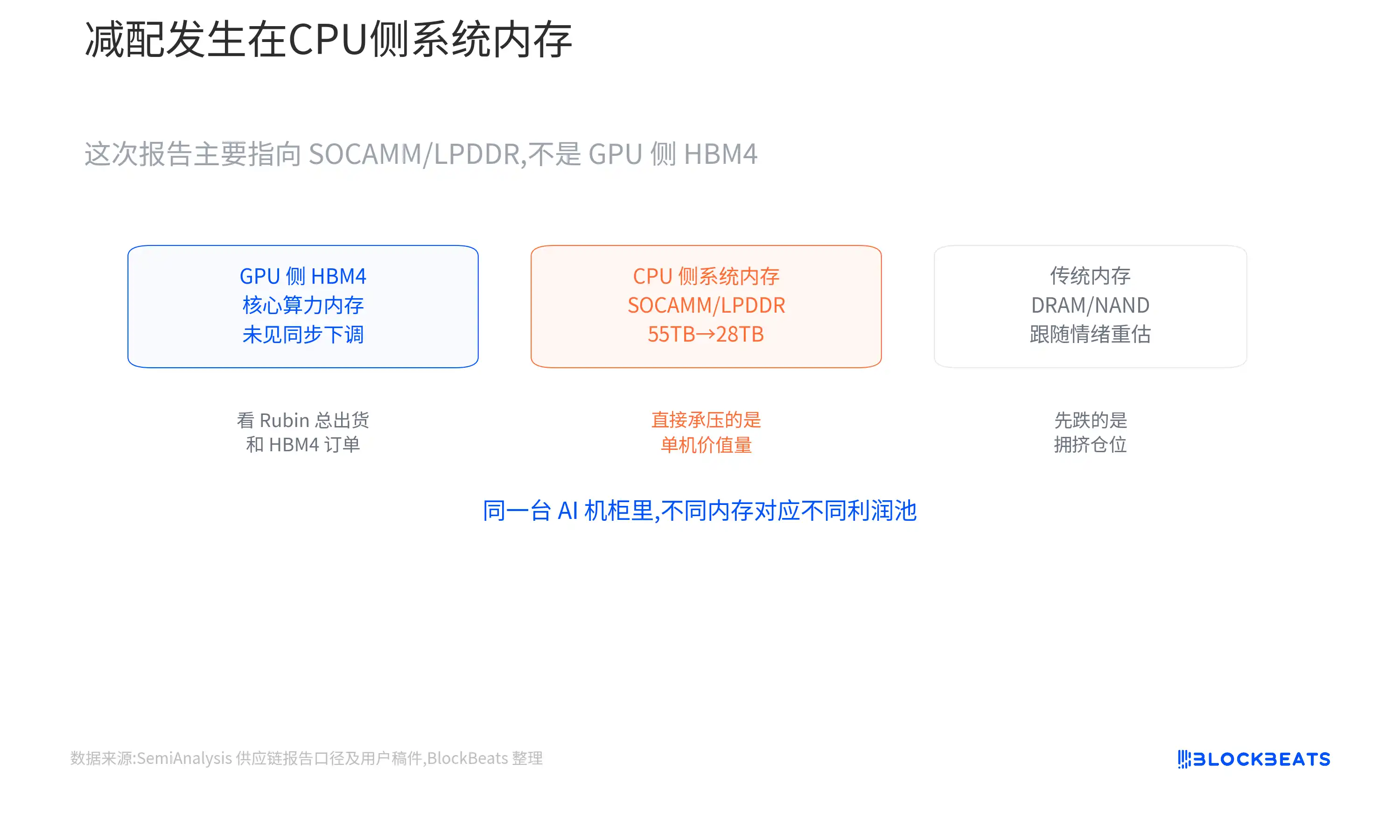
The former determines the speed at which data is fed to the GPU, while the latter affects overall machine scheduling, maintenance, and the performance of some workloads.

The "55TB to 28TB" mentioned by SemiAnalysis primarily falls on CPU-side system memory.

It might change the quantity, capacity, and procurement cost of SOCAMM modules per Rubin NVL72 rack. If most systems shift from 192GB modules to 96GB modules, the per-unit value of high-capacity SOCAMM indeed decreases, pressuring the revenue upside for related suppliers.

But GPU-side HBM4 is another line.

The Rubin platform still revolves around the Rubin GPU and Vera CPU, and HBM4 remains the core memory component for GPU packaging and computing power release. Current information does not show that HBM4 capacity or Rubin GPU shipments have been simultaneously downgraded. Previous multi-party predictions still regard HBM as one of the tightest and most pricing-powerful segments in AI servers, with SK Hynix also seen by the market as a primary beneficiary.

Think of an AI rack as an extremely expensive high-performance server.

HBM is closer to high-speed memory attached next to the GPU, while SOCAMM is closer to replaceable system memory for the whole machine. This adjustment mainly targets the latter.

For holdings, the distinction is very direct: if Micron has greater exposure in the SOCAMM segment, the downgrade in per-unit value would hit its expectations first; SK Hynix's HBM logic is relatively independent but would also be dragged down by sector sentiment in crowded trading.

Extrapolating system memory reduction directly into a breakdown of HBM4 demand lacks sufficient evidence.

A more reasonable breakdown is that the CPU-side profit pool indeed faces downward revision pressure, while the GPU-side HBM still depends on total Rubin shipments and HBM4 order cadence.

The AI memory theme can no longer be covered by a single line of "all memory is strong." Micron, SK Hynix, and Samsung Electronics have different exposures in HBM, SOCAMM, traditional DRAM, and NAND. Different types of memory within the same rack also correspond to different prices, margins, and supply-demand constraints.

Can Cost Reduction Translate to More Rack Shipments?

An optimistic interpretation stems from cost and delivery cadence.

SemiAnalysis's calculations show that the Rubin NVL72 rack cost might drop from ~$7.6 million to ~$6.8 million, a reduction of ~$800,000.
For cloud vendors like Microsoft, Google, Amazon, and Meta, AI racks are not just hardware purchases but involve calculating hourly computing costs, delivery time, and stability of large-scale deployment.

If a reduced configuration allows Rubin to be delivered faster, some per-unit value decline might be offset by more racks.

The logic is not complicated. If high-capacity SOCAMM supply is tight, NVIDIA choosing a more readily available configuration can lower the BOM per rack and reduce the risk of a single component delaying overall machine delivery.

For buyers, if a lower system memory configuration does not significantly impact core workloads, getting racks earlier might be more attractive than waiting for fully configured versions.

The problem is that this step remains speculative for now.

Cost reduction does not automatically equal increased orders. For "per-unit value decline" to be offset by "increased total rack volume," NVIDIA needs to deliver more Rubin NVL72 racks, and cloud vendors also need to add or advance purchases.

Existing materials lack public orders, quarterly guidance, or actual shipment data to prove this.

To understand with a simple scenario: if a certain SOCAMM capacity is nearly halved per rack, then total rack shipments need to increase significantly for the total Bit demand in this segment to return to previous expectations.
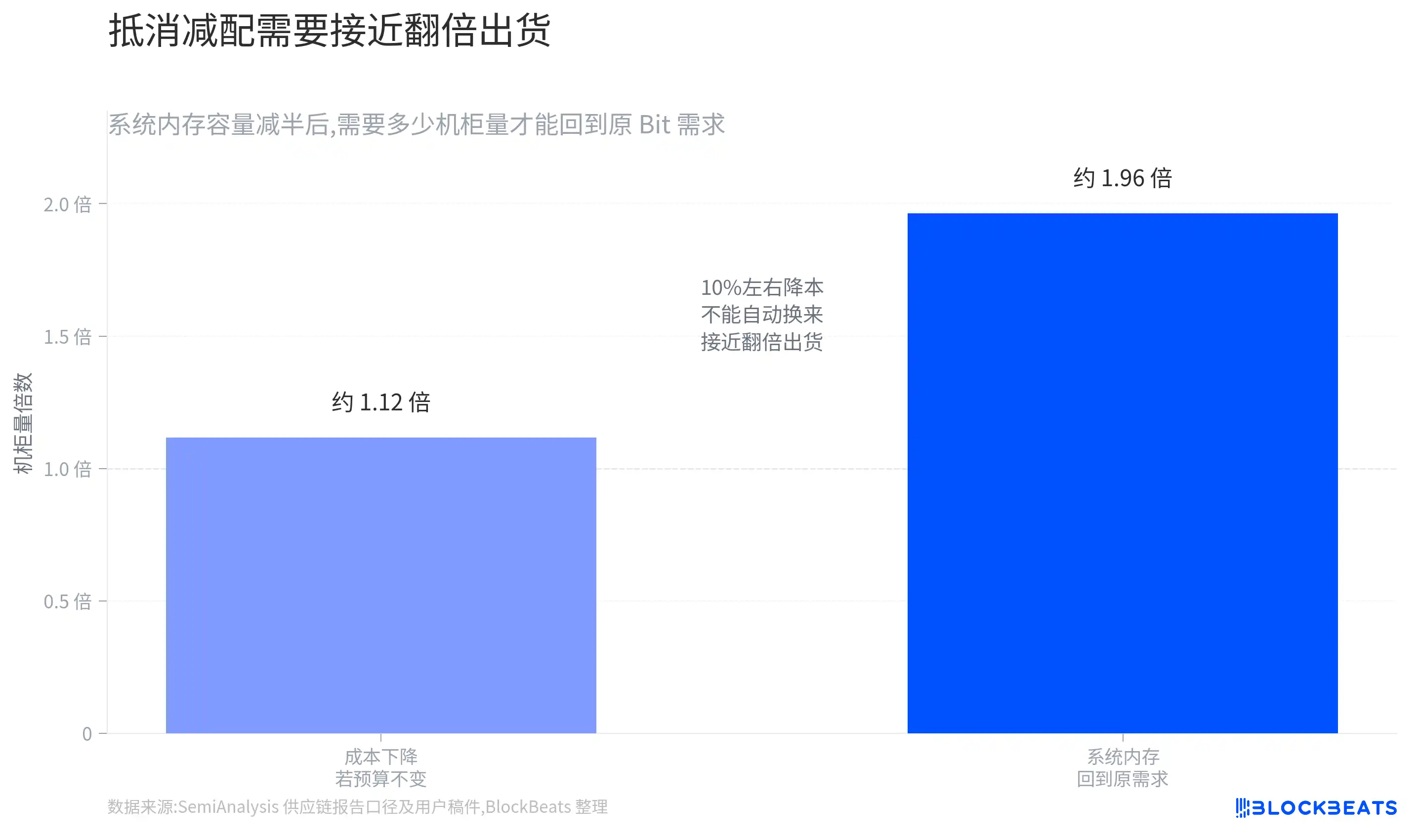
Even with a ~10% cost reduction, one cannot directly conclude that customers will buy enough extra racks. Large cloud vendor procurement is also influenced by power, data center construction, GPU supply, advanced packaging, and networking equipment; a single BOM reduction is just one variable.

The HBM situation is relatively more stable but not completely immune.

If total Rubin shipments remain robust, HBM4 will still be one of the most direct beneficiaries; if subsequent evidence shows overall machine delivery is hampered by other bottlenecks, HBM would also be affected by the platform's shipment cadence.

The difference is that this report did not directly downgrade HBM4 configuration. What the market awaits is total rack shipment volume, not just focusing on SOCAMM capacity numbers.

Shipment Data is the True Pricing Anchor

The current biggest risk is that the market first revalues based on profit pool breakdown, but subsequent data fails to back the optimistic interpretation.

If NVIDIA or the supply chain ultimately confirms that Rubin NVL72 will long-term adopt lower SOCAMM configurations, while total rack shipments are not significantly revised upward, CPU-side system memory suppliers will face more lasting compression of revenue expectations.

For Micron, the key is not just the overall label of "benefiting from AI memory," but the revenue breakdown of different products.

In subsequent earnings reports and conference calls, it's necessary to see if management discloses growth cadence for AI server-related DRAM, SOCAMM, HBM, and whether margins change due to specifications, prices, or customer bargaining power.

If the company only provides optimistic statements on overall demand but cannot explain the impact of SOCAMM configuration adjustments, the market may continue to discount it.

For SK Hynix, the verification point leans more towards HBM.

If its HBM4 order share, shipment cadence, and pricing maintain strength, this pullback resembles more of a sector sentiment fluctuation; if subsequent Rubin total shipments or HBM delivery cadence also show downgrades, the market would then extend the shock from SOCAMM to the HBM theme.

This is also a typical evolution as the AI memory theme reaches its mid-stage.

Early on, the market bought the direction: more AI racks are being built, and advanced memory is getting scarcer.

Now, representative stocks have accumulated significant gains, and capital is beginning to scrutinize whether each piece of profit is truly materializing. A single supply chain detail can trigger a 7%-8% intraday swing, indicating sector trading has become somewhat crowded, making negative information easier to amplify.

Before actual shipment and earnings breakdowns emerge, labeling this pullback as "bad news fully priced in" or "AI demand collapse" is premature.

A more prudent view is to acknowledge the pressure of per-unit value downgrade on the CPU side, while pricing HBM4 and SOCAMM separately.

What can most change the judgment next is still whether NVIDIA confirms the final BOM for Rubin NVL72, whether actual Rubin rack shipment plans can be revised upward, and the revenue exposure and margin changes for Micron, SK Hynix, and Samsung Electronics in HBM versus SOCAMM/LPDDR.


Trend Kriptolar

İlgili Sorular

QWhat triggered the sharp decline in the AI memory stock market according to the article?

AThe decline was triggered by a supply chain report from SemiAnalysis, which suggested a potential reduction in CPU-side system memory (SOCAMM/LPDDR) capacity per Nvidia Rubin NVL72 rack, from about 55TB to about 28TB. The report's alarming headline caused a market panic, despite later clarifications that it was not a 'disastrous bearish' report.

QAccording to the article, what is the key distinction between the two main types of memory in an AI server rack, and which one was reportedly impacted by the configuration change?

AThe two main types are GPU-side HBM (High Bandwidth Memory, like HBM4) and CPU-side system memory (like SOCAMM and LPDDR). The reported configuration change primarily impacted the CPU-side system memory (SOCAMM/LPDDR), potentially reducing its capacity and value per rack. The article states there is no confirmed change to the GPU-side HBM4 configuration.

QWhy did stocks like Micron and SK Hynix both fall significantly, even though their exposure to the affected memory segment might differ?

ABoth stocks fell due to a sharp contraction in sector risk appetite and a crowded trade. When the negative headline about 'memory capacity being halved' hit, investors reacted quickly by reducing exposure to the entire AI memory theme without initially distinguishing between the different memory types (HBM vs. system memory). This caused a broad sell-off before details were fully digested.

QWhat is the potential positive interpretation of the reported memory configuration change for the Rubin rack, as mentioned in the article?

AThe potential positive interpretation is that reducing the CPU-side memory specification could lower the overall cost and complexity of the Rubin NVL72 rack, potentially improving its delivery timeline and reliability. If this leads to increased total rack shipments by Nvidia, the reduction in per-unit value for certain memory components could be offset by higher volume.

QWhat does the article suggest is the most important factor for determining the true impact on memory suppliers following this report?

AThe article suggests that actual shipment data and financial breakdowns are the key determinants. For a final assessment, the market needs to see: Nvidia's confirmed final BOM for Rubin racks, the actual shipment plans for Rubin platforms, and detailed revenue/earnings breakdowns from suppliers like Micron and SK Hynix showing their exposure and margin trends for HBM versus SOCAMM/LPDDR products.

İlgili Okumalar

Report Analysis: What Is Coherent Planning as CPO Booms?

Title: Report Interpretation: What Moves Is Coherent Making Amid the CPO Boom? Summary: JP Morgan analyst Samik Chatterjee reiterates an Overweight rating on Coherent (COHR), citing undervalued growth potential across three core areas: data center optical transceivers, co-packaged optics (CPO) chips, and industrial lasers/thermal management. COHR's 1.6T data center transceivers are in high demand, with pricing remaining firm. The rise of CPO is seen not as a threat but as a catalyst, creating higher demand for sophisticated optical components, an area where COHR holds a competitive edge with its comprehensive portfolio (lasers, isolators, VCSELs, thermoelectric coolers). Each CPO chip offers significantly greater revenue potential than traditional transceivers. Furthermore, its Optical Circuit Switch (OCS) technology targets a potential $4B market with reliability and power advantages. The company is expanding its InP (Indium Phosphide) device capacity fourfold within two years, securing substrate supply and transitioning to more cost-effective 6-inch wafers. As one of only two major suppliers of high-quality pump lasers—currently in severe shortage—COHR can now move up the value chain from components to complete line cards/systems, boosting ASP over tenfold. Gross margin targets (>42%) may be revised upward due to high-end product premiums, cost improvements from the wafer transition, and contributions from new high-margin products like CPO and OCS. Its efficient thermadite thermal material also offers long-term growth. Industrial segment revenue grows at a steady 5-10%, supported by semiconductor equipment orders. Changes in Apple's Face ID protocol present a re-competition opportunity for 3D sensing. Overall, Coherent is positioned as a key infrastructure provider, with AI-driven compute demand fueling the need for high-speed optical interconnectivity. Growth from CPO/OCS, stable industrial performance, and margin improvement support the bullish thesis. *Disclaimer: This summary interprets a third-party analyst report from JP Morgan. It does not constitute investment advice.*

marsbit3 dk önce

Report Analysis: What Is Coherent Planning as CPO Booms?

marsbit3 dk önce

After Laying Off 20% of Staff, What Are the Key Points of EF's New Structure?

Following the completion of a months-long organizational restructuring, the Ethereum Foundation (EF) announced a 20% workforce reduction (approximately 54 employees) on June 23rd. It reorganized its teams into five new core clusters: Protocol, Access, User, Community, and Institutional (plus Operations/Management support units). Officially, this move implements the EF's 2026 Mandate and 2025 Treasury Management Policy, aiming to create a more focused and "self-sovereign" organization. The restructuring prioritizes the CROPS principles—Censorship Resistance, Openness & Freedom, Privacy, and Security—as foundational organizational tenets. The Protocol cluster will focus on core protocol R&D, including MEV reduction and zkEVM. The Access cluster emphasizes preserving user "zero option" for non-custodial, permissionless interaction. The User, Community, and Institutional clusters will manage external engagement, with the latter handling institutional and regulatory matters. While offering enhanced severance and transition support for affected employees, the EF did not disclose budget allocations or specific KPIs for the new clusters. This has led to market uncertainty about the impact on project funding and development priorities. Analysts note the announcement's positive tone of mission focus contrasts with a backdrop of recent EF leadership changes and broader ecosystem pressures. The true impact—whether this signifies strategic realignment or reactive contraction—will become clearer as the new structure's resource allocation and project prioritization are revealed in the coming months.

marsbit13 dk önce

After Laying Off 20% of Staff, What Are the Key Points of EF's New Structure?

marsbit13 dk önce

Top-Tier MEV Bot Loses $7.5 Million: Is 'Approval' the Most Overlooked Fatal Risk On-Chain?

The article discusses a sophisticated attack on a prominent Ethereum MEV (Miner Extractable Value) bot, Jaredfromsubway.eth, resulting in a loss exceeding $7.5 million. Unlike typical exploits involving key leaks or smart contract bugs, this attack was a carefully orchestrated "reverse hunt." The attacker spent weeks deploying fake tokens and liquidity pools that mimicked legitimate assets like WETH and USDC. These pools were designed to appear as profitable arbitrage opportunities, tricking the automated bot's trading logic. During its normal operation, the bot was induced to grant ERC-20 token approvals to the malicious contracts. Once sufficient permissions were accumulated, the attacker drained the bot's funds by calling these pre-approved allowances. This incident highlights the often-underestimated risks associated with token approvals in Web3. The article explains that approvals are a fundamental mechanism, allowing smart contracts (like DEXs) to move a user's tokens on their behalf. However, risks arise from practices like granting infinite approvals, the persistence of approvals even after disconnecting from a dApp, and the potential for a once-trusted contract to become compromised later. The piece concludes with advice for managing approval risks: users should adopt the principle of least privilege (approving only the needed amount), use separate wallets for storage versus interactions, and regularly audit and revoke unnecessary approvals using tools like Revoke.cash. It also emphasizes the role of wallets like imToken in providing proactive defenses, such as risk warnings and clear, readable transaction signing interfaces, to help users make informed decisions. Ultimately, wallet security must extend beyond private key protection to include active management of token approvals.

marsbit18 dk önce

Top-Tier MEV Bot Loses $7.5 Million: Is 'Approval' the Most Overlooked Fatal Risk On-Chain?

marsbit18 dk önce

Precious Metals Decline Alongside, What Signal is Gold Sending to the Market?

Gold and silver prices have declined recently, moving in tandem with a sell-off in risk assets like South Korean semiconductor stocks. This is unusual, as gold typically rises when equities fall due to its safe-haven status. The synchronized drop signals a shift in market focus: it's not about finding safety, but about the rising cost of holding assets that do not yield interest. This cost is the real interest rate. The key driver is a change in Federal Reserve policy expectations under new Chair Kevin Warsh. Despite holding rates steady, the Fed's rhetoric has turned more hawkish, emphasizing persistent inflation risks. This has led markets to price in a "higher for longer" rate environment, increasing the appeal of cash and bonds while pressuring zero-yield assets like gold and tech stocks with high future cash flow valuations. Technically, gold breached the $4,100/oz support level, approaching the critical $4,000 psychological and technical zone. A break below could trigger accelerated selling from momentum traders and ETFs. While long-term supportive factors like central bank buying and geopolitical risks remain, short-term price action is dominated by liquidity and opportunity cost dynamics. The South Korean market meltdown, driven by crowded AI-trade unwinding, is a symptom—not the cause—of this broader macro repricing. Both markets are reacting to the same pressures: higher real rates and a stronger US dollar. In summary, the concurrent decline in equities and precious metals highlights that diverse assets can share exposure to a common macro variable—the price of money. The near-term path for gold and silver depends primarily on the persistence of Fed hawkishness, dollar strength, and real yields, which currently override their traditional safe-haven narratives.

marsbit28 dk önce

Precious Metals Decline Alongside, What Signal is Gold Sending to the Market?

marsbit28 dk önce

İşlemler

Spot
Futures

Popüler Makaleler

$S$ Nedir

SPERO'yu Anlamak: Kapsamlı Bir Genel Bakış SPERO'ya Giriş İnovasyonun manzarası gelişmeye devam ederken, web3 teknolojilerinin ve kripto para projelerinin ortaya çıkışı dijital geleceği şekillendirmede önemli bir rol oynamaktadır. Bu dinamik alanda dikkat çeken projelerden biri SPERO, $$s$$ olarak adlandırılmaktadır. Bu makale, SPERO hakkında ayrıntılı bilgi toplamak ve sunmak amacıyla, meraklılar ve yatırımcıların web3 ve kripto alanlarındaki temellerini, hedeflerini ve yeniliklerini anlamalarına yardımcı olmayı amaçlamaktadır. SPERO,$$s$$ Nedir? SPERO,$$s$$, kripto alanında merkeziyetsizlik ve blok zinciri teknolojisi ilkelerini kullanarak etkileşimi, faydayı ve finansal kapsayıcılığı teşvik eden bir ekosistem yaratmayı amaçlayan benzersiz bir projedir. Proje, kullanıcıların yenilikçi finansal çözümler ve hizmetler sunarak eşler arası etkileşimleri yeni yollarla kolaylaştırmayı hedeflemektedir. SPERO,$$s$$'nin temel amacı, bireyleri güçlendirmek ve kripto para alanındaki kullanıcı deneyimini artıran araçlar ve platformlar sağlamaktır. Bu, daha esnek işlem yöntemlerini mümkün kılmayı, topluluk odaklı girişimleri teşvik etmeyi ve merkeziyetsiz uygulamalar (dApp'ler) aracılığıyla finansal fırsatlar yaratmayı içermektedir. SPERO,$$s$$'nin temel vizyonu kapsayıcılık etrafında dönmekte olup, geleneksel finansal sistemlerdeki boşlukları kapatmayı ve blok zinciri teknolojisinin faydalarından yararlanmayı hedeflemektedir. SPERO,$$s$$'nin Yaratıcısı Kimdir? SPERO,$$s$$'nin yaratıcısının kimliği bir miktar belirsizdir, çünkü kurucusu(ları) hakkında ayrıntılı arka plan bilgisi sağlayan sınırlı kamuya açık kaynaklar bulunmaktadır. Bu şeffaflık eksikliği, projenin merkeziyetsizlik taahhüdünden kaynaklanabilir—birçok web3 projesinin paylaştığı bir etik anlayışı, bireysel tanınmanın yerine kolektif katkıları önceliklendirmektedir. Topluluk ve onun kolektif hedefleri etrafında tartışmaları merkezileştirerek, SPERO,$$s$$, belirli bireyleri öne çıkarmadan güçlendirme özünü taşımaktadır. Bu nedenle, SPERO'nun etik anlayışını ve misyonunu anlamak, tek bir yaratıcının kimliğini belirlemekten daha önemlidir. SPERO,$$s$$'nin Yatırımcıları Kimlerdir? SPERO,$$s$$, kripto sektöründe yeniliği teşvik etmeye adanmış girişim sermayedarlarından melek yatırımcılara kadar çeşitli yatırımcılar tarafından desteklenmektedir. Bu yatırımcıların odak noktası genellikle SPERO'nun misyonuyla uyumlu olup, toplumsal teknolojik ilerlemeyi, finansal kapsayıcılığı ve merkeziyetsiz yönetimi vaat eden projeleri önceliklendirmektedir. Bu yatırımcı temelleri, yalnızca yenilikçi ürünler sunan projelere değil, aynı zamanda blok zinciri topluluğuna ve ekosistemlerine olumlu katkılarda bulunan projelere de ilgi duymaktadır. Bu yatırımcıların desteği, SPERO,$$s$$'yi hızla gelişen kripto projeleri alanında dikkate değer bir rakip haline getirmektedir. SPERO,$$s$$ Nasıl Çalışır? SPERO,$$s$$, onu geleneksel kripto para projelerinden ayıran çok yönlü bir çerçeve kullanmaktadır. İşte benzersizliğini ve yeniliğini vurgulayan bazı temel özellikler: Merkeziyetsiz Yönetim: SPERO,$$s$$, kullanıcıların projenin geleceğiyle ilgili karar alma süreçlerine aktif olarak katılmalarını sağlayan merkeziyetsiz yönetim modellerini entegre etmektedir. Bu yaklaşım, topluluk üyeleri arasında sahiplik ve hesap verebilirlik duygusunu teşvik etmektedir. Token Kullanımı: SPERO,$$s$$, ekosistem içinde çeşitli işlevler sunmak üzere tasarlanmış kendi kripto para token'ını kullanmaktadır. Bu token'lar, işlemleri, ödülleri ve platformda sunulan hizmetlerin kolaylaştırılmasını sağlayarak genel etkileşimi ve faydayı artırmaktadır. Katmanlı Mimari: SPERO,$$s$$'nin teknik mimarisi, modülerlik ve ölçeklenebilirliği destekleyerek projenin evrimi sırasında ek özelliklerin ve uygulamaların sorunsuz bir şekilde entegrasyonuna olanak tanımaktadır. Bu uyum sağlama yeteneği, sürekli değişen kripto manzarasında geçerliliği sürdürmek için hayati öneme sahiptir. Topluluk Katılımı: Proje, işbirliği ve geri bildirim teşvik eden mekanizmalar kullanarak topluluk odaklı girişimlere vurgu yapmaktadır. Güçlü bir topluluk oluşturarak, SPERO,$$s$$, kullanıcı ihtiyaçlarını daha iyi karşılayabilir ve piyasa trendlerine uyum sağlayabilir. Kapsayıcılığa Odaklanma: Düşük işlem ücretleri ve kullanıcı dostu arayüzler sunarak, SPERO,$$s$$, daha önce kripto alanında yer almamış bireyler de dahil olmak üzere çeşitli bir kullanıcı tabanını çekmeyi hedeflemektedir. Bu kapsayıcılık taahhüdü, erişilebilirlik yoluyla güçlendirme misyonuyla uyumludur. SPERO,$$s$$ Zaman Çizelgesi Bir projenin tarihini anlamak, gelişim yolculuğu ve kilometre taşları hakkında kritik bilgiler sağlar. Aşağıda, SPERO,$$s$$'nin evriminde önemli olayları haritalayan önerilen bir zaman çizelgesi bulunmaktadır: Kavram Geliştirme ve Fikir Aşaması: SPERO,$$s$$'nin temelini oluşturan ilk fikirler, blok zinciri endüstrisindeki merkeziyetsizlik ve topluluk odaklılık ilkeleriyle yakından uyumlu olarak geliştirildi. Proje Beyaz Kağıdının Yayınlanması: Kavramsal aşamayı takiben, SPERO,$$s$$'nin vizyonunu, hedeflerini ve teknolojik altyapısını ayrıntılı bir şekilde açıklayan kapsamlı bir beyaz kağıt yayımlandı ve topluluk ilgisini ve geri bildirimini toplamak amacıyla sunuldu. Topluluk Oluşturma ve Erken Katılımlar: Projenin hedefleri etrafında tartışmalar yürüterek destek toplamak ve erken benimseyenler ile potansiyel yatırımcılar için bir topluluk oluşturmak amacıyla aktif iletişim çabaları gerçekleştirildi. Token Üretim Etkinliği: SPERO,$$s$$, yerel token'larını erken destekçilere dağıtmak ve ekosistem içinde başlangıç likiditesini sağlamak amacıyla bir token üretim etkinliği (TGE) gerçekleştirdi. İlk dApp'in Yayınlanması: SPERO,$$s$$ ile ilişkili ilk merkeziyetsiz uygulama (dApp) faaliyete geçti ve kullanıcıların platformun temel işlevleriyle etkileşimde bulunmalarını sağladı. Sürekli Gelişim ve Ortaklıklar: Projenin tekliflerine sürekli güncellemeler ve iyileştirmeler yapılmakta olup, blok zinciri alanındaki diğer oyuncularla stratejik ortaklıklar, SPERO,$$s$$'yi rekabetçi ve gelişen bir oyuncu haline getirmiştir. Sonuç SPERO,$$s$$, web3 ve kripto paranın finansal sistemleri devrim niteliğinde dönüştürme ve bireyleri güçlendirme potansiyelinin bir kanıtıdır. Merkeziyetsiz yönetime, topluluk katılımına ve yenilikçi tasarlanmış işlevselliğe olan bağlılığıyla, daha kapsayıcı bir finansal manzaraya doğru bir yol açmaktadır. Hızla gelişen kripto alanındaki herhangi bir yatırımda olduğu gibi, potansiyel yatırımcılar ve kullanıcılar, SPERO,$$s$$ içindeki devam eden gelişmelerle ilgili olarak kapsamlı bir araştırma yapmaları ve düşünceli bir şekilde katılmaları teşvik edilmektedir. Proje, kripto endüstrisinin yenilikçi ruhunu sergileyerek, sayısız olasılığını keşfetmeye davet etmektedir. SPERO,$$s$$'nin yolculuğu hala devam ederken, temel ilkeleri, teknoloji, finans ve birbirimizle etkileşim biçimimizi etkileyebilir.

102 Toplam GörüntülenmeYayınlanma 2024.12.17Güncellenme 2024.12.17

$S$ Nedir

AGENT S Nedir

Agent S: Web3'te Otonom Etkileşimin Geleceği Giriş Web3 ve kripto para dünyasında sürekli gelişen manzarada, yenilikler bireylerin dijital platformlarla etkileşim biçimlerini sürekli olarak yeniden tanımlıyor. Bu tür öncü projelerden biri olan Agent S, açık ajans çerçevesi aracılığıyla insan-bilgisayar etkileşimini devrim niteliğinde değiştirmeyi vaat ediyor. Otonom etkileşimlerin yolunu açarak, Agent S karmaşık görevleri basitleştirmeyi ve yapay zeka (AI) alanında dönüştürücü uygulamalar sunmayı hedefliyor. Bu detaylı inceleme, projenin karmaşıklıklarına, benzersiz özelliklerine ve kripto para alanındaki etkilerine dalacaktır. Agent S Nedir? Agent S, bilgisayar görevlerinin otomasyonunda üç temel zorluğu ele almak üzere özel olarak tasarlanmış çığır açıcı bir açık ajans çerçevesidir: Alan Spesifik Bilgi Edinimi: Çerçeve, çeşitli dış bilgi kaynaklarından ve iç deneyimlerden akıllıca öğrenir. Bu çift yönlü yaklaşım, alan spesifik bilgi açısından zengin bir veri havuzu oluşturmasını sağlar ve görev yürütmedeki performansını artırır. Uzun Görev Ufukları Üzerinde Planlama: Agent S, karmaşık görevlerin verimli bir şekilde parçalanmasını ve yürütülmesini kolaylaştıran deneyim artırımlı hiyerarşik planlama kullanır. Bu özellik, çoklu alt görevleri etkili ve verimli bir şekilde yönetme yeteneğini önemli ölçüde artırır. Dinamik, Homojen Olmayan Arayüzlerle Başlama: Proje, ajanlar ve kullanıcılar arasındaki etkileşimi geliştiren yenilikçi bir çözüm olan Ajan-Bilgisayar Arayüzü'ni (ACI) tanıtmaktadır. Çok Modlu Büyük Dil Modellerini (MLLM'ler) kullanarak, Agent S çeşitli grafik kullanıcı arayüzlerini sorunsuz bir şekilde gezinebilir ve manipüle edebilir. Bu öncü özellikler aracılığıyla, Agent S, makinelerle insan etkileşimini otomatikleştirmede karşılaşılan karmaşıklıkları ele alan sağlam bir çerçeve sunarak, AI ve ötesinde birçok uygulama için zemin hazırlıyor. Agent S'nin Yaratıcısı Kimdir? Agent S'nin kavramı temelde yenilikçi olsa da, yaratıcısı hakkında spesifik bilgiler belirsizliğini koruyor. Yaratıcı şu anda bilinmiyor, bu da projenin yeni aşamasını veya kurucu üyeleri gizli tutma stratejik tercihini vurguluyor. Anonimlikten bağımsız olarak, odak çerçevenin yetenekleri ve potansiyeli üzerinde kalıyor. Agent S'nin Yatırımcıları Kimlerdir? Agent S, kriptografik ekosistemde oldukça yeni olduğundan, yatırımcıları ve finansal destekçileri hakkında ayrıntılı bilgiler açıkça belgelenmemiştir. Projeyi destekleyen yatırım temelleri veya organizasyonları hakkında kamuya açık bilgilerdeki eksiklik, finansman yapısı ve gelişim yol haritası hakkında sorular doğuruyor. Destekleyicilerin anlaşılması, projenin sürdürülebilirliğini ve potansiyel pazar etkisini değerlendirmek için kritik öneme sahiptir. Agent S Nasıl Çalışır? Agent S'nin temelinde, çeşitli ortamlarda etkili bir şekilde çalışmasını sağlayan son teknoloji bir sistem yatmaktadır. İşleyiş modeli birkaç ana özellik etrafında inşa edilmiştir: İnsan Benzeri Bilgisayar Etkileşimi: Çerçeve, bilgisayarlarla etkileşimleri daha sezgisel hale getirmeyi amaçlayan gelişmiş AI planlaması sunar. Görev yürütmedeki insan davranışını taklit ederek, kullanıcı deneyimlerini yükseltmeyi vaat eder. Anlatı Belleği: Yüksek düzeyde deneyimlerden yararlanmak için kullanılan Agent S, görev geçmişlerini takip etmek amacıyla anlatı belleğini kullanarak karar verme süreçlerini geliştirir. Episodik Bellek: Bu özellik, kullanıcılara adım adım rehberlik sağlayarak, çerçevenin görevler gelişirken bağlamsal destek sunmasına olanak tanır. OpenACI Desteği: Yerel olarak çalışabilme yeteneği ile Agent S, kullanıcıların etkileşimleri ve iş akışları üzerinde kontrol sağlamasına olanak tanır ve Web3'ün merkeziyetsiz felsefesiyle uyumlu hale gelir. Dış API'lerle Kolay Entegrasyon: Çeşitli AI platformlarıyla uyumluluğu ve çok yönlülüğü, Agent S'nin mevcut teknolojik ekosistemlere sorunsuz bir şekilde entegre olmasını sağlar ve geliştiriciler ile organizasyonlar için cazip bir seçenek haline getirir. Bu işlevsellikler, Agent S'nin kripto alanındaki benzersiz konumuna katkıda bulunarak, karmaşık, çok aşamalı görevleri minimum insan müdahalesi ile otomatikleştirir. Proje geliştikçe, Web3'teki potansiyel uygulamaları dijital etkileşimlerin nasıl gelişeceğini yeniden tanımlayabilir. Agent S'nin Zaman Çizelgesi Agent S'nin gelişimi ve kilometre taşları, önemli olaylarını vurgulayan bir zaman çizelgesinde özetlenebilir: 27 Eylül 2024: Agent S'nin kavramı, “Bilgisayarları İnsan Gibi Kullanan Açık Bir Ajans Çerçevesi” başlıklı kapsamlı bir araştırma makalesi ile tanıtıldı ve projenin temelini sergiledi. 10 Ekim 2024: Araştırma makalesi arXiv'de kamuya açık olarak yayınlandı ve çerçevenin derinlemesine bir incelemesini ve OSWorld benchmark'ına dayalı performans değerlendirmesini sundu. 12 Ekim 2024: Agent S'nin yetenekleri ve özellikleri hakkında görsel bir içgörü sağlayan bir video sunumu yayımlandı ve potansiyel kullanıcılar ve yatırımcılarla daha fazla etkileşim sağlandı. Bu zaman çizelgesindeki işaretler, sadece Agent S'nin ilerlemesini değil, aynı zamanda şeffaflık ve topluluk katılımına olan bağlılığını da göstermektedir. Agent S Hakkında Ana Noktalar Agent S çerçevesi gelişmeye devam ederken, birkaç ana özellik öne çıkmakta ve yenilikçi doğasını ve potansiyelini vurgulamaktadır: Yenilikçi Çerçeve: İnsan etkileşimine benzer bir bilgisayar kullanımı sağlamak üzere tasarlanan Agent S, görev otomasyonuna yeni bir yaklaşım getiriyor. Otonom Etkileşim: GUI aracılığıyla bilgisayarlarla otonom olarak etkileşim kurabilme yeteneği, daha akıllı ve verimli hesaplama çözümlerine doğru bir sıçrama anlamına geliyor. Karmaşık Görev Otomasyonu: Sağlam metodolojisi ile karmaşık, çok aşamalı görevleri otomatikleştirerek süreçleri daha hızlı ve daha az hata payı ile gerçekleştirebilir. Sürekli İyileştirme: Öğrenme mekanizmaları, Agent S'nin geçmiş deneyimlerden öğrenmesini sağlar ve sürekli olarak performansını ve etkinliğini artırır. Çok Yönlülük: OSWorld ve WindowsAgentArena gibi farklı işletim ortamlarında uyumlu olması, geniş bir uygulama yelpazesine hizmet edebilmesini sağlar. Agent S, Web3 ve kripto alanında kendini konumlandırırken, etkileşim yeteneklerini artırma ve süreçleri otomatikleştirme potansiyeli, AI teknolojilerinde önemli bir ilerlemeyi temsil etmektedir. Yenilikçi çerçevesi aracılığıyla, Agent S dijital etkileşimlerin geleceğini örneklemekte ve çeşitli sektörlerde kullanıcılar için daha sorunsuz ve verimli bir deneyim vaat etmektedir. Sonuç Agent S, AI ve Web3'ün birleşiminde cesur bir sıçramayı temsil ediyor ve teknoloji ile etkileşim biçimimizi yeniden tanımlama kapasitesine sahip. Henüz erken aşamalarında olmasına rağmen, uygulama olanakları geniş ve çekici. Kritik zorlukları ele alan kapsamlı çerçevesi ile Agent S, otonom etkileşimleri dijital deneyimin ön plana çıkmasına taşımayı hedefliyor. Kripto para ve merkeziyetsizlik alanlarına daha derinlemesine girdikçe, Agent S gibi projelerin teknoloji ve insan-bilgisayar işbirliğinin geleceğini şekillendirmede önemli bir rol oynayacağı kesin.

595 Toplam GörüntülenmeYayınlanma 2025.01.14Güncellenme 2025.01.14

AGENT S Nedir

S Nasıl Satın Alınır

HTX.com’a hoş geldiniz! Sonic (S) satın alma işlemlerini basit ve kullanışlı bir hâle getirdik. Adım adım açıkladığımız rehberimizi takip ederek kripto yolculuğunuza başlayın. 1. Adım: HTX Hesabınızı OluşturunHTX'te ücretsiz bir hesap açmak için e-posta adresinizi veya telefon numaranızı kullanın. Sorunsuzca kaydolun ve tüm özelliklerin kilidini açın. Hesabımı Aç2. Adım: Kripto Satın Al Bölümüne Gidin ve Ödeme Yönteminizi SeçinKredi/Banka Kartı: Visa veya Mastercard'ınızı kullanarak anında Sonic (S) satın alın.Bakiye: Sorunsuz bir şekilde işlem yapmak için HTX hesap bakiyenizdeki fonları kullanın.Üçüncü Taraflar: Kullanımı kolaylaştırmak için Google Pay ve Apple Pay gibi popüler ödeme yöntemlerini ekledik.P2P: HTX'teki diğer kullanıcılarla doğrudan işlem yapın.Borsa Dışı (OTC): Yatırımcılar için kişiye özel hizmetler ve rekabetçi döviz kurları sunuyoruz.3. Adım: Sonic (S) Varlıklarınızı SaklayınSonic (S) satın aldıktan sonra HTX hesabınızda saklayın. Alternatif olarak, blok zinciri transferi yoluyla başka bir yere gönderebilir veya diğer kripto para birimlerini takas etmek için kullanabilirsiniz.4. Adım: Sonic (S) Varlıklarınızla İşlem YapınHTX'in spot piyasasında Sonic (S) ile kolayca işlemler yapın.Hesabınıza erişin, işlem çiftinizi seçin, işlemlerinizi gerçekleştirin ve gerçek zamanlı olarak izleyin. Hem yeni başlayanlar hem de deneyimli yatırımcılar için kullanıcı dostu bir deneyim sunuyoruz.

1.6k Toplam GörüntülenmeYayınlanma 2025.01.15Güncellenme 2026.06.02

S Nasıl Satın Alınır

Tartışmalar

HTX Topluluğuna hoş geldiniz. Burada, en son platform gelişmeleri hakkında bilgi sahibi olabilir ve profesyonel piyasa görüşlerine erişebilirsiniz. Kullanıcıların S (S) fiyatı hakkındaki görüşleri aşağıda sunulmaktadır.

活动图片