A High-Stakes Gamble in the Regulatory Void: Binance Fully Backs Unlicensed Stablecoin U

比推2026-01-13 tarihinde yayınlandı2026-01-13 tarihinde güncellendi

Özet

On January 13, Binance announced the listing of the stablecoin United Stables (U), launching U/USDT and U/USDC trading pairs with zero trading and leverage fees. Within 30 minutes, trading volume exceeded $4.5 million. U is issued by United Stables Limited, a BVI-registered entity, and is backed 1:1 by reserves held in a trust structure with fiat in regulated banks and digital assets with licensed custodians. It has received a custody attestation from Ceffu and a smart contract audit from PeckShield. Notably, U currently lacks regulatory approval under major frameworks like EU’s MiCA, Hong Kong’s Stablecoin Ordinance, or the U.S. GENIUS Act. Binance, though not the official issuer, is deeply integrated with U across its ecosystem—including BNB Chain, Binance Wallet, and DeFi protocols—providing liquidity and adoption support. The CEO, Athena Y, is a former Binance NFT lead and Ceffu CEO, but the project has not fully disclosed its core team or financial backing. U aims to serve as a “unified liquidity layer” rather than a direct competitor to USDT or USDC, targeting use cases in exchanges, DeFi, payments, and AI agents. As of January 13, U’s supply is around 410 million tokens with nearly 14,000 holders. It has been adopted by HTX, Aster, Lista DAO, and AEON Pay, though on-chain activity remains moderate.

Author: Nicky, Foresight News

Original Title: Is U the Stablecoin Binance Needs?


On January 13, Binance announced the listing of United Stables (U) and opened spot trading pairs for U/USDT and U/USDC, simultaneously launching zero-fee activities for these spot and leverage trading pairs. Within 30 minutes of the listing, the trading volume exceeded $4.5 million.

Against the backdrop of a highly mature stablecoin landscape and a continuously tightening regulatory environment, Binance's decision to list a new dollar-denominated stablecoin at this time carries significant implications. Since the gradual phase-out of BUSD, the compliance costs and regulatory pressures faced by centralized exchanges directly issuing stablecoins have significantly increased, while the demand for stable assets in trading, DeFi, and on-chain settlement scenarios has not diminished. How to introduce a stablecoin that is highly synergistic with its ecosystem without directly assuming issuance responsibilities has become a practical issue that exchanges must address.

The emergence of United Stables (U) may precisely meet this need. U is issued by the independent legal entity United Stables Limited, with Binance not being its legal issuer. However, the stablecoin has been rapidly integrated into BNB Chain, Binance Wallet, Binance Exchange, and multiple ecosystem protocols, making it highly tied to the Binance ecosystem in terms of usage.

Binance not only provides spot and leverage trading pairs for U but also simultaneously launches zero-fee activities to create conditions for its rapid establishment of liquidity and usage depth in the early stages.

On December 18, 2025, Binance founder CZ mentioned the latest progress of U during the "2025 Year-End Q&A AMA" hosted by BNB Chain, stating that it "has certain potential." However, the project has not disclosed any financing progress, and YZi Labs has also not disclosed relevant investment information.

United Stables (U) is issued by United Stables Limited, a company registered in the British Virgin Islands (BVI). According to the project's official website, U is pegged to the US dollar and adopts a 1:1 reserve backing mechanism. Reserve assets are custodied through an independent trust structure to achieve legal isolation from the issuer's assets. Fiat reserves are held in compliant banking institutions, while digital asset reserves are custodied by licensed custodians.
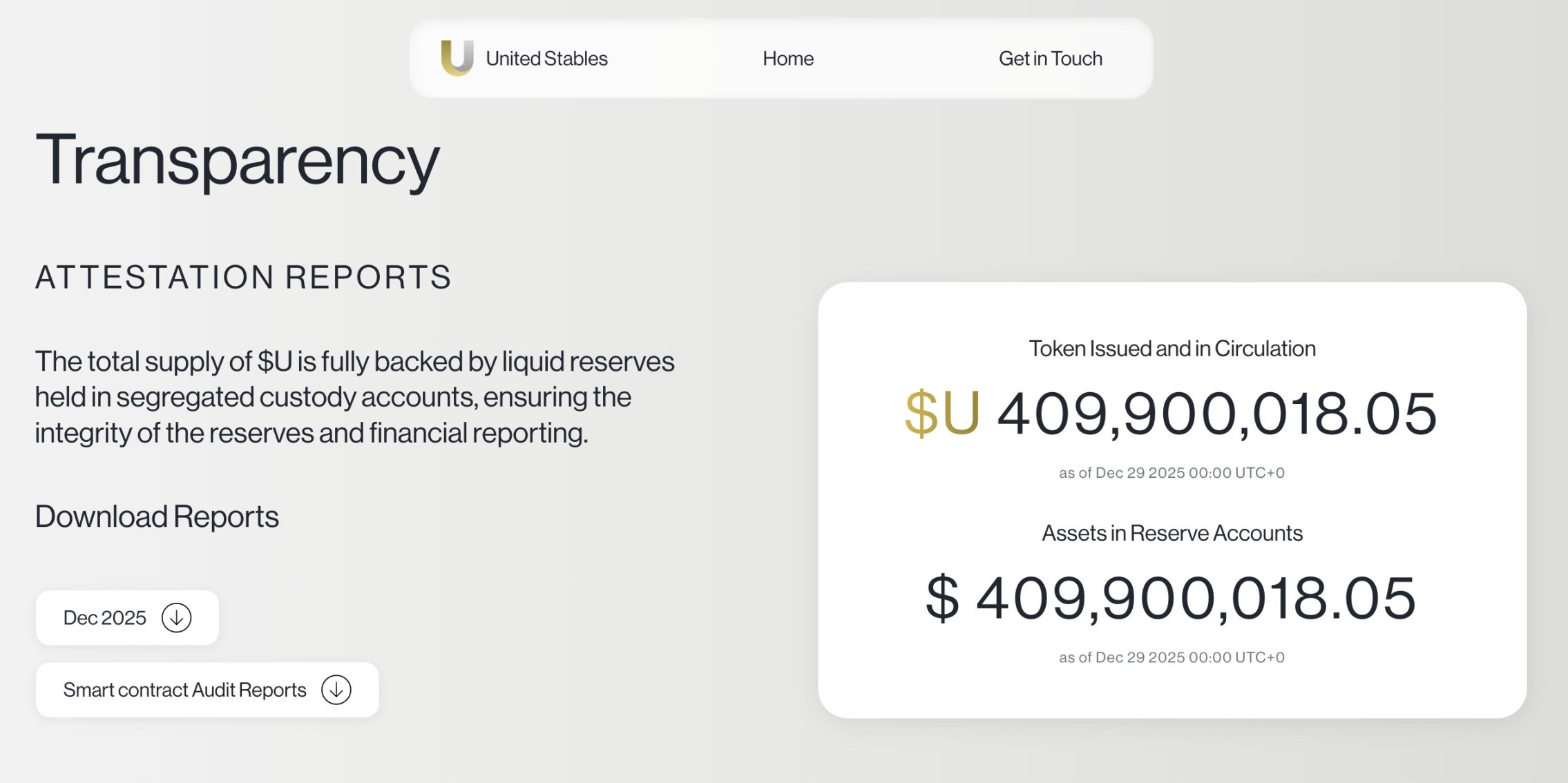
Previously, the digital asset custody platform Ceffu issued the latest custody balance proof for the project on December 29, 2025, while PeckShield has issued a smart contract audit report.

For comparison, the reserve management models of current mainstream stablecoins vary. Tether (USDT) is issued by Tether Limited, with its reserve assets primarily consisting of US Treasury bonds, money market instruments, reverse repurchase agreements, and cash. These assets are held by multiple financial institutions and custodians, and reserve proof reports issued by third-party accounting firms are regularly published. Circle (USDC), on the other hand, manages its reserves through regulated bank accounts and US-registered government money market funds, continuously disclosing reviewed or audited reserve reports.

It is important to note that United Stables Limited explicitly states on its official website that U has not been registered or licensed under the EU's MiCA, Hong Kong's "Stablecoin Ordinance," the US GENIUS Act, or any relevant US or EU securities or stablecoin regulatory frameworks. This means the stablecoin is currently not included in the regulatory systems for stablecoins in major jurisdictions.

Public information shows that its core members include Athena Y and Charles W., among others. Athena Y is currently the CEO of United Stables, previously the co-founder of the payment platform Wello, and has served as the head of Binance's NFT business and as the CEO of the institutional digital asset custody platform Ceffu. Charles W. is currently studying at the London School of Economics (LSE) and participates in the project's community communication and external collaboration as an intern at United Stables. His past experiences include internships at institutions such as Goldman Sachs and Citadel.

Further background checks on the project reveal that, apart from the public information about the CEO, United Stables has not systematically disclosed a complete management team structure, including key positions such as compliance, risk control, finance, or reserve management.

In terms of product positioning, U does not describe itself as a direct replacement for mainstream stablecoins like USDT or USDC but rather attempts to serve as a "unified liquidity layer." Its core idea is to use fiat or mainstream stablecoins for minting, providing a unified settlement and circulation vehicle for different stablecoins when used on-chain, thereby reducing the operational friction costs across protocols and scenarios. The official documentation also mentions that U's target use cases include exchanges, DeFi, payment networks, and AI automation agents, among others.

According to on-chain data, as of the time of writing on January 13, the total supply of U is approximately 410 million tokens, with nearly 14,000 holder addresses and over 1.8 million cumulative transfers.

In terms of ecosystem progress, U has been rapidly integrated into multiple applications and protocols centered around BNB Chain after its launch. On December 18, 2025, HTX listed U and opened deposit and withdrawal services, while Aster simultaneously opened the U/USDT trading pair. Binance Wallet also supported trading on BNB Chain and Ethereum networks on the same day.

On the same day, Four.Meme announced that U would be one of the stablecoins used for fundraising and trading on its platform. However, current on-chain data shows that the overall scale of Meme tokens using U as their liquidity remains limited, with UDOG leading with a market capitalization of approximately $900,000, though it was not launched on the Four.Meme platform.

In DeFi, Lista DAO has launched U vaults and multiple lending markets. As of the time of writing on January 13, the deposit scale of the U Vault is approximately 3.51 million tokens, with an annualized yield of about 3.3%. In the payment sector, AEON announced a collaboration with United Stables. Its AEON Pay already supports offline扫码 payments using U and has adopted U as a settlement asset for x402 AI-native payment and automated trading scenarios on BNB Chain.


Twitter:https://twitter.com/BitpushNewsCN

Bitpush TG Discussion:https://t.me/BitPushCommunity

Bitpush TG Subscription: https://t.me/bitpush

Original link:https://www.bitpush.news/articles/7602245

İlgili Sorular

QWhat is the name of the new stablecoin that Binance has listed, and what trading pairs were launched?

AThe new stablecoin is called United Stables (U). Binance launched the U/USDT and U/USDC spot trading pairs.

QWhich company issues the U stablecoin, and in which jurisdiction is it registered?

AThe U stablecoin is issued by United Stables Limited, which is registered in the British Virgin Islands (BVI).

QAccording to the article, what major regulatory frameworks has U NOT obtained registration or licensing under?

AU has not obtained registration or licensing under the EU's MiCA, Hong Kong's Stablecoin Ordinance, the U.S. GENIUS Act, or any U.S. or EU securities or stablecoin regulatory frameworks.

QWho is the CEO of United Stables, and what is her previous professional background?

AThe CEO of United Stables is Athena Y. She was previously a co-founder of the payment platform Wello, served as the head of Binance's NFT business, and was the CEO of the institutional digital asset custody platform Ceffu.

QWhat is the stated goal or core idea behind the U stablecoin's product positioning?

AThe core idea is to act as a 'unified liquidity layer' by accepting fiat or major stablecoins for minting, providing a unified settlement and circulation载体 for different stablecoins to reduce friction costs in cross-protocol and cross-scenario operations.

İlgili Okumalar

Has the 'Digital Gold' Narrative for BTC Failed?

**Title: Has the "Digital Gold" Narrative for Bitcoin Failed?** The article argues that Bitcoin's "digital gold" narrative remains valid despite a recent sharp price decline (from a peak near $126k in Oct 2025 to briefly under $61k in Feb 2026). It presents a long-term investment framework based on three core points: **1. Viewing Bitcoin as an Asset:** Bitcoin is presented as a superior potential store of value compared to gold. Key arguments are its absolute scarcity (21 million cap), superior portability, and transparent auditability via its public ledger. While acknowledging its current use in early, volatile stages (~3-4% global adoption), the author draws parallels to the early, disruptive phases of the internet and e-commerce. **2. Understanding the Recent Downturn:** The current ~50% correction is framed as a predictable, consensus-driven cycle following its post-halving peak (the 2024 halving preceded the Oct 2025 high). A crucial factor is a historic "changing of hands": the influx of new institutional buyers via ETFs allowed early, low-cost holders (miners, OG believers) to take profits. The author notes that while severe, Bitcoin's historical drawdowns (e.g., 93% in 2011, 77% in 2021-22) have been progressively smaller, suggesting maturing holder structure and decreasing volatility over time. **3. The Long-Term Perspective:** The long-term thesis hinges on Bitcoin capturing a portion of gold's market value. With Bitcoin's market cap at ~$1.4 trillion (at $70k) versus gold's ~$20 trillion, significant upside potential exists if the "digital gold" narrative is partially realized. However, the author strongly cautions that short-term risks remain, the bottom is unpredictable, and high volatility is inherent. The real risk is not Bitcoin failing but poor personal position management (over-leverage, wrong capital) and a lack of deep understanding, which can force investors out during severe downturns. The conclusion uses Amazon's 95% crash post-2000 dot-com bubble and subsequent 42x recovery as an analogy. The ultimate question is not if Bitcoin's price will rise, but if an investor's strategy and conviction can withstand the volatility to see the long-term play out. The recent divergence (gold up, Bitcoin down) is posed not as a narrative failure, but as potential evidence of this ongoing, painful transition from a speculative asset to a mainstream allocation.

marsbit2 saat önce

Has the 'Digital Gold' Narrative for BTC Failed?

marsbit2 saat önce

Has BTC's 'Digital Gold' Narrative Failed?

The article discusses Bitcoin's "digital gold" narrative, its recent price drop, and long-term outlook through the perspective of "Jason". It argues the narrative is not a failure but that Bitcoin represents a superior, new asset class due to its fixed supply (21 million), portability, and auditability. The piece compares its current ~3-4% global adoption rate to early internet/e-commerce, suggesting significant growth potential. Regarding the 2025-2026 price decline (from ~$126k to briefly under $61k), the author views it as a predictable, consensus-driven sell-off within Bitcoin's ~4-year cycle post-halving, exacerbated by a major "handover" from early, low-cost holders to new institutional buyers via ETFs. A key observation is that historical peak-to-trough drawdowns have lessened over time (e.g., 93% in 2011 to ~50% in 2026), indicating maturing volatility as holder structure changes. For the long term, the author uses a simple framework: Bitcoin's total market cap (~$1.4T at $70k) is only about 7% of gold's (~$20T). Even capturing 30-50% of gold's value would imply substantial upside. However, the article strongly cautions against viewing this as investment advice, emphasizing extreme volatility and the critical importance of risk management, position sizing, and deep fundamental understanding to survive severe drawdowns. It concludes by drawing a parallel to Amazon's 95% crash in 2000 and subsequent 42x recovery, stressing that the key is surviving market cycles to realize long-term potential.

链捕手3 saat önce

Has BTC's 'Digital Gold' Narrative Failed?

链捕手3 saat önce

From Code to Cognition: A Ten-Thousand-Word Guide to the Evolution of the Robot Brain

"From Code to Cognition: The Evolution of Robot Brains" The journey of robotic intelligence has shifted dramatically from manually coded systems to AI-driven brains. For decades, robots relied on layered software stacks—perception, state estimation, planning, control—each handcrafted. While predictable, they lacked adaptability. The 2010s saw deep learning revolutionize perception (e.g., object detection) and control (via reinforcement learning), but learned skills remained narrow. The arrival of Large Language Models (LLMs) marked a turning point. LLMs acted as high-level planners, interpreting natural language instructions and generating sequences of actions for traditional robotic systems to execute. However, true integration came with Visual-Language-Action (VLA) models, which fused vision, language, and motion prediction into a single network. Pioneered by models like RT-2 and open-source projects like OpenVLA, VLAs enable robots to reason and act directly from visual input and commands. The most advanced humanoid robots now employ a "dual-brain" architecture: a slow-thinking, large VLA (System 2) for reasoning and planning, and a fast-reacting, small network (System 1) for high-frequency motion control, sometimes with an even lower-level System 0 for balance. This split balances cognition with the physics of real-time movement. Computation is split between onboard hardware (e.g., NVIDIA Jetson) for safety-critical control loops and cloud/edge servers for non-critical tasks like learning and interfaces. A crucial driver is the open-source ecosystem—models like GR00T and OpenVLA allow startups to build upon pre-trained brains and fine-tune them with their own data, accelerating development. Despite progress, current systems struggle with recovery from errors, sample inefficiency, and long-horizon tasks. This has spurred the rise of **World Models**—neural networks that predict the consequences of actions. By simulating possible futures before acting (like NVIDIA Cosmos or Meta V-JEPA), robots can plan, recover, and generalize better. This represents the next frontier: shifting intelligence from learned reactions to an internal model of physics and cause-and-effect. The field is rapidly evolving. While not yet at its "ChatGPT moment," the convergence of cheaper hardware, scalable simulation, and world models points toward robots that are increasingly capable, adaptive, and useful. The question is shifting from "what can robots do?" to "what *should* they do?"

marsbit3 saat önce

From Code to Cognition: A Ten-Thousand-Word Guide to the Evolution of the Robot Brain

marsbit3 saat önce

AI Bubble Is Bursting

The AI Bubble is Bursting: A Necessary Purge on the Path to Ubiquitous Intelligence Market volatility has reignited debates about an AI bubble, with figures like Ray Dalio pointing to high valuations. However, this parallels the dot-com bubble, which, despite its crash, laid the physical infrastructure for today's internet era. The current AI investment frenzy, with tech giants planning trillions in infrastructure spending far outstripping current AI application revenues, appears similarly imbalanced. This 'bubble' is seen as an inevitable phase for a disruptive technology, paying the "innovation tax." Critically, AI inference costs have plummeted over 99.7% since 2023, making intelligence nearly free at the margin. This hasn't reduced spending but has instead unlocked massive new demand, as seen in enterprise AI cloud expenditure tripling. This follows the Jevons Paradox: efficiency gains lead to greater total consumption. The market is now entering a cleansing phase, weeding out speculative ventures lacking real moats. The deeper shift is a move from capital expenditure (CapEx) on hardware to value creation in operational expenditure (OpEx) through AI applications that solve real industry problems. While infrastructure valuations are high, rapid earnings growth from widespread AI adoption across sectors—from manufacturing and finance to law and healthcare—may digest these valuations over time. Ultimately, this creative destruction will leave behind robust infrastructure and optimized models, cheaply powering an AI-augmented future for all industries, much as the internet became indispensable after its own bubble burst. The core productive potential remains undiminished.

链捕手3 saat önce

AI Bubble Is Bursting

链捕手3 saat önce

İşlemler

Spot
Futures

Popüler Makaleler

BNB WHALES Nedir

BNB Balinalarını Anlamak: Kripto Para Manzarasına Derin Bir Dalış BNB Balinalarına Giriş Kripto para dünyasında yeni projeler düzenli olarak ortaya çıkmakta ve genellikle yenilikçi çözümler ve benzersiz deneyimler vaat etmektedir. Bu projelerden biri, 2023 yılında başlatılmış olan ve BNB Akıllı Zinciri (BEP20) üzerinde inşa edilmiş BNB Balinalarıdır. BNB Balinaları, kripto para ekosisteminde kendine özgü bir varlık oluşturmayı amaçlayarak, blockchain teknolojisinin faydalarını sosyal ve oyun etkileşimleriyle birleştiren etkileşimli bir platform yaratmaya odaklanmaktadır. Bu makale, BNB Balinalarına daha derinlemesine bir bakış atmayı, temel bileşenlerini, mekaniklerini ve gelişim yolunu keşfetmeyi hedeflemektedir. BNB Balinaları Nedir? BNB Balinaları, büyüyen Web3 ortamında kullanıcılarına çeşitli özellikler ve fırsatlar sunmayı amaçlayan bir kripto para girişimidir. BEP20 standartını kullanarak, projenin toplam token arzı 100 trilyon (100.000.000.000.000.000) olarak belirlenmiştir. Bu önemli rakama rağmen, şu anda dolaşımda olan hiçbir token bulunmamaktadır; bu durum, projenin muhtemelen henüz erken gelişim aşamalarında olduğunu göstermektedir. BNB Balinalarının birincil hedefi, kullanıcıların çeşitli etkileşimli etkinliklere katılabilecekleri, aynı zamanda blockchain teknolojisinin sağladığı güvenlik ve şeffaflıktan faydalanabilecekleri bir platform oluşturmaktır. Benzersiz ve çekici bir ortam oluşturarak, BNB Balinaları, projeye ve gelişimine yatırım yapan güçlü bir kullanıcı topluluğu oluşturmayı amaçlamaktadır. BNB Balinalarının Yaratıcısı Kimdir? BNB Balinalarının yaratıcısının kimliği şu anda açıklanmamıştır; bu durum, projenin kurucu prensiplerini ve vizyoner bakış açılarını anlamaya çalışanlar için bir zorluk teşkil etmektedir. Projenin liderliğiyle ilgili kamuya açık bilgi eksikliği, potansiyel yatırımcılar ve kullanıcılar arasında yönetişim ve hesap verebilirlik yapısı hakkında soru işaretleri doğurabilir. BNB Balinalarının Yatırımcıları Kimdir? BNB Balinaları gelişmeye devam ettikçe, belirli yatırımcılar veya yatırım fonlarından gelen destekle ilgili bilgiler şu anda mevcut değildir. Projenin resmi belgeleri, beyaz kağıdı da dahil olmak üzere, bireysel veya kurumsal finansal destekçileri açıklamamaktadır. Bu konuda şeffaflık eksikliği, bazen cryptocurrency ekosistemindeki yeni projelerin meşruiyeti ve sürdürülebilirliği hakkında soru işaretlerine neden olabilir. BNB Balinaları Nasıl Çalışır? BNB Balinaları, BEP20 standardını kullanarak BNB Akıllı Zinciri üzerinde çalışmaktadır; bu standart, verimliliği ve düşük işlem ücretleri ile tanınmakta, çeşitli geliştirici ve projeleri çekmektedir. BNB Balinalarının benzersiz yönü, topluluk odaklı bir platform oluşturma konusundaki odaklanmasıdır. Kesin operasyonel detaylar sınırlı olsa da, proje etkileşimi ve katılımı vurgulamaktadır; bu, muhtemelen sunduğu öğelere oyunlaştırılmış unsurların entegre edilmesini içermektedir. Topluluk vurgusu, kripto para alanındaki mevcut eğilimlerle uyumlu olduğu için çok önemlidir; burada kullanıcı girdisi ve katılımı genellikle bir projenin başarısını belirler. Daha fazla yenilik beklenebilir, ancak şu anda BNB Balinalarını diğer kripto girişimlerden ayıran belirli mekanizmalar ve özellikler henüz tam olarak açıklanmamıştır. İşlevselliği hakkında detaylı bilgi olmadan, projenin farklılaştırıcı unsurlarını kapsamlı bir şekilde değerlendirmek zordur. BNB Balinalarının Zaman Çizelgesi BNB Balinalarının gelişimi, kripto para manzarasında yolculuğunu işaretleyen önemli kilometre taşları boyunca gerçekleşmiştir. Projeye ilişkin önemli olayların zaman çizelgesi aşağıda verilmiştir: 2023: BNB Balinalarının piyasaya girişi. 2023: Projenin bulgularını ve operasyonel çerçevesini ortaya koyan beyaz kağıdının yayımlanması. Devam Ediyor: BNB Balinaları, sağlam bir kullanıcı tabanı oluşturmayı ve sunduğu hizmetleri genişletmeyi hedefleyerek özelliklerini geliştirmeye devam etmektedir. BNB Balinaları Hakkında Ana Noktalar Platform: BNB Akıllı Zinciri (BEP20) Toplam Arz: 100 trilyon token (100.000.000.000.000.000) Dolaşımdaki Arz: 0 token (yeni bir aşamaya işaret eder) Proje Hedefi: Etkileşim ve topluluk oluşturma için çekici bir kripto para platformu geliştirmek. Yaratıcı: Bilinmiyor Yatırımcılar: Açıklanmamış Operasyonel Durum: Sürekli gelişim ve genişlemeyle aktif Sonuç BNB Balinaları rekabetçi kripto para manzarasında navigasyon yaparken, blockchain teknolojisinin temellerine dayalı topluluk odaklı projelerin potansiyeline bir bakış sunmaktadır. Katılım ve etkileşime odaklanarak, girişim Web3 alanındaki yeniliklerin ön safında yer almaktadır. Ancak, projenin başarısı nihayetinde operasyonel mekaniklerinin netliği, yönetişim yapısının açıklanması ve sağlam bir kullanıcı topluluğunun kurulmasına bağlıdır. Potansiyel kullanıcılar ve yatırımcılar için BNB Balinaları, kripto para projelerinin evrilen doğasına dair bir örnek teşkil etmekte—hem heyecan verici olanakları hem de yeni girişimlerle ilgili karmaşıklıkları göstermektedir. Manzara gelişmeye devam ederken, BNB Balinalarının ilerlemesini ve daha geniş kripto para ekosistemindeki etkisini izlemek önemlidir.

431 Toplam GörüntülenmeYayınlanma 2024.04.05Güncellenme 2024.12.03

BNB WHALES Nedir

BNB Nasıl Satın Alınır

HTX.com’a hoş geldiniz! Binance Coin (BNB) satın alma işlemlerini basit ve kullanışlı bir hâle getirdik. Adım adım açıkladığımız rehberimizi takip ederek kripto yolculuğunuza başlayın. 1. Adım: HTX Hesabınızı OluşturunHTX'te ücretsiz bir hesap açmak için e-posta adresinizi veya telefon numaranızı kullanın. Sorunsuzca kaydolun ve tüm özelliklerin kilidini açın. Hesabımı Aç2. Adım: Kripto Satın Al Bölümüne Gidin ve Ödeme Yönteminizi SeçinKredi/Banka Kartı: Visa veya Mastercard'ınızı kullanarak anında Binance Coin (BNB) satın alın.Bakiye: Sorunsuz bir şekilde işlem yapmak için HTX hesap bakiyenizdeki fonları kullanın.Üçüncü Taraflar: Kullanımı kolaylaştırmak için Google Pay ve Apple Pay gibi popüler ödeme yöntemlerini ekledik.P2P: HTX'teki diğer kullanıcılarla doğrudan işlem yapın.Borsa Dışı (OTC): Yatırımcılar için kişiye özel hizmetler ve rekabetçi döviz kurları sunuyoruz.3. Adım: Binance Coin (BNB) Varlıklarınızı SaklayınBinance Coin (BNB) satın aldıktan sonra HTX hesabınızda saklayın. Alternatif olarak, blok zinciri transferi yoluyla başka bir yere gönderebilir veya diğer kripto para birimlerini takas etmek için kullanabilirsiniz.4. Adım: Binance Coin (BNB) Varlıklarınızla İşlem YapınHTX'in spot piyasasında Binance Coin (BNB) ile kolayca işlemler yapın.Hesabınıza erişin, işlem çiftinizi seçin, işlemlerinizi gerçekleştirin ve gerçek zamanlı olarak izleyin. Hem yeni başlayanlar hem de deneyimli yatırımcılar için kullanıcı dostu bir deneyim sunuyoruz.

1.2k Toplam GörüntülenmeYayınlanma 2024.12.12Güncellenme 2026.06.02

BNB Nasıl Satın Alınır

BNB CARD Nedir

BNB Kartı Anlamak: Web3'te Dijital Kimliği Devrimleştirmek Hızla gelişen blockchain teknolojisi ve kripto para manzarasında, BNB Kartı veya $BNBCARD dikkate değer bir proje olarak öne çıkıyor. Bu topluluk odaklı fayda meme token'ı, meme kültürünü yenilikçi dijital kimlik çözümleri ile entegre etmeyi amaçlayarak BNB Akıllı Zinciri'nden (BSC) yararlanıyor. Daha fazla kullanıcı merkeziyetsizlik alanlarına daldıkça, BNB Kartı'nın sunduklarını, operasyonel nüanslarını ve potansiyel piyasa etkisini incelemek kritik önem taşıyor. BNB Kartı Nedir ($BNBCARD)? BNB Kartı'nın özü, önemli bir faydaya sahip bir meme token'ı temsil etmesidir. Kullanıcıların hem ifade edici hem de işlevsel kişiselleştirilmiş dijital kimlik kartları oluşturmasına olanak tanıyarak onları güçlendirmek için tasarlanmıştır. Proje, birkaç anahtar özelliği kapsar: Özelleştirilebilir Kimlik Kartları: Kullanıcılar, kendilerine özelleştirilmiş Binance temalı dijital kimlik kartları tasarlama yeteneğine sahiptir, bu da onlara kendilerini ifade etme ve topluluk etkileşimini artırma platformu sunar. Merkeziyetsiz Çerçeve: BSC üzerinde geliştirilen BNB Kartı, güvenlik, şeffaflık ve kullanıcı egemenliği gibi temel özelliklere vurgu yapar. Çerçevenin merkeziyetsiz doğası, hem verimli hem de güvenli işlemler yapılmasına olanak tanır. Topluluk Merkezli Model: Laboratuvar odaklı finansal modeller yerine tabandan katılım vurgusu, kullanıcılar için ilgi çekici bir ortam yaratır. Meme kültürünün doğuştan gelen viralliğinden yararlanarak, BNB Kartı sağlam bir topluluk hareketini teşvik eder. BNB Kartı'nın birincil amacı, Web3'te dijital kimlik araçlarını demokratikleştirmek, kullanıcıların yararına olan erişilebilir çözümler sunmaktır; bu çözümler genellikle geleneksel kimlik yönetim sistemleriyle ilişkili yüklerden uzaktır. Yaratıcı ve Yatırımcılar BNB Kartı'nın arkasındaki kimliği araştırırken, hiçbir tek yaratıcının açıkça kredilendirilmediğini belirtmek önemlidir. Bunun yerine, proje topluluk odaklı görünmektedir ve Binance'ın “Erken Geliştirici Kartı” fikrinden ilham alan kolektif bir çabayı önermektedir. Bu organik gelişim yaklaşımı, genellikle topluluğun tutkusundan etkilenen meme token spektrumundaki projelerde yaygındır; burada gelişim genellikle merkezi bir otoriteden ziyade topluluğun katılımıyla şekillenir. Yatırım açısından, kamusal olarak açıklanan kurumsal destekçilerin yokluğu, projenin taban temelli yapısını daha da vurgular. Organik topluluk desteği üzerine gelişir ve bu, genellikle sosyal kanallar aracılığıyla izleyicilerini dahil eden meme odaklı projelerin alışılmadık bir özelliğidir. Nasıl Çalışır BNB Kartı, işleyişini ve yenilikçi ruhunu belirleyen birkaç mekanizma kullanır: Token Kullanımı: BNBCARD token'ı, kullanıcılara kimlik oluşturma araçlarına erişim sağlarken aynı zamanda topluluk yönetimi için bir platform sunar. Token, bu işlevsellikleri mümkün kılan temel unsurdur. Blockchain Entegrasyonu: BSC'yi kullanarak, BNB Kartı Ethereum Sanal Makinesi (EVM) tabanlı uygulamalarla uyumluluğu garanti eder. Bu entegrasyon, kullanıcılara düşük işlem ücretleri ve erişilebilirlik avantajları sunar. Kendin Yap Ekosistemi: BNB Kartı'nın çekiciliğinin merkezinde, dijital kimlik kartı oluşturma konusundaki kendin yap (DIY) yaklaşımı bulunmaktadır. Bu katılımcı unsur, kullanıcıları yaratıcı ifade ile etkileşime girmeye teşvik eder ve katkı ve işbirliği üzerine gelişen kapsayıcı bir kültürü besler. Zaman Çizelgesi Zaman çizelgesi, BNB Kartı'nın seyrini anlamak için hayati öneme sahiptir. Projenin tarihindeki önemli kilometre taşları şunlardır: 18 Mart 2025: BNB Kartı LBank'ta listelendi ve bu, borsa yolculuğunda önemli bir adım atarak likidite ve kullanıcı erişimi için kapılar açtı. 19 Mart 2025: Token, 24 saat içinde %26,000'lik astronomik bir artış yaşadığı kritik bir an yaşadı ve potansiyeli ile topluluğun heyecanını topladı. Devam Eden Gelişmeler: Proje, PancakeSwap gibi merkeziyetsiz borsalar (DEX'ler) ile ortaklıklarını sürekli olarak genişletiyor ve bu da likiditeyi ve kullanıcı etkileşimini artırıyor. Yenilik ve Farklılaşma BNB Kartı'nın neyin onu farklı kıldığını anlamak, yenilikçi çerçevesine daha derinlemesine bir keşif gerektirir: Meme-Fayda Hibriti: BNB Kartı, meme kültürünün eğlenceli cazibesini dijital kimlik yönetimindeki pratik uygulamalarla başarılı bir şekilde birleştirir. Bu niş yaklaşım, hem teknoloji meraklısı kullanıcıları hem de kriptoya yeni olanları çekerek geniş bir demografiye hitap eder. Merkeziyetsiz Yönetim: Merkezi kontrol olmadan işletilmesi, projenin topluluk katkısını doğrudan kullanmasına olanak tanır. Topluluk katılımıyla desteklenen kolektif karar alma süreci, kullanıcıları güçlendirir ve seslerinin projenin gelişimine ve yönüne katkıda bulunmasını sağlar. Ölçeklenebilirlik: BNB Kartı, 2025 yol haritası BNB Zinciri'nde yapılacak iyileştirmelerden büyük ölçüde fayda sağlayacaktır; bu iyileştirmeler arasında işlem hızlarının artırılması ve yapay zeka araçlarının entegrasyonu bulunmaktadır. Bu iyileştirmeler, projeyi son derece rekabetçi bir ortamda avantajlı bir konuma getirir. Sonuç BNB Kartı, Web3 ekosisteminde yeni bir dijital kimlik çözümleri dalgasının sembolüdür. Eğlence, topluluk katılımı ve pratik faydayı birleştirerek, kullanıcıları dijital kimliklerini şekillendirmeye aktif olarak katılmaya davet eder. Proje, dinamik kripto para manzarasında ilerlerken, başarısı muhtemelen güçlü topluluk desteğini sürdürmeye ve teknolojik gelişmelere ve kullanıcı ihtiyaçlarına uyum sağlamaya bağlı olacaktır. Merkeziyetsizlik ile meme kültürünün entegrasyonu, yalnızca kullanıcı odaklı katılım için bir araç değil, aynı zamanda blockchain çağında dijital kimlik etrafındaki gelişen anlatının temeli olarak hizmet eder. Özetle, BNB Kartı, kripto alanında yaratıcılık ve faydanın birleşimini temsil etmekle kalmaz, aynı zamanda merkeziyetsiz teknolojilerin geleceğini yönlendirmede topluluğun önemini de vurgular.

354 Toplam GörüntülenmeYayınlanma 2025.03.26Güncellenme 2025.03.26

BNB CARD Nedir

Tartışmalar

HTX Topluluğuna hoş geldiniz. Burada, en son platform gelişmeleri hakkında bilgi sahibi olabilir ve profesyonel piyasa görüşlerine erişebilirsiniz. Kullanıcıların BNB (BNB) fiyatı hakkındaki görüşleri aşağıda sunulmaktadır.

活动图片