Probability of Fed Rate Hike Surges After Warsh Issues 'Hawkish' Warning

cryptonews.ru2026-07-30 tarihinde yayınlandı2026-07-30 tarihinde güncellendi

Özet

The probability of a Fed rate hike has surged following hawkish comments from Chairman Kevin Warsh. At its latest meeting, the Federal Open Market Committee voted 9-3 to hold rates steady. Warsh emphasized the committee's singular commitment to 2% inflation, signaling no softening of its stance. Markets reacted by pricing in a higher chance of a September hike. The CME FedWatch Tool now sees a 61.4% probability of a 25-basis-point increase. Prediction markets from Kalshi and Polymarket show similar odds. Warsh highlighted two key developments since the last meeting: a significant rise in Treasury yields, which tightens financial conditions, and persistent business investment in AI, which complicates the inflation outlook by boosting demand for expensive infrastructure. Stock markets initially sold off sharply post-announcement but partially recovered the next day, led by tech. Bitcoin traded in a narrow range above $64,000. The next FOMC decision is on September 16, with incoming data on inflation, employment, and consumer spending set to be crucial. Warsh concluded that policy is shifting away from predictable signals toward a more data-dependent approach.

The Federal Open Market Committee voted 9-3 to keep the target range unchanged. Federal Reserve Chairman Kevin Warsh addressed the dissent during the post-meeting press conference, making clear the Committee aims to reinforce its commitment to price stability, not soften its stance.

"There is no soft inflation target, there is no soft implicit target — not at least while this Committee is at the helm," Warsh told reporters. The Fed Chair added:

"There is only one target, and it is 2 percent."

Markets Price in September Rate Hike

Rate expectations shifted almost immediately after the meeting: traders on the three largest exchanges now lean toward a hike occurring in September. This reaction follows a familiar pattern. When the Fed makes a 'hawkish' hold decision rather than a 'dovish' pause, markets often spend more time reevaluating the next meeting than reacting to the current one.

The CME Fedwatch Tool now prices a 61.4% chance of a 25 basis point hike, which would raise the target range to 3.75%–4.00% on September 16; a month ago, that probability was 50.6%. Expectations for a larger 50 basis point hike have vanished entirely, down from 25% a week prior to 0.0%, while the probability of a rate cut is zero.
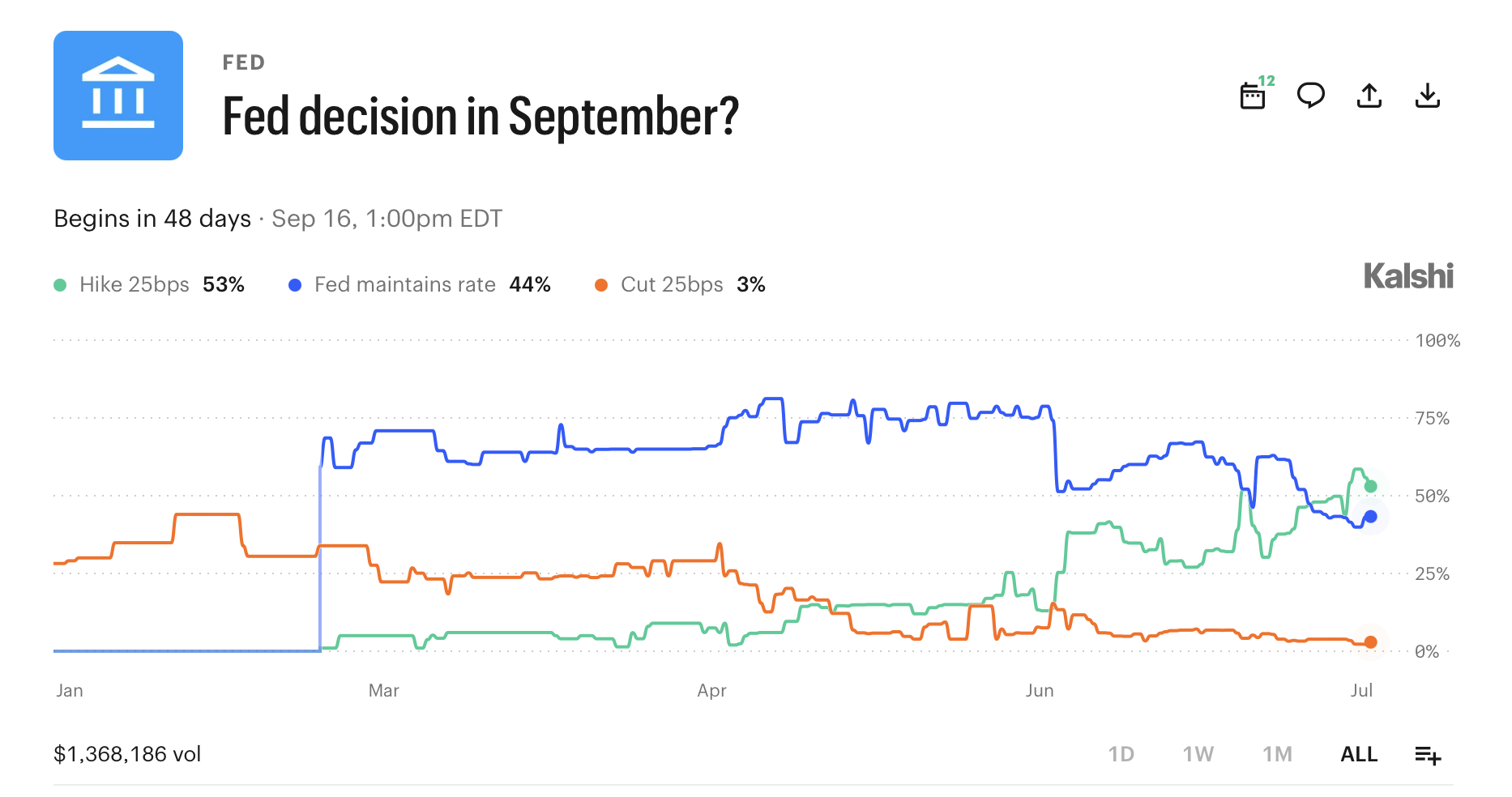
Kalshi market data on the Fed's interest rate decision for September, recorded on July 30, 2026.

Prediction markets paint a similar picture. Traders on Kalshi price a 53% chance of a 25 basis point hike versus 44% for holding rates steady, with trading volume exceeding $1.36 million. On Polymarket, where trading volume surpassed $8 million, betting participants price a 52% chance of a hike compared to 46% for maintaining the current rate.

While each platform arrives at these conclusions differently, all three are reacting to the same signals: inflation hasn't cooled enough to satisfy policymakers, and Warsh's remarks leave little doubt that the Committee remains focused on restoring credibility, not preparing markets for policy easing.

Warsh Highlights Treasury Yields, AI Spending

Warsh began by highlighting two developments that stood out particularly over the 42 days since the Committee's last meeting.

The first was the shift in Treasury yields. Sharp rises in both nominal and real yields tend to tighten financial conditions even before the Fed changes rates, making it an important signal policymakers watch closely. The U.S. central bank chief described the increase as "among the most significant in the past two decades" and partly attributed it to the Fed stepping back from detailed forward guidance, telling reporters markets were "learning to play ball, not umpire."

The second factor concerned business investment. Spending related to artificial intelligence (AI) is becoming harder to separate from broader capital expenditure trends, as large-scale infrastructure projects simultaneously impact manufacturing, semiconductors, power demand, and construction. Warsh noted that investment in AI equipment and software has risen almost 20% over the past four quarters, supporting industrial output but also complicating the inflation picture as these same expenditures boost demand for costly equipment and infrastructure.

Warsh said the Committee devoted much of its meeting to discussing four practical questions: how five years of above-target inflation should influence today's monetary policy decisions; how various economic shocks affect employment and growth; whether AI-driven capital expenditures represent temporary price pressure or a broader inflation risk; and to what extent monetary policy easing is still provided by the Fed's balance sheet, separate from interest rate policy.

Stocks Recover, Bitcoin Stabilizes

On Wednesday, markets parsed the Fed statement, then shifted direction the following day. This sequence is typical following major policy announcements, especially when investors first react to headlines before reassessing the overall tone of the press conference.

Wednesday's sell-off marked the Dow Jones Industrial Average's sharpest one-day drop in roughly 15 months, with the index falling about 2.2%. The S&P 500 declined about 1.5%, and the Nasdaq Composite dropped about 1.7%. During Wednesday's session, the U.S. stock market shed $1.2 trillion in value.

By midday Thursday, buyers returned to the market. The Dow Jones recovered about 0.6%, trading near 51,900. The S&P 500 gained roughly 1% to 1.2%, and the Nasdaq rose 1.5%–2.4% on the back of better-than-expected results from Microsoft's Azure cloud segment. Meta shares lagged amid tempered forecasts, and rising long-term Treasury yields — with 30-year bonds nearing multi-year highs — continued to cap overall optimism.

Bitcoin traded in a relatively narrow range throughout the session, holding above $64,000 with a slight upward bias. Price action remained orderly despite 24-hour trading volume exceeding $20 billion, suggesting market participants preferred to await additional macroeconomic data rather than take aggressive positions immediately following the Fed meeting. Such consolidation often follows a sharp move, especially after Bitcoin pulled back from highs near $66,000 in early July.

What Comes Next

The next Fed monetary policy decision will occur on September 16, giving officials roughly seven weeks to study additional inflation, employment, and consumer spending data before voting again. Historically, when the Committee is split, incoming economic reports carry even greater weight, as they can rapidly shift internal consensus.

Concluding, Warsh emphasized the Committee is moving away from predictable policy signals and toward decisions more driven by incoming data and internal debates regarding inflation, supply-side pressures, and AI-related investment.

For investors, the gap between the Fed's official decision and market expectations will remain the dominant theme heading into September. If inflation remains stubbornly high and long-term bond yields stay elevated, a quarter-percentage-point hike will no longer be a surprise. Instead, it will be the next step in a policy course markets have already begun to price in.

end-content
İlgili Sorular

QWhat was the outcome of the Federal Open Market Committee's vote on interest rates?

AThe Federal Open Market Committee voted 9 to 3 to keep the target range for the federal funds rate unchanged.

QAccording to market data from CME Fedwatch, what is the probability of a 25-basis-point rate hike in September?

AAccording to the CME Fedwatch Tool, the probability of a 25-basis-point rate hike in September is now 61.4%.

QWhat two events did Fed Chairman Kevin Warsh highlight as significant since the last Committee meeting?

AFed Chairman Kevin Warsh highlighted two significant events: a major shift in Treasury yields, which he called one of the most significant in two decades, and the difficulty of separating business investments related to artificial intelligence (AI) from broader capital expenditure trends.

QHow did major US stock indices perform on the day following the Fed's policy announcement?

AOn the day following the announcement, the Dow Jones Industrial Average recovered roughly 0.6%, the S&P 500 gained approximately 1% to 1.2%, and the Nasdaq Composite rose between 1.5% and 2.4%.

QWhat is the next date for a Federal Reserve monetary policy decision, and what will officials focus on before then?

AThe next Federal Reserve monetary policy decision is scheduled for September 16. Officials will use the roughly seven weeks to study additional data on inflation, employment, and consumer spending before the next vote.

İlgili Okumalar

MSX US Stock Daily Insight: Amazon 2026 Q2 Earnings: AWS Records Fastest Growth in Five Years

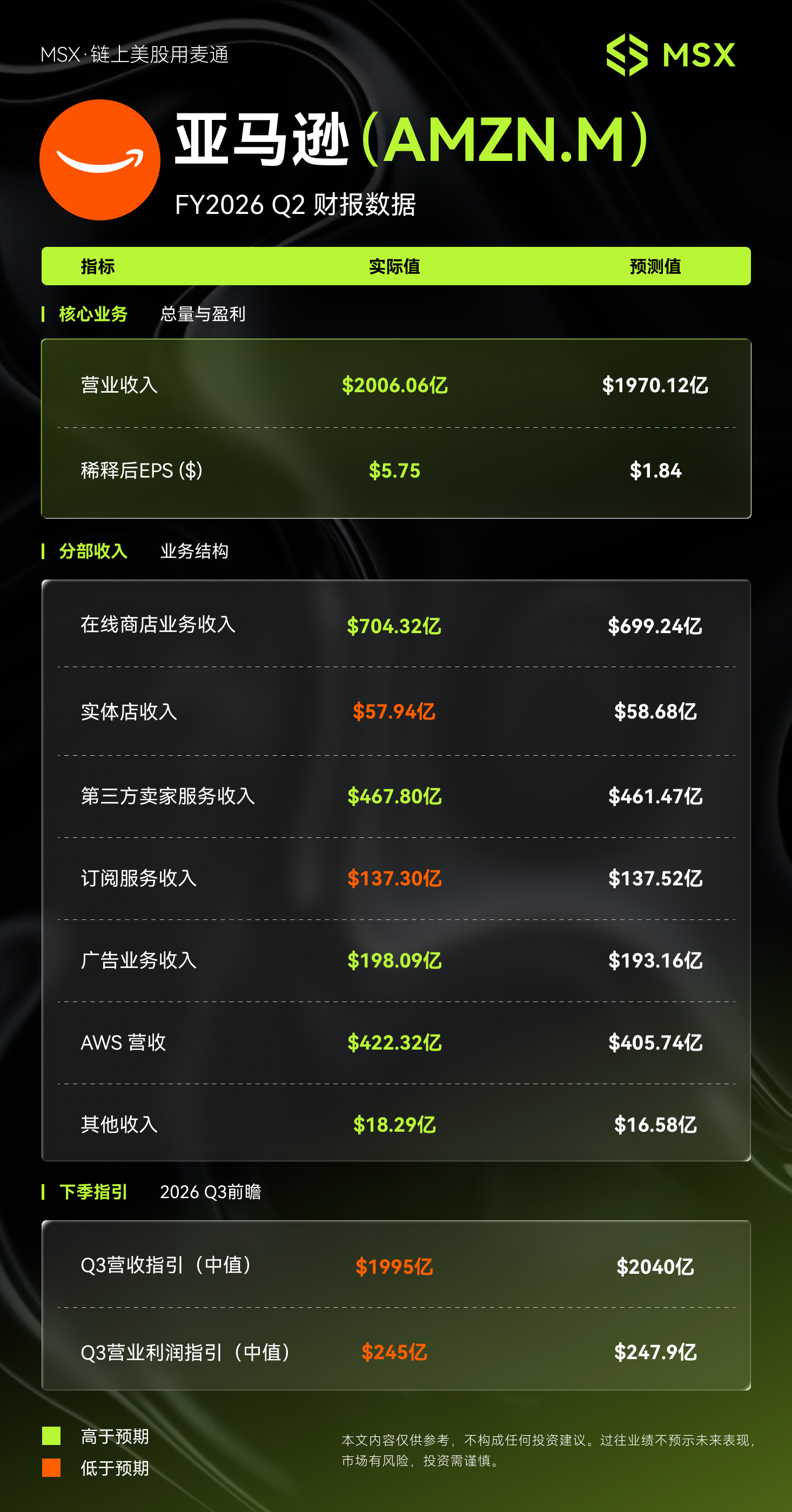
**MSX Daily US Stock Observation: Amazon's Q2 2026 Earnings: AWS Achieves Fastest Growth in Five Years** Amazon's latest quarterly results exceeded expectations, driven by a strong performance from its cloud computing unit. The company reported revenue of $200.66 billion, surpassing estimates of approximately $197 billion. The key highlight was Amazon Web Services (AWS), which generated $42.232 billion in revenue, surging 37% year-over-year. This marked the segment's fastest growth pace in 18 quarters, indicating robust demand for cloud services. Reported Earnings Per Share (EPS) of $5.75 significantly exceeded the $1.84 forecast. However, this figure included a substantial one-time, non-operating gain of $53.4 billion, primarily from the revaluation of Amazon's investment in AI company Anthropic. Excluding this item, core operating profit was $27.461 billion, a strong increase of 43% compared to the same period last year. Despite the positive results, Amazon provided guidance for the upcoming third quarter that fell short of market expectations. The company's revenue guidance midpoint is $199.5 billion, below the consensus estimate of around $204 billion. Operating profit guidance of $24.5 billion also slightly missed expectations of approximately $247.9 billion. Furthermore, Amazon raised its forecast for full-year capital expenditures to $220 billion, citing rising memory chip costs, which weighed on investor sentiment regarding future profitability. In summary, Amazon's quarter showcased accelerating momentum in its core AWS business. The underlying operational profit growth remains solid. However, cautious forward guidance and increased investment spending present key areas for monitoring in the coming quarters, as the market assesses whether the current growth phase will translate into sustained profit margin expansion.

Odaily星球日报6 dk önce

MSX US Stock Daily Insight: Amazon 2026 Q2 Earnings: AWS Records Fastest Growth in Five Years

Odaily星球日报6 dk önce

Cyclical Stock or Growth Stock? Coinbase's Q2 Earnings Report Reveals 'Valuation Disagreement'

Coinbase's Q2 2026 financial results revealed a mixed performance, reigniting debate over whether the company should be valued as a cyclical stock tied to crypto markets or a growth stock with future potential. Total revenue missed expectations at $1.22 billion, down 19% year-over-year. Transaction revenue fell to $599 million, with retail crypto spot trading revenue dropping 30% to $452 million, back to 2023 levels. The company reported a net loss of $359 million, marking its third consecutive quarterly loss. Despite CEO Brian Armstrong's positive commentary on metrics like a 10.3% overall crypto trading market share and 106% growth in prediction markets, the market reacted negatively, with shares dropping over 5% after-hours. A key issue is the decline in core retail trading. While Coinbase touted record market share, this figure includes derivatives and new products. Its traditional crypto spot trading share is likely shrinking. New ventures like prediction markets, while growing, contributed less than $30 million, insufficient to offset the core revenue decline. The valuation debate hinges on perspective. As a cyclical stock, Coinbase remains deeply tied to the crypto bear market, with user attrition and competitive pressures justifying a lower valuation. The company's strategy appears focused on surviving until the next bull cycle. Viewed as a growth stock, however, Coinbase shows promising diversification. Subscription and service revenue reached $555 million, nearly matching transaction revenue. Stablecoin revenue, its second-largest source at $292 million, remains strong through its partnership with Circle. Critically, Coinbase is positioning itself as a leader in the emerging on-chain "agent economy." Over 90% of agent-based stablecoin transactions occur on its Base network, which it believes could handle trillions in future agent transactions. The recent acquisition of Deribit also aims to boost its international derivatives offering. In summary, Coinbase's present struggles are clear, but its future hinges on whether its investments in revenue diversification, stablecoins, and the agent economy can ultimately transform its business model and justify a growth premium.

Odaily星球日报26 dk önce

Cyclical Stock or Growth Stock? Coinbase's Q2 Earnings Report Reveals 'Valuation Disagreement'

Odaily星球日报26 dk önce

Global Market Share Survey: Japanese Firms Lead in Semiconductor Materials

Global Market Share Survey: Japanese Firms Lead in Semiconductor Materials According to the 2025 "Major Goods and Services Market Share Survey" by Nikkei, Japanese companies maintain strong positions in semiconductor-related materials. In silicon wafers, Shin-Etsu Chemical ranks first with a 26.3% share, followed by SUMCO at 17.8%. Together, they hold 44.1% of the market, widening their lead over competitors from Taiwan, Germany, and South Korea. In photoresists, Tokyo Ohka Kogyo, JSR, and Shin-Etsu Chemical occupy the top three spots, with a combined share of 60.5%. Despite their strength in materials, Japanese firms have a weaker presence in core semiconductor segments like DRAM and NAND flash memory, where South Korean and U.S. companies dominate. For instance, SK Hynix and Samsung lead in DRAM, while China’s CXMT doubled its share to 6% in 2025. The semiconductor market is projected to grow rapidly, with WSTS forecasting a 90% increase to $1.5112 trillion by 2026. Major players like Samsung, SK Hynix, and Micron are making massive investments to expand capacity. To maintain their edge in materials, Japanese companies must similarly commit to large-scale, risk-taking investments. In contrast, Japan’s automotive sector shows stagnation. Toyota remains the global leader but with only a slight share increase to 12.3%, while Japanese brands are absent from the top five in the EV market. In shipbuilding, Imabari Shipbuilding rose to third place globally with a 7.2% share, benefiting from large container ship deliveries. However, Chinese and South Korean firms dominate the sector, holding the top two positions. Japan aims to revitalize its shipbuilding industry through government and corporate efforts, targeting a near doubling of output by 2035. Addressing labor shortages and adopting advanced technologies like physical AI will be critical for competitiveness.

marsbit51 dk önce

Global Market Share Survey: Japanese Firms Lead in Semiconductor Materials

marsbit51 dk önce

İşlemler

Spot
活动图片