A $20 Billion Valuation: Kalshi and Polymarket in an Arms Race?

marsbit2026-03-09 tarihinde yayınlandı2026-03-09 tarihinde güncellendi

Özet

A potential "arms race" is brewing in the prediction market sector, with industry leaders Polymarket and Kalshi each reportedly in funding talks at valuations around $20 billion. This represents a near doubling of their respective $12 billion and $11 billion valuations from late 2025. As of February 2026, the global prediction market has reached a cumulative notional trading volume of $127.5 billion. Polymarket leads with $56.07 billion, followed closely by Kalshi at $44.71 billion, together commanding 79% market share. Their growth trajectories differ: Kalshi has experienced explosive user growth, with monthly active users surging from 600,000 to over 5.1 million in 2025, while Polymarket's user growth has been steadier, peaking around 700,000 monthly active users. Kalshi's trading volume skyrocketed over 1100% in 2025, largely driven by sports contracts which account for 81% of its volume. It has secured key partnerships with platforms like Robinhood, which contributed over 50% of its volume in late 2025, and media outlets like CNBC and CNN. Polymarket maintains a stronghold in political and crypto event markets. It has formed significant partnerships with X (formerly Twitter), ICE (for a strategic investment up to $2 billion), and the UFC for exclusive prediction market data. Both platforms are also official partners of the NHL, and their data is integrated into Google's search and finance products. Their divergent strategies—Kalshi's focus on USD-compliant trading and...

Recently, according to The Wall Street Journal, the two leading prediction market platforms, Polymarket and Kalshi, have been in talks with potential investors for funding rounds, each with an estimated valuation of around $20 billion. In November 2025, it was reported that Polymarket was negotiating funding at a $12 billion valuation. That December, Kalshi completed a $1 billion funding round, bringing its valuation to $11 billion.

In just a few months, the valuations have nearly doubled again.

According to public market data and industry reports, as of the end of February 2026, the cumulative nominal trading volume of the global prediction market reached $127.5 billion, with Polymarket leading at $56.07 billion and Kalshi at $44.71 billion, together accounting for 79% of the market share.

While leading in cumulative trading volume, Kalshi showed more outstanding growth in 2025, not only reversing its market share from a minority position at the beginning of the year to over 60% but also driving its monthly active users (MAU) from 600,000 to over 5.1 million, demonstrating a faster pace of scale expansion. In contrast, Polymarket, leveraging its crypto-native advantages, maintained its global event coverage and cumulative trading lead, but its user growth was relatively steady, with peak MAU hovering around 700,000. The two core metrics—trading volume and MAU—clearly outline Kalshi's explosive catch-up and Polymarket's sustained深耕 (deep cultivation), forming a duopoly in the prediction market.

Specifically regarding trading volume performance, Kalshi's growth trajectory shows a leap from a low base to a high volume.
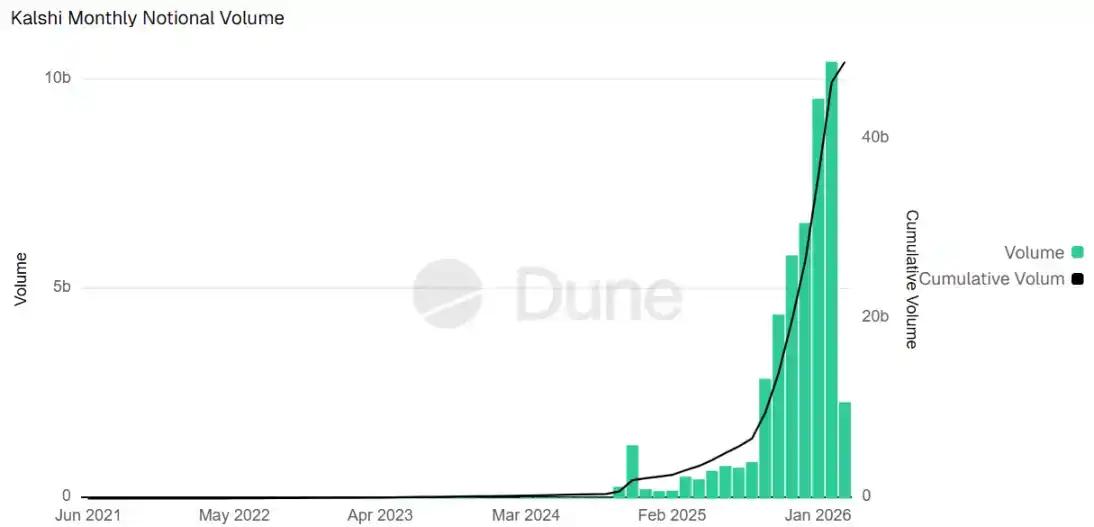
In 2024, Kalshi's annual nominal trading volume was approximately $1.9 billion, limited by early regulatory frameworks and market awareness, primarily driven by a few events. Entering 2025, this number surged to about $23.8 billion, a year-on-year increase of over 1100%. This explosion was directly reflected in monthly and weekly records: September single-month trading reached $2.86 billion, October further climbed to $4.39 billion, and December skyrocketed to $6.58 billion. The strong momentum continued into the beginning of 2026, with January's monthly trading exceeding $10.4 billion.
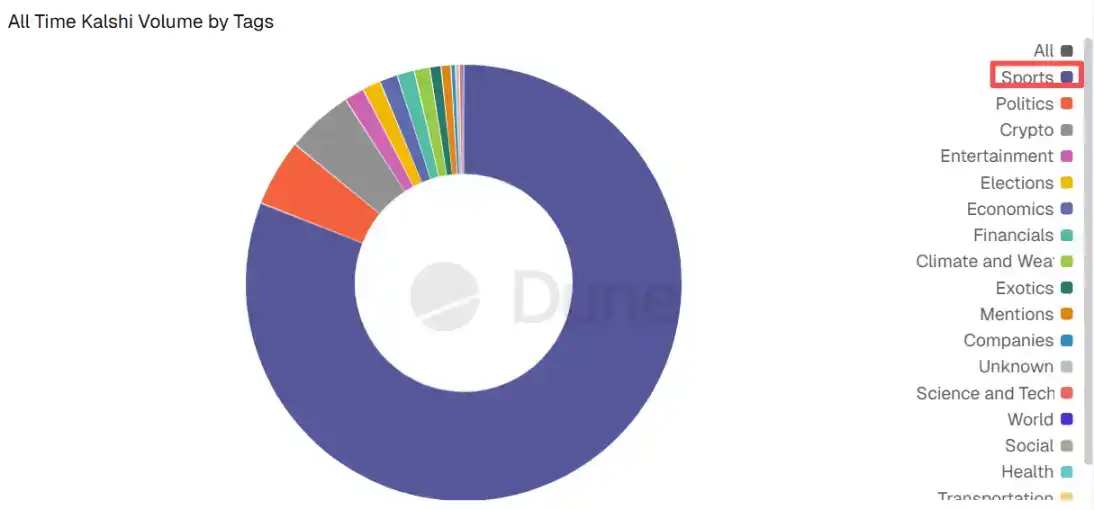
Sports event contracts contributed about 81% of this trading volume.

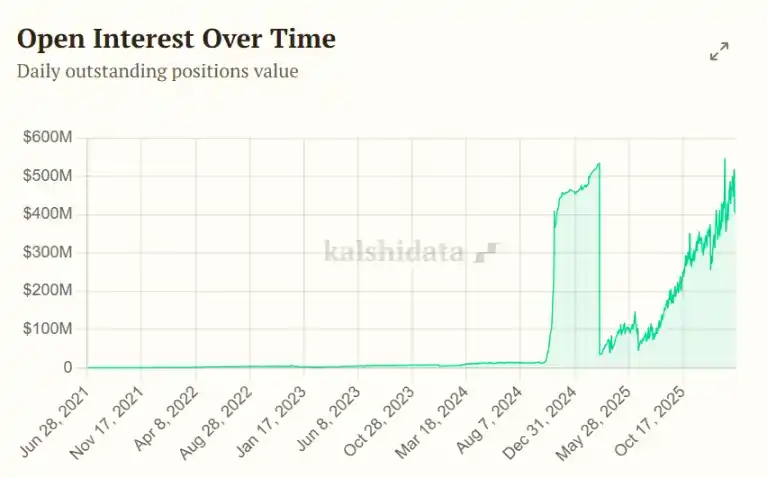
As of March 9, Kalshi's cumulative total trading volume exceeded $48.6 billion. Currently, its open interest hovers around $500 million.
Polymarket's trading volume reflects its earlier accumulation advantage and later steady maintenance. Dune Analytics data shows that in 2024, Polymarket's monthly nominal trading volume experienced explosive growth, reaching a historical high of $4.266 billion in October 2024, bringing its cumulative trading volume to $7.6 billion.
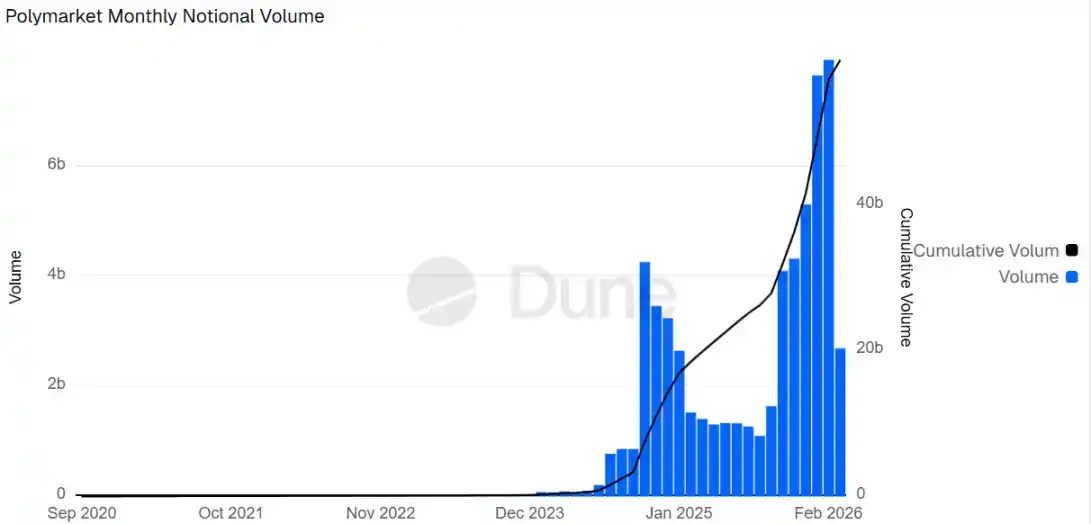
Subsequently, although its monthly trading volume slowly declined, it remained at a high level. The turning point occurred in September 2025, when Polymarket began its pulse-like surge in trading volume.

October single-month trading broke $4.1 billion, November broke $4.3 billion.

By 2026, in January alone, its trading volume broke $7.658 billion, and February broke $7.9 billion. As of March 9, its cumulative trading volume exceeded $59.9 billion.
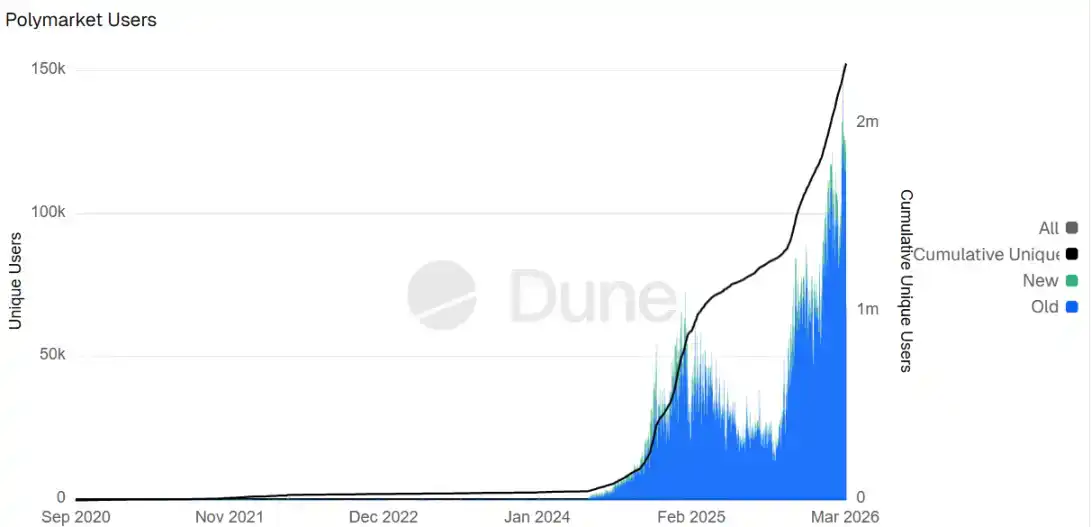
According to Dune data statistics, its total number of users has skyrocketed from 40,000 in 2024 to 2.31 million today.

It is worth noting that Polymarket still holds an advantage in liquidity depth for political and crypto events, with some weekly transaction counts accounting for up to 57%, but its overall market share dropped from 95% to 35-40% in mid-2025 before gradually stabilizing.

The divergence in trading volume data between the two platforms essentially stems from differences in business focus and user access models. Kalshi, as a CFTC-regulated entity, focuses on compliant trading in USD, covering over 42 US states. Kalshi gains the upper hand in sports dominance, while Polymarket maintains a lead in political and crypto domains, jointly pushing the entire market's weekly nominal trading volume to stably remain in the tens of billions of dollars.

In terms of ecosystem partnerships, the two major prediction markets are also frequently active, deeply integrating with mainstream institutions, media, and sports IPs. Both are not only opening offline pop-up shops but also expanding疯狂 (frantically) online.

Kalshi focuses on leveraging its compliance advantages, forming a strategic partnership with Tradeweb and receiving a minority equity investment, embedding real-time probability data into its institutional trading platform; Robinhood became its largest traffic source, contributing over 50% of trading volume in the second half of 2025; simultaneously, it secured exclusive media partnerships with CNBC and CNN, with data directly integrated into programs and reports.

Polymarket, on the other hand, emphasizes Wall Street data output and entertainment penetration. In June last year, Polymarket partnered with X, becoming its official prediction partner. It secured a strategic investment of up to $2 billion from ICE, which incorporates the data into financial product streams. In November, Polymarket reached a multi-year exclusive agreement with TKO Group, becoming the official prediction market partner for UFC and Zuffa Boxing, with data integrated into broadcasts and live events.

In January 2026, Polymarket entered an exclusive partnership with Dow Jones-owned media, providing prediction market data to media outlets including Barron's and The Wall Street Journal.

Interestingly, both are official NHL prediction market partners. Additionally, Google has integrated data from both into its search and finance platforms.

Overall, judging from the trading volume and MAU data over the past two years, both are jointly driving the evolution of prediction markets from niche tools into mainstream information and risk management platforms. This trend is not only reshaping the valuation logic of the crypto industry but also providing real-time signal references for traditional finance. If subsequent funding rounds materialize, coupled with热门 (hot) geopolitical events (US-Iran conflict), World Cup tournaments, and the eve of the US election, various data points for both platforms in 2026 are expected to break historical records.


İlgili Sorular

QWhat are the current valuations of Polymarket and Kalshi, and how have they changed recently?

ABoth Polymarket and Kalshi are currently in talks with potential investors at valuations around $20 billion. In November 2025, Polymarket was negotiating funding at a $12 billion valuation, and in December 2025, Kalshi completed a $1 billion financing round at an $11 billion valuation. Their valuations have nearly doubled in just a few months.

QWhich platform leads in cumulative nominal trading volume, and what is the combined market share of these two companies?

AAs of the end of February 2026, Polymarket leads with a cumulative nominal trading volume of $56.07 billion, followed by Kalshi with $44.71 billion. Together, they account for 79% of the global prediction market share.

QWhat drove Kalshi's explosive growth in trading volume in 2025?

AKalshi's trading volume surged by over 1100% in 2025, driven primarily by sports event contracts, which contributed approximately 81% of its trading volume. Key monthly records included $6.58 billion in December 2025 and over $10.4 billion in January 2026.

QHow do Polymarket and Kalshi differ in their business focus and user access models?

AKalshi, as a CFTC-regulated entity, focuses on compliant USD trading and is available in over 42 U.S. states, with a strong emphasis on sports contracts. Polymarket leverages its crypto-native advantages, maintaining leadership in political and crypto events, and uses cryptocurrency for settlements.

QWhat major partnerships have Polymarket and Kalshi established to expand their influence?

AKalshi partnered with Tradeweb for institutional data integration, Robinhood for significant traffic, and CNBC and CNN for media coverage. Polymarket collaborated with X (Twitter) as its official prediction partner, ICE for a strategic investment, TKO Group for UFC and boxing data, and Dow Jones media outlets including The Wall Street Journal.

İlgili Okumalar

From Survival to Accelerated Growth: The Journey of Zcash's Three-Year Rise as Told by the Founder of ZODL

**From Survival to Accelerated Growth: Zcash Founder Details the 3-Year Rise** Three years ago, Zcash (ZEC) was a struggling pioneer in privacy technology, with a price near $30, low shielded supply (11%), and a community mired in governance disputes. Today, ZEC trades around $600, with over 31% of its supply (~$3B) in user-controlled shielded pools. This transformation resulted from breaking key constraints. First, **governance shackles were removed**. The old model guaranteed funding to two entities (ECC and ZF) regardless of performance, creating a monopoly. In 2024, ECC rejected further direct funding, forcing a change. The NU6 upgrade ended direct funding, allocating 8% to community grants and 12% to a protocol-controlled treasury for retroactive rewards, expiring in 2028 unless renewed by overwhelming consensus. The entities also relinquished their trademark-based veto power, freeing community governance. Second, the **product focus shifted** from pure cryptography to user growth. Previously, engineering excelled at privacy tech but failed to attract users. In early 2024, the team (later ZODL) pivoted to building products users wanted, like the Zodl wallet (default privacy, hardware support, cross-asset swaps). This drove shielded supply to grow over 400% in ZEC terms, with 86.5% of recent transactions being shielded, representing real user adoption. Third, the **narrative evolved** from the limiting "privacy coin" label to "unstoppable private money." This clarified Zcash's value proposition: a Bitcoin-like monetary policy with verifiable private payments via advanced cryptography. This structural narrative—protocol (Zcash), asset (ZEC), gateway (Zodl)—enabled broader exchange listings, institutional interest, and ETF filings. Finally, **organizational constraints were broken**. In early 2026, the ECC team left its non-profit structure after disputes over control, forming Zcash Open Development Lab (ZODL). ZODL raised $25M from top VCs (Paradigm, a16z, etc.), gaining the capital and agility of a startup to scale consumer products. Current metrics show strong momentum: social discussion volume for ZEC surged 15,245% in a year, with 81% positive sentiment. The focus is now on enhancing user experience (Zodl wallet), scalability (Tachyon project targeting Visa-level throughput with 25-second blocks), and post-quantum security (quantum-recoverable wallets coming soon). Zcash is positioned to become faster, more usable, scalable, and quantum-resistant.

marsbit2 dk önce

From Survival to Accelerated Growth: The Journey of Zcash's Three-Year Rise as Told by the Founder of ZODL

marsbit2 dk önce

Five Counterparty Risk Architectures: A Settlement-Layer Methodology for Classifying TradFi Models in Crypto Exchanges

**Summary:** This companion piece reframes the five TradFi-on-crypto exchange architectures, previously classified by "architectural fingerprint," through the lens of counterparty risk. The core question is: whose balance sheet bears the loss first in a stress scenario, and has it historically done so? Each of the five models corresponds to a distinct risk holder with its own documented failure modes. * **Model 1 (Stablecoin-Settled CEX Perpetuals):** Risk is held by the stablecoin issuer (e.g., reserve composition, bank connectivity) and the CEX's own book. History includes Tether's banking disconnections (2017) and reserve misrepresentations (CFTC 2021 Order). * **Model 2 (CFD Brokers):** Risk resides on the broker's balance sheet (B-book model). Regulatory differences (e.g., ESMA's mandatory negative balance protection vs. Mauritius FSC's lack thereof) define loss allocation rules, as seen in the 2015 SNB event (Alpari UK insolvency). * **Model 3 (Off-Chain Custody & Transfer Agent Chain):** Risk lies with the off-chain custodian/platform. User asset recovery depends on Terms of Use and corporate structure, exemplified by the Celsius bankruptcy ruling (2023) where Earn Account assets were deemed property of the estate. * **Model 4 (DEX Perpetual Protocols):** No single balance sheet bears risk. Loss absorption relies on a protocol's insurance fund and Auto-Deleveraging (ADL) mechanism, as demonstrated in the GMX V1 (2022) and dYdX v3 YFI (2023) incidents. * **Model 5 (Regulated CCP - DCM-DCO-FCM):** The most institutionalized model concentrates risk in the Central Counterparty (CCP). However, history shows CCPs can employ non-standard tools under extreme stress, such as mass trade cancellation (LME Nickel, 2022) or enabling negative price settlements (CME WTI, 2020). The report argues that regulatory choices and counterparty risk structures are co-extensive, not in an upstream-downstream relationship. It concludes with five separate observation checklists (not predictions) for monitoring the structural vulnerabilities of each risk model.

marsbit19 dk önce

Five Counterparty Risk Architectures: A Settlement-Layer Methodology for Classifying TradFi Models in Crypto Exchanges

marsbit19 dk önce

İşlemler

Spot
Futures
活动图片




