Failed BEAT push toward $4 threatens a correction below $2

ambcrypto2026-07-01 tarihinde yayınlandı2026-07-01 tarihinde güncellendi

Özet

Audiera (BEAT) experienced a 12.4% price drop in 24 hours, with Open Interest falling 19.85%. Despite a 50% surge a week prior, the token failed to break past the $3.70 resistance and reach $4. The funding rate turned negative, indicating bearish sentiment. While the long-term structure remains bullish with a key low at $0.94 intact, technical indicators signal short-term weakness. The Chaikin Money Flow (CMF) is negative, showing capital outflows, and the MACD is bearish. Price action was rejected from a key supply zone (Fair Value Gap) between $3.04 and $3.68. Analysis of the 4-hour chart and liquidation heatmaps suggests a likely correction toward the $1.50 support level. The immediate trader recommendation is to wait. The bullish long-term trend conflicts with the current bearish momentum, leaving the market to determine if buyers can defend the $1.50 zone or if prices will fall further.

Audiera [BEAT] witnessed a 12.4% price correction in the past 24 hours. The Open Interest also slumped by 19.85% in the same time period. A week ago, the token gained 50% in a day and appeared to be recovering from a deep correction.

The funding rate was starting to turn negative, Coinalyze data warned. This meant that speculative traders were willing to pay funding to keep their positions open, signaling bearish market sentiment and aggressive short selling.

AMBCrypto had warned that sustained buying pressure is needed to keep BEAT’s bullish recovery going. Though the $2.64 local resistance was breached, the altcoin did not manage to clear the $3.70 hurdle and bound past $4.

The bullish long-term structure is at odds with BEAT expectations
Source: BEAT on TradingView

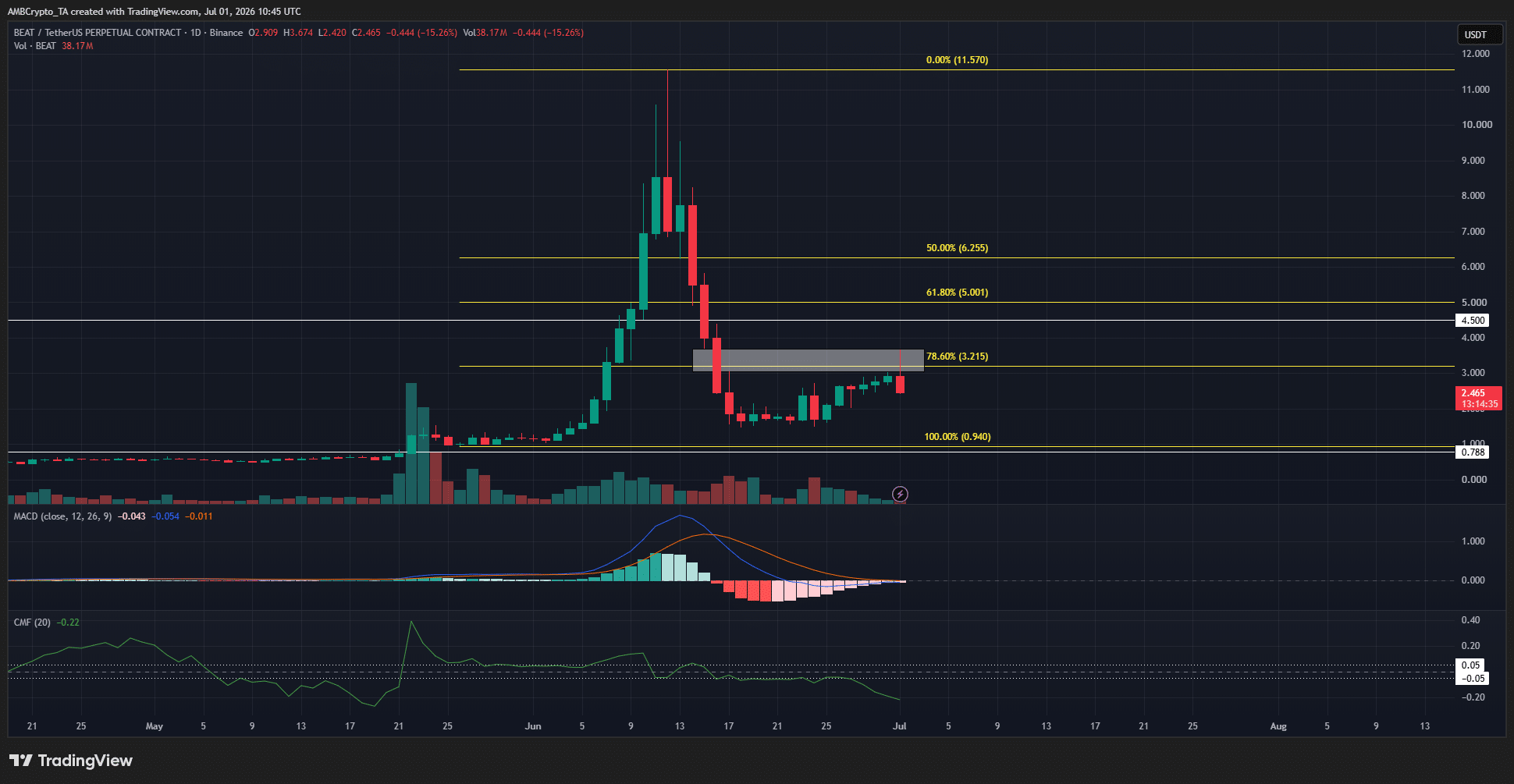
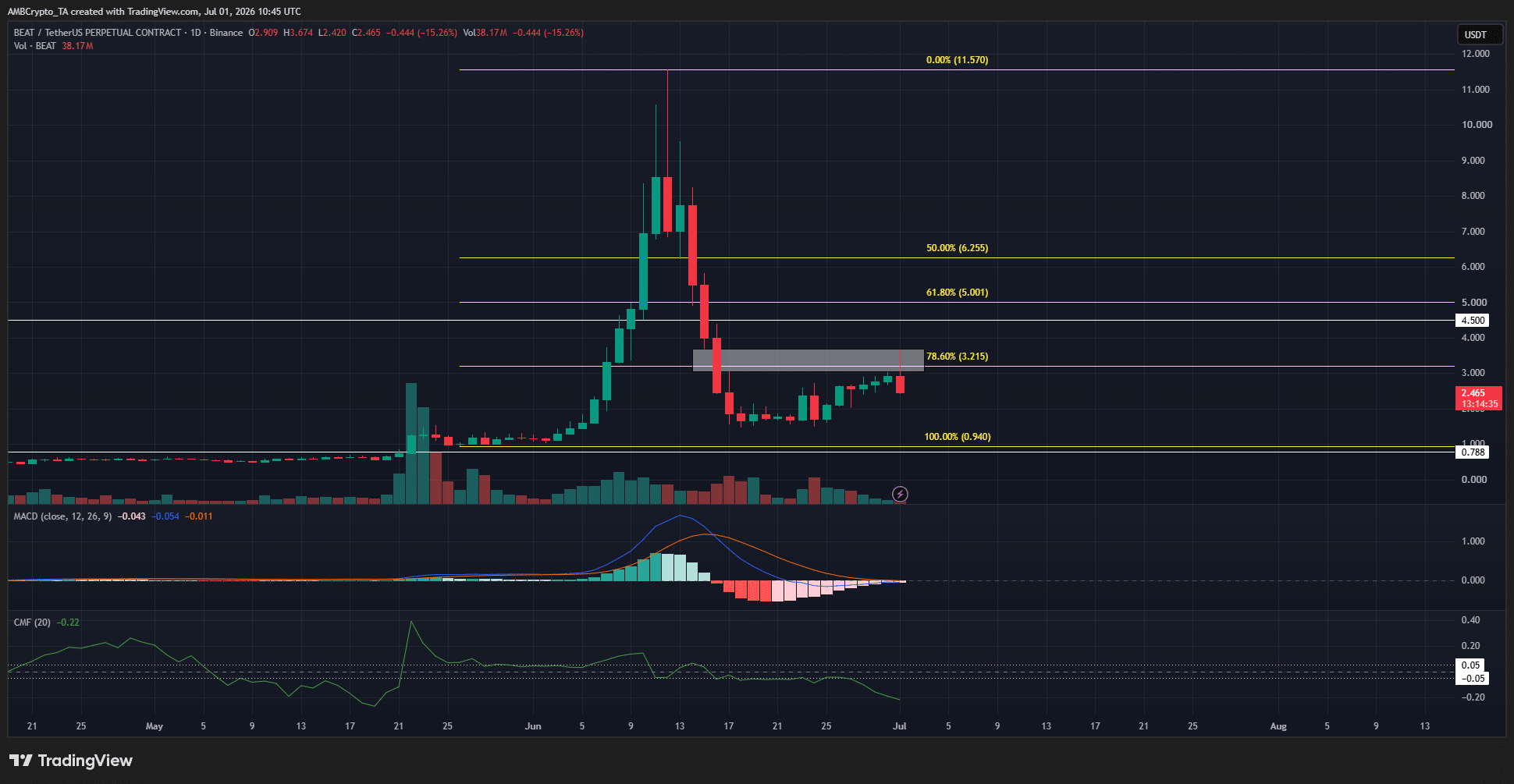
On the 1-day chart, the bullish swing structure remained intact. The swing low at $0.94 remained unbroken, keeping this upward bias alive. Yet, the technical indicators were flashing insistent warning signs.

The CMF was at -0.22, showing heavy capital outflows and selling pressure. The MACD was also moving below the zero line and has not undone the bearish crossover it made in mid-June.

Together, they capture the downward pressure on BEAT.

The price action also revealed a crucial clue. The fair value gap [white box] from $3.04-$3.68 was a key local supply zone. In recent hours of trading, Audiera token prices swept this area and have faced nearly 35% losses within 10 hours.

The failure to reclaim this FVG, which also coincided with the 78.6% Fibonacci retracement level, was a sign of bearish strength.

Traders’ call to action- Wait
Source: BEAT on TradingView

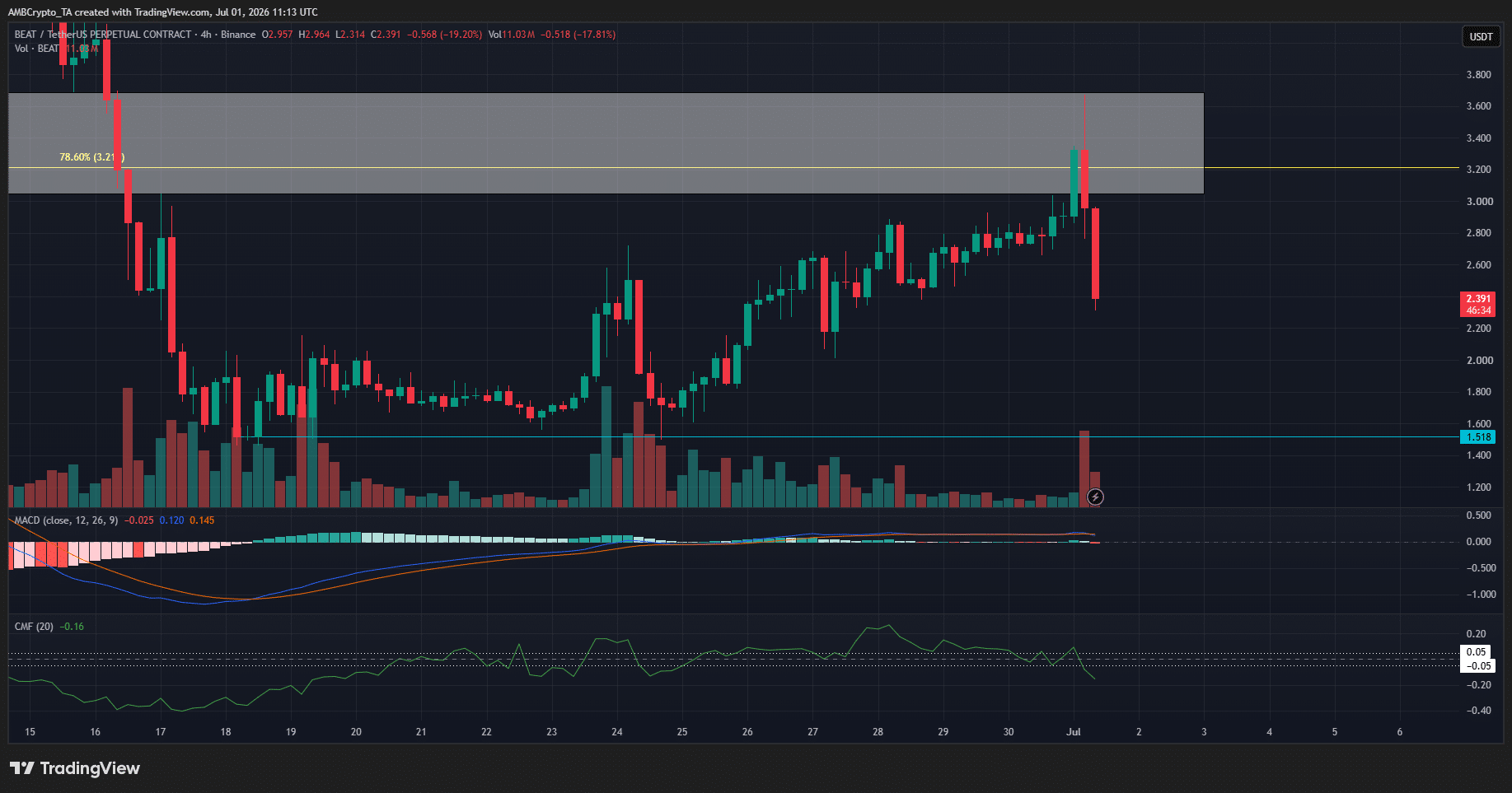
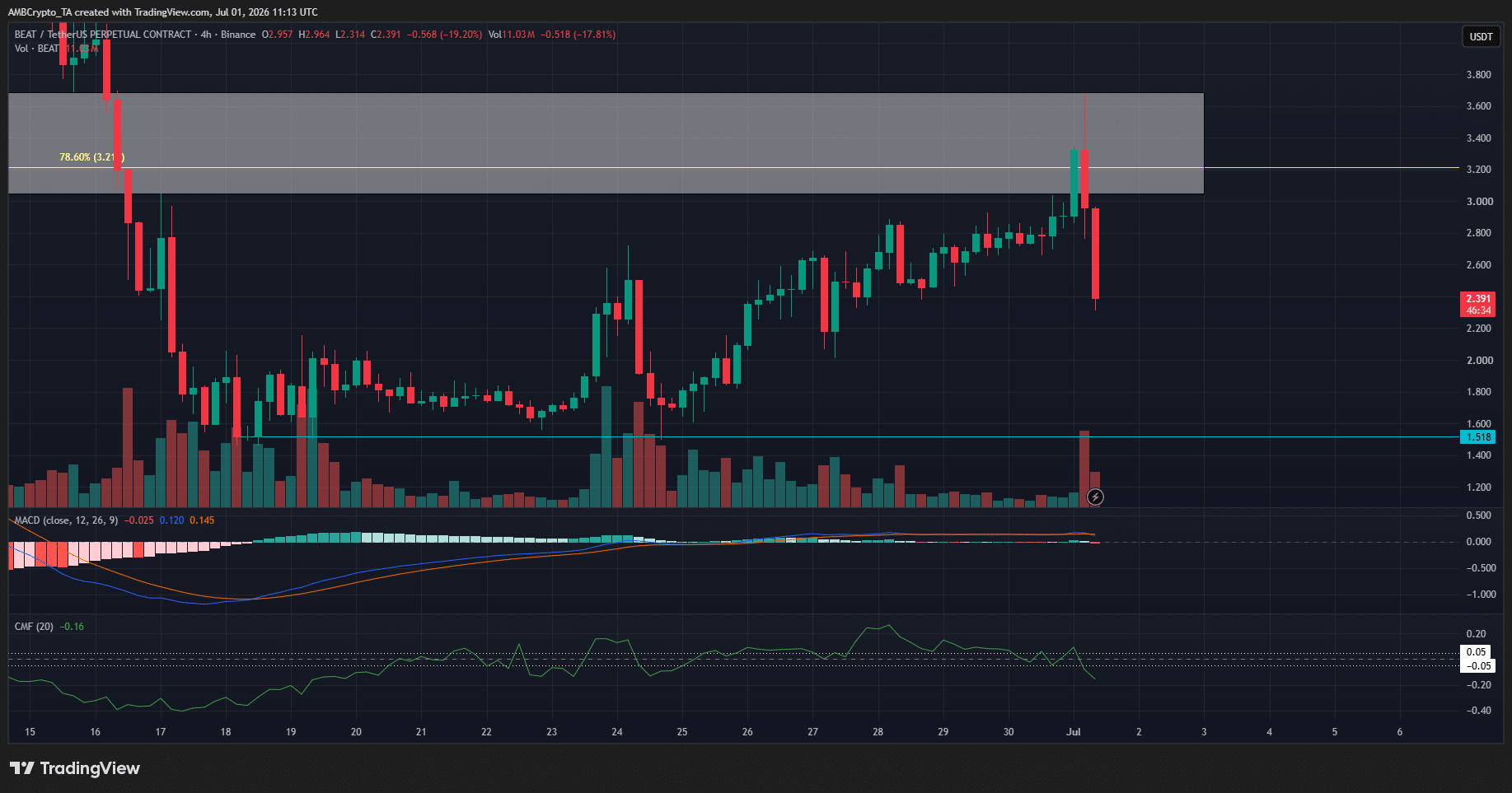
The 4-hour chart showcased the rejection from $3.68 better. Though the short-term structure is bullish, the CMF has flipped negative, and the MACD made a bearish crossover.

It appeared that a price drop was likely. The $1.51 local support zone needs to be breached to give traders a clear sell signal.
Source: CoinGlass

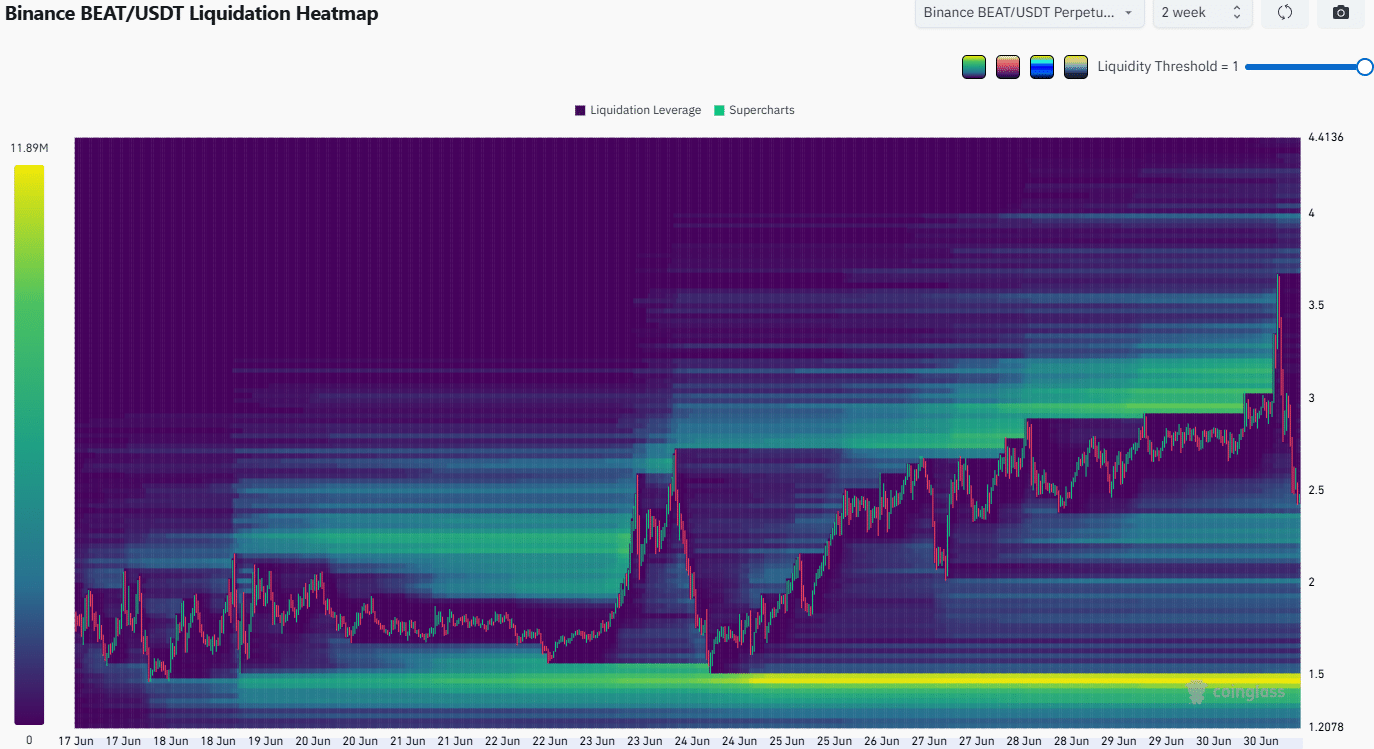
The liquidity around $3 has been swept, and the $1.5 area is the next magnetic zone of interest, the liquidation heatmap concurred.

This is the short-term expectation for BEAT- a potential correction toward $1.5. It remains to be seen if the buyers are strong enough to defend this local support, or if the market-wide malaise would beat down BEAT prices.


Final Summary

  • The BEAT long-term price structure remained bullish.
  • The rejection from above the $3 supply zone indicated bears have the upper hand in the short-term and could force a correction towards $1.50.


Trend Kriptolar

İlgili Sorular

QAccording to the article, what were the key percentage changes for BEAT's price and Open Interest in the past 24 hours?

AIn the past 24 hours, BEAT's price corrected by 12.4% and its Open Interest slumped by 19.85%.

QWhat specific technical indicators and price levels does the article cite as evidence of the current downward pressure on BEAT?

AThe article cites the CMF at -0.22 (showing capital outflows), the MACD below the zero line with a persistent bearish crossover, and the failure to reclaim the fair value gap/Fibonacci level at $3.04-$3.68 as key evidence of downward pressure.

QWhat is identified as the crucial local support level that, if breached, would give a clear sell signal for BEAT?

AThe $1.51 local support zone is identified as the crucial level. A breach of this support would give traders a clear sell signal.

QWhat contradictory signals does the article highlight between BEAT's long-term and short-term outlook?

AThe article highlights that while the long-term bullish swing structure (with a swing low at $0.94 unbroken) remains intact, the short-term indicators like negative CMF, bearish MACD crossover, and rejection from key resistance levels suggest a potential correction is likely.

QBased on the liquidity heatmap and price action analysis, what is the next key 'magnetic zone' or price target for a potential BEAT correction?

ABased on the liquidation heatmap and price action, the $1.5 area is identified as the next key magnetic zone or target for a potential BEAT correction.

İlgili Okumalar

The Most Hidden AI Winners

"The Most Under-the-Radar AI Winners" While core AI giants and their direct suppliers have dominated headlines, a group of seemingly unrelated, decades-old manufacturing companies have emerged as major beneficiaries. A key example is Japan's TOTO, famous for bathroom fixtures. Its stock soared 145% in a year, driven not by its mainstay toilet business but by its nearly 40-year-old semiconductor ceramic component unit. Specifically, TOTO manufactures electrostatic chucks—critical, hard-to-replace parts for advanced chip manufacturing processes like etching and EUV lithography. This segment, though only 9% of revenue, contributed over 54% of operating profit in FY2025 with a 43% margin. High barriers to entry, including deep know-how in high-purity ceramic sintering and long supplier certification cycles (5+ years), secure its position. This pattern repeats across industries. Nitto Boseki, a 128-year-old glass fiber maker, saw its stock rise 325% due to near-monopoly supply of T-glass, an essential low-expansion material for AI chip substrates. Similarly, Ajinomoto, the global MSG leader, commands 80-95% of the market for ABF film, a vital insulating layer in chip packaging. These "hidden" segments, often born from deep materials science expertise, are now bottleneck supplies in the AI hardware chain, enjoying pricing power and high margins. In China's A-share market, the theme combines this AI-driven demand with domestic substitution. Companies like Zhongci Electronic (advancing in electrostatic chucks) and Honghe Technology & Feilihua (in high-end electronic glass fabrics) are gaining traction. The investment thesis hinges on whether these domestic players can rapidly scale qualified capacity to capture the supply gap within the critical time window. Ultimately, these cases show that in the AI supply chain, high-profit concentrations exist not only at the cutting-edge tech frontier but also in indispensable, difficult-to-replicate materials and components. Market recognition often lags behind fundamental profit shifts, creating potential for significant re-ratings as traditional industrial firms are re-evaluated as key enablers of advanced semiconductor manufacturing.

marsbit14 dk önce

The Most Hidden AI Winners

marsbit14 dk önce

The Most Secretive Winners of the AI Boom

"The Most Hidden AI Winners" An unlikely group of companies are emerging as major beneficiaries of the AI boom, not from designing chips, but from supplying critical materials and components essential for advanced semiconductor manufacturing. These 'hidden winners' are traditional manufacturers whose deep expertise in materials science has become indispensable. Japanese companies are leading this trend. Toto, globally known for bathroom fixtures, has seen its stock surge 145% over the past year, driven by its 40-year-old semiconductor ceramics business, which now contributes over half of its operating profit. Its electrostatic chucks are vital for advanced chip production and require years of expertise to manufacture. Similarly, Nittobo, a 128-year-old textile firm, controls 90% of the market for T-glass, a low-expansion glass fiber essential for AI chip substrates. Ajinomoto, the world's largest MSG producer, dominates the market (80-95% share) for ABF insulating film used in chip packaging. The core insight is that chasing "advanced" chips paradoxically increases reliance on traditional, high-precision material science where supply cannot be quickly replicated. These materials are now critical bottlenecks in the AI supply chain. This trend is mirrored in China's A股 market, framed by the theme of 'import substitution'. Companies like Zhongci Dianzi (electrostatic chucks) and Honghe Technology (ultra-thin electronic cloth) are making progress, but face the test of scaling production and matching Japanese rivals' quality. The key tension lies in the slow change of market perception. While profit structures rapidly shift towards high-margin tech components, these firms retain their traditional industry classifications, creating a valuation gap that is gradually closing as their roles in the AI ecosystem become undeniable.

链捕手21 dk önce

The Most Secretive Winners of the AI Boom

链捕手21 dk önce

DeFi Enters a Moment of Value Reassessment: Risks and Opportunities Behind the $70 Billion TVL

DeFi Enters a Moment of Value Reassessment: Peril and Opportunity Behind $70 Billion TVL On July 1st, the total value locked (TVL) across all DeFi protocols fell below $70 billion to approximately $69.358 billion, hitting its lowest point since February 2024. This decline signals a significant contraction in DeFi liquidity and marks a new adjustment phase for the industry, far from its 2021 peak of over $180 billion. The primary drivers of this TVL drop are a general decrease in crypto market risk appetite, which leads capital to exit volatile sectors like DeFi first, and the fading effectiveness of the high-yield liquidity incentive models that fueled the initial DeFi boom. Many protocols' high TVL figures were built on temporary subsidy-driven capital rather than genuine demand. Furthermore, capital is migrating to newer narratives like AI, RWA, and modular infrastructure. This cooldown exposes DeFi's growth bottlenecks: innovation has slowed with rampant protocol copycats, real yields have normalized to single digits, and poor user experience continues to hinder mass adoption beyond crypto-natives. However, the TVL decline does not spell the end for DeFi. The metric itself is limited, as it fluctuates with underlying asset prices. The industry is shifting from capital accumulation to efficiency competition, leveraging Layer 2 solutions and modular architecture to do more with less locked value. Crucially, DeFi is expanding into real-world financial use cases like the tokenization of real-world assets (RWA) and the growth of the stablecoin ecosystem, moving its value proposition from speculative token subsidies to real cash flows. In conclusion, while short-term pressures from liquidity contraction and user growth stagnation persist, the sector is undergoing a necessary value reassessment. DeFi is transitioning from a subsidy-driven, hype-based era toward a more mature, rational, and efficiency-focused phase, with long-term growth hinging on meeting real-world financial needs through RWA, stablecoins, and robust infrastructure.

marsbit40 dk önce

DeFi Enters a Moment of Value Reassessment: Risks and Opportunities Behind the $70 Billion TVL

marsbit40 dk önce

İşlemler

Spot

Popüler Makaleler

4 Nasıl Satın Alınır

HTX.com’a hoş geldiniz! 4 (4) satın alma işlemlerini basit ve kullanışlı bir hâle getirdik. Adım adım açıkladığımız rehberimizi takip ederek kripto yolculuğunuza başlayın. 1. Adım: HTX Hesabınızı OluşturunHTX'te ücretsiz bir hesap açmak için e-posta adresinizi veya telefon numaranızı kullanın. Sorunsuzca kaydolun ve tüm özelliklerin kilidini açın. Hesabımı Aç2. Adım: Kripto Satın Al Bölümüne Gidin ve Ödeme Yönteminizi SeçinKredi/Banka Kartı: Visa veya Mastercard'ınızı kullanarak anında 4 (4) satın alın.Bakiye: Sorunsuz bir şekilde işlem yapmak için HTX hesap bakiyenizdeki fonları kullanın.Üçüncü Taraflar: Kullanımı kolaylaştırmak için Google Pay ve Apple Pay gibi popüler ödeme yöntemlerini ekledik.P2P: HTX'teki diğer kullanıcılarla doğrudan işlem yapın.Borsa Dışı (OTC): Yatırımcılar için kişiye özel hizmetler ve rekabetçi döviz kurları sunuyoruz.3. Adım: 4 (4) Varlıklarınızı Saklayın4 (4) satın aldıktan sonra HTX hesabınızda saklayın. Alternatif olarak, blok zinciri transferi yoluyla başka bir yere gönderebilir veya diğer kripto para birimlerini takas etmek için kullanabilirsiniz.4. Adım: 4 (4) Varlıklarınızla İşlem YapınHTX'in spot piyasasında 4 (4) ile kolayca işlemler yapın.Hesabınıza erişin, işlem çiftinizi seçin, işlemlerinizi gerçekleştirin ve gerçek zamanlı olarak izleyin. Hem yeni başlayanlar hem de deneyimli yatırımcılar için kullanıcı dostu bir deneyim sunuyoruz.

408 Toplam GörüntülenmeYayınlanma 2025.10.20Güncellenme 2026.06.02

4 Nasıl Satın Alınır

Tartışmalar

HTX Topluluğuna hoş geldiniz. Burada, en son platform gelişmeleri hakkında bilgi sahibi olabilir ve profesyonel piyasa görüşlerine erişebilirsiniz. Kullanıcıların 4 (4) fiyatı hakkındaki görüşleri aşağıda sunulmaktadır.

活动图片