DeFi Enters a Moment of Value Reassessment: Risks and Opportunities Behind the $70 Billion TVL

marsbit2026-07-02 tarihinde yayınlandı2026-07-02 tarihinde güncellendi

Özet

DeFi Enters a Moment of Value Reassessment: Peril and Opportunity Behind $70 Billion TVL On July 1st, the total value locked (TVL) across all DeFi protocols fell below $70 billion to approximately $69.358 billion, hitting its lowest point since February 2024. This decline signals a significant contraction in DeFi liquidity and marks a new adjustment phase for the industry, far from its 2021 peak of over $180 billion. The primary drivers of this TVL drop are a general decrease in crypto market risk appetite, which leads capital to exit volatile sectors like DeFi first, and the fading effectiveness of the high-yield liquidity incentive models that fueled the initial DeFi boom. Many protocols' high TVL figures were built on temporary subsidy-driven capital rather than genuine demand. Furthermore, capital is migrating to newer narratives like AI, RWA, and modular infrastructure. This cooldown exposes DeFi's growth bottlenecks: innovation has slowed with rampant protocol copycats, real yields have normalized to single digits, and poor user experience continues to hinder mass adoption beyond crypto-natives. However, the TVL decline does not spell the end for DeFi. The metric itself is limited, as it fluctuates with underlying asset prices. The industry is shifting from capital accumulation to efficiency competition, leveraging Layer 2 solutions and modular architecture to do more with less locked value. Crucially, DeFi is expanding into real-world financial use cases like the t...

Author: Flora, CryptoPulse Labs

On July 1, according to DeFiLlama data, the total value locked (TVL) in DeFi across all networks has fallen below $70 billion. Currently at approximately $69.358 billion, it has hit a new low since February 2024, a figure that quickly drew market attention.

As a crucial indicator measuring the activity level of the decentralized finance ecosystem, changes in TVL not only reflect on-chain capital flow but also, to some extent, mirror market sentiment and industry cycles.

Compared to its peak size of over $180 billion during 2021, the current DeFi market is clearly entering a new adjustment phase. Does TVL breaking through this key level signify that DeFi is entering a downturn cycle, or is the industry undergoing a new round of reshuffling and restructuring?

I. TVL Falls Below $70 Billion: Why is DeFi Liquidity Continuously Shrinking?

TVL, or Total Value Locked, has long been regarded as a core metric for gauging the health of the DeFi ecosystem. It represents the total value of assets users have locked in protocols such as lending, DEXs, derivatives, and yield aggregators.
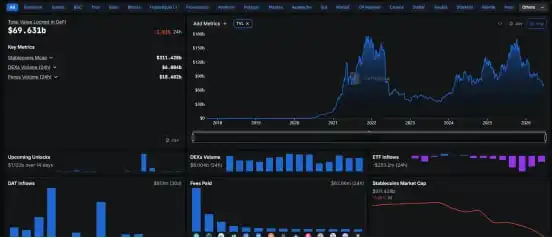
Therefore, an increase in TVL typically signals capital inflow and market activity, while a decrease indicates capital withdrawal and liquidity contraction. The recent drop of the entire network's TVL below $70 billion essentially reflects the continuous shrinkage of overall DeFi liquidity.

The primary reason for this phenomenon is the decline in overall risk appetite across the crypto market. When core assets like Bitcoin and Ethereum enter phases of consolidation or even correction, risk capital in the market often withdraws first from highly volatile sectors.

DeFi, being a field highly dependent on market sentiment, naturally bears the brunt. Users become less frequent in conducting leveraged trading, lending, and liquidity mining operations, leading to a subsequent decrease in on-chain capital activity.

Simultaneously, the liquidity incentive model that DeFi heavily relied on in recent years is losing its effectiveness. During the DeFi Summer period from 2020 to 2021, numerous protocols attracted massive capital inflows through high token subsidies, with APYs often reaching tens or even hundreds of percent, leading to rapid capital accumulation.

However, this growth model was essentially subsidy-driven rather than real demand-driven. Once incentives weakened, capital quickly exited. The market is now becoming increasingly aware that the high TVL of many protocols does not represent real value but is more a result of short-term arbitrage capital accumulation.

Additionally, the migration of capital towards other popular narratives is also a significant factor. Over the past two years, market focus has gradually shifted from DeFi to new sectors such as AI, RWA, stablecoin payments, and modular infrastructure.

Capital naturally chases higher growth expectations. When new narratives continuously attract attention, the appeal for capital in the traditional DeFi sector weakens. In other words, the decline in TVL does not merely signify capital leaving the chain; it also indicates that the market is reallocating capital.

II. Behind the DeFi Cooling: The Industry is Facing Growth Bottlenecks

Looking back at the development history of DeFi, it was once one of the most revolutionary innovative directions in the entire crypto industry. Protocols represented by Uniswap, Aave, and MakerDAO successfully reconstructed mechanisms for trading, lending, and stablecoin issuance found in traditional finance, allowing users to perform complex financial operations without banks or brokers.

This concept of permissionless finance was once considered one of the core application scenarios of blockchain.

However, after several market cycles (bull and bear), the growth bottlenecks of DeFi have become increasingly apparent. First, the pace of innovation has significantly slowed down. In the early DeFi ecosystem, there was clear differentiation between protocols—some focused on trading, some on lending, and some explored synthetic assets. But now, many new projects are merely copies or slight tweaks of old models.

New AMMs, new lending protocols, and new yield farms emerge endlessly but rarely bring about real structural innovation. Intensified homogeneous competition leads to reduced willingness among users to migrate.

Secondly, the substantial decline in yields has weakened the appeal of DeFi. Many of the high yields common in 2021 came from token inflation and market bubbles. As the market matures, real yields are gradually returning to rationality.

Currently, returns for stablecoin lending, market making, and basic yield products have generally dropped to single-digit percentages. For average users, when DeFi yields gradually approach those of traditional financial products, its complex operations and smart contract risks become disadvantages.

A deeper issue lies in the stagnation of user growth. Despite years of development, DeFi still struggles to break out of the crypto-native user circle. For the average user, concepts like wallet management, gas fees, cross-chain bridges, private key security, and liquidation risks remain significant barriers.

Compared to using traditional payment systems like PayPal or Visa, the user experience in DeFi is still relatively complex. Technological advancement does not equate to product ease of use. This user experience bottleneck prevents DeFi from achieving truly large-scale adoption.

III. TVL Decline Does Not Mean the End: DeFi May Be Moving Towards a New Stage

Although TVL has dropped to a phase low, this does not signify the end of DeFi. In fact, viewing TVL as the sole metric itself has limitations.
Since TVL is usually denominated in USD, price fluctuations of crypto assets directly affect its numerical value. Even if the amount of user lock-up remains unchanged, TVL can shrink significantly simply because the price of assets like Ethereum falls. Therefore, a decline in TVL does not entirely equate to real capital outflow.

More importantly, the industry is shifting from capital accumulation to efficiency competition. With the continuous maturation of Layer 2, modular architecture, intent-driven trading, and cross-chain liquidity solutions, future DeFi protocols may no longer need massive TVL to support their business scale.

Improvements in capital efficiency mean that less locked capital can create higher trading volumes and better user experiences. This will change the market's past singular reliance on TVL.

Simultaneously, DeFi is also extending into more real-world financial scenarios. One of the most watched directions is RWA, or Real World Asset tokenization. Through tokenization, traditional assets like US Treasury bonds, funds, real estate, and private credit are gradually entering the on-chain financial system.

This means the source of DeFi's yield is beginning to shift from "token subsidies" to real cash flows, providing a more solid value foundation.

On the other hand, the rapid expansion of the stablecoin ecosystem is also propelling DeFi into a new stage. USD Coin issued by Circle and Tether issued by Tether have gradually become the core liquidity foundation of on-chain finance.

From a longer-cycle perspective, the core future competition in DeFi might no longer be "whose APY is higher," but rather "who can provide more stable, secure, and efficient financial services." Protocols that can truly weather cycles often possess four characteristics: real revenue, strong user stickiness, high capital efficiency, and robust security.

A TVL of $70 billion might seem like a low point, but it more closely resembles a watershed moment after the industry bubble has cleared. DeFi is bidding farewell to the old era reliant on subsidies and speculation and moving towards a new, more rational and mature stage. The next industry explosion might no longer be about financial speculation, but rather about who gets closer to real-world financial needs.

Conclusion

The decline of DeFi's total value locked below $70 billion, on the surface, signals a cooling market, but behind it reflects that the industry is undergoing a profound value reassessment. From the wild growth driven by liquidity mining to today's return of capital to rationality and accelerated market clearing, DeFi is leaving behind the old narrative built on high-yield myths.

In the short term, liquidity contraction, slowing user growth, and intensified sector competition will continue to put considerable pressure on the industry. However, from a long-term perspective, the continuous evolution of RWA, stablecoin payments, and on-chain financial infrastructure also opens up new growth space for DeFi.


İlgili Sorular

QWhat is the primary reason for the continued contraction of DeFi liquidity, as indicated by TVL dropping below $70 billion?

AThe primary reason is the decline in overall risk appetite in the crypto market. As core assets like Bitcoin and Ethereum enter volatile or correction phases, risk capital tends to withdraw from high-volatility sectors like DeFi first.

QAccording to the article, what are the main growth bottlenecks currently facing the DeFi industry?

AThe main growth bottlenecks are: 1) A significant slowdown in genuine innovation, with many new projects being slight variations of existing models. 2) A sharp decline in yields, making DeFi less attractive compared to its complexity and risks. 3) Stagnant user growth due to high barriers like wallet management, gas fees, and security concerns, preventing mass adoption.

QWhy does the article argue that a falling TVL doesn't necessarily signal the end for DeFi?

AThe article argues that TVL is a limited metric because its dollar value is heavily influenced by crypto asset price fluctuations. More importantly, the industry is shifting from capital accumulation to efficiency competition. Advancements in Layer 2, modular architecture, and cross-chain solutions mean future protocols can operate with higher capital efficiency, requiring less locked value to facilitate significant activity.

QWhat new direction is mentioned as a potential source of more stable value and real cash flow for DeFi?

AThe tokenization of Real World Assets (RWA) is mentioned as a key direction. Bringing assets like US Treasury bonds, funds, real estate, and private credit on-chain provides DeFi with real-world cash flows and more solid value backing, moving away from reliance on token subsidies.

QWhat does the article suggest will be the core of future competition in the DeFi space, replacing the focus on high APY?

AThe future competitive core will shift from 'who offers the highest APY' to 'who can provide more stable, secure, and efficient financial services.' Protocols that can endure market cycles will be characterized by real revenue, strong user stickiness, high capital efficiency, and robust security.

İlgili Okumalar

Bitcoin Soars Over 24% in a Week, Best Weekly K in Recent Years, $2.7B Short Squeeze Sets Record, Policy Tailwinds Ignite Rally

Bitcoin surged over 24% this week, breaking above $78,000 and marking its best weekly performance since March 2024. The rally accelerated following a series of crypto-friendly signals from Washington and was further amplified by a record wave of forced short liquidations. Data from CoinGlass shows approximately $27.4 billion in crypto short positions were liquidated within 24 hours, the largest such event since the platform's records began in 2021. Total liquidations neared $30 billion, with shorts accounting for about 92%. Key drivers included a new SEC proposal ("Regulation Crypto Assets") to simplify token offerings, progress on the stalled CLARITY法案, comments from CFTC Chairman Michael Selig about moving forward independently if Congress delays, and former President Trump's remarks regarding bringing the Hyperliquid exchange into the US compliantly. Macroscopically, the US Treasury's announcement to double its long-term bond buyback program helped lower yields, improving liquidity expectations for risk assets. The market, previously stagnant near $60,000 with high short positioning, saw a violent squeeze. This created a self-reinforcing cycle where rising prices triggered further short liquidations. The interplay between shifting policy expectations and this massive deleveraging event fueled the historic weekly gain.

marsbit4 dk önce

Bitcoin Soars Over 24% in a Week, Best Weekly K in Recent Years, $2.7B Short Squeeze Sets Record, Policy Tailwinds Ignite Rally

marsbit4 dk önce

19 New Decacorns in Half a Year: Why is the Primary Market Chasing 'Certainty'?

In the first half of 2026, China’s primary market saw a notable increase in unicorns, adding 19 new companies each valued over 100 billion RMB, particularly in sectors like embodied AI and large language models (LLMs). Firms such as Galaxy General, Zibian, and ZhiPingFang even surpassed 200 billion RMB valuations within months. Moonshot AI's valuation surged from around $10 billion to $35 billion by July 2026, with a pre-IPO target of $50 billion. This concentration of capital into a few "certain" sectors highlights a market shift. The driving force is not a general abundance of capital but a chase for "certainty"—primarily clearer exit pathways like imminent IPOs. Companies with defined public listing timelines attract intense investment despite higher valuations, as they reduce exit uncertainty for investors. Secondary market valuations of listed peers also serve as new anchors, boosting the perceived value of private companies in similar fields, though this creates dependency on public market sentiment. Another form of certainty comes from the expectation of rising valuations in subsequent funding rounds. The investment logic has shifted in some cases from assessing long-term fundamental value to betting on the next round attracting higher prices. This dynamic is also seen in deep-tech areas like nuclear fusion, where firms like NeoFusion secured a 10.6 billion RMB valuation despite early commercial stages, driven by scarcity and strategic bets. However, this trend signals a risk transfer: technical uncertainties remain but are temporarily masked by valuation inflation. As valuations climb—50 billion to 200 billion or 500 billion RMB—companies face increasing pressure to demonstrate real revenue, profit, and sustainable business models. The danger lies not in the rise of unicorns itself, but if valuations become detached from value creation and rely merely on the expectation of future funding or exits. Ultimately, the surge reflects investors seeking perceived safety in shorter-term exit certainty and transactional momentum, rather than a renewed appetite for risk. The true test will come when the market inevitably refocuses on fundamentals, questioning how many of today’s high valuations are backed by genuine economic value.

marsbit34 dk önce

19 New Decacorns in Half a Year: Why is the Primary Market Chasing 'Certainty'?

marsbit34 dk önce

Just Now, Sam Altman Blasts Dario Amodei as 'Anti-Human', Secret Model Exposed the Same Day

Just now, Sam Altman strongly criticized Dario (Amodei, co-founder of Anthropic), denouncing his "doomsday marketing" as "anti-human dictator rhetoric." This came alongside the accidental exposure of OpenAI's next-generation model, codenamed "gpt-nathree," hinting at the imminent release of GPT-6 Astra. The leak occurred when an OpenAI employee's public GitHub commit mentioned the codename. Combined with previous leaks of "gpt-mewfour," it suggests these are iterative checkpoints for OpenAI's upcoming agent model, Astra. Astra is known for multi-agent collaboration and long-duration task handling, having reportedly solved previously unsolved mathematical problems. Meanwhile, two new Anthropic model codenames, "claude-marshmallow-eap" and "claude-melon-eap," were also exposed but are believed to be iterations of the Claude 5 series, not a new flagship. In a wide-ranging podcast interview, Altman admitted he was wrong about the speed of AI-driven disruption, acknowledging societal inertia slows adoption. He fiercely criticized rivals' marketing that simultaneously promises immense benefits (like curing cancer) and warns of existential risk, calling it a dangerous "benevolent dictator" narrative that seeks to concentrate power. He emphasized that people are the ultimate purpose of AI. Altman also revealed OpenAI's unconventional, consensus-defying path: spending four and a half years in the "dark" without a public product before ChatGPT's breakthrough, driven by scaling laws rather than early customer feedback. He concluded that even with superintelligent AI, genuine human connection will remain irreplaceably valuable.

marsbit1 saat önce

Just Now, Sam Altman Blasts Dario Amodei as 'Anti-Human', Secret Model Exposed the Same Day

marsbit1 saat önce

İşlemler

Spot
活动图片