Starknet Launches Privacy-First Bitcoin strkBTC, Targeting Institutional On-Chain Finance

marsbit2026-07-21 tarihinde yayınlandı2026-07-21 tarihinde güncellendi

Özet

Starknet introduces strkBTC, a privacy-focused version of Bitcoin designed for institutional on-chain finance. As digital assets face increased scrutiny, two major challenges emerge: the public visibility of all transactions and the looming threat of quantum computing to current cryptographic signatures. Bitcoin, representing over 56% of the crypto market, highlights these issues most clearly. strkBTC, built on Starknet’s STRK20 privacy framework, allows Bitcoin to be used privately on-chain while maintaining compliance. It operates in two modes: a public mode like standard ERC-20 tokens, and a shielded mode that hides balances and transactions from public view. This addresses the need for confidentiality in institutional finance, similar to traditional markets’ private trading venues. A third-party auditor, Financial Privacy Inc, holds view keys for regulatory access when necessary. Additionally, Starknet is positioned ahead in quantum resistance. Its STARK-based proof system relies on hash functions rather than elliptic-curve cryptography, making it less vulnerable to quantum attacks. Starknet’s native account abstraction also allows easier migration to quantum-resistant signatures without protocol-level forks. The team has outlined a roadmap to achieve end-to-end quantum security before “Q-day,” though dependencies on Ethereum’s own migration remain. While strkBTC currently uses a trusted bridge consortium, Starknet plans to transition toward more trustless, Bitcoin-nat...

Author: Castle Labs

Compiled by: TechFlow Deep Tides

Deep Tides Guide: As on-chain finance increasingly converges with traditional markets, two critical issues emerge: all capital flows are publicly visible, and quantum computing poses a threat to existing cryptographic signatures. Bitcoin, as the largest asset holding over 56% of the crypto market's share, serves as the clearest test case for both problems. Starknet's strkBTC solution attempts to address visibility and longevity simultaneously: enabling private Bitcoin transfers while preparing the technology for the quantum era.
As on-chain finance moves closer to traditional markets, digital assets are facing higher standards and more stringent requirements.

This new world presents two key issues: on-chain capital flows are publicly visible to everyone, and the cryptographic signatures underpinning the entire technology face a threat from quantum computing.

This is most evident with Bitcoin.

Bitcoin currently accounts for over 56% of the total crypto market capitalization, remaining the anchor of the entire crypto market, despite having almost no programmability itself.

To enhance its utility and programmability, Bitcoin is cross-chained out, entering the world of on-chain finance through wrapped tokens.

But Bitcoin in DeFi needs more than just higher yields; it needs a way to transfer large amounts without broadcasting it publicly, and a guarantee that it remains secure when tomorrow's quantum computers arrive.

The same is true for other assets in on-chain finance: assets need to be transferred, settled, and combined without exposing every position to the public, and they cannot rely on cryptographic technologies that may not survive the next decade.

We have been tracking a protocol that seems to have understood these issues earlier than most and built its solutions around these two problems.

While Starknet launched its BTCFi campaign earlier this year, it's not just about making Bitcoin usable on-chain. It's treating Bitcoin as the first clear test case for the conditions that individuals and institutions genuinely care about: private by default, disclosable when necessary, and hardened for a post-quantum future.

For context on Starknet's work in this area, we previously covered why $2 trillion worth of Bitcoin sits idle and how Starknet's roadmap charts a path to trustless BTC, as well as Starknet's new privacy framework STRK20, and why they designed the system for "privacy through ownership."

Privacy and the Quantum Countdown

A core tenet of the crypto world has always been "don't trust, verify," which is precisely what transparent blockchains have allowed us to do. Verify balances, peek at transfers, examine cash flows, monitor contract interactions. Everything is public for everyone.

You can understand how this started.

Transparency builds trust, but complete transparency harms intellectual property, strategy, personal safety, and operational privacy. This is especially true today, where AI-driven deanonymization can link public addresses to real identities with up to 90% accuracy.

Privacy is not only a human right but also critical infrastructure needed for user protection and institutional adoption on-chain.

Individuals need privacy to avoid surveillance, profiling, harassment, crime, and political exposure. Institutions need privacy to ensure the confidentiality of holdings, order flows, and other data, as well as to prevent counterparty visibility and strategy leaks. Furthermore, privacy needs to be configurable for selective disclosure to auditors, regulators, or compliance departments.

Previous attempts at on-chain privacy have repeatedly highlighted trade-offs:

Pure anonymity privacy pools like Tornado Cash faced compliance pressures, leading to OFAC sanctions, criminal charges, and prison sentences for developers, stark proof that non-compliant paths are fraught with political and legal risk.

Native privacy coins (e.g., Monero, Zcash) demonstrated that hiding transactions is possible but have struggled to integrate with the rest of the on-chain world, unable to compose with DeFi primitives at scale, pointing to a problem bigger than privacy itself: liquidity, interoperability, and compliance issues.

Private execution systems like Aztec saw early demand for private DeFi, but they often faced high costs, fragmented liquidity, and poor user experiences.

The lack of privacy leads to issues not just in the isolated on-chain world but also permeates the physical world. On-chain addresses tied to real people and publicly visible balances create higher risks of attack. CertiK reported 34 verified physical attacks against cryptocurrency holders in the first four months of 2026, a 41% increase year-over-year, representing only the documented portion of these severely underreported incidents. More specifically, in France, there were 41 crypto-related kidnappings from January to May 2026, averaging one every 2.5 days.

Privacy is not just about hiding transaction activity or protecting alpha; it's increasingly about lowering personal and operational risk.

While privacy issues are being actively addressed in the industry, another threat from quantum computing has emerged. A path that simultaneously solves visibility and longevity could propel blockchains closer to becoming next-generation financial infrastructure.

This March, a Google Quantum AI report co-authored by Justin Drake (Ethereum Foundation) and Dan Boneh (Stanford University) identified multiple attack vectors and estimated that roughly $100 billion in the Ethereum ecosystem is at risk. It also singled out Starknet as having a stronger post-quantum standing than other major L2s because its proof system is based on hash-based STARK assumptions rather than elliptic curve cryptography.
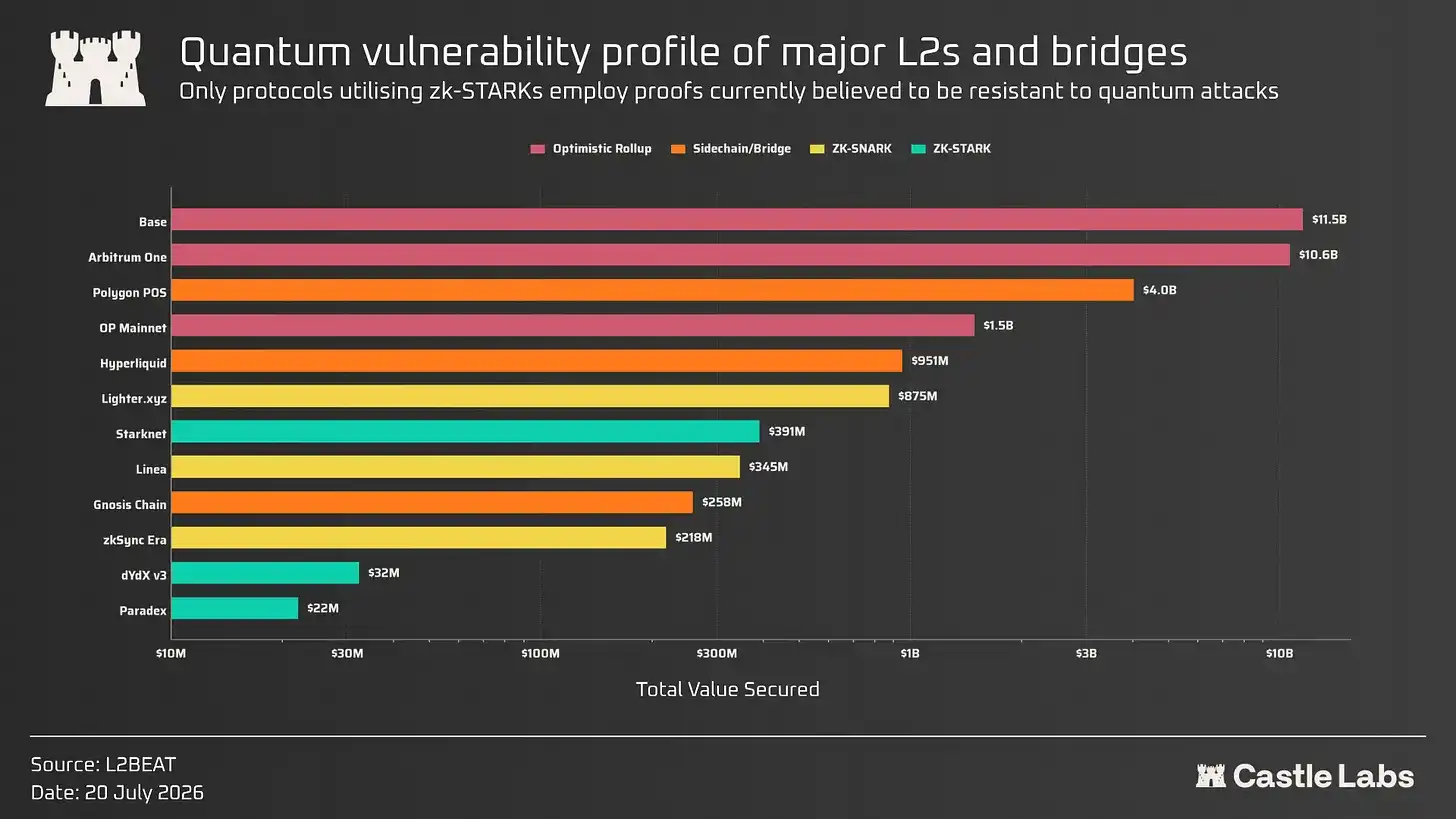
The paper focused on secp256k1 public key exposure, relevant to Bitcoin and Ethereum wallets, stating that a sufficiently powerful quantum computer could attack wallets in less than 9 minutes. Justin Drake later warned that there is "at least a 10% chance" quantum computers could recover private keys from exposed public keys by 2032.

While not a reality today, the long-term security and longevity of assets meant to be held for decades are being called into question.

Bitcoin is the world's most important digital asset, and as it increasingly serves as collateral, reserves, and assets on institutional balance sheets, its security and privacy requirements rise.

In the next section, we highlight a solution being developed around Bitcoin, the largest and clearest test case for these privacy challenges.

strkBTC: Private Bitcoin on Starknet

We've likely all used wrapped BTC tokens. They bring Bitcoin into other ecosystems and make it composable: as a tradable asset, as collateral, as liquidity.

What they don't solve is visibility.

While wrapped BTC can become productive, every move remains monitorable, inspectable, and counterparty-tradeable. Deposits, loans, trades, LP positions, repayments, withdrawals, wallet clustering, treasury flows. All public by default.

This is not how serious financial markets operate, and until this is addressed, on-chain finance will keep hitting an institutional ceiling.

In traditional finance, privacy is built into the infrastructure, whether you're a retail user or an institutional giant. In fact, a large portion of equity trading volume flows through private or over-the-counter venues like dark pools, where counterparties see what they need, regulators retain access when required, and the public sees aggregated volume, not every real-time move.

Cryptocurrency treats visibility as the standard. In reality, privacy should be the norm.

strkBTC is Starknet's attempt to let Bitcoin flow in the on-chain finance world without this limitation.

strkBTC is an ERC-20 on Starknet, backed by BTC locked on the Bitcoin network, and built on StarkWare's privacy framework STRK20 for shielded balances and private transfers.

STRK20 provides strkBTC with two modes:

In public mode, it behaves like a standard ERC-20: users can hold, transfer, supply to lending markets, provide liquidity, or use it as collateral.

In shielded mode, selected balances and transfers are hidden from public view. Users can shield, trade privately, and unshield back to public balances directly from within their wallet.
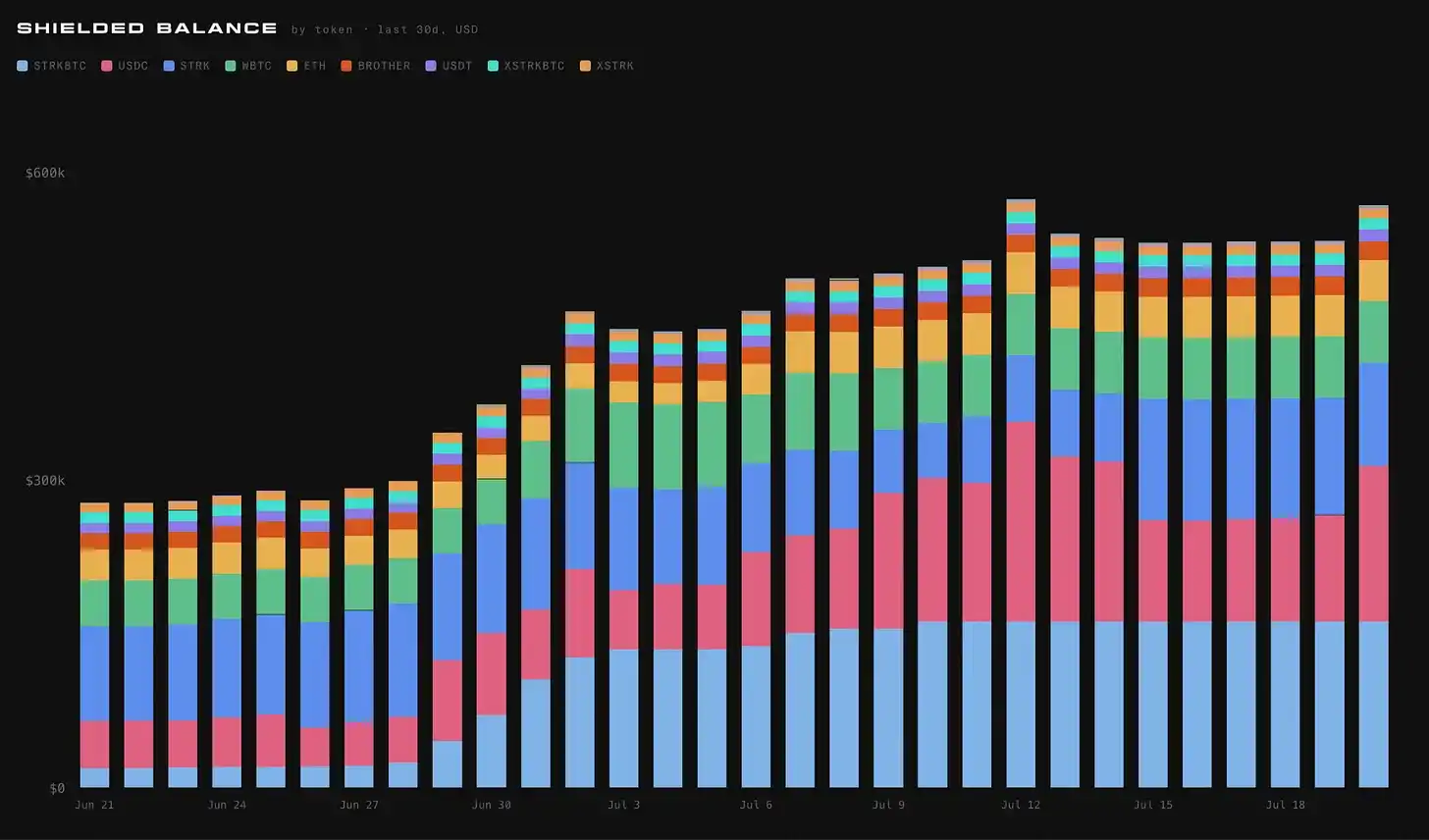
Before the Starknet v0.14.2 upgrade, which enabled STRK20, applications wanting to verify STARK proofs on Starknet had to do so within a smart contract, making it expensive and complex due to proof size. Now, transactions can directly reference off-chain proofs, with Starknet consensus handling verification natively via in-protocol proof verification.

This unlocks privacy at the protocol level, versus the historical friction of separate apps, chains, pools, or mixers, which added complexity, cost, and liquidity fragmentation. This allows applications to focus on building better products, as the underlying infrastructure has made private operations easily accessible to builders.

Compliance is a key part of the design, opening Starknet to institutions coming on-chain.

When users shield strkBTC, associated viewing keys are shared with Financial Privacy Inc. (also known as FPI), an independent third-party auditor operating the compliance infrastructure for STRK20, granting them scoped access in the event of a valid regulatory request. While this may not align with pure cypherpunk philosophy, it aligns much more closely with traditional markets. Private to the public, disclosed to regulators.

The bridge follows similar logic, operated by a trusted strkBTC consortium composed of Twinstake, NEAR Intents, Luganodes, UTXO Management, and Xverse. Currently, these independent signers support minting and burning between BTC and strkBTC. The consortium is not the final state; however, Starknet is committed to a hardening roadmap over time.

strkBTC is not meant to be just another wrapped token; it's meant to unlock the potential of a programmable, composable BTC whose moves aren't broadcast, solving the first issue: visibility.

The next issue is longevity.

The Quantum Problem for Blockchains

Every blockchain relies on public-key cryptography. When a user signs a transaction, they reveal their public key while keeping their private key hidden. This is routine on Bitcoin and most other blockchains, considered perfectly normal and secure in today's environment. But in a post-quantum world, this assumption becomes somewhat unstable.

As mentioned earlier, a sufficiently powerful quantum computer running Shor's algorithm could theoretically derive the private key from an exposed public key. This means public key exposure, the harmless part of transaction validation, could soon become a potential attack surface. This isn't unique to any single chain, as the same elliptic curve underpinnings lie beneath Bitcoin, Ethereum, and Solana.

The threat is shared, but the response capabilities are not. The most exposed chains are often the slowest to move, with Bitcoin being the clearest example.

Bitcoin isn't short on ideas for a post-quantum future. If anything, it has too many. The problem is agreeing on the trade-offs the network is willing to accept: larger signatures, higher costs, legacy coin handling, user migration, wallet support, miner policies, or battles over freezing dormant and unmigrated coins.

Clearly, Bitcoin's problem is as much social and political as it is technical.

Dan Boneh, a co-author of the Google paper, calmed everyone down in a recent interview: "Bitcoin should not panic, but it also can't ignore this. Moving too fast could be worse than waiting, because a rushed post-quantum migration could introduce catastrophic bugs before quantum is a live attack."

Bitcoin will likely solve its quantum problem, but not quickly or cleanly.

This slowness is, in some ways, a feature of sound money, but it also leaves a door open. While the base layer debates, more agile stacks can build the longevity that Bitcoin itself cannot yet commit to.

Ethereum and its extended L2s won't escape this problem. Most rollups settle to Ethereum and rely on it for data availability, thus inheriting the base layer's exposure. Ethereum is aware of this and has released its own multi-year migration plan, but until that plan arrives, every chain built on it is exposed to Ethereum's post-quantum migration problem.

This is where Starknet is ahead. While it settles to Ethereum like any other L2, Starknet's core, its proof layer, is built on foundations that don't rely on quantum-vulnerable cryptography. While the exposure inherited from Ethereum is real, everything within Starknet's own stack carries less migration debt than most major chains, and it has more in the pipeline.

Architectural Advantages

Starknet's advantageous position stems from two design choices, both made before quantum computing was a pressing concern.

The first is the proof layer, the system generating STARK proofs to secure every state transition on the network. It relies on hash functions, not the elliptic curve mathematics threatened by quantum computers, a design established since a 2018 paper co-authored by StarkWare CEO Eli Ben-Sasson. This is the critical security layer and why Google's paper listed Starknet as the only major L2 already ahead.

The second is native account abstraction. On most chains, signature schemes are fixed at the protocol level, so replacing them requires a hard fork, with every user and app having to follow. Starknet lets accounts define how to verify identity themselves, so users can migrate to quantum-resistant signatures without changing the protocol layer. According to StarkWare, a quantum-resistant wallet, S2morrow, is already deployed using Falcon-512, and OpenZeppelin is building a standardized version.

On many chains, such a change would mean coordinating a whole-protocol migration. On Starknet, much of the work can start with wallet upgrades. This doesn't mean every Starknet wallet is quantum-resistant, but this model provides an easier path for Starknet users.

StarkWare is now working to close the remaining gaps. Last week they released a roadmap to make Starknet end-to-end quantum-resistant before Q-day. Q-day refers to the point in time when quantum computers become powerful enough to break today's cryptography.

The roadmap is divided into three phases:
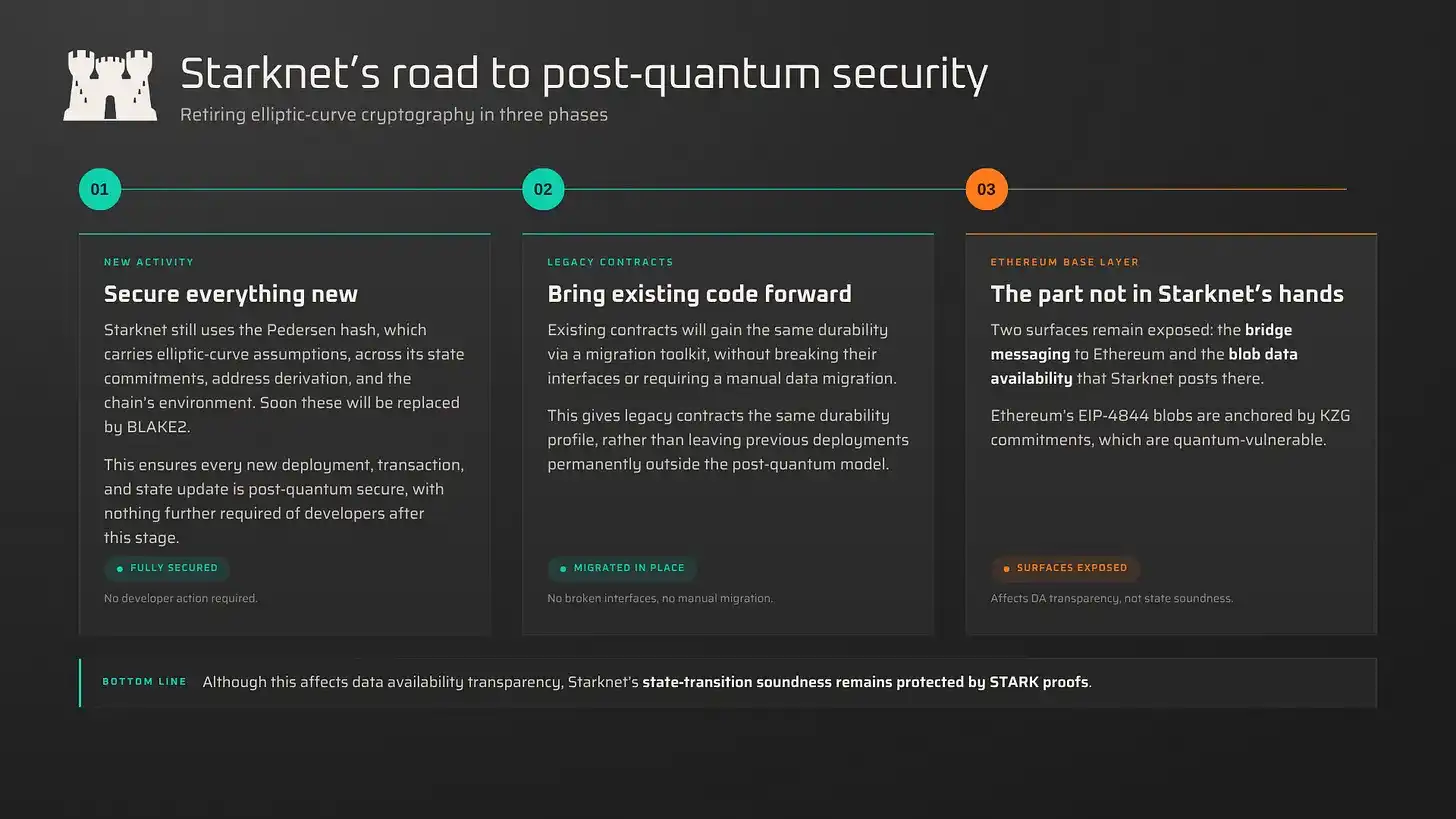
None of this means Starknet is fully quantum-resistant today, nor does the roadmap claim so.

What Still Needs Proving?

Starknet can replace Pedersen with BLAKE2, improve quantum-resistant wallet support, and provide migration paths for legacy contracts, but it cannot eliminate all problems inherited from the base layer. Bridged messages and blob data availability still depend on Ethereum's own quantum-resistant roadmap. Starknet can harden the parts it controls, but what's inherited from Ethereum will progress on Ethereum's timeline. That said, the Ethereum Foundation has outlined structured fork milestones, aiming to complete core quantum-resistant infrastructure around 2029.

strkBTC has a similar staged story. Currently, the bridge relies on a consortium to coordinate minting and burning between BTC and strkBTC. This is a trusted starting point, not the ideal trustless final state. Starknet aims to move from the consortium model to Bitcoin-native verification, then to a less-trust BitVM design, and finally, if Bitcoin enables the required opcodes in the future, to a fully trustless OP_CAT-based design.

Viewing keys are another part yet to be proven. They are Starknet's pragmatic answer to institutional privacy: publicly opaque but selectively disclosable, but they haven't been stress-tested in real scenarios, raising questions about who can request disclosure, under what conditions, and with what safeguards.

Digital assets, including Bitcoin, don't need another wrapper. They need surrounding infrastructure that can operate on-chain without compromising the two things institutions care about most: confidentiality today and longevity tomorrow.

strkBTC solves confidentiality by providing a private, selectively disclosable path for BTC into DeFi. Starknet's existing architecture and roadmap target longevity: its proof layer already avoids the elliptic curve assumptions that burden other protocols with quantum-resistant migration, and its roadmap now extends this advantage to the remaining pieces, explicitly aiming to make Starknet quantum-resistant before "Q-day."

While outcomes are still early, the direction is clear: the next institutional phase of on-chain finance needs more than just yield. It needs privacy, compliance, programmability, and longevity all integrated within the same tech stack.


Trend Kriptolar

İlgili Sorular

QWhat are the two main challenges for on-chain finance as it approaches traditional markets, as described in the article?

AThe two main challenges are: 1) All capital flows are publicly visible, compromising operational and personal privacy. 2) The threat of quantum computing to existing cryptographic signatures, which endangers the long-term security of assets.

QWhat is strkBTC and how does it address the issue of transaction visibility on-chain?

AstrkBTC is a private version of Bitcoin on Starknet, built as an ERC-20 token backed by BTC locked on the Bitcoin network. It leverages StarkWare's STRK20 privacy framework to offer two modes: a public mode (like a standard ERC-20) and a shielded mode where selected balances and transfers are hidden from public view. This allows for private transfers, addressing the issue of default public visibility in on-chain finance.

QHow does Starknet's architecture give it a stronger position regarding the quantum computing threat compared to other major L2s?

AStarknet's proof system is based on hash-based STARK assumptions, not elliptic curve cryptography, which is vulnerable to quantum attacks. This design choice, made before quantum computing was a pressing concern, means its core proof layer is inherently more quantum-resistant. Additionally, its native account abstraction allows wallets to migrate to quantum-resistant signature schemes without requiring a protocol-level hard fork.

QWhat role does the 'viewing key' play in strkBTC's privacy and compliance model?

AWhen a user shields their strkBTC, a related viewing key is shared with an independent third-party auditor called Financial Privacy Inc. (FPI). This key grants FPI scoped access, enabling selective disclosure of transaction details to regulators or compliance bodies upon valid requests. This model provides privacy from the public while allowing for necessary regulatory oversight, aligning with traditional market practices.

QWhat are the stated future goals for the strkBTC bridge and Starknet's overall quantum resistance according to the article?

AFor the strkBTC bridge, the goal is to evolve from the current trusted consortium model to Bitcoin-native verification, then to a less-trust BitVM design, and finally to a fully trustless design based on OP_CAT if Bitcoin enables the required opcodes. For overall quantum resistance, Starknet has a roadmap aiming to make the network end-to-end quantum-secure before 'Q-day' (the point when quantum computers can break current cryptography). This involves upgrading hash functions, improving wallet support, and providing migration paths, though it acknowledges dependencies on Ethereum's own quantum migration timeline.

İlgili Okumalar

Global Stock Market's Storm Center: South Korea's Stock Market De-leveraging Is Largely Complete

Storm's Eye: South Korean Market De-leveraging Nears Completion The recent sharp correction in South Korean equities, with the KOSPI index dropping 32% from its June high, has been a key trigger for global tech stock volatility. The core driver was not a fundamental shift but a forced de-leveraging process within the market's unique structure, which is now largely complete. Two main leverage channels amplified the sell-off: 1. **Leveraged ETFs:** Their size, proportionally four times larger than in the U.S., peaked near $50 billion. Their mandatory daily rebalancing mechanism created a vicious cycle of "price drop → forced selling → further drop." Approximately 75% of this excess has been unwound, shrinking to $26 billion, with regulatory curbs now blocking new inflows. 2. **Hedge Fund Leverage:** Using swaps to magnify exposure, hedge funds saw their net long positioning fall by over 50% from peak levels. The most intense phase of this institutional de-leveraging is over. In contrast, **retail margin debt** poses minimal systemic risk. At 0.5% of market cap, it is far lower than in the U.S. or China, lacks automatic triggers, and is concentrated in smaller stocks. The conclusion: the high-leverage structures most prone to "chain-reaction selling" have been substantially cleared. The market is transitioning from a liquidity-driven crash to one priced more on fundamentals. The article argues that the AI trend—centered on Korean memory chips—remains intact. This episode represents a painful but necessary clearing of crowded trades, not the end of the AI revolution. For investors, the key question is conviction in the long-term AI direction; if the trend is real, current volatility is a cost of entry, not a terminal risk.

链捕手1 saat önce

Global Stock Market's Storm Center: South Korea's Stock Market De-leveraging Is Largely Complete

链捕手1 saat önce

İşlemler

Spot

Popüler Makaleler

BITCOIN Nedir

HarryPotterObamaSonic10Inu (ERC-20)'yu ve Kripto Alanındaki Yerini Anlamak Son yıllarda, kripto para piyasası, hem ticaret yapanların hem de topluluk etkileşimi ve eğlence değeri arayanların ilgisini çeken meme coin'lerin popülaritesinde bir artış gördü. Bu benzersiz token'lar arasında, kripto para dokusuna kültürel referansları harmanlayan ilginç bir proje olan HarryPotterObamaSonic10Inu (ERC-20) bulunmaktadır. Bu makale, HarryPotterObamaSonic10Inu'nun temel yönlerini, mekanizmalarını, topluluk odaklı ethosunu ve daha geniş kripto manzarasıyla etkileşimini incelemektedir. HarryPotterObamaSonic10Inu (ERC-20) Nedir? Adından da anlaşılacağı gibi, HarryPotterObamaSonic10Inu, Ethereum blok zinciri üzerinde inşa edilen bir meme coin'dir ve ERC-20 standardı altında sınıflandırılmaktadır. Geleneksel kripto paraların pratik kullanılabilirlik veya yatırım potansiyeline odaklandığı durumların aksine, bu token eğlence değeri ve topluluğunun gücü üzerine kuruludur. Proje, bağlı kullanıcıların bir araya gelebileceği, fikirlerini paylaşabileceği ve çeşitli kültürel fenomenlerden ilham alan etkinliklere katılabileceği bir ortam yaratmayı hedeflemektedir. HarryPotterObamaSonic10Inu'nun dikkate değer özelliklerinden biri işlemlerde sıfır vergi olmasıdır. Bu çekici unsur, küçük ölçekli yatırımcıları caydırabilecek ek ücretlerden yoksun olarak ticareti ve topluluk katılımını teşvik etmeyi amaçlamaktadır. Coin'in toplam arzı bir milyar token olarak belirlenmiştir; bu, topluluk içinde önemli bir dolaşım sağlama niyetini göstermektedir. HarryPotterObamaSonic10Inu (ERC-20) Yaratıcısı HarryPotterObamaSonic10Inu'nun kökenleri bir miktar gizemlidir; yaratıcısı hakkında spesifik bilgilerin ne olduğu bilinmemektedir. Bu token'ın geliştirilmesi, belirli bir ekip veya açık bir plan eksikliği ile gerçekleşmiştir; bu durum, meme coin sektöründe oldukça yaygındır. Proje, topluluğunun heyecanı ve katılımına dayalı olarak organik bir şekilde ortaya çıkmıştır. HarryPotterObamaSonic10Inu (ERC-20) Yatırımcıları Dış yatırımlar ve destekler söz konusu olduğunda, HarryPotterObamaSonic10Inu da belirsiz kalmaktadır. Token, bilinen herhangi bir yatırım fonunu veya önemli bir kurumsal desteği listelememektedir. Bunun yerine, projenin can damarı, kolektif eylem ve kripto alanındaki katılım yoluyla büyüme ve sürdürülebilirlik sağlayan temel topluluğudur. HarryPotterObamaSonic10Inu (ERC-20) Nasıl Çalışır? Bir meme coin olarak, HarryPotterObamaSonic10Inu, genellikle varlık değerini yöneten geleneksel çerçevelerin dışında çalışmaktadır. Projenin nasıl çalıştığını tanımlayan birkaç özelliği vardır: Sıfır Vergi İşlemleri: İşlemlerde vergi ücreti olmadan, kullanıcılar gizli maliyet endişesi olmadan token'ı serbestçe alıp satabilirler. Topluluk Etkileşimi: Proje, topluluk etkileşimi üzerine kuruludur ve sosyal medya platformlarını kullanarak heyecan yaratarak katılımı kolaylaştırır. Tartışmalar, içerik paylaşımı ve katılım, projenin erişimini genişletmeye ve destekleyiciler arasında sadakat oluşturmaya yardımcı olan kritik unsurlardır. Pratik Kullanılabilirlik Yok: HarryPotterObamaSonic10Inu'nun mali ekosistem içinde somut bir kullanılabilirlik sunmadığı belirtilmelidir. Daha ziyade, eğlence ve topluluk etkinlikleri için bir token olarak sınıflandırılmaktadır. Kültürel Referans: Token, popüler kültürden unsurları zekice harmanlayarak ilgi çekmektedir ve hem meme meraklıları hem de kripto takipçileriyle bağlantı kurmaktadır. HarryPotterObamaSonic10Inu, meme coin'lerin, daha geleneksel kripto para projelerinden nasıl farklı çalıştığını örneklendirmektedir; bu projeler, utilitarist varlıklar yerine yenilikçi sosyal yapıların bir parçası olarak piyasaya girmektedir. HarryPotterObamaSonic10Inu (ERC-20) Zaman Çizelgesi HarryPotterObamaSonic10Inu'nun tarihi, birkaç dikkate değer kilometre taşı ile işaretlenmiştir: Oluşum: Token, birçok kripto meraklısının hayal gücünü yakalayan bir viral meme'den ortaya çıkmıştır. Spesifik yaratım tarihleri mevcut değildir ve bu onun organik yükselişini vurgulamaktadır. Borsa Listelemeleri: HarryPotterObamaSonic10Inu, topluluğun daha kolay erişim ve ticaret yapabilmesini sağlamak için çeşitli borsalarda yer bulmuştur. Topluluk Katılım İnisiyatifleri: Yarışmalar, sosyal medya kampanyaları ve hayranlar ile destekçilerden içerik üretimini içeren topluluk etkileşimini artırmayı amaçlayan devam eden etkinlikler. Gelecek Genişleme Planları: Projenin yol haritası, kültürel temalarına ilişkin bir NFT koleksiyonu, ticari ürünler ve bir e-ticaret sitesi başlatılmasını içermektedir; bu da topluluğun daha fazla katılımını sağlamayı ve ekosistemine daha fazla boyut kazandırmayı hedeflemektedir. HarryPotterObamaSonic10Inu (ERC-20) Hakkında Kilit Noktalar Topluluk Odaklı Doğası: Proje, kullanıcı katılımını geliştirme önceliği taşır ve böylece kullanıcıların sürecin en önünde yer almasını sağlar. Meme Coin Sınıflandırması: Eğlenceye dayalı kripto paranın doruk noktasıdır ve geleneksel yatırım araçlarından ayrılmaktadır. Bitcoin ile Doğrudan İlişki Yok: Ticker ismindeki benzeliğe rağmen, HarryPotterObamaSonic10Inu ayırt edicidir ve Bitcoin veya diğer yerleşik kripto paralarla herhangi bir ilişkisi yoktur. İşbirliğine Odaklanma: HarryPotterObamaSonic10Inu, sahipleri arasında işbirliği ve hikaye paylaşımı için bir alan oluşturmak üzere tasarlanmıştır ve bu da yaratıcılık ve topluluk bağlarını sağlamaktadır. Gelecek Beklentileri: Başlangıçta belirlendiği temalardan NFTs ve ticari ürünlere genişleme arzusu, projenin dijital kültürde daha ana akıma girebilmesi için bir yol haritası çizmektedir. Meme coin'ler, kripto para topluluğunun hayal gücünü çalmaya devam ederken, HarryPotterObamaSonic10Inu (ERC-20), kültürel bağları ve topluluk merkezli yaklaşımıyla öne çıkmaktadır. Geleneksel bir hizmet odaklı token modeliyle uyumlu olmasa da, özünde destekçileri arasında sağlanan neşe ve dostluğu vurgulayarak, giderek dijitalleşen bir çağda kripto paraların evrilen doğasını göstermektedir. Proje gelişmeye devam ettikçe, topluluk dinamiklerinin blockchain teknolojisi dünyasındaki seyrini nasıl etkilediğini izlemek önemli olacaktır.

2.1k Toplam GörüntülenmeYayınlanma 2024.04.01Güncellenme 2024.12.03

BITCOIN Nedir

BTC Nasıl Satın Alınır

HTX.com’a hoş geldiniz! Bitcoin (BTC) satın alma işlemlerini basit ve kullanışlı bir hâle getirdik. Adım adım açıkladığımız rehberimizi takip ederek kripto yolculuğunuza başlayın. 1. Adım: HTX Hesabınızı OluşturunHTX'te ücretsiz bir hesap açmak için e-posta adresinizi veya telefon numaranızı kullanın. Sorunsuzca kaydolun ve tüm özelliklerin kilidini açın. Hesabımı Aç2. Adım: Kripto Satın Al Bölümüne Gidin ve Ödeme Yönteminizi SeçinKredi/Banka Kartı: Visa veya Mastercard'ınızı kullanarak anında Bitcoin (BTC) satın alın.Bakiye: Sorunsuz bir şekilde işlem yapmak için HTX hesap bakiyenizdeki fonları kullanın.Üçüncü Taraflar: Kullanımı kolaylaştırmak için Google Pay ve Apple Pay gibi popüler ödeme yöntemlerini ekledik.P2P: HTX'teki diğer kullanıcılarla doğrudan işlem yapın.Borsa Dışı (OTC): Yatırımcılar için kişiye özel hizmetler ve rekabetçi döviz kurları sunuyoruz.3. Adım: Bitcoin (BTC) Varlıklarınızı SaklayınBitcoin (BTC) satın aldıktan sonra HTX hesabınızda saklayın. Alternatif olarak, blok zinciri transferi yoluyla başka bir yere gönderebilir veya diğer kripto para birimlerini takas etmek için kullanabilirsiniz.4. Adım: Bitcoin (BTC) Varlıklarınızla İşlem YapınHTX'in spot piyasasında Bitcoin (BTC) ile kolayca işlemler yapın.Hesabınıza erişin, işlem çiftinizi seçin, işlemlerinizi gerçekleştirin ve gerçek zamanlı olarak izleyin. Hem yeni başlayanlar hem de deneyimli yatırımcılar için kullanıcı dostu bir deneyim sunuyoruz.

8.2k Toplam GörüntülenmeYayınlanma 2024.12.12Güncellenme 2026.06.02

BTC Nasıl Satın Alınır

$BITCOIN Nedir

DİJİTAL ALTIN ($BITCOIN): Kapsamlı Bir Analiz DİJİTAL ALTIN ($BITCOIN) Tanıtımı DİJİTAL ALTIN ($BITCOIN), geleneksel değerli metallerin özelliklerini merkeziyetsiz teknolojilerin yeniliği ile birleştirmeyi amaçlayan Solana ağı üzerinde çalışan blockchain tabanlı bir projedir. Bitcoin ile aynı isme sahip olmasına rağmen, genellikle bir değer saklama aracı olarak algılandığı için “dijital altın” olarak anılmaktadır; DİJİTAL ALTIN, Web3 ortamında benzersiz bir ekosistem yaratmak için tasarlanmış ayrı bir tokendir. Hedefi, uygulanabilir bir alternatif dijital varlık olarak kendini konumlandırmaktır, ancak uygulamaları ve işlevleri ile ilgili ayrıntılar hala gelişmektedir. DİJİTAL ALTIN ($BITCOIN) Nedir? DİJİTAL ALTIN ($BITCOIN), Solana blockchain'inde kullanılmak üzere açıkça tasarlanmış bir kripto para tokenidir. Bitcoin'in yaygın olarak tanınan bir değer saklama rolü sağlamasının aksine, bu token daha geniş uygulamalara ve özelliklere odaklanıyor gibi görünmektedir. Dikkate değer yönler şunlardır: Blockchain Altyapısı: Token, yüksek hızlı ve düşük maliyetli işlemleri yönetme kapasitesi ile bilinen Solana blockchain'inde inşa edilmiştir. Arz Dinamikleri: DİJİTAL ALTIN'ın maksimum arzı 100 katrilyon token (100P $BITCOIN) ile sınırlıdır, ancak dolaşımdaki arzı ile ilgili ayrıntılar şu anda açıklanmamıştır. Kullanım Alanı: Kesin işlevler açıkça belirtilmemiş olsa da, token'ın merkeziyetsiz uygulamalar (dApps) veya varlık tokenizasyon stratejileri ile ilgili çeşitli uygulamalar için kullanılabileceğine dair işaretler bulunmaktadır. DİJİTAL ALTIN ($BITCOIN) Yaratıcısı Kimdir? Şu anda, DİJİTAL ALTIN ($BITCOIN) arkasındaki yaratıcıların ve geliştirme ekibinin kimliği bilinmemektedir. Bu durum, merkeziyetsiz finans ve meme coin fenomenleriyle uyumlu olan birçok yenilikçi proje arasında yaygındır. Böyle bir anonimlik, topluluk odaklı bir kültürü teşvik edebilirken, yönetişim ve hesap verebilirlik konusundaki endişeleri artırmaktadır. DİJİTAL ALTIN ($BITCOIN) Yatırımcıları Kimlerdir? Mevcut bilgiler, DİJİTAL ALTIN ($BITCOIN) için bilinen herhangi bir kurumsal destekçi veya önde gelen risk sermayesi yatırımı olmadığını göstermektedir. Proje, geleneksel finansman yolları yerine topluluk desteği ve benimsemeye odaklanan bir eşler arası modelde çalışıyor gibi görünmektedir. Faaliyetleri ve likiditesi esas olarak PumpSwap gibi merkeziyetsiz borsalarda (DEX'ler) yer almakta olup, bu da onun taban hareketine vurgu yapmaktadır. DİJİTAL ALTIN ($BITCOIN) Nasıl Çalışır DİJİTAL ALTIN ($BITCOIN) 'ın operasyonel mekanikleri, blockchain tasarımı ve ağ özellikleri temelinde açıklanabilir: Konsensüs Mekanizması: Solana'nın benzersiz tarih kanıtı (PoH) ile bir hisse kanıtı (PoS) modelini birleştirerek, proje ağın yüksek performansına katkıda bulunan verimli işlem doğrulamasını sağlar. Tokenomik: Belirli deflasyonist mekanizmalar kapsamlı bir şekilde detaylandırılmamış olsa da, geniş maksimum token arzı, henüz tanımlanmamış mikro işlemler veya niş kullanım durumlarına hitap edebileceğini ima etmektedir. Etkileşim: Solana'nın daha geniş ekosistemi ile entegrasyon potansiyeli bulunmaktadır; bu, çeşitli merkeziyetsiz finans (DeFi) platformlarını içermektedir. Ancak, belirli entegrasyonlarla ilgili ayrıntılar belirtilmemiştir. Önemli Olayların Zaman Çizelgesi DİJİTAL ALTIN ($BITCOIN) ile ilgili önemli kilometre taşlarını vurgulayan bir zaman çizelgesi: 2023: Token'ın Solana blockchain'inde ilk dağıtımı, sözleşme adresi ile işaretlenmiştir. 2024: DİJİTAL ALTIN, PumpSwap gibi merkeziyetsiz borsalarda işlem görmeye başladıkça görünürlük kazanır ve kullanıcıların bunu SOL karşısında ticaret yapmasına olanak tanır. 2025: Proje, topluluk odaklı etkileşimlere yönelik potansiyel ilgi ve ara sıra ticaret faaliyetleri görür, ancak şu ana kadar dikkate değer ortaklıklar veya teknik ilerlemeler belgelenmemiştir. Kritik Analiz Güçlü Yönler Ölçeklenebilirlik: Temel Solana altyapısı, yüksek işlem hacimlerini destekleyerek $BITCOIN'in çeşitli işlem senaryolarındaki faydasını artırabilir. Erişilebilirlik: Token başına potansiyel düşük ticaret fiyatı, perakende yatırımcıları çekebilir ve parçalı mülkiyet fırsatları sayesinde daha geniş katılımı kolaylaştırabilir. Riskler Şeffaflık Eksikliği: Kamuya açık olarak bilinen destekçilerin, geliştiricilerin veya bir denetim sürecinin olmaması, projenin sürdürülebilirliği ve güvenilirliği konusunda şüpheler doğurabilir. Piyasa Volatilitesi: Ticaret faaliyeti büyük ölçüde spekülatif davranışa dayanmakta olup, bu da yatırımcılar için önemli fiyat dalgalanmalarına ve belirsizliklere yol açabilir. Sonuç DİJİTAL ALTIN ($BITCOIN), hızla gelişen Solana ekosisteminde ilginç ama belirsiz bir proje olarak ortaya çıkmaktadır. “Dijital altın” anlatısını kullanmaya çalışırken, Bitcoin'in değer saklama rolünden ayrılması, amaçlanan faydasının ve yönetişim yapısının daha net bir şekilde tanımlanması gerekliliğini vurgulamaktadır. Gelecekteki kabul ve benimseme, mevcut belirsizliklerin giderilmesine ve operasyonel ile ekonomik stratejilerinin daha açık bir şekilde tanımlanmasına bağlı olacaktır. Not: Bu rapor, Ekim 2023 itibarıyla mevcut olan sentezlenmiş bilgileri kapsamaktadır ve araştırma döneminin ötesinde gelişmeler yaşanmış olabilir.

208 Toplam GörüntülenmeYayınlanma 2025.05.13Güncellenme 2025.05.13

$BITCOIN Nedir

Tartışmalar

HTX Topluluğuna hoş geldiniz. Burada, en son platform gelişmeleri hakkında bilgi sahibi olabilir ve profesyonel piyasa görüşlerine erişebilirsiniz. Kullanıcıların BTC (BTC) fiyatı hakkındaki görüşleri aşağıda sunulmaktadır.

活动图片













