Standard Chartered Bank’s 50-Fold Fantasy: Predicting AAVE to Reach $3,500

链捕手2026-06-25 tarihinde yayınlandı2026-06-25 tarihinde güncellendi

Özet

Standard Chartered Bank has issued an optimistic research report predicting that the AAVE token could surge 50-fold to $3,500 by 2030. This forecast is based on the projection that the total value locked (TVL) in DeFi will grow 37x to approximately $2.7 trillion, driven by stablecoin expansion and the tokenization of real-world assets (RWA). The bank's model links Aave's potential valuation directly to its protocol revenue, which is primarily driven by net interest margins. The report highlights Aave's current dominant position, noting it captures over 80% of the net earnings ("protocol retained earnings") in the lending sector while holding only about half of its TVL. It also points to the recent launch of the Aave V4 architecture and a healthy revenue stream of $142 million in 2025 as positive fundamentals. Grayscale's separate analysis, applying traditional valuation metrics like DCF, concluded AAVE is currently undervalued. However, the article notes significant challenges. Aave's peer-to-pool lending model suffers from inherent capital inefficiency, with an estimated $52 million annual "deadweight loss" due to idle funds needed for liquidity buffers. This structural flaw was exposed during the April KelpDAO exploit, which locked a WETH pool at 100% utilization for days. Emerging protocols like Morpho, with more efficient point-to-point models, are cited as growing competitive threats. In summary, while institutional forecasts paint a macro picture of massive growth fu...

Author: Jae, PANews

Following its bullish call on UNI, Standard Chartered Bank has made another bold statement to the crypto industry: AAVE could surge 50-fold by the end of 2030, reaching $3,500.

Related reading:Standard Chartered Opens 40x "Bet," Calls for UNI to Rise to $100

Aggressive rhetoric, exaggerated multiples, coupled with a familiar script: AAVE’s price surged past $80, with 24-hour gains once approaching 20%. The on-chain lending market is in an uproar—some cheer the traditional giant’s bullish stance on AAVE, while others mock Standard Chartered as another sell-side entity carried away by hype.

Aave’s next battle will unfold at the intersection of fantasy and reality.

Standard Chartered Uses Excel to Draw a 50x "Candlestick" for AAVE

If one were to condense Standard Chartered’s AAVE research report into one sentence, it would be:Deposit scale determines lending capacity, lending capacity drives fee income, and fee income ultimately translates into token market capitalization. Over the past 12 months, approximately 90% of Aave’s fee revenue came from the net interest spread between deposits and loans.

The traditional valuation framework based on linear mapping logic has been directly applied by Standard Chartered to the lending protocol. According to its pricing model, AAVE will follow a stepwise upward trajectory.
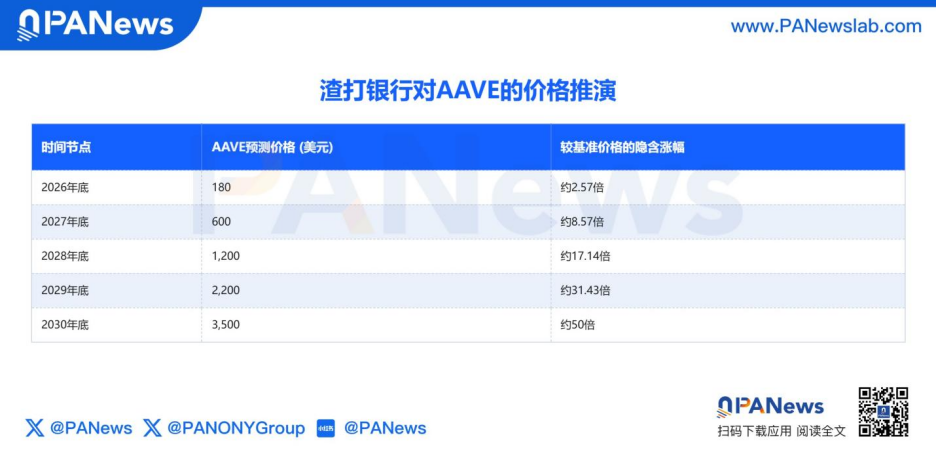
Standard Chartered’s assumptions stem from predictions about two major trends in the DeFi sector:

  • DeFi TVL (Total Value Locked) will grow 37-fold. Standard Chartered predicts that by 2030, the total value of active assets in DeFi will grow 37 times from current levels, reaching approximately $2.7 trillion. This will be driven by a $2 trillion expansion in stablecoin scale and the massive wave of on-chain migration of RWAs (Real World Assets).

  • RWA penetration in DeFi will increase from 3.5% to 30%. This means trillions of dollars in traditional assets will flow into on-chain lending protocols.

Looking back at its peak in October last year, Aave once managed deposits as high as $75 billion. If viewed as a traditional bank, this scale would place it among the top 35 banks in the United States.

Standard Chartered believes that Aave’s operational efficiency far surpasses that of traditional banks reliant on physical branches and redundant manpower. Once the tokenization wave arrives, Aave will leverage its Horizon permissioned lending market and the fee capture from its stablecoin GHO to convert the benefits of RWA on-chain into tangible protocol revenue.

Regarding the capital outflow triggered by the KelpDAO rsETH bridging security incident in April, Standard Chartered Bank characterizes it as a short-term fluctuation during the bottoming phase, not a collapse in the long-term protocol fundamentals.

Even setting aside the long-term narrative and focusing on a medium-to-short-term perspective, Aave’s fundamentals remain robust enough.

On June 18, Grayscale released an in-depth report on Aave, applying the traditional finance DCF (Discounted Cash Flow) model and P/E (Price-to-Earnings) ratio method to value a DeFi protocol for the first time.

Grayscale concluded:AAVE is a typical cash-flow-driven asset, currently trading at undervalued levels.
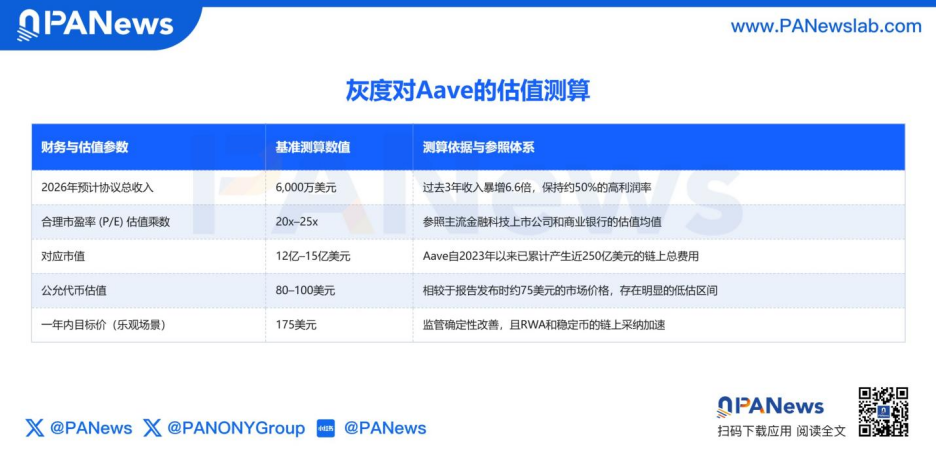
Grayscale emphasized that Aave’s full-year protocol revenue for 2025 was as high as $142 million, indicating healthy cash flow. More importantly, the token buyback and burn plan launched by Aave DAO in April last year, as well as the "Aave Will Win" proposal’s shift of product revenue to token holders, have institutionally established the transmission path from "protocol revenue generation → token value appreciation.”

Monopolizing 80% of Profits with Half the Sector's TVL, Idle Funds Remain Its Achilles' Heel

Beyond the macro vision painted by institutional capital, Aave has also built a deep moat at the micro level.

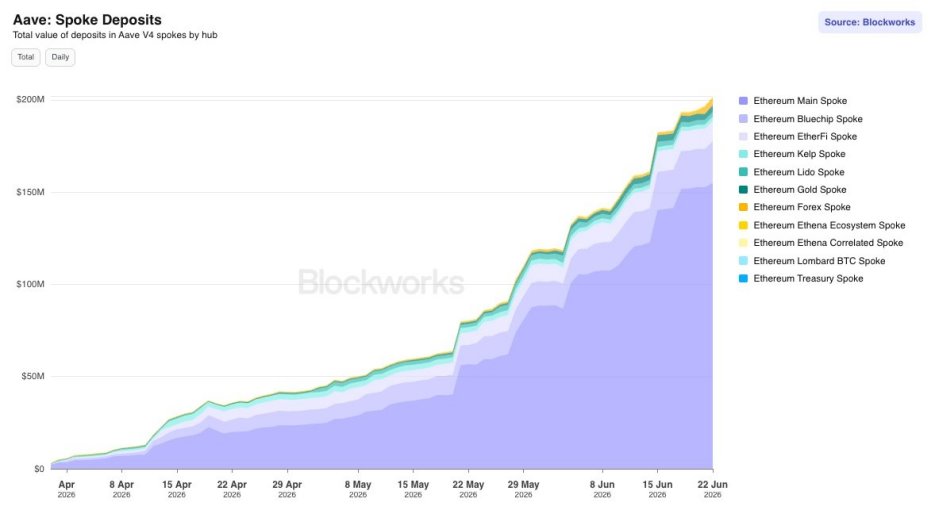
First, there is the breakthrough of the new-generation technical architecture, Aave V4. As the largest underlying architecture rewrite since the protocol’s inception in 2020, V4 employs a "liquidity hub-and-spoke" design to break the silo effect of single-chain liquidity. To date, V4’s total deposits have surpassed $200 million, with loan volumes nearing $60 million.
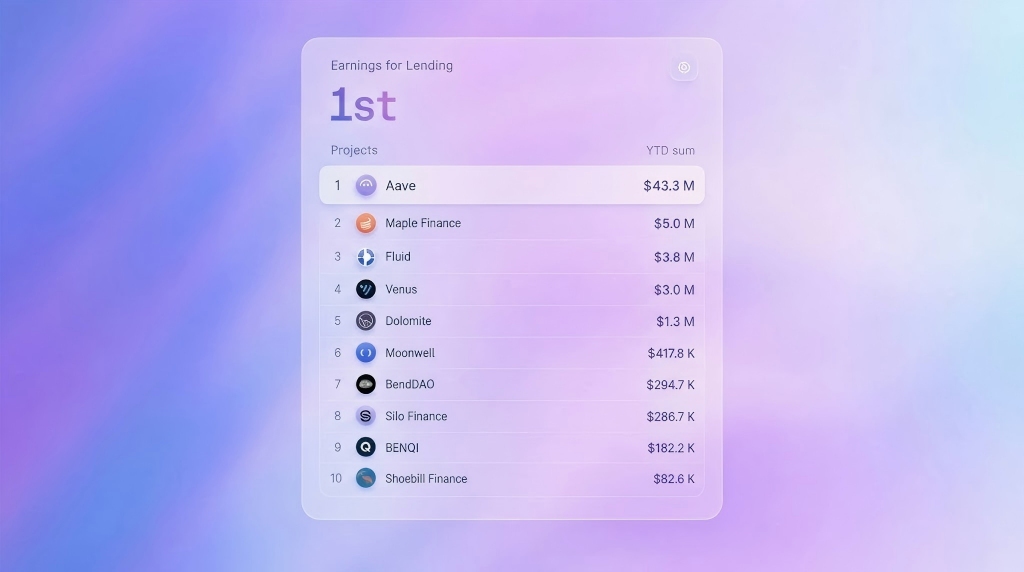
More remarkable is its profitability. On-chain data analytics firm MSB Intel pointed out that year-to-date, Aave has accumulated approximately $43.3 million in "protocol retained earnings" within the lending sector, accounting for 80.7% of the entire sector’s profits. Protocols like Maple Finance, Fluid, Venus, ranked behind it, each generating less than $5 million in profit, not on the same scale as Aave.

In the traditional business world, a company’s substance is often determined by net profit, not total assets. Retained earnings are an indicator that, after deducting relevant operational costs and token inflation incentives, truly reflects a protocol’s on-chain net revenue generation capability.

In other words, Aave uses roughly half of the sector’s TVL to capture over 80% of its net profit. This near-monopolistic profit structure is the hardest cornerstone in Standard Chartered’s 50-fold prediction.
On the flip side, the structural flaw once highlighted by crypto research firm Delphi Digital remains an unresolved challenge. The root of the problem lies within Aave’s peer-to-pool lending model.

According to Delphi Digital’s estimates, in the three primary markets of WETH, USDT, and USDC, Aave incurs an annual invisible loss (Deadweight Loss) of approximately $52 million due to idle funds, a scale almost equivalent to half of its annualized net revenue for Q1 2026.
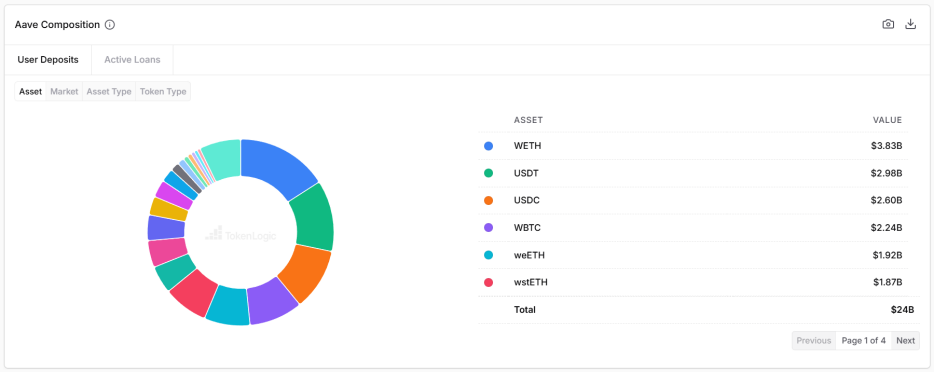
The systemic disconnect between deposit and borrowing rates is an inherent defect of the peer-to-pool model. To ensure depositors can redeem their funds at any time without loss, Aave must maintain a massive idle liquidity buffer within its pools. This results in depositors receiving rates typically 25% to 35% lower than what borrowers pay. The difference is the opportunity cost of idle funds. Even if the DAO governance layer sets the reserve factor to 0, the invisible loss from idle funds would still be as high as $36 million.

The KelpDAO incident in April further revealed the fragility of this model. After hackers drained nearly $200 million worth of WETH, the WETH pool utilization rate was locked at 100% for five days. Ordinary depositors could neither withdraw nor participate in liquidations, leaving a scar on Aave that has yet to fully heal.

This structural flaw makes Aave susceptible to "upstream risk" contagion. Coupled with the inherent shortcoming of low capital efficiency, it also gives latecomers an opportunity to break through. Emerging lending protocols like Morpho, focusing on modular isolation, peer-to-peer matching, and minimalist underlying design, are encroaching on Aave’s market share from an efficiency standpoint, becoming its most formidable challenger beneath the throne.

Looking back from the midpoint of 2026, Aave stands at the corner of fantasy and reality.

The "$3,500" pie chart drawn by Standard Chartered Bank reflects traditional finance’s ambition for asset tokenization. Beyond mere TVL growth, Aave’s future focus will be on finding a viable path to support a trillion-dollar asset scale.

The throne of DeFi lending remains, but the foundation beneath it still requires a process of reconstruction or reinforcement.


Trend Kriptolar

İlgili Sorular

QWhat is Standard Chartered Bank's price target for AAVE by the end of 2030, and what multiple increase does this represent from its current price?

AStandard Chartered Bank's price target for AAVE by the end of 2030 is $3,500, which represents a 50-fold (or 5,000%) increase from its price at the time of the report.

QWhat are the two major DeFi trends that Standard Chartered's prediction for AAVE is based on?

AStandard Chartered's prediction is based on two major DeFi trends: 1) DeFi TVL (Total Value Locked) growing 37-fold to approximately $2.7 trillion by 2030, driven by stablecoin expansion and the tokenization of real-world assets (RWA). 2) The penetration rate of RWA in DeFi increasing from 3.5% to 30%.

QAccording to Grayscale's report, what makes AAVE a 'cash flow-driven asset', and what valuation methods did they apply?

AGrayscale's report states that AAVE is a cash flow-driven asset because it generated substantial protocol revenue of $142 million in 2025 and has mechanisms like token buyback/burn plans that link protocol earnings to token value. They applied traditional financial valuation methods, specifically the DCF (Discounted Cash Flow) model and P/E (Price-to-Earnings) ratio, to value the DeFi protocol.

QWhat is AAVE's key competitive advantage in terms of profitability within the lending sector, as highlighted by MSB Intel?

AAccording to MSB Intel, AAVE's key competitive advantage is its dominant profitability. Year-to-date, it has generated approximately $43.3 million in 'Protocol Retained Earnings', accounting for 80.7% of the entire lending sector's profits, despite holding only about half of the sector's TVL.

QWhat is the fundamental structural flaw in Aave's peer-to-pool lending model identified by Delphi Digital, and what is its consequence?

AThe fundamental structural flaw identified by Delphi Digital is the systemic disconnect between deposit and borrowing rates, necessitating a large idle liquidity buffer in the pool. This leads to significant 'deadweight loss' or opportunity cost, estimated at $52 million annually for major markets, representing low capital efficiency. A consequence of this model was evident during the KelpDAO hack, where the WETH pool was locked at 100% utilization for days, preventing user withdrawals.

İlgili Okumalar

GPT Designs GPT

OpenAI has unveiled its first custom AI chip, Jalapeño, a move signaling a strategic shift beyond being a mere model company. While many see it as a challenge to NVIDIA, its core aim is to control the entire intelligent production pipeline—from models and chips to data centers and energy. The key driver is the evolving competitive landscape: model advantages are shrinking, while the computational gap in areas like cost-per-token, system throughput, and energy efficiency is becoming the true long-term barrier. Jalapeño is primarily an inference chip, targeting the massive and growing "inference tax"—the daily operational cost of generating tokens for services like ChatGPT and APIs. By designing its own hardware optimized for its specific workloads and future product roadmaps (even using AI to aid the chip design process), OpenAI aims to drastically reduce token generation costs and improve system efficiency. This creates a potential flywheel: better models help design better chips, which lower costs for running next-generation models, supporting more users and products, which in turn provides more data to refine future chips. The strategy mirrors Apple’s integrated approach, building a closed loop where hardware, software, and applications are co-optimized. In the long term, OpenAI is not trying to become the next NVIDIA (a supplier of "shovels" to all AI companies) but to own and operate the entire "mine"—selling the end product of intelligence itself. This move marks OpenAI's ambition to evolve from creating the smartest models to controlling the foundational infrastructure of AI production.

marsbit16 dk önce

GPT Designs GPT

marsbit16 dk önce

Ethereum Foundation Interim Executive Director Speaks Out: What Is Our Mission?

The Ethereum Foundation's core mission is to ensure Ethereum remains a truly permissionless, censorship-resistant, private, and open infrastructure for large-scale, sovereign coordination. The article clarifies the EF's focus and dismisses irrelevant objectives, such as pursuing institutional popularity or short-term speculation. Its core work centers on eliminating systemic weaknesses. This involves fortifying Ethereum across multiple layers—protocol, access, user, and institutional—against exploitation, control, or surveillance. Key initiatives include minimizing harmful MEV and preventing privileged control over transaction flow, making unconditional privacy a foundational default, ensuring staking remains permissionless and decentralized, and strengthening user-facing access points to uphold autonomy. Concurrently, the EF aims to seize strategic opportunities. These include leading the transition to post-quantum cryptography, achieving a fully verifiable protocol stack, establishing Ethereum as private digital cash, integrating user-owned AI agents with personal wallets, and demonstrating that trusted-neutral infrastructure can competitively handle disintermediated coordination at an institutional scale. The article also addresses recent organizational changes, stating that personnel departures were due to strategic realignment, role fit, or natural evolution. It clarifies the approach to spin-outs, emphasizing that external funding will be provided only for work critical to the EF's mission that reduces Ethereum's dependency without creating new risks or mission drift. Ultimately, the EF is committed to building an enduring, neutral system that reshapes global coordination, focusing relentlessly on the principles of censorship resistance, openness, privacy, and sovereignty (CROP).

链捕手58 dk önce

Ethereum Foundation Interim Executive Director Speaks Out: What Is Our Mission?

链捕手58 dk önce

İşlemler

Spot
Futures

Popüler Makaleler

$BANK Nedir

Bank AI: Bankacılıkta Devrimsel Bir Adım Giriş Teknolojideki hızlı ilerlemelerin damgasını vurduğu bir çağda, Bank AI, yapay zeka (AI) ve bankacılık hizmetleri kesişiminde yer almaktadır. Bu yenilikçi proje, finansal manzarayı yeniden tanımlamayı, operasyonel verimliliği, güvenlik önlemlerini ve müşteri deneyimlerini AI'nin gücüyle geliştirmeyi hedefliyor. Bank AI yolculuğuna çıkarken, projenin içeriğine, operasyonel dinamiklerine, tarihsel bağlamına ve önemli kilometre taşlarına dalacağız. Bank AI Nedir? Bank AI, yapay zekanın çeşitli bankacılık operasyonlarına entegrasyonunu hedefleyen dönüştürücü bir girişimi temsil etmektedir. Bu proje, süreçleri otomatikleştirmek, risk yönetimi protokollerini geliştirmek ve kişiselleştirilmiş hizmetler aracılığıyla müşteri etkileşimini artırmak için AI'nin yeteneklerinden yararlanmaktadır. Bank AI'nin temel hedefleri şunlardır: Bankacılık Fonksiyonlarının Otomasyonu: AI teknolojilerini kullanarak, Bank AI rutin görevleri otomatikleştirmeyi, insan kaynakları üzerindeki yükü azaltmayı ve verimliliği artırmayı amaçlamaktadır. Geliştirilmiş Risk Yönetimi: Proje, dolandırıcılık ve diğer tehditlere karşı güvenlik önlemlerini güçlendirerek riski tahmin edip tanımlamak için AI algoritmalarını kullanmaktadır. Bankacılık Hizmetlerinin Kişiselleştirilmesi: Bank AI, müşteri verilerini ve davranışlarını analiz ederek, özel finansal ürünler ve hizmetler sunmaya odaklanmaktadır. Müşteri Deneyimini İyileştirme: Chatbotlar ve sanal asistanlar gibi AI destekli çözümlerin uygulanması, kullanıcıların daha insana yakın etkileşimler yaşamasını sağlamayı hedeflemekte, bankalarla etkileşim biçimlerini devrim niteliğinde değiştirmektedir. Bu hedeflerle, Bank AI, bankacılığı daha verimli, güvenli ve kullanıcı odaklı hale getiren önemli bir oyuncu olarak kendini konumlandırmaktadır. Bank AI'nin Yaratıcısı Kimdir? Bank AI'nin yaratıcısı hakkında detaylar bilinmemektedir. Bu nedenle, mevcut bilgilerde belirli bir kişi veya organizasyon tanımlanmamıştır. Projenin başlangıcı etrafındaki anonimlik soruları gündeme getirse de, bunun iddialı vizyonu ve hedefleri üzerinde bir olumsuz etkisi yoktur. Bank AI'nin Yatırımcıları Kimlerdir? Proje yaratıcılarında olduğu gibi, Bank AI'nin yatırımcıları veya destekleyen organizasyonları hakkında da özel bilgiler açıklanmamıştır. Bu bilgiler olmadan, projenin ilerlemesini destekleyen finansal destek ve kurumsal destek hakkında bir çerçeve çizmek zordur. Yine de, böyle yenilikçi bir alanda gelişimi sürdürmek için sağlam bir yatırım temelinin önemi büyüktür. Bank AI Nasıl Çalışır? Bank AI, geleneksel bankacılık çerçevelerinden ayıran benzersiz faktörlere odaklanarak birden fazla yenilikçi alanda faaliyet göstermektedir. İşte temel operasyonel özellikler: Otomasyon: Makine öğrenimi algoritmalarını uygulayarak, Bank AI bankalar içindeki çeşitli manuel süreçleri otomatikleştirir. Bu, operasyonel maliyetleri azaltır ve insan çalışanların daha stratejik faaliyetlere yönelmelerini sağlar. Gelişmiş Risk Yönetimi: Risk yönetimi uygulamalarına AI entegrasyonu, bankaların dolandırıcılık gibi potansiyel tehditleri doğru bir şekilde tahmin etme araçlarıyla donatılmasını sağlar, böylece müşteri bilgileri ve varlıkları güvence altına alınır. Özelleştirilmiş Finansal Tavsiyeler: Müşteri etkileşimlerinden sürekli olarak öğrenerek, AI sistemleri kullanıcı ihtiyaçlarının daha iyi anlaşılmasını sağlar ve finansal kararlar hakkında özelleştirilmiş tavsiyeler sunar. Geliştirilmiş Müşteri Etkileşimleri: AI destekli chatbotlar ve sanal asistanlar kullanarak, Bank AI daha etkileşimli bir müşteri deneyimi sunar, kullanıcıların sorularını hızlı bir şekilde çözmelerine imkan tanır, bekleme sürelerini azaltır ve memnuniyet seviyelerini artırır. Bu operasyonel özellikler, Bank AI'yi bankacılık sektöründe bir öncü olarak konumlandırmakta ve hizmet sunumu ile operasyonel mükemmeliyet için yeni standartlar belirlemektedir. Bank AI Zaman Çizelgesi Bank AI'nin gidişatını anlamak için tarihsel bağlamına bir göz atmak gerekmektedir. Aşağıda önemli kilometre taşlarını ve gelişmeleri vurgulayan bir zaman çizelgesi bulunmaktadır: 2010'ların Başları: AI entegrasyonunun bankacılık hizmetlerine olan ilgisi arttı, bankacılık kurumları potansiyel faydalarını tanımaya başladılar. 2018: Bankaların temel müşteri hizmetleri ve geliştirilmiş güvenlik yönetimi için risk yönetim sistemlerinde chatbotlar gibi AI araçları kullanmaya başlamasıyla AI teknolojilerinin uygulanmasında belirgin bir artış yaşandı. 2023: AI'nin karmaşıklığı artmaya devam etti ve belge işleme ile gerçek zamanlı yatırım analizi gibi daha karmaşık görevler için üretken AI devreye alındı. Bu yıl, AI teknolojisi sayesinde bankaların sahip olduğu yeteneklerde önemli bir sıçrama yaşandı. 2024-Güncel Durum: Bu yıl itibarıyla, Bank AI yükselişte, devam eden araştırmalar ve geliştirmeler bankacılık operasyonlarındaki yetenekleri daha da artırmaya hazırlanıyor. AI uygulamalarının sürekli araştırılması, heyecan verici gelişmelere işaret etmektedir. Bank AI Hakkında Anahtar Noktalar Bankacılıkta AI Entegrasyonu: Bank AI, bankacılık süreçlerini kolaylaştırmak ve kullanıcı deneyimlerini geliştirmek için yapay zekanın benimsenmesine odaklanmaktadır. Otomasyon ve Risk Yönetimi Vurgusu: Proje, rutin görevlerin yükünü azaltmayı amaçlarken, tahmine dayalı analizlerle güvenlik çerçevelerini geliştirmeye büyük önem vermektedir. Kişiselleştirilmiş Bankacılık Çözümleri: Müşteri verilerinden yararlanarak, Bank AI bireysel kullanıcı ihtiyaçlarına yönelik özelleştirilmiş bankacılık hizmetleri sunar. Gelişime Bağlılık: Bank AI, teknolojinin sürekli evrimi ile uyumlu olmasını sağlamak ve güncel kalmak için sürekli araştırma ve geliştirme çabalarına bağlı kalmaktadır. Sonuç Özetle, Bank AI bankacılık endüstrisinde önemli bir adımı temsil etmekte, yapay zekayı kullanarak operasyonel paradigmaları yeniden şekillendirmekte, güvenliği artırmakta ve müşteri memnuniyetini teşvik etmektedir. Yaratıcı ve yatırımcılar hakkındaki bilgi eksikliklerine rağmen, Bank AI'nin net hedefleri ve işlevsel mekanizmaları, devam eden evrimi için güçlü bir temel sunmaktadır. AI teknolojisi gelişmeye ve bankacılık sektörüyle birleşmeye devam ettikçe, Bank AI finansal hizmetlerin geleceğini önemli ölçüde etkilemeye hazır durumda, bankacılıkla olan anlayışımızı ve etkileşim biçimlerimizi geliştirmektedir.

151 Toplam GörüntülenmeYayınlanma 2024.04.06Güncellenme 2024.12.03

$BANK Nedir

BANK Nasıl Satın Alınır

HTX.com’a hoş geldiniz! Lorenzo Protocol (BANK) satın alma işlemlerini basit ve kullanışlı bir hâle getirdik. Adım adım açıkladığımız rehberimizi takip ederek kripto yolculuğunuza başlayın. 1. Adım: HTX Hesabınızı OluşturunHTX'te ücretsiz bir hesap açmak için e-posta adresinizi veya telefon numaranızı kullanın. Sorunsuzca kaydolun ve tüm özelliklerin kilidini açın. Hesabımı Aç2. Adım: Kripto Satın Al Bölümüne Gidin ve Ödeme Yönteminizi SeçinKredi/Banka Kartı: Visa veya Mastercard'ınızı kullanarak anında Lorenzo Protocol (BANK) satın alın.Bakiye: Sorunsuz bir şekilde işlem yapmak için HTX hesap bakiyenizdeki fonları kullanın.Üçüncü Taraflar: Kullanımı kolaylaştırmak için Google Pay ve Apple Pay gibi popüler ödeme yöntemlerini ekledik.P2P: HTX'teki diğer kullanıcılarla doğrudan işlem yapın.Borsa Dışı (OTC): Yatırımcılar için kişiye özel hizmetler ve rekabetçi döviz kurları sunuyoruz.3. Adım: Lorenzo Protocol (BANK) Varlıklarınızı SaklayınLorenzo Protocol (BANK) satın aldıktan sonra HTX hesabınızda saklayın. Alternatif olarak, blok zinciri transferi yoluyla başka bir yere gönderebilir veya diğer kripto para birimlerini takas etmek için kullanabilirsiniz.4. Adım: Lorenzo Protocol (BANK) Varlıklarınızla İşlem YapınHTX'in spot piyasasında Lorenzo Protocol (BANK) ile kolayca işlemler yapın.Hesabınıza erişin, işlem çiftinizi seçin, işlemlerinizi gerçekleştirin ve gerçek zamanlı olarak izleyin. Hem yeni başlayanlar hem de deneyimli yatırımcılar için kullanıcı dostu bir deneyim sunuyoruz.

730 Toplam GörüntülenmeYayınlanma 2025.05.09Güncellenme 2026.06.02

BANK Nasıl Satın Alınır

Tartışmalar

HTX Topluluğuna hoş geldiniz. Burada, en son platform gelişmeleri hakkında bilgi sahibi olabilir ve profesyonel piyasa görüşlerine erişebilirsiniz. Kullanıcıların BANK (BANK) fiyatı hakkındaki görüşleri aşağıda sunulmaktadır.

活动图片