Zcash price prediction – Can Ironwood upgrade keep ZEC’s 37% rally alive?

ambcrypto2026-07-21 tarihinde yayınlandı2026-07-21 tarihinde güncellendi

Özet

Zcash has rallied nearly 37% since its Ironwood (NU6.3) upgrade deployed to testnet in early July. This major upgrade introduces a new shielded pool and a "turnstile" mechanism to strengthen supply verification without compromising privacy. Concurrently, it marks the retirement of the legacy zcashd node, a significant architectural shift for the network. After its rally, ZEC is consolidating around $546, with buyers attempting to establish support. Immediate resistance lies near $560, with a breakout potentially targeting $600, while the $500 region acts as key support. The final testing phase precedes Ironwood's planned mainnet activation later this month.

Zcash [ZEC] has rallied nearly 37% since developers deployed the Ironwood [NU6.3] upgrade to testnet earlier this month, with the privacy-focused cryptocurrency outperforming many of its peers ahead of the protocol’s next major network upgrade.

As the community prepares for Ironwood’s mainnet activation, the upgrade also marks the beginning of the end for zcashd. This is the network’s long-running reference node, making this one of the most significant transitions in Zcash’s history.

Ironwood aims to strengthen confidence in Zcash’s supply

The Zcash Open Development Lab deployed the Ironwood [NU6.3] upgrade to testnet on July 2, with activation following on July 4. The milestone serves as the final testing phase before the planned mainnet rollout later this month.

Ironwood was introduced following the disclosure of an Orchard protocol vulnerability in June. While developers said there was no evidence the issue had been exploited or that user funds were at risk, the flaw highlighted a limitation in proving the integrity of Zcash’s shielded supply.

To address that, Ironwood introduces a new shielded pool alongside a “turnstile” mechanism that enables the network to verify the amount of ZEC migrating into the new pool without compromising transaction privacy.

The upgrade is designed to strengthen confidence in Zcash’s circulating supply while preserving the privacy guarantees that distinguish the network from other cryptocurrencies.

Legacy zcashd node heads for retirement

Ironwood also marks a major infrastructure shift for the ecosystem.

The long-running zcashd reference implementation will not support NU6.3. It is being phased out as the network transitions to a Rust-based architecture built around Zebra, Zaino, and Zallet.

Developers have urged node operators to migrate before Ironwood activates on mainnet, as legacy zcashd nodes are approaching their automatic end-of-life shutdown. It will no longer participate in the upgraded network.

The transition represents one of the largest architectural changes since Zcash launched. It replaces the software that has underpinned the blockchain for years.

ZEC price prediction: Bulls pause after 37% advance

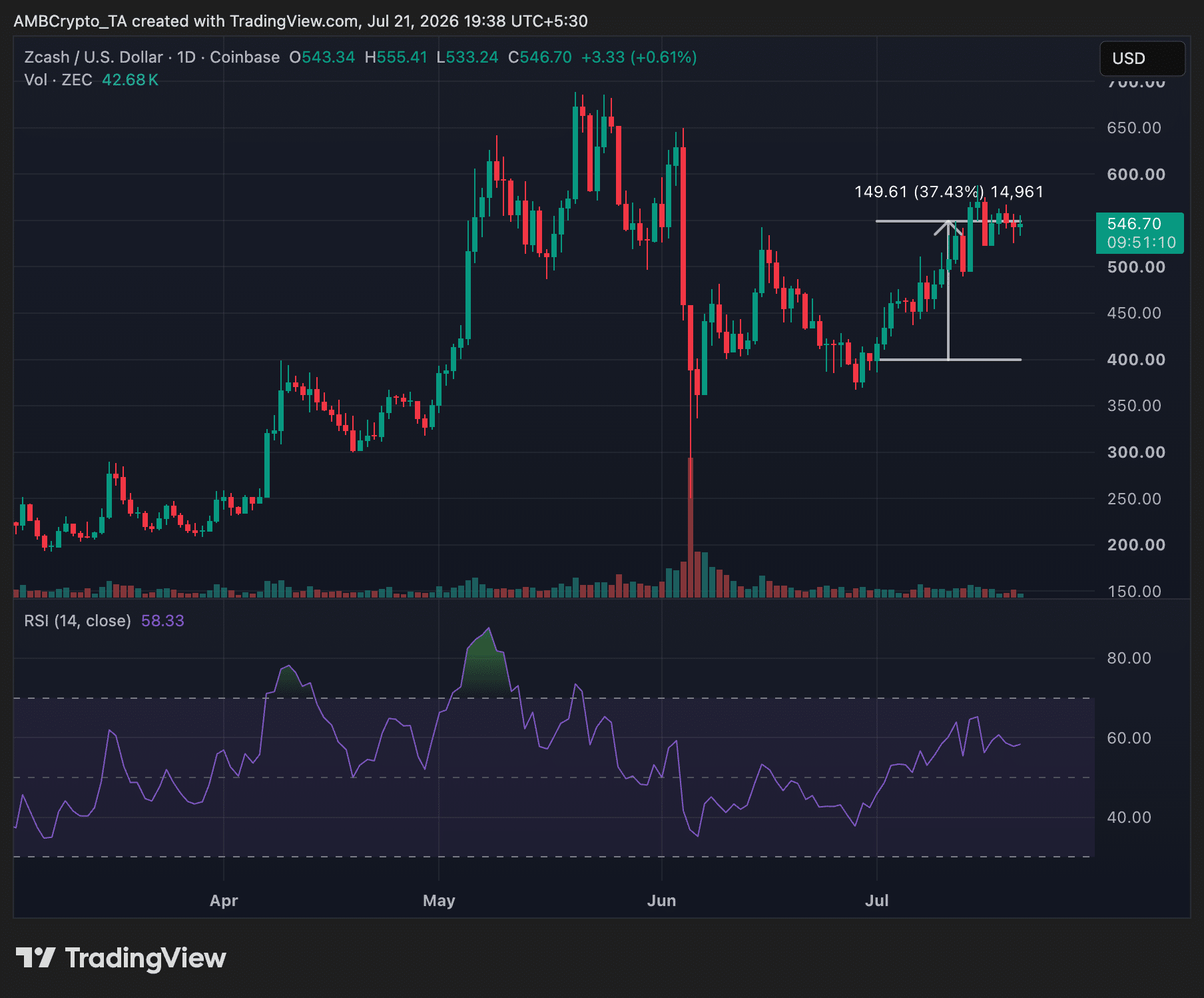
At press time, ZEC traded around $546, up roughly 37.4% from its early July lows.

The rally has since slowed into a period of consolidation, with buyers attempting to establish support after reaching the recent highs.

The daily RSI stood at around 58, indicating bullish momentum remained intact without entering overbought territory. That suggests buyers still hold a modest advantage. However, the strong upside momentum seen earlier in the month has begun to moderate.
Source: TradingView

The immediate resistance lies around $560, where recent advances have repeatedly stalled.

A decisive breakout above that level could pave the way for another attempt at $600, a price zone that acted as resistance earlier this year.

On the downside, the $500 region has emerged as the first meaningful support. Holding above that level would preserve the current higher-low structure. At the same time, a break below it could trigger a deeper pullback before buyers attempt another advance.


Final Summary

  • Zcash’s Ironwood upgrade has entered its final testing phase, introducing a new shielded pool while paving the way for the retirement of the legacy zcashd node.
  • ZEC has gained nearly 37% since Ironwood entered testnet, with bulls now attempting to break above the $560 resistance to target $600.


Trend Kriptolar

İlgili Sorular

QWhat is the Ironwood upgrade and what key problem does it aim to address for Zcash?

AIronwood is Zcash's NU6.3 network upgrade, currently on testnet. It was introduced to address a limitation in proving the integrity of Zcash's shielded supply, following the disclosure of an Orchard protocol vulnerability. It introduces a new shielded pool and a 'turnstile' mechanism to verify ZEC migrating into it without compromising transaction privacy.

QWhy is the Ironwood upgrade a significant infrastructure shift for the Zcash network?

AIronwood marks a major infrastructure shift because the legacy reference node software, zcashd, will not support the upgrade. It is being phased out as the network transitions to a new Rust-based architecture built around Zebra, Zaino, and Zallet, representing one of the largest architectural changes since Zcash's launch.

QHow has ZEC's price reacted to the Ironwood upgrade news, and what are the key technical levels to watch?

AZEC rallied approximately 37% since the Ironwood upgrade was deployed to testnet. At the time of writing, it was consolidating near $546. Key resistance is at $560, with a breakout potentially targeting $600. Key support is at the $500 level.

QWhat is the role of the 'turnstile' mechanism in the Ironwood upgrade?

AThe 'turnstile' mechanism enables the Zcash network to verify the total amount of ZEC migrating into the new shielded pool, thereby strengthening confidence in the circulating supply, all while preserving the privacy of individual transactions.

QWhat is the current status of the Ironwood upgrade and its final deployment timeline?

AThe Ironwood (NU6.3) upgrade was deployed to testnet on July 2 and activated on July 4. This is the final testing phase before its planned mainnet activation later in the same month (July).

İlgili Okumalar

FBI Agent Steals from Within: Millions in Cryptocurrency Stolen by Memorizing Recovery Phrases

A criminal complaint filed in the U.S. District Court for the Eastern District of Virginia details the case of Patrick Steven Yaroch, a former FBI supervisory special agent. Yaroch is accused of using his position to steal nearly $1 million in cryptocurrency from accounts associated with a "foreign adversary" (reportedly Russia) that were under FBI monitoring. He allegedly accessed the accounts' seed phrases from an FBI system, memorized them, and transferred the funds to personal wallets over 10-12 transactions in late 2024 or early 2025. Some stolen assets were held on the Kraken exchange and others were deposited into the Suilend DeFi protocol to earn yield. Despite his senior GS-14 position and high security clearance, Yaroch claimed his actions stemmed from frustration with the FBI's perceived inaction against the monitored accounts. However, evidence from his phone, including ChatGPT conversations from May and June 2026, revealed plans to move to Europe (specifically Portugal) with $1 million and retire early. He booked flights for his family and initiated steps for Portuguese residency. Tormented by guilt, Yaroch voluntarily confessed to the Justice Department and FBI in late July 2026, surrendering the seed phrase and a hardware wallet. He was immediately fired and arrested. He faces charges of interstate transportation of stolen property and receipt of stolen goods. The case highlights vulnerabilities within law enforcement, including excessive access to sensitive data like seed phrases, inadequate internal oversight, and the difficulty of detecting such insider theft on-chain. It echoes past corruption cases, such as those involving agents Carl Force and Shaun Bridges during the Silk Road investigation, where officials misappropriated Bitcoin. The incident underscores that human fallibility remains a critical risk in managing digital assets, even within heavily monitored agencies.

marsbit2 saat önce

FBI Agent Steals from Within: Millions in Cryptocurrency Stolen by Memorizing Recovery Phrases

marsbit2 saat önce

Inside a Fake Ledger: How a 4G Modem is Secretly Embedded in a Hardware Wallet

In a presentation at Hardwear.io 2026, hardware security expert Joe Grand detailed a sophisticated spy chip discovered inside counterfeit Ledger Nano X hardware wallets. Initially reported in 2021, these tampered devices reached victims through data leaked from Ledger in 2020 and subsequent phishing campaigns. The implanted board connects to the internal SPI bus, passively intercepting data between the Secure Element and the OLED display. Using pattern recognition, it "reads" the seed phrase words displayed during wallet setup or recovery, stores them in its flash memory, and then exfiltrates the data via a built-in 4G modem and eSIM, independent of the victim's computer. To fit the extra hardware, the attackers reduced the battery size and replaced a thermal sensor with a fixed resistor to fake a 100% charge reading. Grand noted this is not an isolated incident, with similar supply-chain attacks previously targeting Trezor devices where compromised firmware generated predictable seed phrases. The researcher plans to intercept and decrypt the chip's cellular traffic to learn more about the attackers. Ledger advises users to purchase devices directly from the manufacturer or authorized resellers, not third-party marketplaces, and to compare devices against official photos. The company is also considering enhanced physical security for future products. The article questions whether Ledger Live's Secure Element authentication would detect such a passive hardware implant and highlights that the core risk lies in the physical supply chain, not just software.

cryptonews.ru3 saat önce

Inside a Fake Ledger: How a 4G Modem is Secretly Embedded in a Hardware Wallet

cryptonews.ru3 saat önce

İşlemler

Spot

Popüler Makaleler

ZEC Nasıl Satın Alınır

HTX.com’a hoş geldiniz! Zcash (ZEC) satın alma işlemlerini basit ve kullanışlı bir hâle getirdik. Adım adım açıkladığımız rehberimizi takip ederek kripto yolculuğunuza başlayın. 1. Adım: HTX Hesabınızı OluşturunHTX'te ücretsiz bir hesap açmak için e-posta adresinizi veya telefon numaranızı kullanın. Sorunsuzca kaydolun ve tüm özelliklerin kilidini açın. Hesabımı Aç2. Adım: Kripto Satın Al Bölümüne Gidin ve Ödeme Yönteminizi SeçinKredi/Banka Kartı: Visa veya Mastercard'ınızı kullanarak anında Zcash (ZEC) satın alın.Bakiye: Sorunsuz bir şekilde işlem yapmak için HTX hesap bakiyenizdeki fonları kullanın.Üçüncü Taraflar: Kullanımı kolaylaştırmak için Google Pay ve Apple Pay gibi popüler ödeme yöntemlerini ekledik.P2P: HTX'teki diğer kullanıcılarla doğrudan işlem yapın.Borsa Dışı (OTC): Yatırımcılar için kişiye özel hizmetler ve rekabetçi döviz kurları sunuyoruz.3. Adım: Zcash (ZEC) Varlıklarınızı SaklayınZcash (ZEC) satın aldıktan sonra HTX hesabınızda saklayın. Alternatif olarak, blok zinciri transferi yoluyla başka bir yere gönderebilir veya diğer kripto para birimlerini takas etmek için kullanabilirsiniz.4. Adım: Zcash (ZEC) Varlıklarınızla İşlem YapınHTX'in spot piyasasında Zcash (ZEC) ile kolayca işlemler yapın.Hesabınıza erişin, işlem çiftinizi seçin, işlemlerinizi gerçekleştirin ve gerçek zamanlı olarak izleyin. Hem yeni başlayanlar hem de deneyimli yatırımcılar için kullanıcı dostu bir deneyim sunuyoruz.

697 Toplam GörüntülenmeYayınlanma 2024.12.12Güncellenme 2026.06.02

ZEC Nasıl Satın Alınır

Tartışmalar

HTX Topluluğuna hoş geldiniz. Burada, en son platform gelişmeleri hakkında bilgi sahibi olabilir ve profesyonel piyasa görüşlerine erişebilirsiniz. Kullanıcıların ZEC (ZEC) fiyatı hakkındaki görüşleri aşağıda sunulmaktadır.

活动图片












