Author: Frank, PANews
The World Cup never lacks predictions. Professional institutions, odds companies, fan communities, and data models all provide their answers before the tournament begins. But in prediction markets, a judgment is not merely an opinion; it's a choice that requires placing real money on the line.
When the price for a strong team's victory in a match is continuously bought higher, when shares for a draw are suddenly swept up just before kickoff, when a single wallet places dozens of orders on the same match—the prediction market no longer merely presents the question "who will win," but becomes a real-time experiment involving capital, information, and bias.
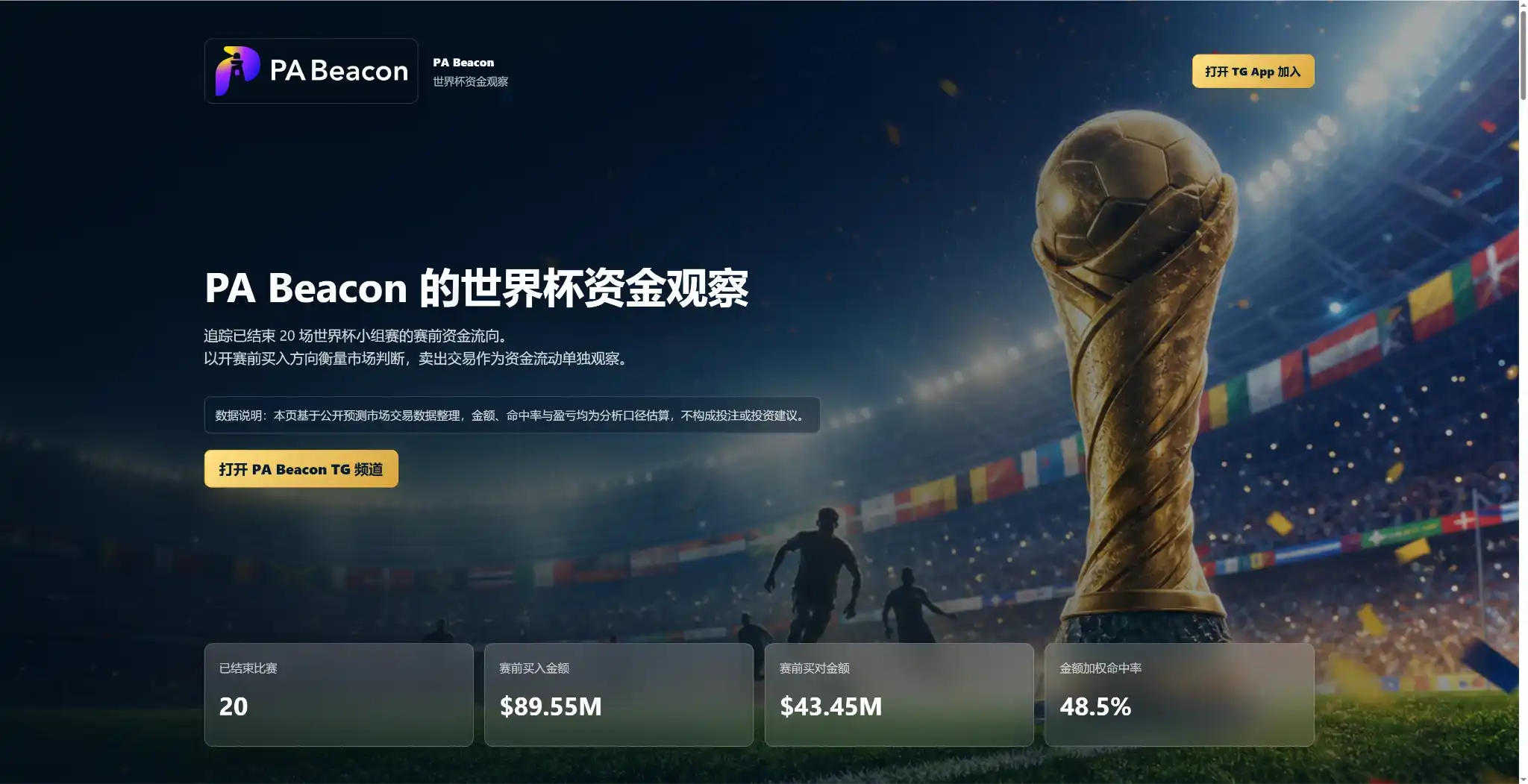
PA Beacon conducted a statistical analysis of trading data for completed World Cup-related contracts on Polymarket. As of June 17, 2026, covering 20 concluded group stage matches with settled outcomes, all single transactions greater than $5,000 were included. The total pre-match buy amount was $89,545,700, with the final correct buy amount being $43,450,400, resulting in a value-weighted hit rate of 48.5%.
This result does not align with the intuitive image many have of "smart money." At least in this World Cup sample, large capital did not act like a crystal ball foretelling all the answers. More interestingly, if we estimate based on holding the aggregated pre-match buy positions until settlement, the 1,278 combined trading positions had a total cost of $89,545,700 and a total payout of $87,786,300, resulting in an overall loss of approximately $1,759,400, or an ROI of -2.0%.
In other words, the true value of prediction markets may not lie in telling us "who will definitely win," but in revealing something more complex: when capital stakes its judgment, which consensuses will be validated, which biases will be punished, and how so-called smart money can also stumble in the face of uncertainty on the pitch.
Draws Remain the Biggest Risk, but Favored Team Scripts Begin to Correct
Among the 20 concluded matches, 12 resulted in a win/loss, while 8 were draws; 10 matches had total goals over 2.5, and 14 matches saw both teams score.
On June 17th, the latest four matches finally saw no upsets. France defeated Senegal 3-1, Norway defeated Iraq 4-1, Argentina defeated Algeria 3-0, and Austria defeated Jordan 3-1. Favorites and strong sides delivered in these matches, pushing the pre-match buy value-weighted hit rate from 45.8% to 48.5%.
However, overall, draws remain the most significant risk factor in this round of the prediction market. 8 out of 20 matches were draws, accounting for 40.0%. For large capital betting on the favored team to win, the most dangerous outcome is often not an underdog upset victory, but the favorite's inability to convert superiority into a win, ultimately having their gains swallowed by a draw.
Belgium vs. Egypt is the most typical case. This match attracted the highest pre-match buy volume in the sample, reaching $12,385,500, with 145 sets of pre-match buys involving 53 wallets. But the match ended 1-1, resulting in a value-weighted hit rate of only 5.4% for the pre-match capital. From the trading results, significant capital clearly viewed a Belgian victory as the main narrative, but the pitch delivered a draw. However, the abnormally high-volume buys on a match with relatively low attention itself seems peculiar. Overseas analyst @ORamosBets suggested that this match might involve $8.6 million in "money laundering" transactions.
Netherlands vs. Japan presented a similar structure. The pre-match buy volume for this match was $6,081,400, with a final score of 2-2, resulting in a value-weighted hit rate of only 18.9%. Spain vs. Cape Verde was even more extreme, with 210 sets of pre-match buys and $4,311,700 entering the market, ending in a 0-0 draw, with a value-weighted hit rate of 23.0%. These three matches collectively absorbed $22,771,500 in pre-match buys, yet all resulted in draws that caused significant deviations for the mainstream capital direction.
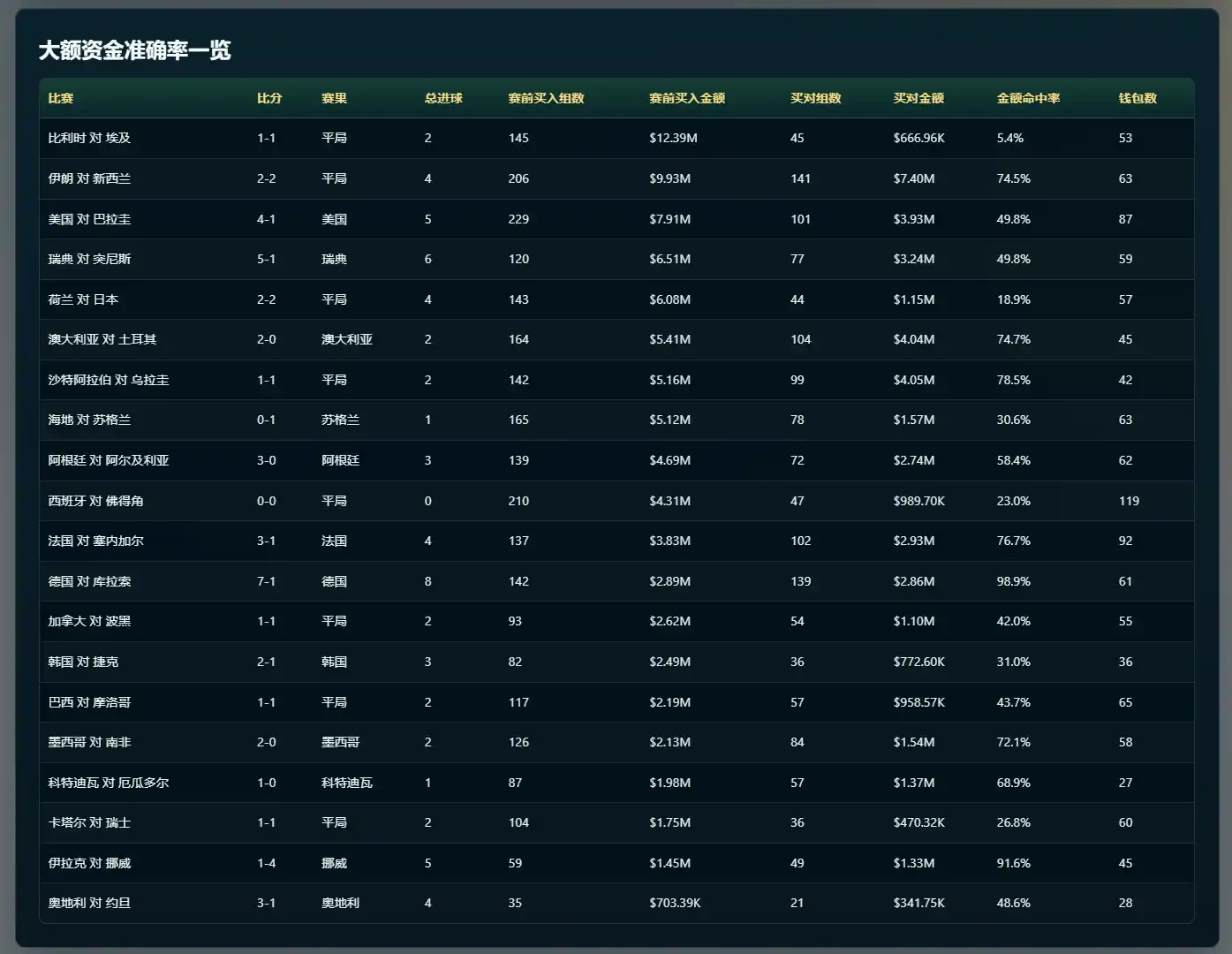
But the market isn't entirely inefficient. Germany vs. Curaçao is a sample of "correct consensus." Germany ultimately won 7-1, with a pre-match buy volume of $2,888,300 and a value-weighted hit rate of 98.9%. In Iraq vs. Norway, Norway won 4-1, with a pre-match buy volume of $1,446,400 and a hit rate of 91.6%. France vs. Senegal also achieved a hit rate of 76.7%. These cases illustrate that when the strength gap is sufficiently clear and the path to outcome is relatively singular, large capital can still reflect relatively high information efficiency in advance.
What is truly worth pondering is when the market is more efficient and when it is more easily led astray by sentiment. The greater the strength disparity, the more easily the price becomes a container for information; when the strength gap isn't large enough to cover the risk of a draw, the price may become an amplifier for popular narratives.
'Buy No' Continues to Outperform, but the Advantage is Narrowing
Looking at outcome shares, in the latest sample of 20 matches, "Buy No" still significantly outperforms "Buy Yes."
Among the 2,645 sets of pre-match buys, the amount buying "Yes" shares was $49,918,800, with a correct amount of $18,717,000, resulting in a value-weighted hit rate of 37.5%; the amount buying "No" shares was $39,627,000, with a correct amount of $24,733,400, achieving a value-weighted hit rate of 62.4%.
This gap remains very pronounced. It doesn't mean "always buy No" is a stable strategy, but rather indicates that within this sample, market pricing for popular outcomes may still be overly full. Once a match ends in a draw, the favorite fails to win, or the market overprices the probability of a particular team's victory, buying "No" shares offers greater margin for error.
Iran vs. New Zealand is one of the best examples. The match ended 2-2, with a pre-match buy volume of $9,928,200 and a value-weighted hit rate of 74.5%. Here, mintblade concentrated on buying "Iran Not to Win," with an aggregated cost of approximately $6,470,500 and an average price of around 0.49. Estimated based on holding until settlement, this position would yield approximately $13,244,300, a profit of about $6,773,800, with an ROI of 104.7%.
This isn't betting on an upset victory, but betting that "the favorite fails to deliver." In prediction markets, this type of trade is more intriguing than directly buying a draw. It doesn't require the trader to accurately predict a draw, only to judge that a particular popular outcome is overvalued. For a tournament environment like the World Cup, characterized by low scores and high randomness, this line of thinking often aligns more closely with the risk itself than betting on a single win/loss outcome.
However, the matches on June 17th also showed that the "Buy No" advantage is not immune to correction. After France, Norway, Argentina, and other favorites delivered as expected, the hit rate for buying "Yes" has increased from 28.8% in the previous sample to 37.5%. This indicates that prediction markets don't always punish favorites, but rather punish them when their prices are excessively full.
Some Made $6.77 Million Overnight, Others Lost $8 Million in One Match
When shifting the sample from the match level to the position level, the high-volatility nature of prediction markets becomes even more apparent.
In this statistical analysis, there were 1,278 aggregated pre-match buy positions, of which 694 were correct and 584 were wrong. The number of correct positions already exceeds incorrect ones, but due to the vast differences in position sizes, the final outcome still depends on the success or failure of a few large positions.
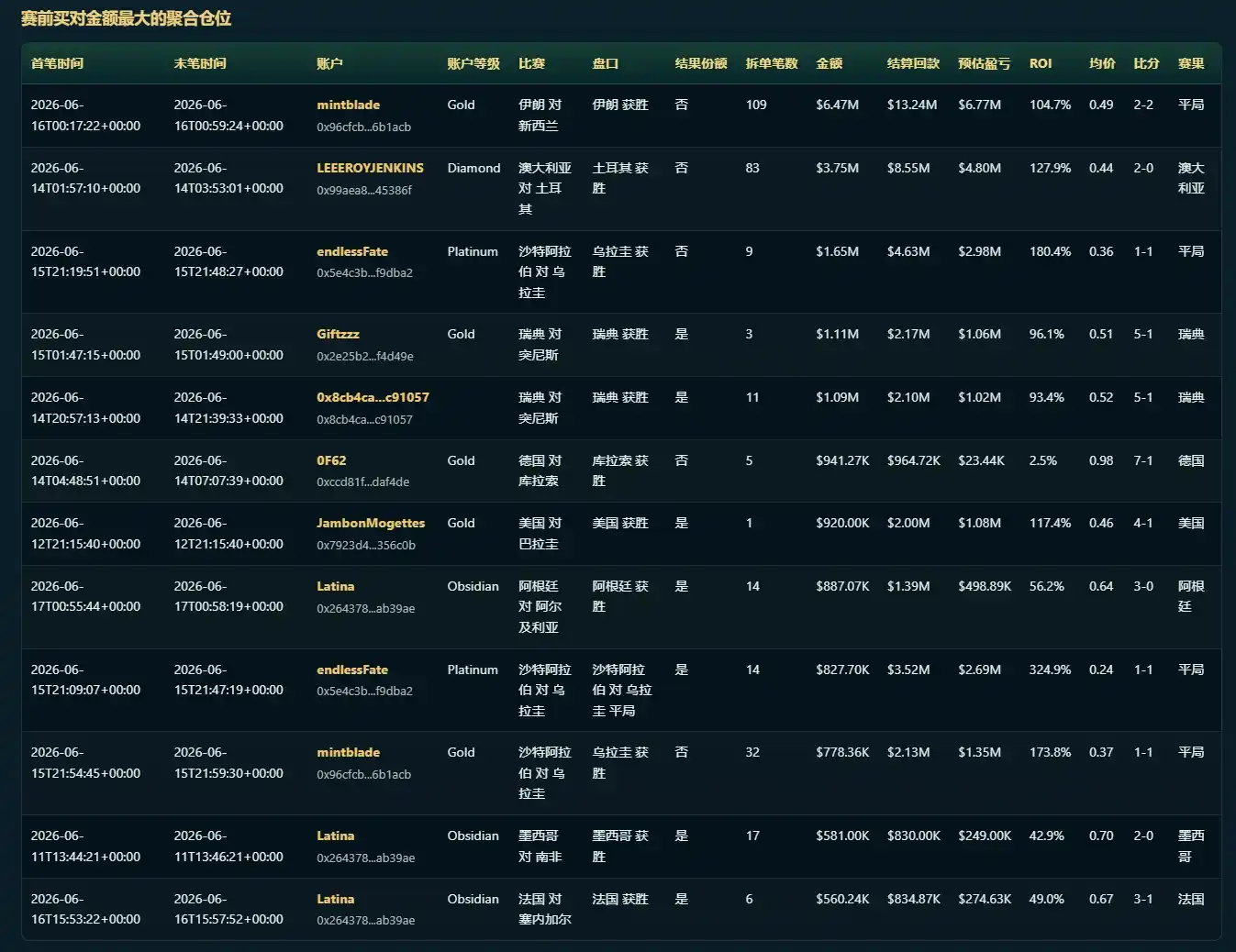
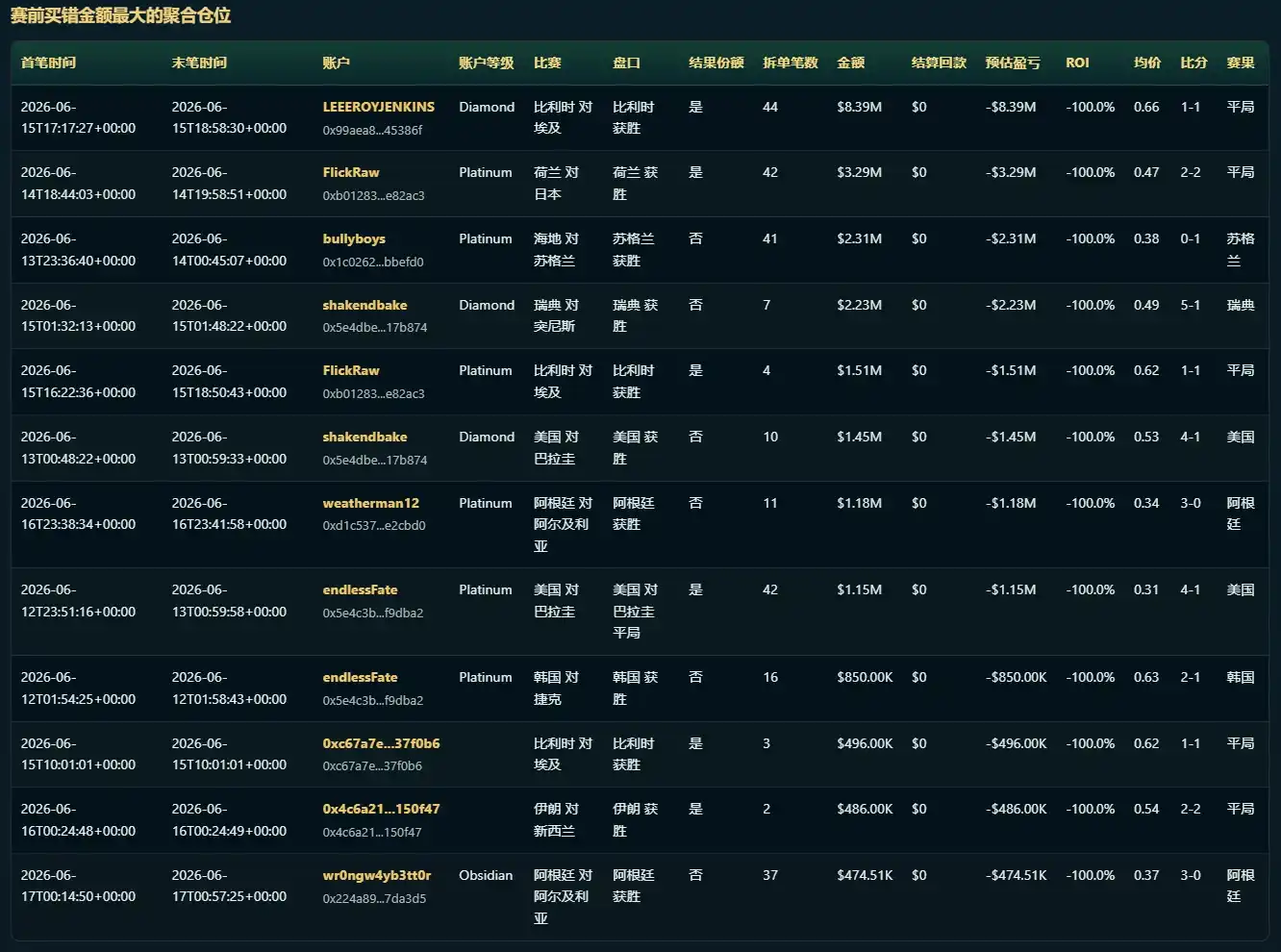
The biggest winning case comes from mintblade. This wallet bought "Iran Not to Win" in the Iran vs. New Zealand match. As mentioned earlier, its cost was approximately $6,470,500, with an estimated profit of $6,773,800.
The second-largest winning case comes from LEEEROYJENKINS, who bought "Turkey Not to Win" in the Australia vs. Turkey match, with a cost of approximately $3,751,100 and an average price of around 0.44. Australia ultimately won 2-0. If held until settlement, this position is estimated to yield a profit of $4,797,600, with an ROI of 127.9%. However, LEEEROYJENKINS also bought "Belgium to Win" in the Belgium vs. Egypt match, with a cost of approximately $8,394,300 and an average price of around 0.66. This position ultimately went to zero, estimated as a loss of $8,394,300. This turned the account's profit from $5 million directly to -$2.57 million, effectively wiping out gains overnight.
The 0-0 draw in Spain vs. Cape Verde also created a case of small cost and high return. fishalive bought "Spain Not to Win," with a cost of approximately $306,500 and an average price of only 0.09. Since the match ended in a draw, this position is estimated to yield a profit of approximately $3,157,200, with an ROI exceeding 1000%. The appeal of such trades is clear: when the market extremely believes the favorite will win, the price of the opposing shares becomes sufficiently low. Once the outcome deviates from the mainstream narrative, the profit elasticity becomes very large.
Latina bought "Argentina to Win" in the Argentina vs. Algeria match, with a cost of approximately $888,300. Argentina won 3-0, resulting in an estimated profit of about $499,300, with an ROI of 56.2%.
FlickRaw bought "Netherlands to Win" in Netherlands vs. Japan, costing $3,290,000. The match ended 2-2, and the position also went to zero. In the new sample, weatherman12 and wr0ngw4yb3tt0r both bought "Argentina Not to Win" in Argentina vs. Algeria, but Argentina won 3-0. Their related positions are estimated to have lost $1,175,900 and $471,600, respectively.
These cases collectively point to one fact: large capital in prediction markets resembles high-volatility information trading more than low-volatility arbitrage. When correct, low-priced shares can bring near-double or even multiple returns; when wrong, the binary settlement mechanism can cause the principal to go directly to zero.
Often, we see a wallet "winning a few million dollars on one match," but we don't see other equally large amounts of capital also going to zero in another match under the same market structure.
Wallets with Continuity Are More Worth Tracking Than Single-Match Whales
From a wallet dimension, those more worthy of long-term tracking are often wallets that cover multiple matches and exhibit continuity in their hits.
Sorted by pre-match buy amount, mintblade represents another extreme. This wallet's buy amount was $7,288,900, covering 2 matches, with a value-weighted hit rate of 100.0%. However, since it only covers 2 matches, the sample size remains small.
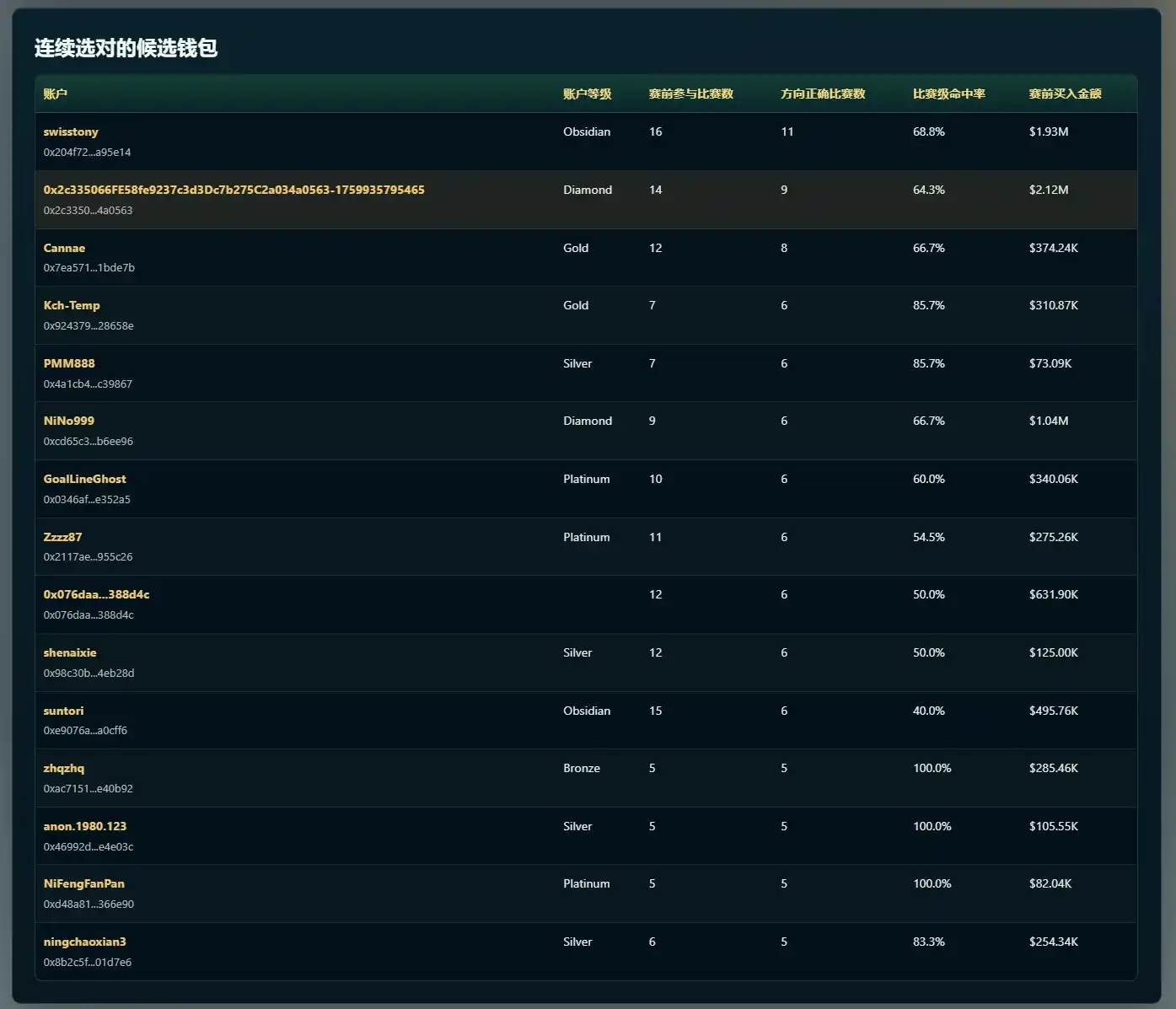
In contrast, swisstony holds more value for continuous observation. This wallet covers 16 matches, hitting on 11 at the match level, with a pre-match buy amount of $1,928,400 and a value-weighted hit rate of 73.3%. NiNo999 covers 9 matches with a value-weighted hit rate of 76.2%; Cannae covers 12 matches with a match-level hit rate of 66.7%. The per-transaction amounts of these wallets may not be the most astonishing, but because they cover more matches, their behavior is closer to an observable trading pattern.
The latest sample also shows some small-amount, high-continuity accounts. For example, zhqzhq, anon.1980.123, and NiFengFanPan all cover 5 matches and hit on all at the match level, but their buy amounts are approximately $290,000, $110,000, and $80,000, respectively. Whether such accounts hold sustained value requires more matches for verification.
The charm of the World Cup lies precisely in its unpredictability. In this capital experiment involving tens of millions of dollars, Polymarket did not become a crystal ball foreseeing the future; instead, it acted more like a mirror, clearly reflecting the crowd's frenzy, biases, and blind following of popular narratives.
The stumble and windfall of large capital once again verifies a simple truth: in the face of absolute uncertainty, no one can forever stand above the rules and probability. The true wisdom of so-called "smart money" lies not in possessing the superpower to see through the future, but in knowing how to find pricing deviations within uncertainty and always maintaining respect for risk.
PA Beacon has recently launched the World Cup Capital Watch, updated daily based on the latest large capital buying and selling activities. Interested readers can click to read the original article. A reminder again: the above content is compiled based on Polymarket trading data; amounts, hit rates, and profit/loss are estimated for analytical purposes and do not constitute betting or investment advice.