The Value Distribution of Stablecoins

链捕手2026-06-15 tarihinde yayınlandı2026-06-15 tarihinde güncellendi

Özet

The Value Distribution of Stablecoins The article argues that stablecoins are evolving from a mere trading tool into a broad "dollar channel." It analyzes the industry's value chain through four layers: 1. **Issuance Layer (e.g., Tether, Circle):** The top layer that mints stablecoins, holds reserve assets, and captures the thickest interest rate spread. 2. **Infrastructure Layer (e.g., Bridge, BVNK):** Connects stablecoins to the traditional financial system, handling critical but complex "dirty work" like fiat on/off-ramps, banking integration, compliance (KYC/AML), and cross-border settlement. 3. **Acquiring/Distribution Layer (e.g., Stripe, Coinbase):** Embeds stablecoins into merchant systems, manages payment flows, and integrates with enterprise software. 4. **Application Layer:** End-users and businesses that ultimately use stablecoins for payments, settlement, or storing value. The author posits that while the issuance layer currently captures the most profit, the most overlooked and potentially critical layer is infrastructure. The core challenge for stablecoin adoption isn't the on-chain transfer (which is simple), but bridging the gap between blockchain and the real-world financial system. This involves solving practical problems for businesses: fiat conversion, reconciliation, tax handling, and user onboarding. Infrastructure companies are currently in a difficult "land-grab" phase—building networks, securing banking relationships, and achieving compliance...

Author:@0xjiawei

Previous chapters discussed the broad trend: stablecoins are evolving from mere trading instruments into a generalized channel for US dollars.

This chapter examines how the stablecoin pie is divided.
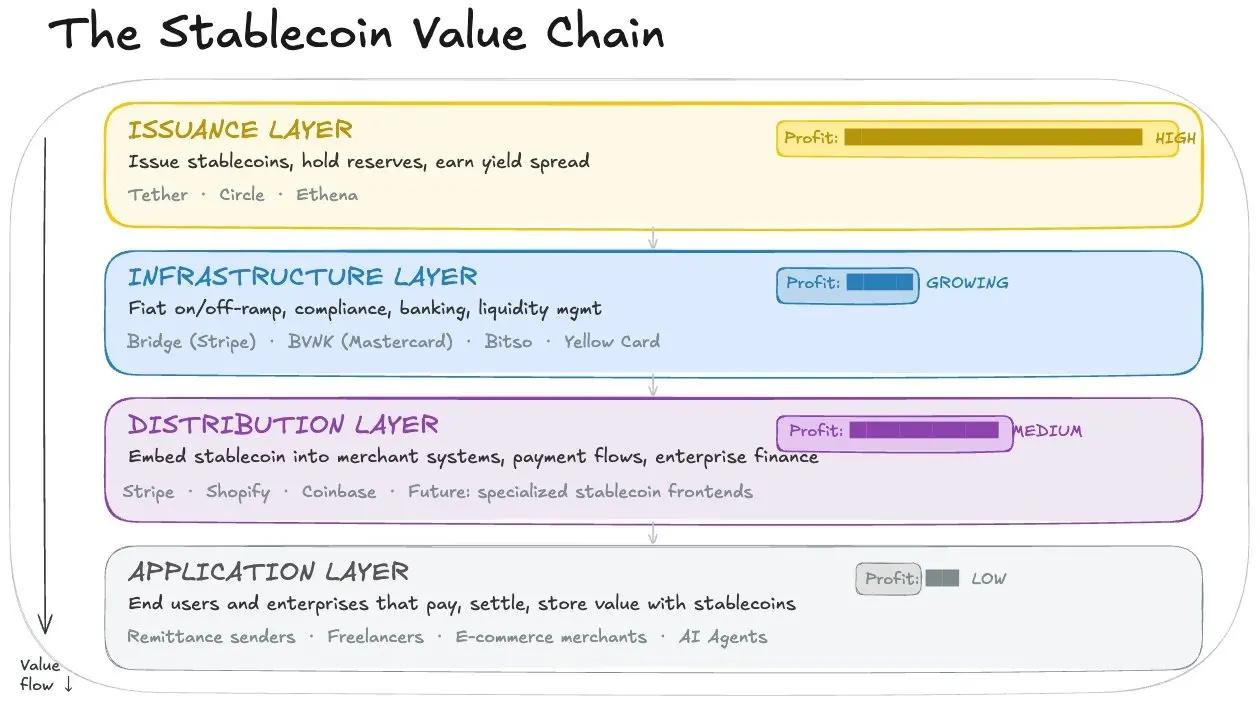
I categorize stablecoins into four layers:

  1. Issuance Layer: Mints stablecoins, holds reserve assets, earns the spread. Representatives: Tether and Circle;
  2. Infrastructure Layer: Connects stablecoins to the real-world financial system—fiat on/off ramps, bank integrations, asset management, compliance. Representatives: Bridge (acquired by Stripe), BVNK (acquired by Mastercard), Bitso, Yellow Card, etc.
  3. Acquiring/Distribution Layer: Embeds stablecoins into merchant systems, manages payment flows, enterprise financial software. Representatives: Stripe, Infini, Coinbase.
  4. Application Layer: End-users and businesses that use stablecoins for payments, settlement, and storage of value.

The Issuance Layer receives user funds and captures the thickest spread; the middle two layers profit from volume, distribution fees, and underlying infrastructure; the Application Layer enjoys convenience but has little bargaining power.

I believe the Infrastructure Layer is currently underappreciated.

It handles the "dirty work": integrating with banks, handling KYC/AML, processing local fiat on/off ramps, connecting merchants, APIs, card networks, and solving settlement and regulatory issues across different countries.

Conversely, this is also where its moat lies. Because technically, transferring USDC on-chain is not the hard part. The real difficulty is penetrating the real world—getting a Latin American company, an African payment provider, or an overseas platform to incorporate stablecoins into their daily cash flows. Someone has to do this dirty work.

The On-Chain Part is Easiest, the Bridge to Reality is Hardest

At first glance, stablecoin payments seem straightforward: fast on-chain transfers, low fees—isn't it just about distributing the product to users?

But the real challenge for stablecoins is the vast gap between the chain and the real-world financial system. Businesses have decision and migration costs; they won't switch their entire workflow just because they heard stablecoins settle in 1 second.

A series of questions arise: How to convert fiat to stablecoins? How to convert back? How to handle reconciliation and taxation? Will the bank block us later? Do users still need to learn how to use a wallet?

The core work of the Infrastructure Layer is bridging the two sides: connecting to the chain and wallets on one end, and to banks, local payment networks, enterprise systems, and compliance on the other.

Stripe's acquisition of Bridge in 2025 bought its stablecoin orchestration system—helping businesses integrate stablecoin capabilities into their operations. Mastercard's announced acquisition of BVNK in March 2026 had similar reasoning.

In other words, traditional payment companies are competing to become the default gateway for businesses using stablecoins.

The key to scaling stablecoin payments lies here.

Paving the Way

Looking further into the Infrastructure Layer:

  1. On/Off Ramps + Currency Exchange. Most business scenarios involve the process "local currency → stablecoin → local currency." This involves banking relationships, compliance, liquidity, and other issues.
  2. API + Account Layer. Businesses need a set of financial capabilities embedded into their workflows—account opening, payments, fund splitting, clearing, reconciliation. This is somewhat like financial SaaS, similar to the Neobank concept.
  3. Payment Network Connectivity. The more payment rails, banks, and regions connected, the more dependent clients become, gradually increasing switching costs.
  4. Capital Efficiency. Helping businesses reduce idle funds, waiting times, and FX losses.

I believe its characteristics dictate a path of initial hardship followed by reward.

  • Grunt Work: It requires connecting banks, achieving compliance, obtaining licenses, and building local teams country by country.
  • Front-loaded Investment to Capture Entry Points: Businesses won't easily switch their payment infrastructure. Those who first secure large clients, banking relationships, compliance pathways, and local fiat rails will later benefit from network effects. Currently, these companies are in a "land grab" phase, far from harvest time.
  • Squeezed by Upstream and Downstream: Upstream issuers take the spread first, while downstream platforms want to control the user interface. The infrastructure layer is in the middle, in an awkward position—"everyone needs you, but no one wants you to earn too much."

Currently, it is in the intermediate stage of moving toward "bargaining power formation."

If we only look at today, the Issuance Layer takes the largest profit, while the Infrastructure Layer is thinner and more capital-intensive.

But if we're talking about how to invest in stablecoins, the seigniorage logic of the Issuance Layer is already well understood by the market, with pricing increasingly revolving around interest rates, regulation, and profit sharing. The Infrastructure Layer is less noticeable today, often simply because it's still in the early investment phase. Bargaining power and user habits haven't fully solidified yet.

Once stablecoins further become the default rails for enterprise funds, the true beneficiaries will be those who, over the years, successfully bridged stablecoins into real-world commercial systems.


İlgili Sorular

QAccording to the article, how many layers is the stablecoin ecosystem divided into? Name them.

AThe stablecoin ecosystem is divided into four layers: 1. Issuance Layer, 2. Infrastructure Layer, 3. Acquirer/Distribution Layer, and 4. Application Layer.

QWhich layer does the author believe is currently undervalued or underappreciated, and why?

AThe author believes the Infrastructure Layer is currently undervalued. It's considered less glamorous because it involves difficult 'dirty work' like bank integration, KYC/AML, local fiat on/off-ramps, merchant onboarding, and solving cross-border regulatory issues. However, this complexity also creates its moat.

QWhat is the core challenge for enabling widespread stablecoin payment adoption, as described in the article?

AThe core challenge is bridging the gap between the blockchain and the real-world financial system. While moving tokens on-chain is technically simple, the real difficulty lies in integrating stablecoins into business workflows, handling fiat conversions, accounting, tax compliance, and overcoming enterprise decision and switching costs.

QWhat strategic moves by traditional payment companies (Stripe and Mastercard) does the article mention, and what is their goal?

AThe article mentions Stripe's acquisition of Bridge in 2025 and Mastercard's announcement to acquire BVNK in 2026. Their goal is to secure the role of becoming the default gateway/entry point for businesses wanting to integrate stablecoin capabilities into their operations.

QWhat are the three key characteristics of the Infrastructure Layer that make it a 'first bitter, then sweet' business?

A1. It involves hard 'dirty work' requiring country-by-country bank integrations, compliance, licensing, and local team building. 2. It requires significant upfront investment to capture market entry points (clients, banking relationships, compliance paths) before network effects can develop. 3. It is squeezed between the profitable upstream Issuance Layer and the downstream platforms that want to control user access, making its position initially precarious.

İlgili Okumalar

The Value Distribution of Stablecoins

**Summary: The Value Distribution of Stablecoins** The article argues that stablecoins are evolving from mere trading tools into broader channels for dollar access. It divides the stablecoin ecosystem into four layers to analyze how value is distributed: 1. **Issuance Layer:** Mints stablecoins, holds reserve assets, and captures the spread between reserve yield and user costs (e.g., Tether, Circle). This layer currently earns the largest profit margin. 2. **Infrastructure Layer:** Connects stablecoins to the traditional financial system, handling fiat on/off-ramps, banking integration, compliance (KYC/AML), and asset management (e.g., Bridge, BVNK). This is the "unglamorous" but critical work, building the essential bridges between crypto and real-world finance. 3. **Acquiring/Distribution Layer:** Integrates stablecoins into merchant systems, manages payment flows, and provides enterprise financial software (e.g., Stripe, Coinbase). They act as the access point for businesses. 4. **Application Layer:** The end-users and businesses that ultimately use stablecoins for payments, settlements, or as a store of value. They benefit from convenience but have little pricing power. The core thesis is that while the issuance layer currently dominates profits, the often-overlooked **infrastructure layer holds significant long-term potential**. The real challenge and barrier to mass adoption is not the on-chain transfer of stablecoins (which is simple), but the complex "last mile" integration into existing business workflows, banking systems, and regulatory frameworks across different countries. Companies in this layer are currently in a "land grab" phase, investing heavily to build networks, secure bank partnerships, and establish compliance pathways. While their position is currently pressured by the profitable issuers above and distribution platforms below, the article suggests that if stablecoins become a default financial rail for businesses, the infrastructure providers who have done the hard work of integration will ultimately gain strong pricing power and become entrenched, essential players.

marsbit1 saat önce

The Value Distribution of Stablecoins

marsbit1 saat önce

How to Do Research Well: Deliberately Practice the Real Skills That Matter

No one truly teaches you how to do research. You're often given a desk, a pre-selected problem, and vague instructions to "create something new." Consequently, many people reverse-engineer the job based on visible outputs—papers, posts, announcements—learning only how to *appear* like a researcher rather than how to *become* one. True research capability is built from stacking small, trainable skills, nearly all of which can be developed through deliberate practice. **Pick Your Own Problem:** Most researchers absorb problems from advisors or trends, lacking the underlying reasoning. Choosing a problem you genuinely care about, as John Schulman advises, leads to original work. Develop "taste" like a muscle: predict experiment outcomes, guess paper results from methods, and track which findings remain important over time. **Upgrade Your Inputs:** Relying on shared reading lists (arXiv hot lists, filtered group chats) leads to unoriginal conclusions. Undervalued old literature often holds crucial insights (e.g., MoE, LSTM, backpropagation). Richard Sutton's "The Bitter Lesson" or Claude Shannon's 1952 talk on creative thinking are more predictive than lengthy modern surveys. Breadth matters as much as depth: draw from neuroscience, mechanism design, hardware knowledge, and honest statistics. Read papers directly, especially appendices and limitations sections. **Write Everything Down:** As Paul Graham noted, writing exposes flaws in seemingly mature ideas. Writing is the cheapest defense against self-deception. Following Feynman's principle, Darwin programmatically wrote down facts contradicting his theory to combat memory bias. Maintain a detailed log of hypotheses, setups, predictions, results, and updated understandings. Reviewing past logs fosters essential humility.

marsbit3 saat önce

How to Do Research Well: Deliberately Practice the Real Skills That Matter

marsbit3 saat önce

İşlemler

Spot
Futures
活动图片