Backpack Surges Over 150% in Half a Month

marsbit2026-06-15 tarihinde yayınlandı2026-06-15 tarihinde güncellendi

Özet

BP, the token of the Backpack exchange, has surged over 150% since early June, driven by the platform's expansion into regulated US stock brokerage and asset tokenization services. On June 2nd, Backpack announced Backpack Securities, offering traditional stock trading and tokenization, causing BP's price to jump over 80%. Momentum continued on June 12th with the launch of SPCX, a tokenized product for SpaceX stock on Solana, facilitating seamless conversion between traditional securities and on-chain assets. This aligns with the RWA (Real World Assets) narrative, creating a bridge between traditional finance and Solana DeFi. The token's unique economics also support its growth. All 2.5 billion initially circulating tokens were airdropped to the community, with zero allocation to the team or investors at launch. A key feature allows users who stake BP for at least one year to gain the right to convert tokens into company equity upon an IPO or acquisition. Despite some initial community controversy over airdrop distribution, focus is shifting to BP's long-term utility and value alignment as real products launch.

Author: Ma He, Foresight News

On June 15, the Backpack exchange token BP surged over 30% again within 24 hours, currently quoted at $0.475 with a market cap of $118.48 million and a fully diluted valuation (FDV) of $473.94 million. Since early June this year, BP has skyrocketed from around $0.16, breaking through a high of $0.48.
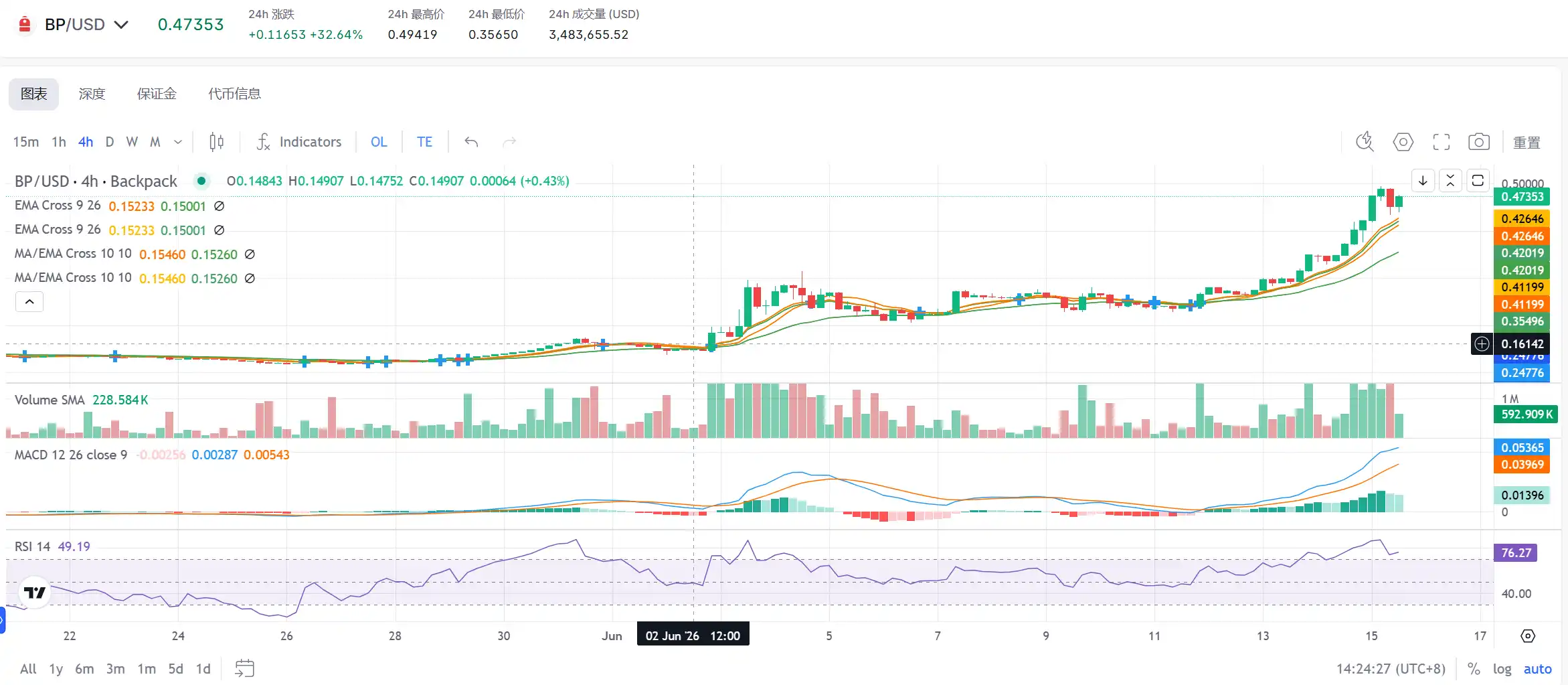
The direct catalyst for this market surge stems from the platform's latest breakthroughs in traditional U.S. stock brokerage and asset tokenization services.

Venturing into U.S. Stock Brokerage and Tokenization Business

In March 2026, BP completed its Token Generation Event (TGE) on Solana with a total supply of 1 billion tokens and an initial circulating supply of 250 million. After listing, the token price briefly touched a high point before rapidly declining, with a single-day drop exceeding 40% at its worst, as the market was once filled with profit-taking pressure. For several weeks thereafter, the price consolidated at lower levels until a turning point emerged in early June.

On June 2, Backpack announced the launch of the Backpack Securities platform, which will provide regulated U.S. stock brokerage services while also supporting the tokenization of traditional stocks for circulation on the blockchain, enabling seamless conversion between traditional securities and on-chain assets. The brokerage service is planned to launch gradually in June, with initial tokenized products rolled out in the Solana ecosystem through a partnership with Sunrise. BP skyrocketed over 80% in a single day, rapidly climbing from the $0.14-$0.15 range to around $0.27, with its market cap approaching $70 million at one point.

On June 12, coinciding with SpaceX's listing on NASDAQ, its tokenized product SPCX launched on Solana. In the subsequent 24 hours, BP rose approximately 27% further, pushing its price above $0.347. This token is pegged 1:1 to real SpaceX shares, supports 24/7 on-chain trading, and can be redeemed through a Backpack brokerage account into a traditional securities account, achieving interoperability between on-chain and off-chain assets. On its first day of launch, the product generated around $35-38 million in on-chain trading volume across DEXs like Jupiter and Raydium. According to the latest official data, the total on-chain SPCX trading volume exceeds $86 million.
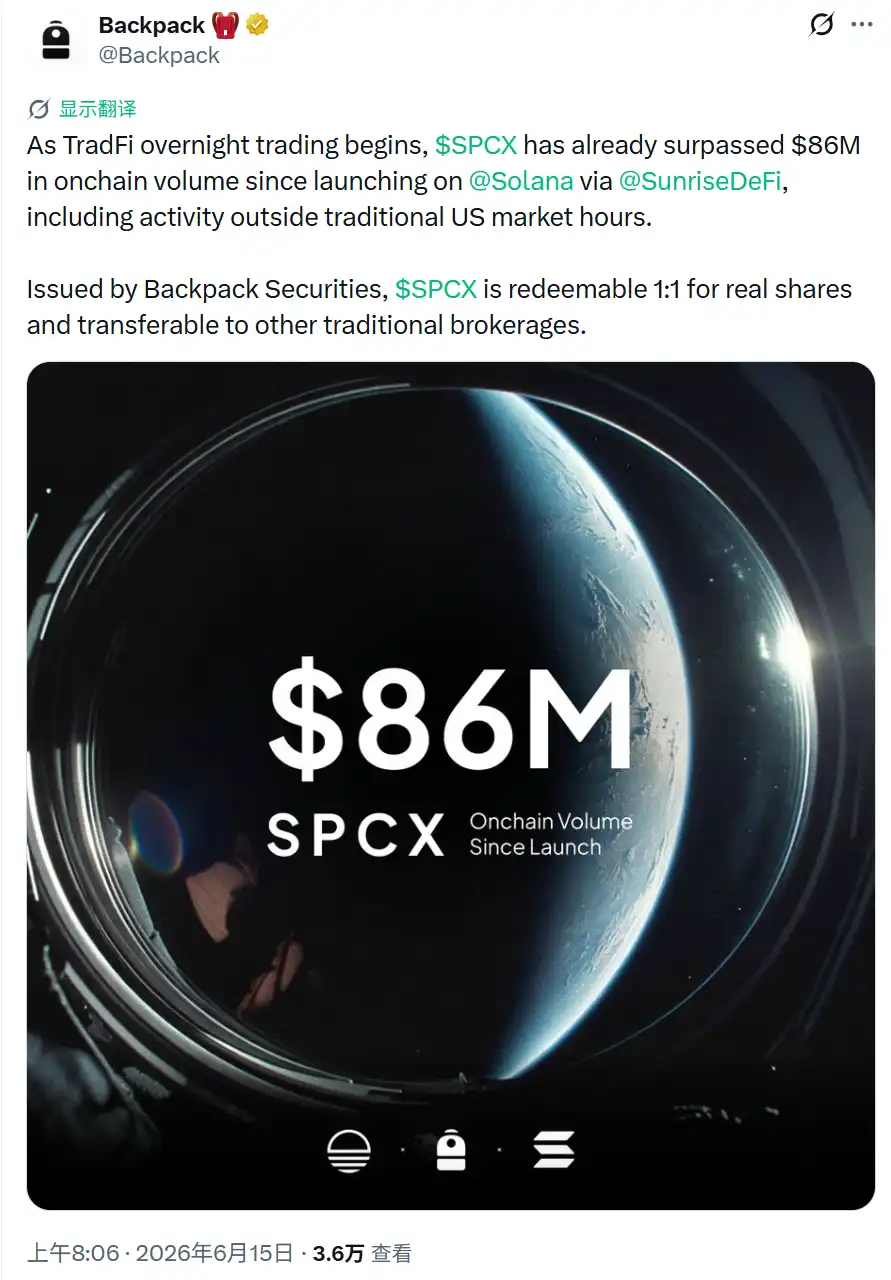
Backpack is building a bridge between traditional U.S. stocks and Solana DeFi. Users can not only trade crypto assets within the platform but also access real stocks through the same account and tokenize portions of their assets for use, trading, or composition on-chain. This pathway aligns highly with the current RWA (Real World Assets) narrative and provides the BP token with clearer use cases and demand support.

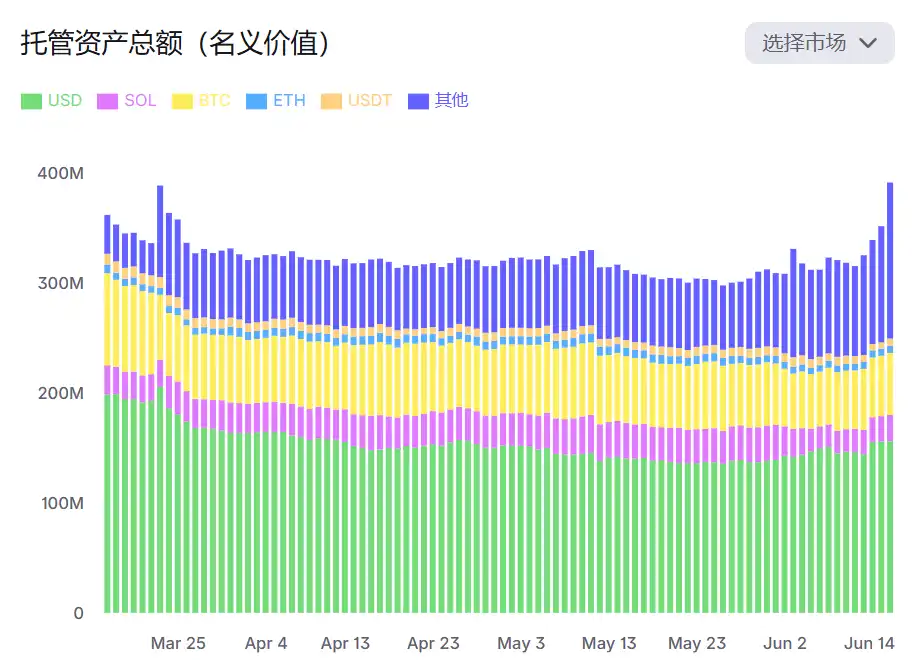
BP's recent surge stems more from substantial platform business expansion than short-term speculation. Currently, its official website shows that Backpack's total custodied assets (nominal value) have rebounded to $390 million.
No Tokens for the Team Unless the Company Goes Public

Supporting the above business development is the BP token and its unique economic structure launched as early as March. The total supply of 1 billion tokens is divided into three phases: 25% (250 million) at TGE was entirely airdropped to community users, with approximately 240 million allocated to participants in the points program and 10 million to Mad Lads NFT holders. At launch, the team, founders, and investors received 0 token allocation; 37.5% in the Pre-IPO phase is tied to growth triggers such as regulatory milestones and product launches, continuing to be distributed to users upon unlocking; 37.5% in the Post-IPO phase enters the company treasury, locked for at least one year after an IPO, with the team benefiting only through equity, not directly through tokens.
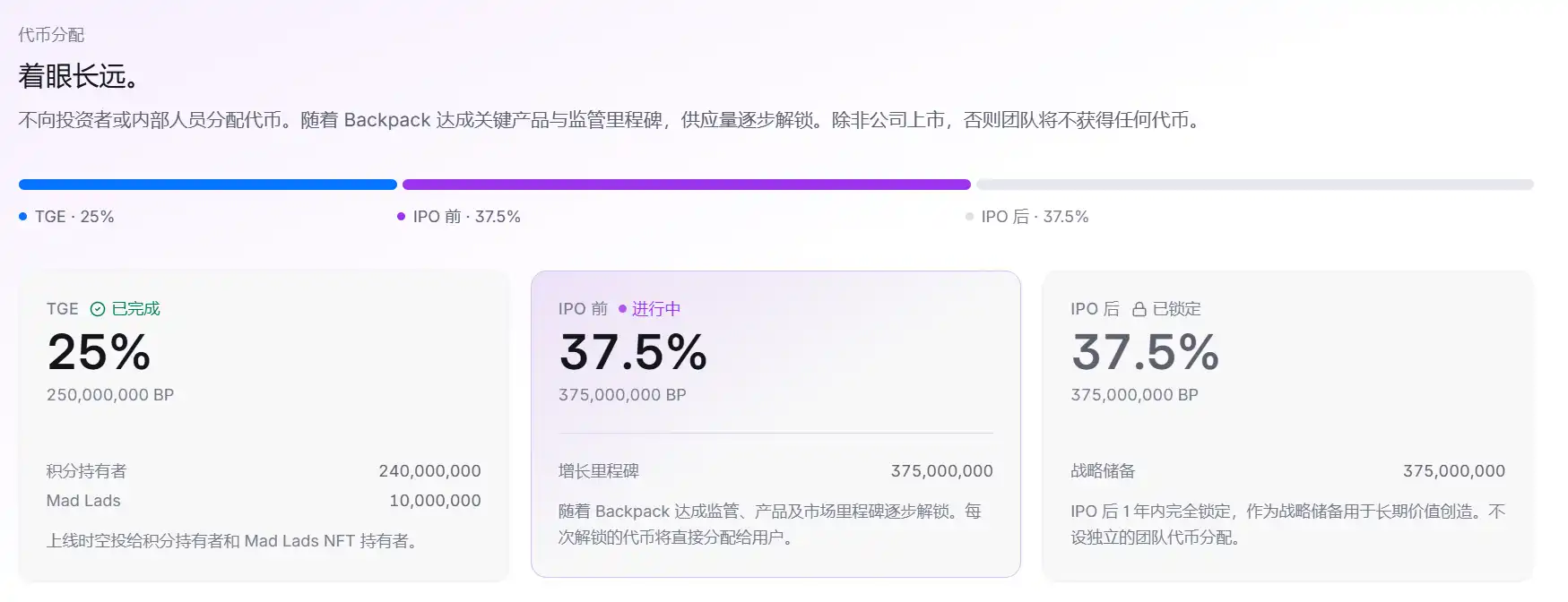
The most attention-grabbing mechanism is the equity conversion design: users who stake BP for at least 1 year gain the right to convert their tokens into company equity upon an IPO or acquisition, with the bonus increasing with holding time up to the 4th year based on the initial unlock.

Additionally, staking provides benefits such as tiered trading fee discounts, extra yield on USD collateral, free wire transfers, and priority access to the Backpack Card. Currently, about 66% (approximately 165 million) of the circulating supply is staked.

While the airdrop process was technically smooth, it also sparked community discussion. Supporters argue that the "no insider TGE allocation" model is quite radical, and the points system genuinely rewarded trading and ecosystem participation. Criticism focused on the relatively strict Sybil filtering mechanism, which led to some long-term users having their points removed, resulting in lower-than-expected allocations, as well as noticeable profit-taking during the post-listing price correction. CEO Armani Ferrante publicly denied allegations of team OTC sales.

These controversies temporarily affected market sentiment, but as tangible products like Backpack Securities were launched, the focus is gradually shifting from allocation details to the platform's long-term growth and the token's actual utility. Against the backdrop of the platform's expansion into U.S. stock brokerage and tokenization services, the long-term alignment value of BP's staking and equity mechanisms is being reevaluated.

İlgili Sorular

QWhat is the key factor driving the recent sharp increase in the price of Backpack's BP token?

AThe key driver is Backpack's expansion into traditional U.S. stock brokerage and asset tokenization services through its new Backpack Securities platform, starting with the tokenized SpaceX (SPCX) offering on Solana.

QWhat is the unique feature of BP's tokenomics regarding team and investor allocation?

AAt TGE, 0 tokens were allocated to the team, founders, or investors. 100% of the initial circulating supply (25% of total) was airdropped to the community. Team members can only benefit through company equity (via a token conversion option post-IPO), not through direct token holdings.

QWhat significant milestone for Backpack occurred on June 12 alongside SpaceX's NASDAQ IPO?

AOn June 12, the tokenized product for SpaceX, SPCX, was launched on Solana. It is a 1:1 tokenized representation of real SpaceX stock, facilitating 24/7 on-chain trading.

QWhat major benefit can BP stakers obtain, and what percentage of the circulating supply is currently staked?

AStakers who lock BP for at least one year gain the right to convert their tokens into company equity upon an IPO or acquisition. Currently, approximately 66% (about 165 million) of the circulating supply is staked.

QWhat criticism did the BP token airdrop face from parts of the community?

ACriticism focused on the Sybil filtering mechanism being overly strict, which led to some long-term users having their points invalidated and receiving fewer tokens than expected. There were also accusations of team OTC selling, which the CEO denied.

İlgili Okumalar

The 'Side Hustle Survival' of DAT Companies: After the Accumulation Flywheel Stops, They Begin Self-Rescue

"Metaplanet's 'Side Hustle Survival': After the 'Crypto Hoarding Flywheel' Stops, They Begin Self-Rescue" The article discusses the strategic pivot of Digital Asset Treasury (DAT) companies as the once-lucrative model of hoarding cryptocurrencies, pioneered by MicroStrategy, faces challenges. With the crypto bear market and the rise of ETFs offering direct, low-premium exposure, many DAT firms are abandoning the passive treasury model. Prominent examples include ETHZilla, which sold ETH to repay debt and shifted to RWA tokenization, and others like Prenetics Global exiting completely. Facing stalled growth, remaining companies are pursuing two main survival paths. The first path is transforming into institutional crypto asset management platforms and yield funds. SharpLink Gaming exemplifies this by staking 100% of its ETH and partnering with Galaxy Digital to launch a yield fund. GameSquare is taking a more aggressive approach, using AI-driven algorithms across DeFi protocols to seek higher returns. The second path involves becoming blockchain infrastructure operators, particularly in the Solana ecosystem. Companies like DeFi Development and SOL Strategies are moving beyond holding SOL to operating validator networks and launching liquid staking tokens, building fee-based revenue models from ecosystem participation. The article notes these transitions reflect a broader industry maturation, shifting from financial engineering to building operational moats through technology, network effects, and deep ecosystem integration. However, risks remain, including DeFi protocol vulnerabilities and dependence on specific blockchain networks' health. Ultimately, this collective shift signals that in crypto, sustainable value comes not from capital games but from active participation, cash flow generation, and providing real utility—a necessary, if painful, step towards industry maturity.

marsbit2 dk önce

The 'Side Hustle Survival' of DAT Companies: After the Accumulation Flywheel Stops, They Begin Self-Rescue

marsbit2 dk önce

Annual Revenue of 13 Billion, Paying 17.2 Billion to Microsoft: The Truth Behind AI's Money-Burning in OpenAI's Leaked Ledger

Leaked OpenAI financial documents from June 2026 revealed that in 2025, the company achieved $13.07 billion in revenue, a 253% growth from 2024. However, this was accompanied by an operational loss of $20.92 billion and a net loss of roughly $8 billion. Despite ChatGPT surpassing 900 million weekly active users, the "burn rate" remained high: for every $1 earned, $1.60 was spent. The cost structure shows $34 billion in total costs. R&D was the largest expense at $19.18 billion, which included $10.59 billion paid to Microsoft. Compute costs for model inference were $7.5 billion, with sales and marketing at $5.73 billion. Notably, total payments to Microsoft reached $17.2 billion, accounting for over 50% of OpenAI's total costs and exceeding its annual revenue, highlighting a significant structural burden. This high-cost, high-loss model is an industry-wide trend. xAI reported a 2025 operational loss of $6.4 billion against $3.2 billion in revenue, spending $3 for every $1 earned. Anthropic, with a reported $90 billion annualized revenue by late 2025, also faced pressure with a 40% gross margin, lower than expected due to high inference costs. Combined, these top three firms' operational losses surpassed $30 billion in 2025. OpenAI's vast user base presents a monetization challenge. With only about 50 million of its 900 million weekly users paying (a ~5.6% conversion rate), the compute cost of serving free users is substantial. This contrasts with strategies like Anthropic's, which focuses on premium pricing for enterprise clients. The industry's path to profitability hinges on dramatically reducing marginal costs, particularly for inference, through innovations in specialized chips or model efficiency. Until then, massive capital inflows—like OpenAI's $122 billion funding round in March 2026—remain essential to fund the relentless pursuit of scale and advanced capabilities.

marsbit13 dk önce

Annual Revenue of 13 Billion, Paying 17.2 Billion to Microsoft: The Truth Behind AI's Money-Burning in OpenAI's Leaked Ledger

marsbit13 dk önce

Dalio's Key Long-Read: How to Position in the Current Market Environment?

Ray Dalio's latest article provides a strategic framework for navigating the current investment landscape, characterized by a market heavily concentrated in AI and other revolutionary new technologies. He argues that investors should view their decisions like moves in a game (e.g., chess, poker), assessing the current "board" shaped by key forces: the AI-driven industry cycle, debt/money, politics, geopolitics, and nature. He warns that such technology-driven periods naturally involve high excitement, volatility, and uncertainty, with historical precedents showing most investors fail by concentrating bets on a few leading companies. The core choice is whether to (a) overweight the new tech sector, (b) match index weightings, or (c) diversify away from this concentration. Dalio strongly advocates for (c) – embracing diversification. He emphasizes that large, new tech companies face inherent risks: over/under-investment, external shocks, future disruption, and intense geopolitical competition (notably from China). His guiding principle is the "holy grail" of investing: a well-engineered portfolio of 15+ high-quality, uncorrelated, and risk-balanced bets. Mathematically, this significantly improves the risk-return ratio compared to any concentrated position. Given the current environment's high uncertainty and concentration, he believes no one can reliably predict outcomes to justify large, concentrated bets. Dalio also expresses a tactical view that future equity returns appear low, with his metrics suggesting potentially negative real returns over 5-10 years. He cautions against conflating excitement about a technology with the attractiveness of its stocks. The key takeaway is that investors should acknowledge the limits of their knowledge, avoid forced opinions, and prioritize a strategically diversified portfolio over risky, correlated concentrated bets.

marsbit55 dk önce

Dalio's Key Long-Read: How to Position in the Current Market Environment?

marsbit55 dk önce

İşlemler

Spot
Futures
活动图片