Key Takeaways
- The Department of Justice has issued a crypto warning as Valentine’s Day hits.
- Real-world losses are escalating.
- Crypto scam activity surged in 2025.
U.S. federal prosecutors are warning Americans not to let Valentine’s Day turn into a costly heartbreak, as romance scammers increasingly demand payment in cryptocurrency.
The U.S. Attorney’s Office for the Northern District of Ohio on Thursday urged the public to remain vigilant against online crypto romance scams that exploit victims’ trust and emotions.
ChangeNow
Bitunix
Bitget

















































































































































DOJ Flags Valentine’s Day Crypto Warning
Federal prosecutors said fraudsters typically approach victims on dating websites, social media platforms, and messaging apps, posing as romantic partners.
In a stark warning , titled “Cupid Doesn’t Ask for Crypto,” the DOJ explained how bad actors cultivate relationships over weeks or months before fabricating emergencies, travel needs, or medical crises.
Among the clearest warning signs, according to the Justice Department, are requests for payment in crypto, gift cards, or wire transfers, methods favored by scammers because they are hard to reverse.
The office said scammers frequently create fake profiles using stolen photos, claim to work overseas in the military or international business, and profess deep affection quickly.
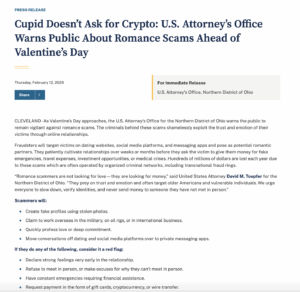
They often move conversations off mainstream dating platforms to private messaging apps and avoid meeting in person.
“Romance scammers are not looking for love — they are looking for money,” said U.S. Attorney David M. Toepfer for the Northern District of Ohio.
Adding: “They prey on trust and emotion and often target older Americans and vulnerable individuals. We urge everyone to slow down, verify identities, and never send money to someone they have not met in person.”
Regional Cases Underscore Growing Threat
Victims are advised to conduct reverse image searches of profile photos, consult trusted friends before sending funds, and report suspicious activity to the FBI’s Internet Crime Complaint Center (IC3).
In the report, authorities cited recent regional cases, including a Ghanaian national charged in an alleged scheme that took more than $8 million from elderly victims.
Last September, a Colorado man was also reported to have lost $1.4 million after falling victim to a crypto-linked romance scam.
The man, who first spoke to 9News , said he met a woman on Ashley Madison, a website marketed to married people seeking affairs.
After weeks of video chatting and exchanging photos, their conversations shifted to the woman’s interest in crypto and her view of it as a good opportunity for him.
Over roughly six weeks, the man said he made four separate cryptocurrency transfers, ultimately losing $1.4 million in retirement funds and life savings.
Crypto Scams Surge in 2025
The warning comes amid a broader surge in cryptocurrency-related fraud.
Blockchain analytics firm Chainalysis said in its 2026 report that crypto scams received at least $14 billion in on-chain funds last year, up sharply from initial 2024 estimates of $9.9 billion.
Based on historical trends, the firm projected that the 2025 total could exceed $17 billion as more illicit wallets are identified.
The average scam payment rose to $2,764 in 2025 from $782 in 2024, a 253% year-on-year increase, according to Chainalysis.
Impersonation scams, also known as Pig Butchering scams, recorded a 1,400% surge in inflows compared with the previous year.