A New Red Line for Crypto? Washington Targets On‑Chain “Death Bets” In Prediction Markets

bitcoinist2026-03-11 tarihinde yayınlandı2026-03-11 tarihinde güncellendi

Özet

A new U.S. bill called the DEATH BETS Act, introduced by Senator Adam Schiff and Representative Mike Levin, aims to explicitly ban prediction market contracts related to terrorism, assassination, war, or an individual’s death on CFTC-regulated platforms. The legislation responds to concerns over platforms like Kalshi and Polymarket offering contracts tied to events such as assassinations, military actions, or political removals. Critics argue these markets allow unethical profiting from real-world violence and human suffering. If passed, the law would push such trading to unregulated offshore platforms while allowing conventional prediction markets (e.g., elections or economic data) to continue. The move signals broader regulatory scrutiny over what crypto-based prediction markets can offer.

A Democratic U.S. Senator from California is introducing new legislation targeting crypto‐driven prediction markets

An Act Against Death

On March 10, Democrat U.S. Senator Adam Schiff (California) and Representative Mike Levin (CA-49) introduced the DEATH BETS Act, a bill aimed explicitly at banning prediction market contracts tied to terrorism, assassination, war or an individual’s death on any platform registered in the Commodity Futures Trading Commission (CTFC). This includes regulated venues like Kalshi or Polymarket’s newly U.S. licensed arm, plus other designated contract markets (DCM) that list event contracts via brokers.

The current law, the Commodity Exchange Act, gives authority to the CFTC to bar contracts tied to terrorism, war or assassination if they are deemed to be “contrary to the public interest”. Schiff’s proposed bill would revoke such flexibility: the senator argues that the agency has too much discretion as it rewrites prediction‐market rules under Chair Mike Selig:

At a time when CFTC Chair Selig has indicated that he will rewrite the rules on prediction markets, the CFTC can no longer be granted this discretion. The DEATH BETS Act will unequivocally ban these contracts.

The DEATH BETS Act And The Crypto World

The proposed bill follows the Senate Democrats pressure to the CFTC to “halt prediction contracts that involve betting on physical injury, death or war”, as stated on a letter sent to Chair Michael Selig in February 23. The letter specifically quotes Polymarket’s on-chain “dangerous prediction contracts” on whether the Artemis II would explode, if Venezuela’s former regime head Nicolás Maduro would be removed from power and if Ukraine’s Myrnohad would be captured by Russian forces.

“The Wild West”

In Senator Schiff’s words, the prediction markets have turned into “the Wild West”:

There is no justification for gambling on lives, or public benefit to be derived by such a market. With regulators turning a blind eye, prediction markets have rapidly become the Wild West.

Now, the Iran war episode takes the spotlight, as the Senator’s office highlights that a bet on whether Iran’s Ali Khamenei would be “out as Supreme Leader” had $54 million in trading volume on Kalshi before it was paused. There are hundreds of millions in Iran‐related bets, with a reported 10 wallets making over $1.2–1.4 million in profit right before U.S. strikes.

Rep. Levin stressed the importance of not letting “someone make money off the outbreak of war or the deaths of American service members”.

We already saw what that looks like: over half a billion dollars was wagered on the timing of U.S. military strikes on Iran alone. That is unacceptable, and this legislation puts a stop to it.

What The DEATH BET Act Means For Traders

Under the DEATH BET Act, CFTC‐supervised platforms will likely become safer but more limited, while riskier war/death flows are pushed further into offshore or permissionless crypto venues, where legal and reputational risks spike. Bets on elections, inflation points and macro data will continue to be safe game, but Washington aims to draw the line on banally “gambling” with the lives of real people.

The DEATH BET Act isn’t a ban on crypto prediction markets, but it is a signal that the next regulatory battles in crypto won’t just be over Bitcoin or ETFs: they’ll be over what the industry considers acceptable to let people bet on.
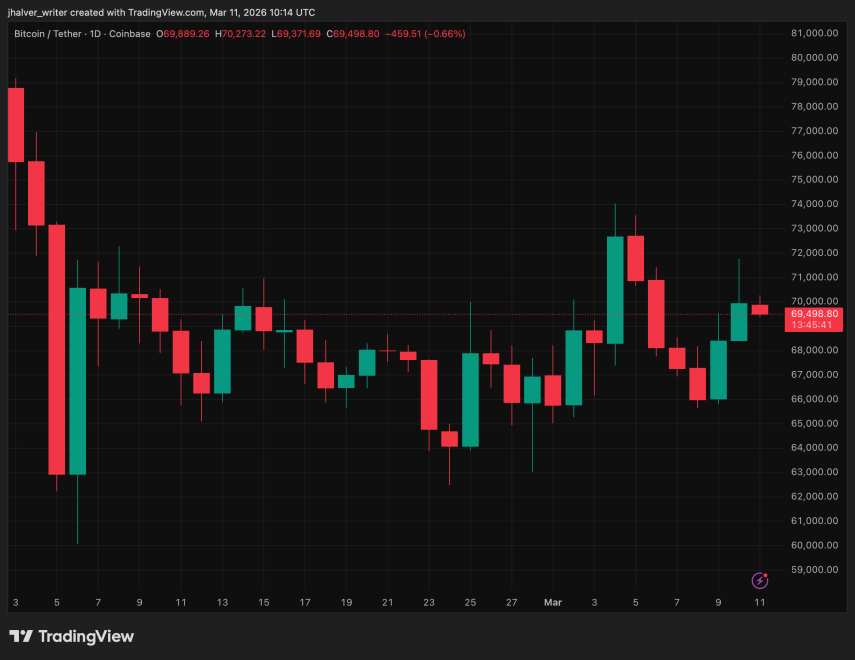
BTC’s price trends to the downside on the daily chart. Source: BTCUSDT on Tradingview

Cover image from Perplexity, BTCUSDT chart from Tradingview

İlgili Sorular

QWhat is the main purpose of the DEATH BETS Act introduced by Senator Schiff?

AThe DEATH BETS Act aims to explicitly ban prediction market contracts tied to terrorism, assassination, war, or an individual's death on any platform registered with the CFTC.

QWhich specific examples of prediction contracts did Senate Democrats cite in their letter to CFTC Chair Michael Selig?

AThe letter cited Polymarket's on-chain contracts on whether the Artemis II would explode, if Venezuela's Nicolás Maduro would be removed from power, and if Ukraine's Myrnohad would be captured by Russian forces.

QHow does Senator Schiff characterize the current state of prediction markets in his statement?

ASenator Schiff characterized prediction markets as 'the Wild West' where regulators have been turning a blind eye to gambling on lives.

QWhat significant trading activity was mentioned regarding Iran-related prediction markets?

AA bet on whether Iran's Ali Khamenei would be 'out as Supreme Leader' had $54 million in trading volume on Kalshi before being paused, with reported profits of $1.2-1.4 million for some traders before U.S. strikes.

QWhat will be the practical effect of the DEATH BET Act on trading platforms according to the article?

ACFTC-supervised platforms will become safer but more limited, while riskier war/death betting will be pushed to offshore or permissionless crypto venues, increasing legal and reputational risks there.

İlgili Okumalar

The Migration of Settlement Power: B18 and the Institutional Starting Point of On-Chain Banking

The article "The Migration of Settlement Power: B18 and the Institutional Starting Point of On-Chain Banking" discusses how traditional finance relies on settlement—not just transactions—to determine ownership of funds. While transactions are instantaneous, settlement requires time, counterparties, and system confirmation, during which users do not fully control their funds. In contrast, early DeFi (decentralized finance) focused on trading and liquidity while avoiding the fundamental question of who defines settlement in the absence of banks. B18, built on Coinbase’s on-chain infrastructure and operating on Base, aims to address this gap by transforming blockchain into a system that handles time, accounting, clearing order, and finality—functions traditionally managed by banks. B18 is not a typical DeFi protocol but an attempt to decouple banking from institutions and encode it into executable rules. Its capital structure reflects this ambition, with support from Paradigm and Wintermute Ventures at the protocol level, GSR Capital for market liquidity, FuturePay for real-world payment integration, and Base Ecosystem Fund builders who design the rules for fund recording, profit recognition, and liquidation conditions. Together, these layers form a new on-chain financial order where code, not institutions, governs settlement—shifting the power dynamics of finance. B18 represents the starting point of this migration. (Note: This is a submitted article and does not represent the views of ChainCatcher or constitute investment advice.)

marsbit3 saat önce

The Migration of Settlement Power: B18 and the Institutional Starting Point of On-Chain Banking

marsbit3 saat önce

From Tencent and Circle: Looking at the Easy and Hard Questions of Investment

The article contrasts the investment prospects of Tencent and Circle in the AI era, framing the decision as a choice between "easy" and "hard" problems, inspired by Charlie Munger's philosophy. Tencent's stock has declined despite strong earnings, as the market shifted from fearing insufficient AI investment to worrying about excessive spending. The author argues this pessimism is overdone. WeChat's nascent AI agent, Yuanbao, is seen as a prototype for a future, more powerful system-native agent. Crucially, this agent would have system-level permissions to seamlessly interact with the massive Mini Program ecosystem (housing apps like Meituan, Didi, etc.), making it a practical, usable product for billions. The author believes the high-probability success of this inevitable development makes investing in Tencent an "easy" decision that the market is currently overlooking. Conversely, Circle's recent rise is fueled by the AI narrative, specifically the belief that AI agents will require blockchain-based stablecoins for settlement, with USDC as the leading compliant option. The author deconstructs this bullish thesis, identifying high uncertainties in its core assumptions: whether AI transactions will *necessarily* use stablecoins (vs. other protocols like Google's UCP), USDC's ability to maintain its lead against competitors like Tether or PayPal, and whether stablecoins even possess strong network effects in an agent-dominated world where cost and friction are paramount. The compounding uncertainty makes investing in Circle a "hard" problem, riskier than market sentiment suggests. In summary, the author posits that Tencent presents a clear, high-probability opportunity (easy), while Circle's future is built on a chain of speculative assumptions (hard).

marsbit3 saat önce

From Tencent and Circle: Looking at the Easy and Hard Questions of Investment

marsbit3 saat önce

İşlemler

Spot
Futures
活动图片