XRP Ledger Gets AI Agent Payments Through Virtuals And t54

bitcoinist2026-03-21 tarihinde yayınlandı2026-03-21 tarihinde güncellendi

Özet

Virtuals Protocol and t54 have integrated "agent commerce" into the XRP Ledger, enabling AI agents to autonomously transact using XRP and RLUSD. The system combines Virtuals' Agent Commerce Protocol (ACP) for commercial workflows—including escrowed jobs, evaluator-based verification, and programmable settlement—with t54's x402 facilitator, which handles payment verification and settlement without traditional API keys or custodial wallets. This infrastructure allows AI agents to programmatically pay for services via standard web requests, leveraging the HTTP 402 payment standard. The collaboration, supported by RippleX, aims to create a native financial environment for autonomous agents, addressing needs like verifiable identity and real-time risk assessment.

Virtuals Protocol and t54 have announced that they are bringing “agent commerce” to the XRP Ledger, a move that would let AI agents transact natively using escrowed jobs, evaluator-based verification and programmable settlement.

The announcement was delivered through coordinated posts from Virtuals, t54 and RippleX rather than a visible standalone press release. Virtuals wrote via X:

“Virtuals is powering agent commerce on XRPL. $95B+ in cumulative transaction volume. 75+ regulatory licenses across global markets. The ledger built from day one for payments is now extending into agent commerce. Together with t54, Virtuals is bringing the commerce infrastructure for agents to transact natively on the XRPL.”

While RippleX only commented: “Agent Commerce is Coming,” t54 added: “Agent commerce is coming to the XRPL. With Virtuals, agents can transact autonomously: escrowed jobs, verification through evaluators, and programmable settlement. Using t54’s x402 facilitator, agents can already natively pay in XRP and RLUSD.”

AI Agents Can Now Pay In XRP And RLUSD

Under the hood, the architecture appears to split cleanly across two layers. Virtuals brings the commerce logic through its Agent Commerce Protocol, or ACP. t54 brings the payment rail through its x402 facilitator, which its documentation describes as infrastructure that “verifies and settles presigned payment transactions” so an API can charge per request “without API keys, custodial wallets, or custom payment glue.” In the same documentation set, t54 shows support for XRP payments and IOU-style assets, including RLUSD.

That matters because x402 is not just a product name inside this announcement. Coinbase describes x402 as an open payment protocol built around the dormant HTTP 402 “Payment Required” status code, designed to let APIs, websites and autonomous agents pay programmatically for access over standard web requests.

In practice, this means an agent can hit a paid endpoint, receive payment requirements, sign a transaction, and have the facilitator submit and settle it on-ledger without the old account-and-session model that most API monetization still relies on.

Virtuals’ role is to give those payments a commercial workflow instead of a raw transfer. In its whitepaper, the protocol describes ACP as a framework for “secure, transparent, and verifiable commerce between autonomous AI agents.”

The mechanics line up closely with RippleX’s summary on X: buyer and provider agents can create jobs, lock payment into smart-contract escrow, route approval through either the buyer or an optional evaluator, and release funds only after successful evaluation.

t54 has been making a broader institutional case for this market since its February seed round, which included strategic participation from Ripple and Virtuals Ventures. At the time, founder Chandler Fang said existing finance rails were built around human actors and now need “agent-native financial primitives” such as verifiable identity, real-time risk assessment and programmable accountability.

At press time, XRP traded at $1.44.
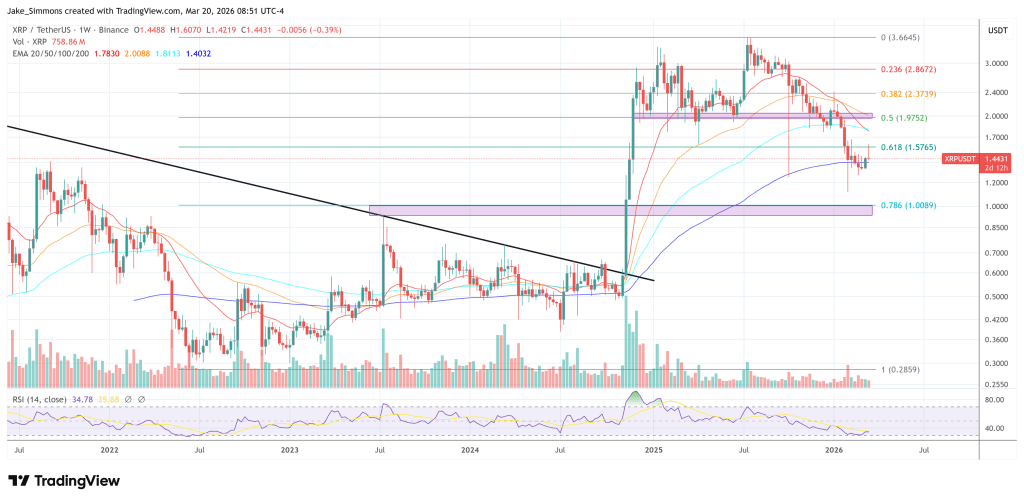
XRP must rise above the 0.618 Fib, 1-week chart | Source: XRPUSDT on TradingView.com

İlgili Sorular

QWhat is the main announcement made by Virtuals Protocol and t54 regarding the XRP Ledger?

AVirtuals Protocol and t54 are bringing 'agent commerce' to the XRP Ledger, enabling AI agents to transact natively using escrowed jobs, evaluator-based verification, and programmable settlement.

QWhich two key technologies are involved in this new agent commerce infrastructure on XRPL?

AVirtuals provides the commerce logic through its Agent Commerce Protocol (ACP), and t54 provides the payment rail through its x402 facilitator.

QWhat cryptocurrencies can AI agents use to pay natively via the t54 x402 facilitator?

AAI agents can natively pay in XRP and RLUSD using the t54 x402 facilitator.

QWhat is the purpose of the x402 payment protocol as described by Coinbase?

ACoinbase describes x402 as an open payment protocol built around the HTTP 402 'Payment Required' status code, designed to allow APIs, websites, and autonomous agents to pay programmatically for access over standard web requests without traditional account-and-session models.

QWhat was Ripple's involvement in t54's February seed round?

ARipple, along with Virtuals Ventures, participated strategically in t54's seed round in February.

İlgili Okumalar

Bank of Korea Reveals Results of Tokenized Deposit Testing

The Bank of Korea has announced the results of its pilot test for tokenized deposits. Involving 28 central banks and international financial organizations, the project saw participation from major South Korean banks including KB Kookmin Bank, NH NongHyup Bank, Shinhan Bank, Woori Bank, and Hana Bank. Transactions, from payment orders to final settlement, were completed in real time, averaging just 80 seconds. The test involved 30 transactions across 17 different scenarios—such as corporate and interbank transfers—and was conducted in six currencies, including the Korean won, US dollar, and euro, with a total transaction value reaching approximately $995,000. The central bank reported that the platform operated stably throughout, despite being only partially connected to the existing banking infrastructure. Settlements using tokenized deposits were executed seamlessly, quickly, and transparently. An internal transfer of 20 million won (about $13,890) between NH NongHyup Bank and Shinhan Bank was also successfully processed via the Project Agora platform, which involved connecting to the Bank of Korea's CBDC test platform, Project Hangang. Additionally, KB Kookmin Bank and Japan's MUFG Bank tested cross-border payments using these deposit tokens—digital certificates issued by commercial banks within the pilot, not directly by the central bank. The Bank of Korea plans to continue testing payments with tokenized deposits. This follows last year's pledge by South Korean authorities to tighten regulations for won-based stablecoins, which will require approval from both the central bank and the Financial Services Commission.

cryptonews.ru1 saat önce

Bank of Korea Reveals Results of Tokenized Deposit Testing

cryptonews.ru1 saat önce

İşlemler

Spot
活动图片