Stablecoin usage in Venezuela likely to keep expanding amid economic instability

cointelegraph2025-12-14 tarihinde yayınlandı2025-12-14 tarihinde güncellendi

Özet

Venezuela's economic instability and hyperinflation are driving increased reliance on stablecoins, particularly USDT, as essential tools for daily transactions and as a store of value. According to TRM Labs, nearly a decade of economic crisis, sanctions, and failing traditional infrastructure has made crypto adoption a necessity. Peer-to-peer platforms and crypto-to-fiat conversions are critical in a low-banking environment, with over 38% of Venezuelan crypto site visits going to a major P2P service. Despite regulatory uncertainty, stablecoins are primarily used for payroll, remittances, and commerce rather than speculation. Venezuela ranks 9th globally in crypto adoption when adjusted for population size.

Venezuelans are already heavily reliant on blockchain technology for banking after suffering through a decade of economic pressures; however, usage is likely to keep growing if conditions worsen in the South American country, blockchain intelligence firm TRM Labs says.

As regional and geopolitical tensions continue to rise, driven in part by US-Venezuela tensions, the TRM Labs team predicted in a report on Thursday that macroeconomic instability and the bolívar’s continued devaluation will likely sustain demand for stablecoins as both a store of value and a medium of exchange.

At the same time, regulatory ambiguity and continued uncertainty surrounding the country’s crypto regulator, SUNACRIP’s, authority and enforcement capacity, and eroding trust in traditional banking infrastructure could prolong the population’s dependence and drive more usage.

“Absent a material shift in Venezuela’s macroeconomic conditions or the emergence of cohesive regulatory oversight, the role of digital assets — particularly stablecoins — is poised to expand.”
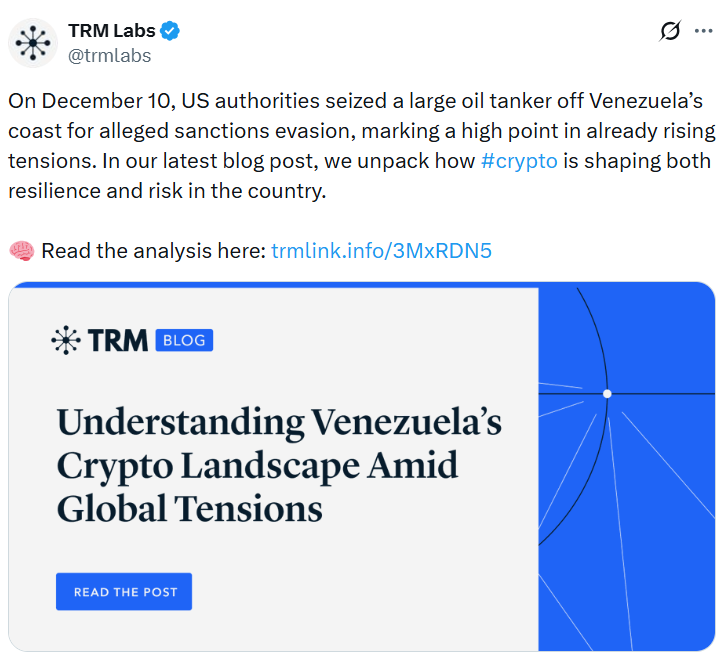
Source: TRM Labs

Venezuela is 18th globally for crypto adoption, the Chainalysis 2025 Crypto Adoption Index report found, but its rank increased to 9th when adjusted for population size.

Peer-to-peer transactions a key service for Venezuelans

Peer-to-peer (P2P), transfers made from one person to another through an intermediary, along with USDT (USDT) to-fiat conversions, have emerged as key services Venezuelans are using in the absence of reliable domestic banking channels, according to TRM Labs.

The blockchain intelligence firm tracked Venezuelan IP addresses and found that more than 38% of site visits were to a lone global platform that offers P2P trading functionality, which underscores its “role in facilitating crypto access in Venezuela’s low-banking environment.”

“A significant share of crypto-to-fiat activity is facilitated through platforms supporting informal settlement rails — even amid reports of intermittent service disruptions.”

Related: Venezuela blocks Binance, X amid presidential election dispute

“Local platforms also play a key role, particularly those offering mobile wallets and bank integrations suited to domestic users,” the team added.

Venezuela’s crypto industry created out of desperate necessity

Venezuela’s crypto ecosystem is ultimately the product of nearly a decade of economic collapse, international sanctions pressure, and state experimentation with digital financial alternatives, the TRM Labs team said.

Stablecoins, especially USDT, play a central role in household and commercial transactions in Venezuela, and despite compliance and sanction evasion concerns, stablecoins remain “overwhelmingly driven by necessity rather than speculation or criminal intent.”

“For most Venezuelans, stablecoins now operate as a substitute for retail banking — facilitating payroll, family remittances, vendor payments, and cross-border purchases in the absence of consistent domestic financial services.”

Magazine: Quantum attacking Bitcoin would be a waste of time: Kevin O’Leary
İlgili Okumalar

Vitalik: We Need to Create Sanctuaries, Not Fight AI

In a recent interview, Vitalik Buterin, founder of Ethereum, addresses the central anxiety of the AI era. He argues the primary risk isn't AI's intelligence, but human passivity—ceding decisions, privacy, and agency to centralized systems or "super AIs" for a sense of "disempowering safety." His solution is not to fight AI, but to build "sanctuary technologies." These are optional, non-totalizing spaces that protect users while preserving their sovereignty and privacy. Ethereum is presented as a prime example, offering a parallel financial system one can freely choose, not a fix for the old one. Reflecting on his journey from a 19-year-old on "autopilot" to an active "pilot," Vitalik notes the world reinvents itself every 5-10 years. To keep up, individuals must actively pilot their lives, not be passive passengers. He stresses that active learning vastly outperforms passive learning, even with equal time invested. His practical advice for builders and individuals in the AI age includes: periodically forcing oneself to do tasks manually to keep the mind engaged; prioritizing active learning and verification over outsourcing answers; building tools that help retain human agency; not outsourcing all strategic thinking to AI; and preserving serendipity through real-world interactions. Ultimately, Buterin redefines Ethereum/crypto's role: not to win against or fix the old world, but to provide a free, optional alternative. The core message is that as AI grows more powerful, the truly scarce resource will be proactive humans who retain their sovereignty, privacy, and capacity for independent thought. The era demands not less tool use, but more intentional and active use of technology.

链捕手1 saat önce

Vitalik: We Need to Create Sanctuaries, Not Fight AI

链捕手1 saat önce

Conversation with Patagon Founder: Revealing the Inside Story of Anthropic's Secondary Market

**Summary: Inside Anthropic's Massive, Opaque Secondary Market** In a revealing interview, Patagon founder Dio Casares pulls back the curtain on the booming, high-risk secondary market for shares in companies like Anthropic. This private market, fueled by companies staying private longer and massive funding rounds, is estimated to involve hundreds of billions of dollars. Casares distinguishes between two types of "secondary" trading: 1. **Company-approved SPV (Special Purpose Vehicle) sales:** Where new capital flows into the company, often facilitated by select private equity firms. Anthropic supports this to manage liquidity and pre-IPO selling pressure. 2. **The "gray" market:** Platforms like Hive and Forge that match buyers and sellers, often creating pricing confusion and competing with official funding rounds. These intermediaries are widely disliked by companies. The market structure is complex and fragmented, relying heavily on personal connections. Brokers connect buyers and sellers, often layering multiple SPVs to pool capital, with single transaction fees as high as 10%. Strikingly, some finance professionals earn more from this trading than from their primary investment roles. **Key risks highlighted include:** * **High Fraud Rates:** An estimated 10-20% of transactions involve fake stock certificates or sellers who take payment without having the shares. * **Complex, Risky Structures:** Nested SPVs, "forward contracts" on employee equity, and tokenized private equity create layers of opacity. This is exemplified by a recent incident where an xAI employee's shares were revoked after an espionage allegation, leaving buyers empty-handed. * **Post-IPO "Settlement Hell":** After an IPO, delays in distributing shares through multiple SPV layers and decisions by fund managers to hold onto shares could trigger years of lawsuits as downstream investors are locked out. **For small investors** holding positions through tokenized vehicles or layered SPVs, it's often impossible to verify the underlying asset. Casares advises caution: if the investment feels wrong, consider exiting. As the private market now surpasses IPO fundraising, this "wild west" ecosystem faces a looming reckoning. While it will likely professionalize, the post-IPO period for a company like Anthropic could unleash a wave of disputes, exposing the vulnerabilities built into this frenzied, largely unregulated marketplace.

marsbit3 saat önce

Conversation with Patagon Founder: Revealing the Inside Story of Anthropic's Secondary Market

marsbit3 saat önce

İşlemler

Spot
Futures
活动图片