According to a J.P. Morgan research report, Kioxia remains bullish with a target price of 155,000 yen, following its record-breaking Q1 profit and the company's announcement of establishing a framework for up to 800 billion yen in treasury stock acquisition. Compared to the stock price of approximately 46,500 yen at the time of the report, this target price suggests significant upside potential.
The core of this assessment is not simply betting on an increase in NAND shipments, but rather on the simultaneous occurrence of data center SSD price increases, improving profit margins, and enhanced shareholder returns.
Kioxia's FY2026 Q1 earnings report, released on July 31, showed that for the three months ended June 30, 2026, the company's revenue was approximately 1.77 trillion yen, a year-over-year increase of 415.5% and a sequential increase of 76.2%. Non-GAAP operating profit was about 1.33 trillion yen, a sequential increase of 121.4%, with a single quarter's profit already exceeding the full-year FY2025 non-GAAP operating profit of approximately 876.2 billion yen. The non-GAAP operating profit margin was about 75.0%.
The Q2 guidance is even more aggressive. The company expects revenue of about 2.39 trillion yen and non-GAAP operating profit of approximately 1.90 trillion yen, corresponding to a profit margin of about 79.5%, with revenue growing 35.2% sequentially. For a cyclical memory stock, this represents a window where price, profit margins, and capital returns are all being re-evaluated by the market.
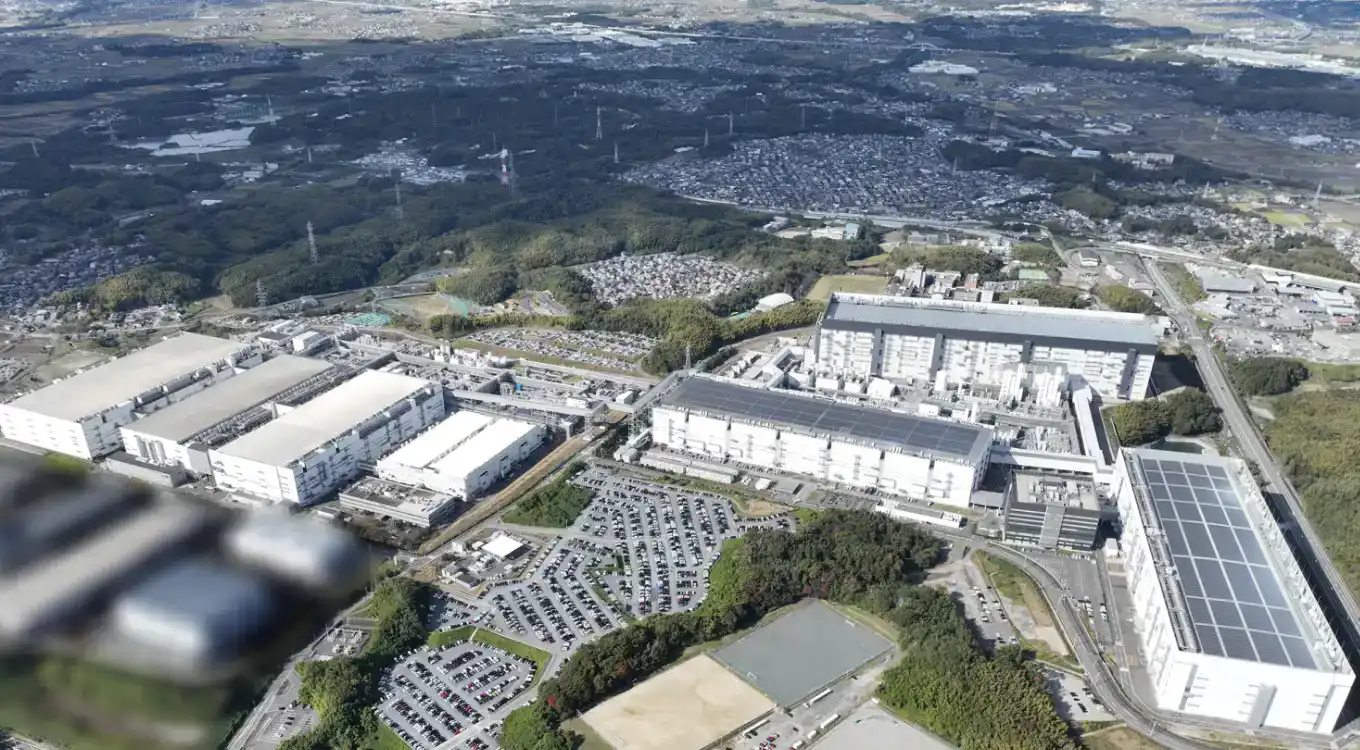
Kioxia's Yokkaichi Plant. The rebound in NAND prices, growth in enterprise SSD demand, and capital discipline are collectively impacting the company's earnings resilience.
155,000 Yen Target Price: First, Look at the Q1 Profit Surge
The most direct driver of Kioxia's recent earnings surge is enterprise SSD and data center customer demand.
The company mentioned in its earnings report that generative AI-related data center customer demand led to a significant increase in the average selling price, while bit shipments increased year-over-year. The research report further indicates that the SSD & Storage segment accounted for the majority of total revenue in Q1, with Datacenter & Enterprise being the most critical profit driver. The ASP for this segment rose approximately 70% sequentially, while bit shipment growth was only in the low single digits, with some orders slipping into Q2.
This is the primary explanation for the seemingly high target price of 155,000 yen. The improvement in profit margins is not solely dependent on volume expansion but is driven by a combination of enterprise SSD price increases, product mix improvement, and a higher proportion of advanced processes. Once price increases flow through to the income statement, operating leverage is amplified rapidly.
On the production side, the report mentions that the proportion of BiCS 8 FLASH has exceeded 50%, and lower-bit-cost technologies like QLC, along with the joint venture system with SanDisk, help support unit costs and investment efficiency. However, the more direct question for the stock price is not the technology roadmap itself, but whether Kioxia can translate this price cycle into more stable profits.
J.P. Morgan's valuation is based on FY2027 EPS and a P/E ratio of approximately 11x. This multiple is higher than the global memory manufacturers' 15-year average of around 9x. The premium justification includes reduced selling pressure from the Bain Capital consortium and the potential for long-term agreements to increase earnings stability.
But 155,000 yen is not a guaranteed return. It is built on the assumption that the NAND price cycle, enterprise SSD demand, and high profit margins can be sustained. If demand falls after price hikes, or if the industry accelerates capacity expansion again, this valuation framework will be re-examined.
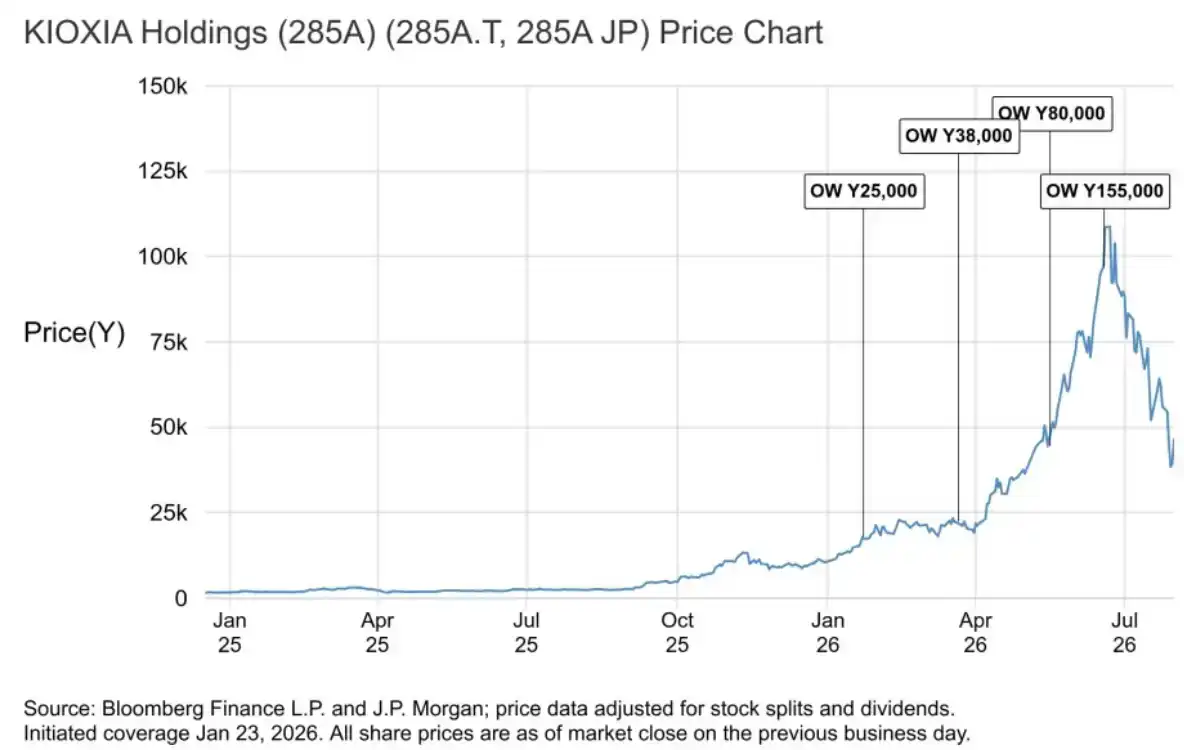
KIOXIA Stock Price Chart: The stock price has risen from around the 20,000 yen range in 2026 to approximately 46,500 yen at the time of the report, with multiple target price upgrades along the trajectory.
The Uptrend Continues in Q2, AI Storage Demand Becomes the New Narrative
Q2 guidance indicates that Kioxia's upward momentum did not stop in Q1.
The company expects Q2 revenue of about 2.39 trillion yen, a sequential increase of 35.2%, with the non-GAAP operating profit margin rising to approximately 79.5%. The earnings report attributes the growth primarily to data center customer demand and a significant increase in ASP. The research report's view is that Datacenter & Enterprise demand is strongest, with contributions from smartphones as well.
The longer-term focus is on 2027. Both management and the research report mention that CY2026 industry NAND bit demand may maintain high-teens growth, and CY2027 demand could potentially exceed supply. If this judgment holds, the NAND industry would not just be experiencing a traditional cyclical rebound but entering a phase of tight supply, providing more support for prices and profit margins.
AI is a new catalyst. Management sees agentic AI as a significant source of new NAND workloads alongside traditional server demand growth. Simply put, if AI applications expand from training and inference to more autonomous agent workflows, the amount of data servers need to process, cache, and store will increase, thereby expanding enterprise SSD demand.
However, this line of reasoning is not as directly visible as GPU orders. AI's pull on NAND depends more on cloud vendor procurement, enterprise customer deployments, and server architecture changes. In the short term, the market can already see enterprise SSD price increases and Kioxia's rising profit margins. In the medium to long term, it depends on how much new storage orders agentic AI can actually bring.
80 Billion Yen Buyback Boosts Sentiment, Cyclical Risks Remain
Kioxia also announced the establishment of a framework for acquiring up to 800 billion yen in treasury stock. For a cyclical memory stock, this move directly addresses market expectations for shareholder returns and stock price support.
The significance of the buyback is that during a phase of improving profits and cash flow, the company is not reserving funds solely for capacity expansion but is also signaling a commitment to shareholder returns. This helps alleviate market concerns about memory manufacturers' tendency to "expand capacity when they make money, leading to oversupply later."
The research report also mentions that the company reiterated its CY2028 long-term agreement sales coverage target of 50%. If long-term agreements can increase visibility on sales volume and price, Kioxia's profit volatility might be lower than that of traditional cyclical memory stocks, making it easier for the market to accept a valuation above the historical average.
However, a buyback is not the answer to all problems. Although the Q2 guidance is strong, it still fell short of some high market expectations. Additionally, some bit shipments from Q1 slipped into Q2. The research report also takes a more cautious short-term view regarding QLC penetration in the nearline HDD market, noting that the speed of SSD replacing HDD cannot be extrapolated linearly.
The bigger risk remains on the supply side. The NAND industry has historically seen multiple instances of capital expenditure expansion following price increases, ultimately leading to renewed supply-demand imbalance. If AI demand does not consistently exceed expectations, or if major manufacturers accelerate capacity expansion again, the judgment of "demand exceeding supply" in 2027 will come under pressure.
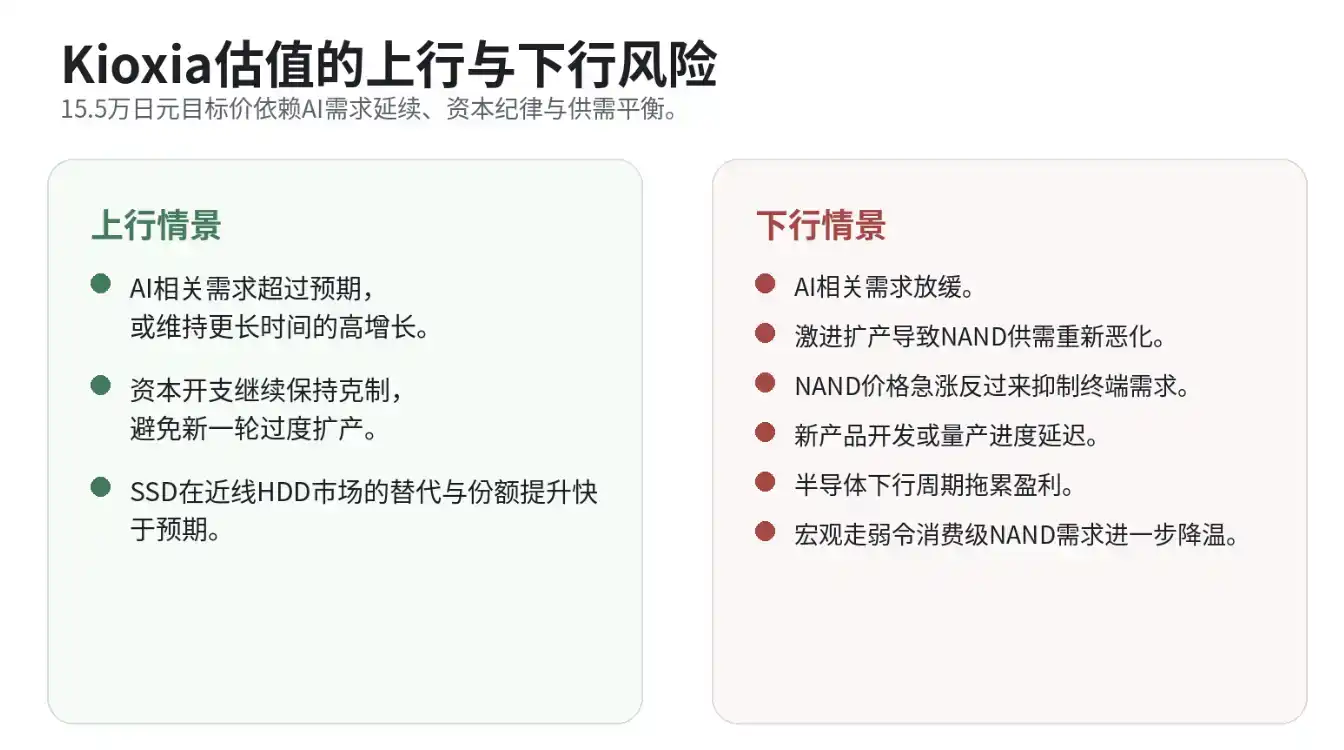
Upside and Downside Risk Scenarios: Upside includes AI demand, capital discipline, and SSD replacing HDD. Downside includes demand slowdown, excessive capacity expansion, and demand drop-off after rapid price increases.
Kioxia's market story is now clear: a Q1 profit margin of 75%, a Q2 guidance margin approaching 80%, a maximum 800 billion yen buyback providing sentiment support, and a 155,000 yen target price that incorporates both the NAND upturn cycle and AI storage demand into a higher valuation.
The next phase of this trend hinges on three specific questions: how long can enterprise SSD price increases last, how much of the new NAND demand driven by AI can be realized, and whether the industry can avoid another supply glut around 2027.