Atkins' First Year at the Helm of the SEC: A Comprehensive Shift in Crypto Regulation

marsbit2026-04-21 tarihinde yayınlandı2026-04-21 tarihinde güncellendi

Özet

Paul Atkins marked his one-year anniversary as Chair of the U.S. Securities and Exchange Commission (SEC) on April 21, 2025, overseeing a significant shift in the agency’s approach to cryptocurrency regulation. Under his leadership, the SEC dropped multiple enforcement actions against crypto firms, approved several crypto-linked ETFs, and issued guidance clarifying that most cryptocurrencies are not considered securities under federal law. The SEC also signed a memorandum with the CFTC to improve regulatory coordination. These actions reversed the aggressive enforcement stance of his predecessor, Gary Gensler, and aligned with Trump administration promises to support the crypto industry. However, Atkins has faced criticism from Democratic lawmakers, including Senator Elizabeth Warren, who raised concerns over potential conflicts of interest, particularly regarding dropped cases linked to Trump-affiliated companies. While regulatory clarity has improved, the SEC still awaits congressional action to formally define its jurisdiction over digital assets.

Author: Turner Wright

Compiled by: Deep Tide TechFlow

Deep Tide Guide: On April 21, 2025, Paul Atkins was sworn in as Chairman of the SEC, marking exactly one year today. Over this year, the SEC has dismissed multiple lawsuits against crypto companies, approved several crypto ETFs, and signed a memorandum of understanding with the CFTC on coordinating digital asset regulation. However, allegations of conflicts of interest against Atkins by Democratic lawmakers are heating up, and the SEC is still awaiting Congress to pass a market structure bill to clarify its jurisdiction over crypto assets.

On April 21, 2025, Paul Atkins was sworn in as Chairman of the U.S. Securities and Exchange Commission (SEC). As of today, it has been exactly one year.

This year, the SEC has undergone a fundamental shift in its regulatory and enforcement stance on digital assets, in stark contrast to the approach during the tenure of former Chairman Gary Gensler.

During the 2024 election campaign, Trump made several promises to the crypto industry: replacing Gensler, establishing a national Bitcoin (BTC) reserve, and opposing the issuance of a U.S. central bank digital currency. After winning the election in November 2024, Gensler resigned in January 2025, and SEC Commissioner Mark Uyeda served as acting chairman until the Senate confirmed Atkins' nomination.
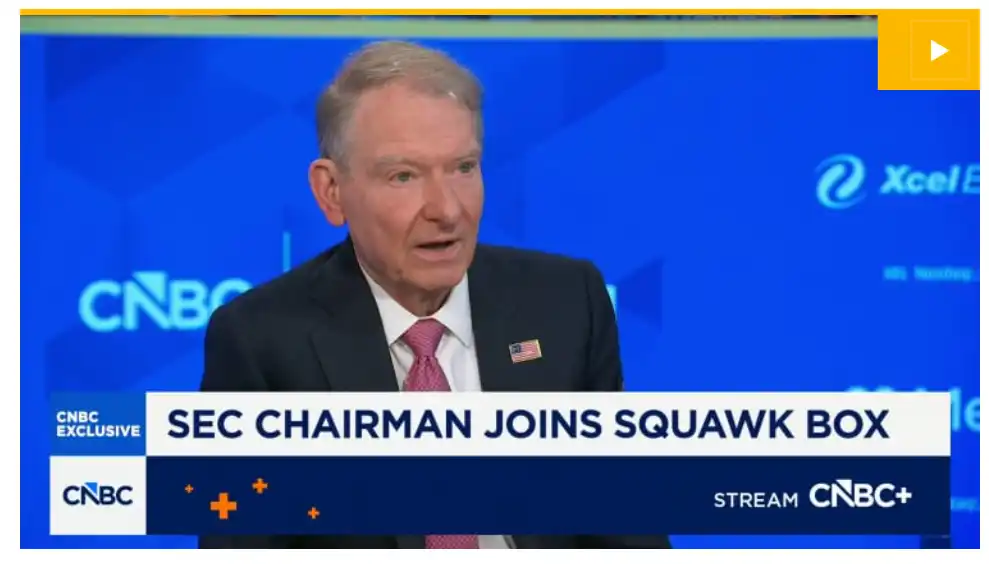
Caption: SEC Chairman Paul Atkins being interviewed on CNBC's Squawk Box on April 20, 2026

Source:CNBC

Even Before Atkins Took Office, the SEC Was Already Shifting

Even before Atkins officially assumed his role, the SEC began sending signals. During Uyeda's acting tenure, the SEC established a crypto working group led by Commissioner Hester Peirce and, starting in February 2025, began dismissing civil enforcement actions and investigations against crypto companies, with Coinbase being the first.

In the 12 months since Atkins officially took office, the SEC has introduced a series of policies widely seen as favorable by the industry:

  • Terminated multiple enforcement actions against crypto companies
  • Approved several exchange-traded funds (ETFs) linked to various crypto assets
  • Signed a memorandum of understanding with the Commodity Futures Trading Commission (CFTC) on coordinating digital asset regulation
  • Issued an interpretive notice clarifying that most cryptocurrencies do not constitute securities under federal law

Atkins himself said in an interview with CNBC on April 21: "The year has passed quickly, but I feel we have made significant progress. When I took office, I promised a new day for the SEC, and we have delivered. We have moved away from the past approach of regulating through enforcement and operating opaquely, and the crypto space is the best example of this."
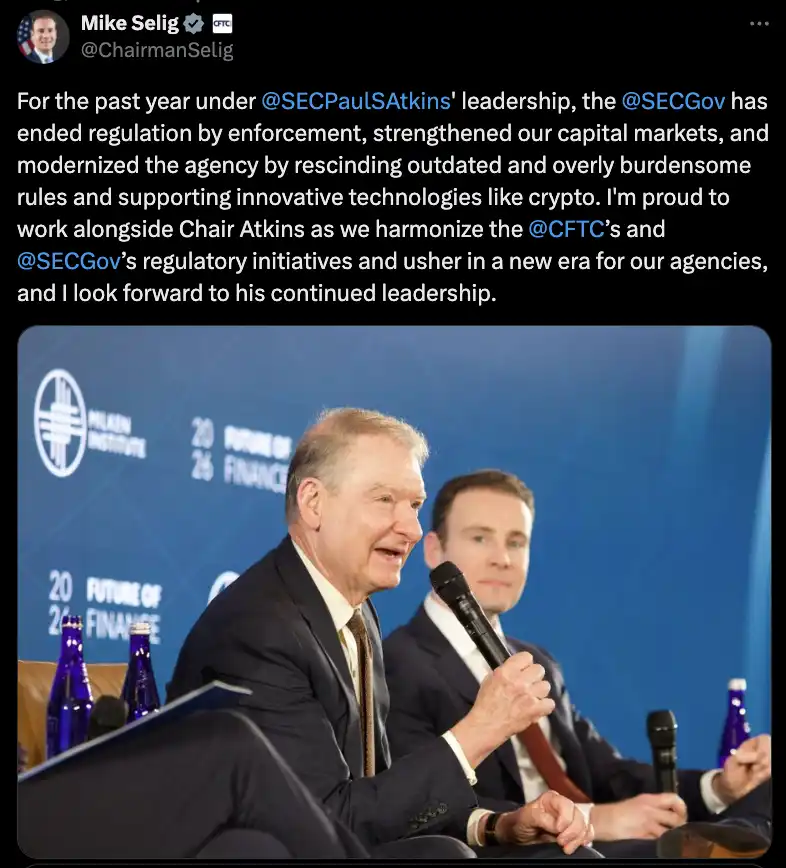
Source:CFTC Chairman Michael Selig

Democratic Lawmakers Focus Fire on Conflicts of Interest

While the crypto industry largely welcomes Atkins' approach, criticism from Congressional Democrats is escalating. The focus is on potential conflicts of interest, as some of the dismissed investigations and enforcement actions involved companies linked to Trump and his family.

Last week, Massachusetts Senator Elizabeth Warren accused Atkins of misleading lawmakers during his Congressional testimony. In a letter dated April 15, Warren pointed out that the SEC's own fiscal year 2025 data shows the number of enforcement actions has dropped to the lowest in a decade.

Despite the clear direction of case dismissals and regulatory relaxation, the SEC is still awaiting Congress to pass a market structure bill to formally clarify the boundaries of its regulatory authority over crypto assets. Until the bill is enacted, the SEC's crypto regulatory framework remains in a transitional state of "administrative guidance + case-by-case handling."

İlgili Sorular

QWhat major changes did the SEC undergo under Paul Atkins' leadership in his first year as chairman?

AUnder Paul Atkins' leadership, the SEC underwent a fundamental shift in its regulatory and enforcement stance on digital assets. This included dropping multiple enforcement actions against crypto companies, approving various crypto-linked ETFs, signing a memorandum of understanding with the CFTC for regulatory coordination, and issuing interpretive guidance clarifying that most cryptocurrencies are not securities under federal law.

QWho was the SEC chairman before Paul Atkins and what was the industry's perception of that leadership?

AGary Gensler was the SEC chairman before Paul Atkins. His tenure was characterized by a starkly different approach, which the crypto industry largely viewed as aggressive enforcement and regulatory uncertainty. This contrasted with the more industry-friendly policies implemented under Atkins.

QWhat is the primary criticism from Democratic lawmakers regarding Chairman Atkins' actions?

AThe primary criticism from Democratic lawmakers, such as Senator Elizabeth Warren, focuses on potential conflicts of interest. They allege that the SEC dropped certain investigations and enforcement actions that involved companies linked to former President Trump and his family, and that Chairman Atkins misled Congress in his testimony about these actions.

QWhat significant action did the SEC take regarding crypto ETFs during Atkins' first year?

AA significant action the SEC took was the approval of multiple exchange-traded funds (ETFs) linked to various crypto assets. This was a major policy shift from the previous administration and was widely seen as a positive development for the industry.

QWhat is the current status of the SEC's regulatory framework for crypto assets, according to the article?

AAccording to the article, the SEC's regulatory framework for crypto assets is currently in a transitional state, operating on a basis of 'administrative guidance + case-by-case handling.' The agency is still waiting for Congress to pass a market structure bill to formally clarify the boundaries of its jurisdiction over crypto assets.

İlgili Okumalar

Summary of Kevin Warsh's Past Remarks: How Will This Prospective 'New Head' Upend the Fed?

Kevin Warsh, nominated by President Trump to replace Fed Chair Powell, is poised to introduce sweeping reforms at the Federal Reserve. His agenda includes structural changes, advocating for lower policy rates, a fundamentally new approach to inflation, a significantly smaller balance sheet, safeguarding Fed independence, narrowing the Fed’s mandate, improving coordination with the Treasury, and reducing communication “noise” from policymakers. Warsh has criticized current monetary policy as “broken” and called for “fundamental regime change,” arguing that continuity is meaningless when the Fed has lost credibility. He believes interest rates should be lower and that a smaller balance sheet would help achieve that, describing the current one as “multiple trillions of dollars larger than necessary.” On inflation, he attributes its rise to cognitive errors at the Fed—including overreliance on flawed models, neglect of money supply, and blaming external factors rather than excessive government spending. He also suggests AI could lead to a structural decline in prices. He strongly defends Fed independence as its “most important asset” and warns against mission creep, which he says risks its core objectives and increases political vulnerability. He proposes closer coordination with the Treasury to align balance sheet and debt issuance plans, clarifying expectations for markets. Regarding communication, Warsh supports transparency but criticizes the current “cacophony of voices” and “forward guidance” that creates ambiguity. He has urged Fed officials to speak less frequently to avoid market confusion.

marsbit27 dk önce

Summary of Kevin Warsh's Past Remarks: How Will This Prospective 'New Head' Upend the Fed?

marsbit27 dk önce

Arbitrum Pretends to Be the Hacker, 'Steals' Back the Money Lost by KelpDAO

Title: Arbitrum Poses as Hacker to Recover Stolen Funds from KelpDAO Last week, KelpDAO suffered a hack resulting in nearly $300 million in losses, marking the largest DeFi security incident this year. Approximately 30,765 ETH (worth over $70 million) remained on an Arbitrum address controlled by the attacker. In an unprecedented move, Arbitrum’s Security Council utilized its emergency authority to upgrade the Inbox bridge contract, adding a function that allowed them to impersonate the hacker’s address and initiate a transfer without access to its private key. The council’s action, approved by 9 of its 12 members, moved the stolen ETH to a frozen address in a single transaction before reverting the contract to its original state. The operation was coordinated with law enforcement, which attributed the attack to North Korea’s Lazarus Group. Community reactions are divided: some praise the recovery of funds, while others question the centralization of power, as the council can upgrade core contracts without governance votes. However, such emergency mechanisms are common among major L2s. Despite the partial recovery, over $292 million was stolen in total, with more than $100 million in bad debt on Aave and remaining funds scattered across other chains. The incident highlights escalating security challenges in DeFi, with state-sponsored hackers employing advanced tactics and L2s responding with elevated countermeasures.

marsbit36 dk önce

Arbitrum Pretends to Be the Hacker, 'Steals' Back the Money Lost by KelpDAO

marsbit36 dk önce

iQiyi Is Too Impatient

The article "iQiyi Is Too Impatient" discusses the controversy surrounding the Chinese streaming platform IQiyi's recent announcement of an "AI Actor Library" during its 2026 World Conference. IQiyi claimed over 100 actors, including well-known names like Zhang Ruoyun and Yu Hewei, had joined the initiative. CEO Gong Yu suggested AI could enable actors to "star in 14 dramas a year instead of 4" and that "live-action filming might become a world cultural heritage." The announcement quickly sparked backlash. Multiple actors named in the list issued urgent statements denying they had signed any AI-related authorization agreements. This forced IQiyi to clarify that inclusion in the library only indicated a willingness to *consider* AI projects, with separate negotiations required for any specific role. The incident, which trended on social media with hashtags like "IQiyi is crazy," is presented as a sign of the company's growing desperation. Facing intense competition from short-video platforms like Douyin and Kuaishou, as well as Bilibili and Xiaohongshu, IQiyi's financial performance has weakened, with revenues declining for two consecutive years. The author argues that IQiyi is "too impatient" to tell a compelling AI story to reassure the market, especially as it pursues a listing on the Hong Kong stock exchange. The piece concludes by outlining three key "AI questions" IQiyi must answer: defining its role as a tool provider versus a content creator, balancing the "coldness" of AI with the human element audiences desire, and properly managing the interests of platforms, actors, and viewers. The core dilemma is that while AI can reduce costs and increase efficiency, it risks creating homogenized, formulaic content and devaluing human performers.

marsbit1 saat önce

iQiyi Is Too Impatient

marsbit1 saat önce

İşlemler

Spot
Futures
活动图片