Ethereum Foundation Cuts 20% of Staff, 54 Depart: The Survival Logic Behind the Restructuring

marsbit2026-06-24 tarihinde yayınlandı2026-06-24 tarihinde güncellendi

Özet

The Ethereum Foundation (EF) has announced a major restructuring, resulting in the departure of 54 staff members, representing approximately 20% of its workforce. This reorganization is not merely a cost-cutting measure but a strategic refocusing. The EF will now concentrate its resources on what it deems critical and unique tasks, structured around five new operational clusters. The new structure comprises clusters dedicated to: the Protocol Layer (ensuring Ethereum's core properties like censorship resistance and security); the Access Layer (enabling trusted, non-intermediated user interactions); the User Layer (grounding decisions in real user needs and constraints); the Community Layer (representing EF's stance and building alliances); and the Institutional Layer (engaging with enterprises, governments, and academia to promote principled adoption). The foundation stated that the layoffs were a difficult but necessary step to align its organization and spending with its long-term mandate, insulating its core work from short-term market fluctuations. Affected employees were offered a severance package and transition support. The restructured EF emerges as a leaner and more focused organization, poised to prioritize the development and preservation of Ethereum's foundational promise of self-sovereignty. Further details on the new operational model are expected in the coming weeks.

Author: Ethereum Foundation

Compilation: Deep Chao TechFlow

Deep Chao Intro: The Ethereum Foundation (EF) has announced a 20% reduction in staff, with 54 people leaving, and has completed a months-long organizational restructuring. This is not a simple cost-cutting measure, but a strategic contraction—the Foundation is concentrating resources on the critical tasks that "only EF can and must do," reorganized into five major clusters. For investors, this signals Ethereum's shift from broad-scatter efforts to focusing on the protocol layer and sovereignty guarantees, but also exposes the financial pressure on non-profit organizations during the bear market.

Today, the Ethereum Foundation (EF) is changing form, concluding a months-long restructuring process, part of implementing our Mandate and treasury management policies.

The restructured EF has the structure, activities, and personnel needed to execute critical future missions. However, 54 colleagues have also departed, representing about 20% of EF's total staff. Many of them will continue contributing to Ethereum in other ways in the coming weeks.

This article briefly introduces the new structure and details how we are supporting those leaving.

New Structure

EF now has five clusters, each responsible for a different work area—Protocol Layer, Access Layer, User Layer, Community Layer, and Institutional Layer—plus a cluster focused on operations and a cluster comprising management and teams directly supporting management.

Each work area requires different approaches, is accountable for different types of outcomes, and has a different internal structure tailored to the required workload. We will share more details next month; today, only the highest-level overview is provided.
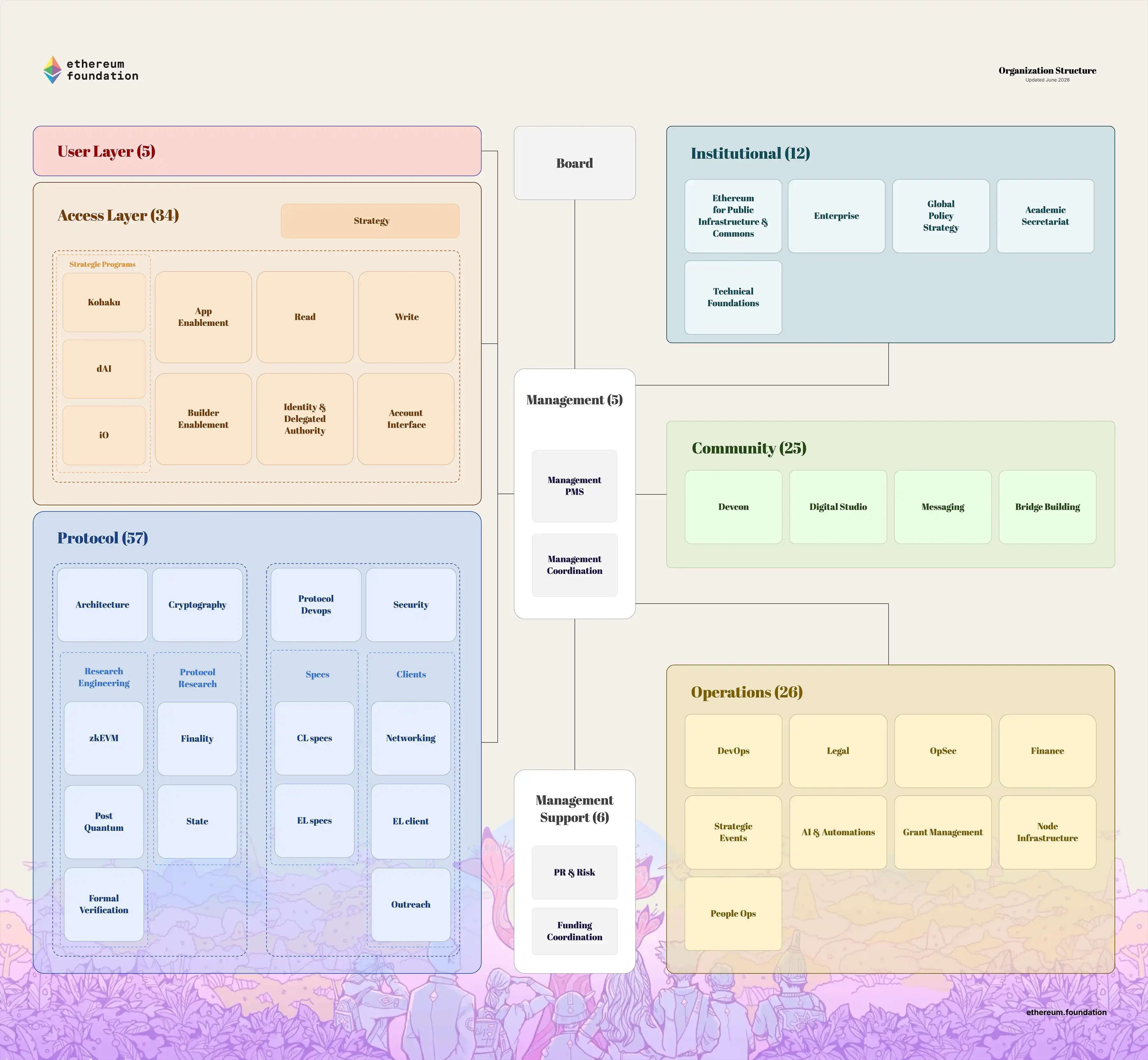
Protocol Layer

The Protocol cluster carries EF's legacy and responsibility, ensuring Ethereum delivers on its fundamental promise to scale self-sovereignty. It does this by laying the groundwork for strengthening and scaling the Ethereum protocol itself. Its goal is to ensure the Ethereum protocol continues to execute on the properties worth defending: censorship and capture resistance, openness and openness-source, and privacy and security as non-negotiable protocol guarantees.

The Protocol cluster exists to ensure the core protocol advances without compromising sovereignty guarantees. It does not exist to make Ethereum more marketable or focused on short-term interests, nor to make it easier to become another financial rail controlled by intermediaries. Its work is to make Ethereum harder to corrupt or capture, and easier to rely on when counterparties fail, platforms censor, governments overreach, or intermediaries extract rent. This means safely delivering forks, reducing unnecessary complexity, minimizing trusted dependencies, protecting transaction pipelines from harmful MEV and privileged order flow, and accelerating and translating long-term research like post-quantum security, zkEVM, and L1 privacy into protocol changes that preserve and improve sovereignty at scale.

Access Layer

The Access layer is where Ethereum serves—or fails—individuals who actually need CROPS properties. This cluster's work is to make self-sovereignty usable, understandable, and sustainable in critical operations: reading the chain, transacting, proving, delegating, and exiting. These operations must support users, and increasingly agents acting on their behalf, who must be able to read current state, history, and related data without relying on unverifiable intermediaries. They should be able to transact privately and without censorship risk, with outcomes either guaranteed or failing for free if conditions aren't met. As more work shifts to agents, users must retain control, grant limited permissions and revoke at will, and keep custody of their intent rather than exposing it to intermediaries. The interface, from silicon to front-end, must be verifiable, understandable, and recoverable, regardless of frequency of use or depth of technical knowledge.

The principle applied by this cluster is zero option: for every intermediated path, a credible, non-intermediated path must exist and remain accessible. Strategically, this means identifying where stronger CROPS properties can be applied to current infrastructure, and acknowledging that credible alternatives are necessary where economic incentives tend toward aggregation, identification, and control.

User Layer

The User Layer cluster grounds EF's work in the users and organizations with a material interest in using Ethereum self-sovereignly, and extends the tools and norms of such use as broadly as possible. It helps EF understand the most important capabilities, the most severe failure modes, and the trade-offs that are acceptable when necessary.

Its work includes user segmentation, roles, educational materials, use case studies, and impact assessments. The goal is not for EF to become a product studio, but to ensure decisions at the Protocol and Access layers are shaped by real current and potential users, real constraints, and real measures of sovereignty.

Community Layer

The Community cluster is responsible for how EF shows up in the world, both within and outside the Ethereum ecosystem. Its work is to make clear the positions EF represents, and how this differs substantively from zero-sum financial crypto, from crypto compromised by corporations, and from the mundane, status-quo-preserving, incentive-distorted, geostrategic-interest-laundering parts of non-profit grant management. EF commits to maximizing its community value by remaining independent from these and other counterproductive entanglements.

This cluster also builds EF's relationships beyond crypto. Self-sovereignty has natural allies in free and open source, security and local-first software and hardware, privacy and cryptography research and advocacy, and civil liberties, decentralized web, and public interest technology spaces. The cluster works to ensure the overlap between Ethereum and these fields is productive, non-coercive, and high-quality.

Institutional Layer

This cluster is responsible for EF's collaboration with institutions that shape how end users interact with Ethereum through institutional intermediary paths. This can include financial institutions, whether consumer payments, insurance, or others. It can include non-financial enterprises, covering manufacturing, social, publishing, and many other industries. It can include government applications. It can include universities or other non-profits.

In all cases, the goal is to prioritize creating showcase examples of Ethereum and crypto integration that maximize CROPS properties and the guarantees offered to both institutions and users—such as guaranteeing fair and correct execution, ensuring data portability and more generally practical exit capabilities, protecting all participants' privacy, proving data authenticity, better detecting or even preventing malfeasance, and so on. We believe many businesses, governments, and non-profits will realize their incentives align with serving users in ways that strengthen sovereignty, while retaining the guarantees they need to create value or fulfill their mission, and that Ethereum and crypto can be part of achieving this. Beyond direct engagements, the Institutional cluster will pursue these goals by helping establish and thoughtfully communicate best practices, standards, reference architectures, and educational materials for institutional adoption.

The Institutional cluster also works upstream with academia and allied advocacy organizations worldwide to ensure Ethereum is understood correctly in its current form and potential, and to track and respond to policy and regulatory developments that might impact Ethereum's commitment to sovereign use and its core principles of censorship (and capture) resistance, open source, privacy, and security.

Departing Personnel

As part of changing EF's structure, activities, and spending shape, we parted ways with 54 colleagues today.

These decisions were difficult but necessary. We must configure resources and organize in a way that allows us to focus for years ahead on the critical work that only EF can—and therefore must—do, without excessive distraction from short-term market fluctuations.

To ensure leavers are prepared for the transition, the package offered includes severance and transition support. Severance is the higher of one month's salary per year worked at EF or the amount specified by local regulations in the individual's jurisdiction. This matches the severance we've provided to colleagues leaving EF over recent months. Transition support includes assistance finding new contributing positions in the ecosystem and a small transition grant specifically for individual transition costs (career coaching, etc.).

We are grateful to each of them for the talent, dedication, and time they contributed to Ethereum at EF and look forward to continuing to work alongside those who find a home elsewhere in the ecosystem.

What's Next

The EF that emerges from this change is leaner and more focused. We'll share more in the coming weeks and months about how our work is changing and how the ecosystem can best engage with the new structure.


Trend Kriptolar

İlgili Sorular

QWhat is the main reason behind the Ethereum Foundation's 20% staff reduction and organizational restructuring?

AThe main reason is a strategic contraction to focus the Foundation's limited resources on critical tasks that 'only the EF can do and must do.' This involves shifting from a broad-scope approach to concentrating on the protocol layer and self-custody guarantees. The restructuring aims to ensure the EF can fulfill its core mission despite financial pressures in a bear market, reorganizing into five key clusters.

QWhat are the five new operational clusters within the restructured Ethereum Foundation?

AThe five new clusters are: 1) Protocol Layer, 2) Access Layer, 3) User Layer, 4) Community Layer, and 5) Institutional Layer. Additionally, there is an Operations cluster and a management cluster.

QAccording to the article, what is the primary mission of the Protocol Layer cluster?

AThe Protocol Layer cluster's primary mission is to ensure the Ethereum protocol fulfills its fundamental promise of scaling self-custody and upholds its core properties: censorship and capture resistance, open source, and privacy and security as non-negotiable protocol guarantees. Its work focuses on delivering safe protocol upgrades and long-term research like zkEVM and post-quantum security.

QHow is the Ethereum Foundation supporting the 54 employees who are leaving?

AThe Foundation is providing a severance package and transition support. The severance pay is the greater of one month's salary per year of service or the local statutory requirement. Transition support includes assistance finding new roles within the ecosystem and a small transition grant for expenses like career coaching.

QWhat does the 'zero-option' principle mentioned for the Access Layer cluster refer to?

AThe 'zero-option' principle means that for every intermediary-dependent path for users to interact with Ethereum, there must be a trustworthy, non-intermediated path available and accessible. This ensures users always have an option that preserves the core CROPS properties (likely related to censorship-resistance, openness, privacy, security).

İlgili Okumalar

Don't Just Focus on Layoffs, The New Structure of the Ethereum Foundation is More Worthy of Appreciation

The Ethereum Foundation (EF) has undergone a significant organizational restructuring, with the most notable change being a strategic refocusing of its priorities rather than just a 20% staff reduction (approximately 54 people). The new structure clearly prioritizes the Protocol and Access layers, which now comprise the largest teams (57 and 34 people, respectively). This signals EF's intent to concentrate its core resources on fundamental, hard-to-outsource aspects of Ethereum: protocol evolution, security, privacy, client development, and the foundational access layer. Key areas within the Protocol layer, led by an architecture group including Vitalik Buterin and Justin Drake, receive heightened emphasis. These include post-quantum security, zkEVM, formal verification, and long-term roadmap development ("Strawmap"). This reflects a shift towards tackling complex, interdependent challenges like scalability, privacy, and future-proofing the protocol, potentially moving from a pure "redundant security" multi-client model towards more specialized clients aided by AI-assisted formal verification. Financially, EF's budget is being reduced by approximately 40%. The goal is to transition from spending about 15% of its remaining funds annually to a more sustainable 5% rate, akin to a long-term endowment, ensuring its longevity. Concurrently, the restructuring involves pushing certain responsibilities—such as application development, adoption, and ecosystem coordination—to external organizations like EthLabs, the Ethereum Apps Guild, and others. This "multi-node" model aims to increase ecosystem resilience by decentralizing functions beyond the EF, though it introduces new coordination challenges. In essence, the reorganization represents EF consciously narrowing its scope to focus on the hardest, most critical protocol-level problems while fostering a more distributed and sustainable ecosystem structure for Ethereum's future growth.

Foresight News23 dk önce

Don't Just Focus on Layoffs, The New Structure of the Ethereum Foundation is More Worthy of Appreciation

Foresight News23 dk önce

Report Analysis: What Is Coherent Planning as CPO Booms?

Title: Report Interpretation: What Moves Is Coherent Making Amid the CPO Boom? Summary: JP Morgan analyst Samik Chatterjee reiterates an Overweight rating on Coherent (COHR), citing undervalued growth potential across three core areas: data center optical transceivers, co-packaged optics (CPO) chips, and industrial lasers/thermal management. COHR's 1.6T data center transceivers are in high demand, with pricing remaining firm. The rise of CPO is seen not as a threat but as a catalyst, creating higher demand for sophisticated optical components, an area where COHR holds a competitive edge with its comprehensive portfolio (lasers, isolators, VCSELs, thermoelectric coolers). Each CPO chip offers significantly greater revenue potential than traditional transceivers. Furthermore, its Optical Circuit Switch (OCS) technology targets a potential $4B market with reliability and power advantages. The company is expanding its InP (Indium Phosphide) device capacity fourfold within two years, securing substrate supply and transitioning to more cost-effective 6-inch wafers. As one of only two major suppliers of high-quality pump lasers—currently in severe shortage—COHR can now move up the value chain from components to complete line cards/systems, boosting ASP over tenfold. Gross margin targets (>42%) may be revised upward due to high-end product premiums, cost improvements from the wafer transition, and contributions from new high-margin products like CPO and OCS. Its efficient thermadite thermal material also offers long-term growth. Industrial segment revenue grows at a steady 5-10%, supported by semiconductor equipment orders. Changes in Apple's Face ID protocol present a re-competition opportunity for 3D sensing. Overall, Coherent is positioned as a key infrastructure provider, with AI-driven compute demand fueling the need for high-speed optical interconnectivity. Growth from CPO/OCS, stable industrial performance, and margin improvement support the bullish thesis. *Disclaimer: This summary interprets a third-party analyst report from JP Morgan. It does not constitute investment advice.*

marsbit45 dk önce

Report Analysis: What Is Coherent Planning as CPO Booms?

marsbit45 dk önce

After Laying Off 20% of Staff, What Are the Key Points of EF's New Structure?

Following the completion of a months-long organizational restructuring, the Ethereum Foundation (EF) announced a 20% workforce reduction (approximately 54 employees) on June 23rd. It reorganized its teams into five new core clusters: Protocol, Access, User, Community, and Institutional (plus Operations/Management support units). Officially, this move implements the EF's 2026 Mandate and 2025 Treasury Management Policy, aiming to create a more focused and "self-sovereign" organization. The restructuring prioritizes the CROPS principles—Censorship Resistance, Openness & Freedom, Privacy, and Security—as foundational organizational tenets. The Protocol cluster will focus on core protocol R&D, including MEV reduction and zkEVM. The Access cluster emphasizes preserving user "zero option" for non-custodial, permissionless interaction. The User, Community, and Institutional clusters will manage external engagement, with the latter handling institutional and regulatory matters. While offering enhanced severance and transition support for affected employees, the EF did not disclose budget allocations or specific KPIs for the new clusters. This has led to market uncertainty about the impact on project funding and development priorities. Analysts note the announcement's positive tone of mission focus contrasts with a backdrop of recent EF leadership changes and broader ecosystem pressures. The true impact—whether this signifies strategic realignment or reactive contraction—will become clearer as the new structure's resource allocation and project prioritization are revealed in the coming months.

marsbit55 dk önce

After Laying Off 20% of Staff, What Are the Key Points of EF's New Structure?

marsbit55 dk önce

Top-Tier MEV Bot Loses $7.5 Million: Is 'Approval' the Most Overlooked Fatal Risk On-Chain?

The article discusses a sophisticated attack on a prominent Ethereum MEV (Miner Extractable Value) bot, Jaredfromsubway.eth, resulting in a loss exceeding $7.5 million. Unlike typical exploits involving key leaks or smart contract bugs, this attack was a carefully orchestrated "reverse hunt." The attacker spent weeks deploying fake tokens and liquidity pools that mimicked legitimate assets like WETH and USDC. These pools were designed to appear as profitable arbitrage opportunities, tricking the automated bot's trading logic. During its normal operation, the bot was induced to grant ERC-20 token approvals to the malicious contracts. Once sufficient permissions were accumulated, the attacker drained the bot's funds by calling these pre-approved allowances. This incident highlights the often-underestimated risks associated with token approvals in Web3. The article explains that approvals are a fundamental mechanism, allowing smart contracts (like DEXs) to move a user's tokens on their behalf. However, risks arise from practices like granting infinite approvals, the persistence of approvals even after disconnecting from a dApp, and the potential for a once-trusted contract to become compromised later. The piece concludes with advice for managing approval risks: users should adopt the principle of least privilege (approving only the needed amount), use separate wallets for storage versus interactions, and regularly audit and revoke unnecessary approvals using tools like Revoke.cash. It also emphasizes the role of wallets like imToken in providing proactive defenses, such as risk warnings and clear, readable transaction signing interfaces, to help users make informed decisions. Ultimately, wallet security must extend beyond private key protection to include active management of token approvals.

marsbit1 saat önce

Top-Tier MEV Bot Loses $7.5 Million: Is 'Approval' the Most Overlooked Fatal Risk On-Chain?

marsbit1 saat önce

İşlemler

Spot
Futures

Popüler Makaleler

ETH 2.0 Nedir

ETH 2.0: Ethereum için Yeni Bir Dönem Giriş ETH 2.0, Ethereum 2.0 olarak da bilinir, Ethereum blok zincirinde önemli bir yükseltmeyi işaret eder. Bu geçiş yalnızca bir yüz değiştirme değil; ağın ölçeklenebilirliğini, güvenliğini ve sürdürülebilirliğini temelinden geliştirmeyi hedeflemektedir. Enerji yoğun Proof of Work (PoW) konsensüs mekanizmasından daha verimli olan Proof of Stake (PoS) mekanizmasına geçişle birlikte, ETH 2.0 blok zinciri ekosistemine dönüştürücü bir yaklaşım vaat etmektedir. ETH 2.0 Nedir? ETH 2.0, Ethereum'un yeteneklerini ve performansını optimize etmeye odaklanmış özel, birbirine bağlı güncellemelerin bir derlemesidir. Yenileme, mevcut Ethereum mekanizmasının karşılaştığı kritik zorlukları, özellikle işlem hızı ve ağ tıkanıklığı ile ilgili sorunları ele almak üzere tasarlanmıştır. ETH 2.0'ın Amaçları ETH 2.0'ın ana amaçları, üç temel unsuru geliştirmeye odaklanmaktadır: Ölçeklenebilirlik: Ağın saniye başına işleyebileceği işlem sayısını önemli ölçüde artırmayı hedefleyen ETH 2.0, mevcut yaklaşık 15 işlem/saniye sınırlamasını aşmayı ve potansiyel olarak binlerce işleme ulaşmayı planlamaktadır. Güvenlik: Geliştirilmiş güvenlik önlemleri, özellikle siber saldırılara karşı daha iyi direnç sağlama ve Ethereum'un merkeziyetsiz görünümünü koruma açısından ETH 2.0 için hayati öneme sahiptir. Sürdürülebilirlik: Yeni PoS mekanizması, sadece verimliliği artırmakla kalmayıp aynı zamanda enerji tüketimini de önemli ölçüde azaltma hedefiyle tasarlanmış olup, Ethereum'un operasyonel çerçevesini çevresel kaygılarla uyumlu hale getirmektedir. ETH 2.0'ın Yaratıcısı Kimdir? ETH 2.0'ın yaratılması Ethereum Vakfı'na atfedilebilir. Ethereum'un gelişimini destekleme konusunda kritik bir rol oynayan bu kar amacı gütmeyen kuruluş, dikkat çekici kurucu ortağı Vitalik Buterin tarafından yönetilmektedir. Daha ölçeklenebilir ve sürdürülebilir bir Ethereum vizyonu, bu yükseltmenin arkasındaki itici güç olmuştur ve protokolü geliştirmek için kendini adamış küresel bir geliştici ve meraklı topluluğunun katkılarını içermektedir. ETH 2.0'ın Yatırımcıları Kimlerdir? ETH 2.0 yatırımcıları ile ilgili detaylar kamuoyuna açıklanmamış olsa da, Ethereum Vakfı'nın blok zinciri ve teknoloji alanında çeşitli kuruluşlar ve bireyler tarafından desteklendiği bilinmektedir. Bu ortaklar arasında merkeziyetsiz teknolojilerin ve blok zinciri altyapısının geliştirilmesine karşılıklı ilgi duyan girişim sermayesi şirketleri, teknoloji firmaları ve hayır kurumları yer almaktadır. ETH 2.0 Nasıl Çalışır? ETH 2.0, onu öncüsünden ayıran bir dizi önemli özelliği tanıtmasıyla dikkat çekmektedir. Proof of Stake (PoS) PoS konsensüs mekanizmasına geçiş, ETH 2.0'ın en belirgin değişikliklerinden biridir. İşlem doğrulama için enerji yoğun madenciliğe dayanmak yerine, PoS kullanıcıların ağa yatırdıkları ETH miktarına göre işlemleri doğrulayıp yeni bloklar oluşturmalarına olanak tanır. Bu, enerji verimliliğinin artırılmasına yol açarak tüketimi yaklaşık %99,95 oranında azaltmakta ve Ethereum 2.0'ı önemli ölçüde daha çevre dostu bir alternatif haline getirmektedir. Shard Zincirleri Shard zincirleri, ETH 2.0'ın diğer bir kritik yeniliğidir. Bu daha küçük zincirler, ana Ethereum zinciri ile paralel olarak çalışarak birden fazla işlemin aynı anda işlenmesine olanak tanır. Bu yaklaşım, ağın genel kapasitesini artırarak Ethereum'u rahatsız eden ölçeklenebilirlik sorunlarını ele alır. Beacon Zinciri ETH 2.0'ın temelinde, ağı koordine eden ve PoS protokolünü yöneten Beacon Zinciri yer almaktadır. Bu, bir tür organizatör olarak işlev görür: doğrulayıcıları denetler, shard'ların ağa bağlı kalmasını sağlar ve blok zinciri ekosisteminin genel sağlığını izler. ETH 2.0 Zaman Çizelgesi ETH 2.0'ın yolculuğu, bu önemli yükseltmenin evrimini gösteren birkaç önemli dönüm noktası ile tanımlanmıştır: Aralık 2020: Beacon Zinciri'nin başlatılması, PoS'un tanıtımını işaret etmiş ve ETH 2.0’a geçiş için sahneyi hazırlamıştır. Eylül 2022: "The Merge" tamamlanması, Ethereum ağının başarılı bir şekilde PoW'den PoS çerçevesine geçiş yaptığı kritik bir anı temsil etmekte ve Ethereum için yeni bir dönemi müjdelemektedir. 2023: Shard zincirlerinin beklenen dağıtımı, Ethereum ağının ölçeklenebilirliğini daha da artırmayı hedeflemekte ve ETH 2.0'ı merkeziyetsiz uygulamalar ve hizmetler için sağlam bir platform haline getirmeyi pekiştirmektedir. Ana Özellikler ve Faydalar Geliştirilmiş Ölçeklenebilirlik ETH 2.0'ın en önemli avantajlarından biri, geliştirilmiş ölçeklenebilirliğidir. PoS ve shard zincirlerinin kombinasyonu, ağın kapasitesini artırarak, eski sistemle kıyaslandığında çok daha fazla işlem hacmi karşılayabilmesini sağlamaktadır. Enerji Verimliliği PoS'un uygulanması, blok zinciri teknolojisinde enerji verimliliği yönünde büyük bir adım teşkil etmektedir. Enerji tüketimini ciddi şekilde azaltarak, ETH 2.0 yalnızca işletme maliyetlerini düşürmekle kalmaz, aynı zamanda küresel sürdürülebilirlik hedefleriyle daha yakın bir uyum sağlar. Geliştirilmiş Güvenlik ETH 2.0'ın güncellenmiş mekanizmaları, ağ genelinde güvenliğin artırılmasına katkıda bulunmaktadır. PoS'un uygulanması ve shard zincirleri ile Beacon Zinciri aracılığıyla geliştirilen yenilikçi kontrol önlemleri, potansiyel tehditlere karşı daha yüksek bir koruma sağlar. Kullanıcılar için Düşük Maliyetler Ölçeklenebilirlik geliştikçe, işlem maliyetleri üzerindeki etkiler de belirgin hale gelecektir. Artan kapasite ve azalan tıkanıklığın, kullanıcılar için düşük ücretler anlamına gelmesi beklenmekte ve Ethereum'u günlük işlemler için daha erişilebilir hale getirmektedir. Sonuç ETH 2.0, Ethereum blok zinciri ekosisteminde önemli bir evrimi işaret etmektedir. Ölçeklenebilirlik, enerji tüketimi, işlem verimliliği ve genel güvenlik gibi temel sorunları ele alırken, bu güncellemenin önemi abartılamaz. Proof of Stake'e geçiş, shard zincirlerinin tanıtımı ve Beacon Zinciri'nin altyapı çalışmaları, Ethereum'un merkeziyetsiz piyasalarının artan taleplerini karşılayabileceği bir geleceği göstermektedir. Yenilik ve ilerleme ile şekillenen bir sektörde, ETH 2.0, blok zinciri teknolojisinin daha sürdürülebilir ve verimli bir dijital ekonomi için yol açmadaki yeteneklerinin bir kanıtıdır.

185 Toplam GörüntülenmeYayınlanma 2024.04.04Güncellenme 2024.12.03

ETH 2.0 Nedir

ETH 3.0 Nedir

ETH3.0 ve $eth 3.0: Ethereum'un Geleceği Üzerine Derinlemesine Bir İnceleme Giriş Hızla evrilen kripto para ve blok zinciri teknolojisi ortamında, ETH3.0, sıklıkla $eth 3.0 olarak adlandırılmakta, önemli bir ilgi ve spekülasyon konusu haline gelmiştir. Bu terim, netleştirilmesi gereken iki temel kavramı kapsamaktadır: Ethereum 3.0: Bu, mevcut Ethereum blok zincirinin yeteneklerini artırmayı hedefleyen olası bir gelecekteki güncellemeyi temsil eder, özellikle ölçeklenebilirlik ve performansı iyileştirmeye odaklanmaktadır. ETH3.0 Meme Token: Bu ayrı kripto para projesi, Ethereum blok zincirini kullanarak meme merkezli bir ekosistem oluşturmayı amaçlamakta ve kripto para topluluğu içinde etkileşimi artırmaktadır. ETH3.0'ün bu yönlerini anlamak, yalnızca kripto meraklıları için değil, aynı zamanda dijital alandaki daha geniş teknolojik trendleri gözlemleyenler için de hayati öneme sahiptir. ETH3.0 Nedir? Ethereum 3.0 Ethereum 3.0, zaten kurulmuş olan Ethereum ağına önerilen bir güncelleme olarak duyurulmaktadır; bu ağ, kuruluşundan bu yana birçok merkeziyetsiz uygulamanın (dApp'ler) ve akıllı sözleşmelerin belkemiği olmuştur. Tasarlanan iyileştirmeler, esasen ölçeklenebilirlik üzerine yoğunlaşmakta – shardlama ve sıfır bilgi kanıtları (zk-proofs) gibi ileri teknolojileri entegre etmektedir. Bu teknolojik yenilikler, saniyede eşi benzeri görülmemiş sayıda işlem (TPS) gerçekleştirmeyi kolaylaştırmayı amaçlamakta olup, muhtemelen milyonlara ulaşarak mevcut blok zinciri teknolojisinin karşılaştığı en büyük sınırlamalardan birine çözüm getirmektedir. İyileştirme yalnızca teknik değil, aynı zamanda stratejiktir; Ethereum ağını, merkeziyetsiz çözümlere olan artan talep ile belirginleşen bir geleceğe hazırlamak için tasarlanmıştır. ETH3.0 Meme Token Ethereum 3.0'ın aksine, ETH3.0 Meme Token, internet meme kültürünü kripto para dinamikleriyle birleştirerek daha hafif ve eğlenceli bir alanda hareket etmektedir. Bu proje, kullanıcıların Ethereum blok zincirinde meme alım, satım ve ticaret yapmalarına izin vererek, yaratıcılık ve ortak ilgi alanları aracılığıyla topluluk etkileşimini teşvik eden bir platform sunmaktadır. ETH3.0 Meme Token, blok zinciri teknolojisinin dijital kültürle nasıl kesişebileceğini göstererek, hem eğlenceli hem de finansal olarak sürdürülebilir kullanım senaryoları oluşturmayı hedeflemektedir. ETH3.0'un Yaratıcısı Kimdir? Ethereum 3.0 Ethereum 3.0'a yönelik girişim, esas olarak Ethereum topluluğundaki bir geliştirici ve araştırmacı konsorsiyumu tarafından yönlendirilmektedir ve bunlar arasında Justin Drake de bulunmaktadır. Ethereum'un evrimine yönelik içgörüleri ve katkılarıyla tanınan Drake, Ethereum'u “Beam Chain” olarak adlandırılan yeni bir konsensüs katmanına geçirme konusundaki tartışmalarda öne çıkan bir figür olmuştur. Geliştirmeye yönelik bu iş birliği yaklaşımı, Ethereum 3.0'ın tek bir yaratıcının ürünü olmadığını, aksine blok zinciri teknolojisini ilerletmeye odaklanmış kolektif bir dehanın tezahürü olduğunu göstermektedir. ETH3.0 Meme Token ETH3.0 Meme Token'ın yaratıcısına dair detaylar şu anda izlenemez durumdadır. Meme tokenların doğası, genellikle daha merkeziyetsiz ve topluluk odaklı bir yapıya yol açmakta olup, bu da spesifik bir atıf eksikliğini açıklayabilir. Bu durum, yeniliğin genellikle iş birliği yerine bireysel çabalardan ortaya çıktığı kripto topluluğunun genel felsefesiyle uyumludur. ETH3.0 Yatırımcıları Kimlerdir? Ethereum 3.0 Ethereum 3.0'a olan destek, esasen Ethereum Vakfı ve hevesli bir geliştirici ve yatırımcı topluluğu tarafından sağlanmaktadır. Bu temel birliktelik, yıllar süren ağ operasyonlarıyla inşa edilen güven ve itibarından yararlanarak önemli bir meşruiyet sağlamaktadır. Kripto para dünyasının hızla değişen ikliminde, topluluk desteği, gelişim ve benimsemeyi yönlendirmede kritik bir rol oynamakta ve Ethereum 3.0'ı gelecekteki blok zinciri ilerlemeleri için ciddi bir rakip haline getirmektedir. ETH3.0 Meme Token Mevcut kaynaklar, ETH3.0 Meme Token'ı destekleyen yatırım temelleri veya kuruluşları hakkında net bilgiler sağlamasa da, bu durum meme tokenlar için tipik olan finansman modelini göstermektedir; bu model genellikle tabandan destek ve topluluk katılımına dayanır. Bu tür projelerdeki yatırımcılar genellikle toplum odaklı yenilik potansiyeli ve kripto topluluğunda bulunan iş birliği ruhuyla motive olmuş bireylerden oluşmaktadır. ETH3.0 Nasıl Çalışır? Ethereum 3.0 Ethereum 3.0'ın ayırt edici özellikleri, önerilen shardlama ve zk-proof teknolojisinin uygulanmasında yatmaktadır. Shardlama, blok zincirini daha küçük, yönetilebilir parçalara veya “parçalara” ayırma yöntemidir; bu parçalar işlemleri ardışık değil, eşzamanlı olarak işleyebilir. Bu işlem yükünün merkeziyetsizliği, tıkanıklığı önlemeye yardımcı olur ve ağın yoğun yük altında bile yanıt verebilir olmasını sağlar. Sıfır bilgi kanıtı (zk-proof) teknolojisi, işleme katılan temel verileri ifşa etmeden işlem doğrulaması sağlamasıyla başka bir sofistike katman ekler. Bu yön, sadece gizliliği artırmakla kalmaz, aynı zamanda ağın genel verimliliğini de artırır. Bu güncellemeye, ağın yeteneklerini ve faydasını daha da artırarak sıfır bilgi Ethereum Sanal Makinesi (zkEVM) entegrasyonunun da eklenmesi gündeme gelmektedir. ETH3.0 Meme Token ETH3.0 Meme Token, meme kültürünün popülaritesinden yararlanarak kendini farklılaştırmaktadır. Kullanıcıların sadece eğlence için değil, aynı zamanda potansiyel ekonomik kazançlar için meme ticareti yapmalarına olanak tanıyacak bir pazar yeri oluşturur. Stake etme, likidite sağlama ve yönetim mekanizmaları gibi özelliklerin entegrasyonu sayesinde, proje topluluk etkileşimini ve katılımını teşvik eden bir ortam oluşturur. Eğlence ve ekonomik fırsatların eşsiz bir karışımını sunarak, ETH3.0 Meme Token, kripto tutkunlarından gündelik meme meraklılarına kadar çeşitli bir kitleyi çekmeyi hedeflemektedir. ETH3.0 Zaman Çizelgesi Ethereum 3.0 11 Kasım 2024: Justin Drake, ölçeklenebilirlik iyileştirmeleri etrafında şekillenen yaklaşan ETH 3.0 güncellemesine işaret ediyor. Bu duyuru, Ethereum'un gelecekteki mimarisi hakkında resmi tartışmaların başlangıcını simgeliyor. 12 Kasım 2024: Ethereum 3.0'a yönelik beklenen önerinin, Bangkok'taki Devcon'da açıklanması planlanıyor ve bu, daha geniş topluluk geri bildirimi ve gelişim için olası sonraki adımların zeminini hazırlıyor. ETH3.0 Meme Token 21 Mart 2024: ETH3.0 Meme Token, CoinMarketCap'ta resmi olarak listeleniyor, bu da kamusal kripto alanına adım atarak meme merkezli ekosisteminin görünürlüğünü artırıyor. Ana Noktalar Sonuç olarak, Ethereum 3.0, gelişmiş teknolojiler aracılığıyla ölçeklenebilirlik ve performansla ilgili sınırlamaların üstesinden gelmeye odaklanan Ethereum ağındaki önemli bir evrimi temsil etmektedir. Önerilen güncellemeleri, gelecekteki talepler ve kullanılabilirlik için proaktif bir yaklaşımı yansıtmaktadır. Öte yandan, ETH3.0 Meme Token, kripto para alanındaki topluluk odaklı kültürün özünü kapsamakta, meme kültürünü kullanarak kullanıcı yaratıcılığını ve katılımını teşvik eden etkileşimli platformlar oluşturmayı hedeflemektedir. ETH3.0 ve $eth 3.0'un farklı amaçlarının ve işlevlerinin anlaşılması, kripto alanındaki gelişmeleri takip eden herkes için hayati öneme sahiptir. Her iki girişim de benzersiz yollar çizerek, blok zinciri yeniliğinin dinamik ve çok yönlü doğasını birlikte vurgulamaktadır.

178 Toplam GörüntülenmeYayınlanma 2024.04.04Güncellenme 2024.12.03

ETH 3.0 Nedir

ETH Nasıl Satın Alınır

HTX.com’a hoş geldiniz! Ethereum (ETH) satın alma işlemlerini basit ve kullanışlı bir hâle getirdik. Adım adım açıkladığımız rehberimizi takip ederek kripto yolculuğunuza başlayın. 1. Adım: HTX Hesabınızı OluşturunHTX'te ücretsiz bir hesap açmak için e-posta adresinizi veya telefon numaranızı kullanın. Sorunsuzca kaydolun ve tüm özelliklerin kilidini açın. Hesabımı Aç2. Adım: Kripto Satın Al Bölümüne Gidin ve Ödeme Yönteminizi SeçinKredi/Banka Kartı: Visa veya Mastercard'ınızı kullanarak anında Ethereum (ETH) satın alın.Bakiye: Sorunsuz bir şekilde işlem yapmak için HTX hesap bakiyenizdeki fonları kullanın.Üçüncü Taraflar: Kullanımı kolaylaştırmak için Google Pay ve Apple Pay gibi popüler ödeme yöntemlerini ekledik.P2P: HTX'teki diğer kullanıcılarla doğrudan işlem yapın.Borsa Dışı (OTC): Yatırımcılar için kişiye özel hizmetler ve rekabetçi döviz kurları sunuyoruz.3. Adım: Ethereum (ETH) Varlıklarınızı SaklayınEthereum (ETH) satın aldıktan sonra HTX hesabınızda saklayın. Alternatif olarak, blok zinciri transferi yoluyla başka bir yere gönderebilir veya diğer kripto para birimlerini takas etmek için kullanabilirsiniz.4. Adım: Ethereum (ETH) Varlıklarınızla İşlem YapınHTX'in spot piyasasında Ethereum (ETH) ile kolayca işlemler yapın.Hesabınıza erişin, işlem çiftinizi seçin, işlemlerinizi gerçekleştirin ve gerçek zamanlı olarak izleyin. Hem yeni başlayanlar hem de deneyimli yatırımcılar için kullanıcı dostu bir deneyim sunuyoruz.

3.6k Toplam GörüntülenmeYayınlanma 2024.12.10Güncellenme 2026.06.02

ETH Nasıl Satın Alınır

Tartışmalar

HTX Topluluğuna hoş geldiniz. Burada, en son platform gelişmeleri hakkında bilgi sahibi olabilir ve profesyonel piyasa görüşlerine erişebilirsiniz. Kullanıcıların ETH (ETH) fiyatı hakkındaki görüşleri aşağıda sunulmaktadır.

活动图片