Understanding $UORE in One Article: The V4 Hook Project That Packs Mining, Lottery, and NFTs into a Single Transaction

marsbit2026-05-08 tarihinde yayınlandı2026-05-08 tarihinde güncellendi

Özet

The article discusses the emergence of a new Ethereum project, $UORE, which leverages Uniswap V4's "Hook" mechanism to combine multiple DeFi and NFT functions into a single transaction. $UORE integrates on-chain mining, a lottery system, and generative pixel NFTs (called Orelings) directly into its Uniswap V4 liquidity pool. Each whole UORE token held automatically generates an Oreling NFT, with its rarity and a random "Hash" value determining its "Mining Power" for staking rewards. A daily token emission, subject to a 1% decay, is distributed to stakers. The project also includes a "Motherlode" lottery triggered by purchases and a deflationary mechanism with buy/sell taxes funding automatic buybacks and burns. The project is a fork of the earlier uPEG V4 Hook project, incorporating ideas from Solana's ORE. However, it faces challenges including high transaction gas fees (2-3x a normal swap due to multiple contract actions), significant complexity for users, and a potentially narrowing attention window as it is the fourth project in a trending but possibly cooling V4 Hook narrative. The founder's message, "Read the contracts and understand the mechanics before deploying capital," underscores its experimental and high-risk nature.

Curry, Shenchao TechFlow

Still FOMOing over Slonk, the hot Ethereum on-chain project from yesterday? Actually, a new narrative has arrived:

V4 Hook.

Over the past two weeks, Uniswap V4's Hook mechanism suddenly caught fire. SATO used Hooks to create an on-chain bonding curve, pushing its market cap to $40 million. uPEG rode the viral story of an unused Uniswap name draft to over $30 million in two weeks. Slonks crammed an AI model into a smart contract to mimic CryptoPunks, achieving 586 ETH in trading volume six days after launch.

Although these three projects have different playstyles, they all leverage Uniswap's V4 mechanism.

Now the fourth one is here.
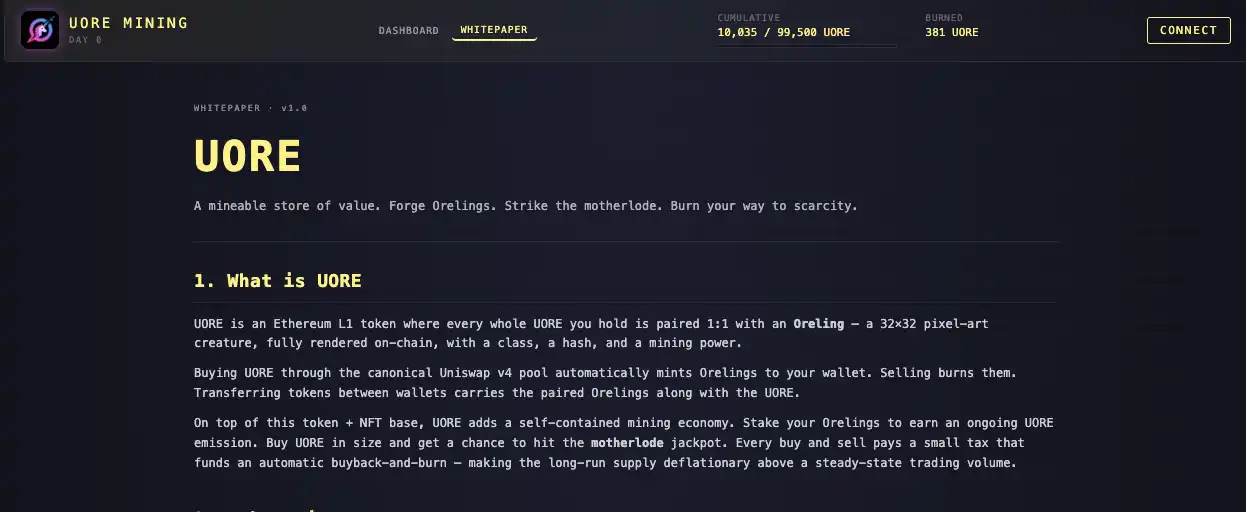
The new project is called $UORE, launched just yesterday. In one sentence, what it does is: Packaging on-chain mining, token-buying lottery, pixel NFT auto-generation, and a deflationary burn mechanism all into a single Uniswap V4 trading pool.

Because when you buy tokens in this pool, the contract will execute the aforementioned six things in the background simultaneously, the gas fee for one transaction is two to three times that of a regular swap...

Currently, if you open CT, you'll see everyone complaining about this high gas.

Regarding the token, according to GMGN data at the time of writing, $UORE reached a market cap of $1.2 million within hours of launch, then quickly dropped to $440k. The pool liquidity is only $64k, but the 24-hour trading volume is $1.2 million, meaning the money in the pool has turned over nearly twenty times.

However, there are only 741 holders, with a total supply of less than ten thousand tokens.
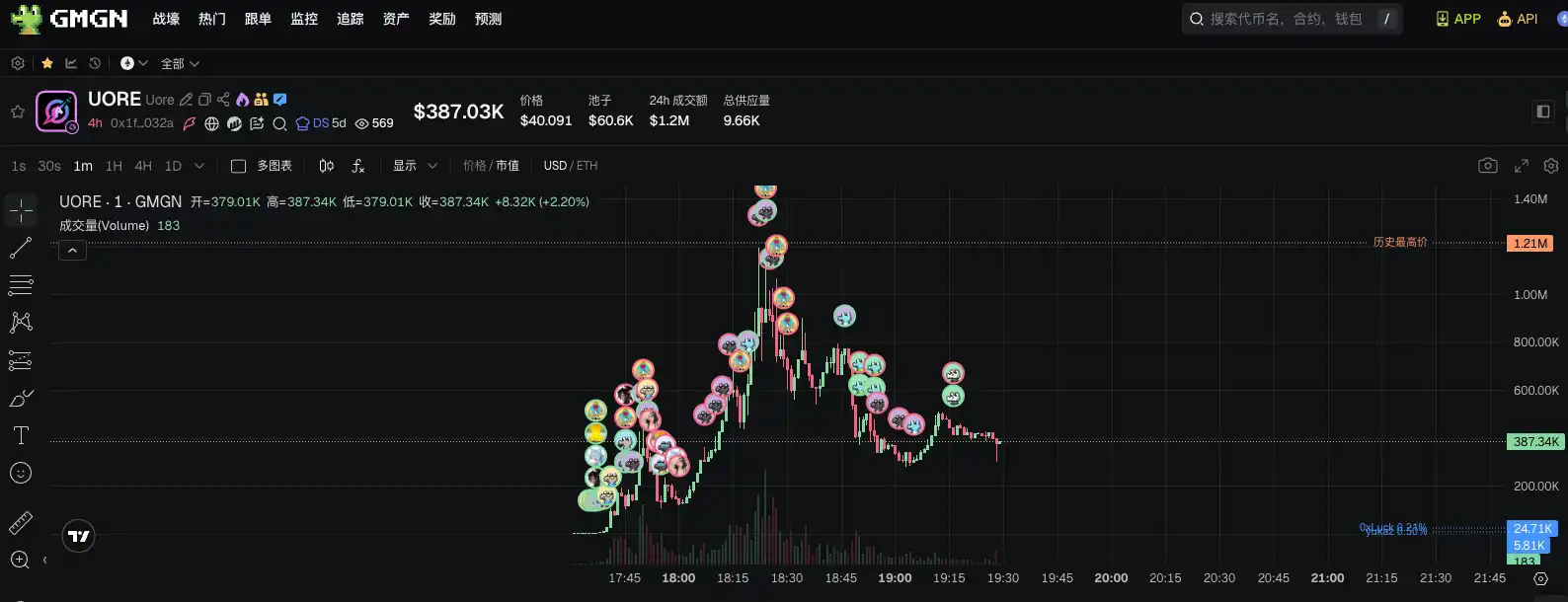
Currently, the risk appears extremely high. After some preliminary research, I personally think it's the most complex mechanism-wise among the V4 Hook ecosystem projects (the recent wave of new on-chain plays tends to make their mechanisms hard to understand...).

It is simultaneously a token, an NFT collection, a staking mine, and a lottery system. Moreover, these four things aren't independent; they are welded together.

Four-in-One Mine

For most NFT projects, the token and the NFT are separate things, bought and sold separately.

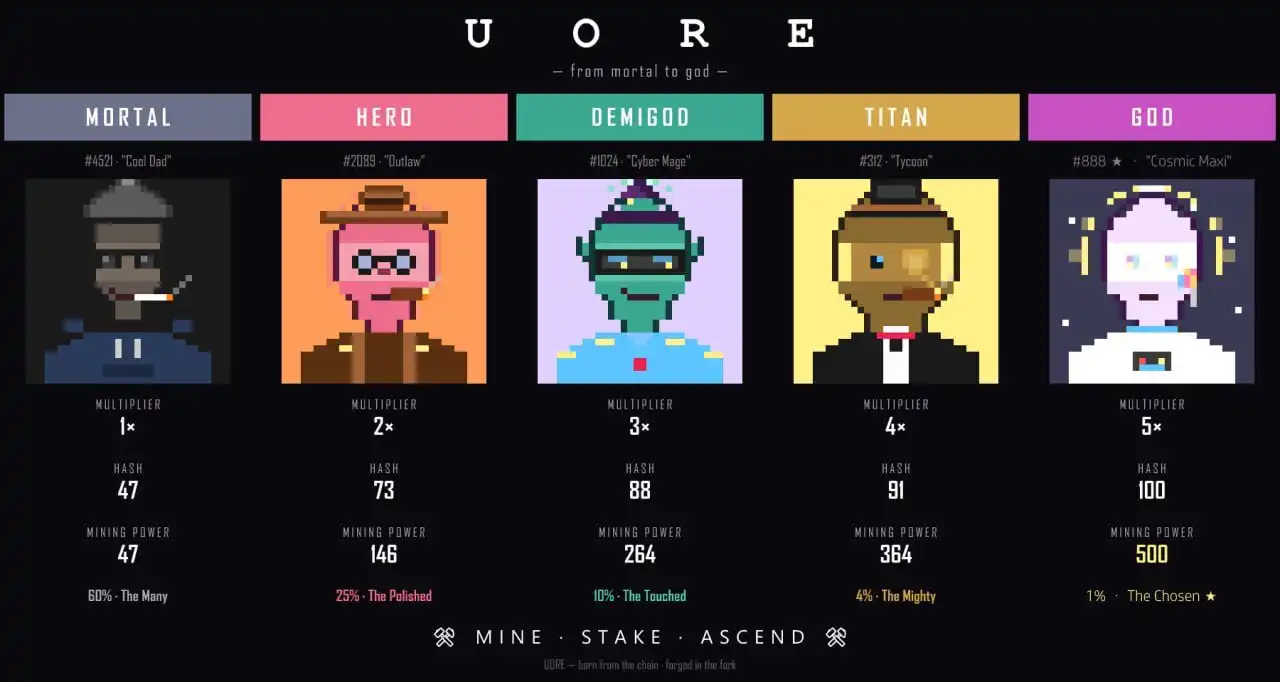
UORE is different. Its NFT is called Oreling, a 32×32 pixel miner character, embedded directly within the token. For every whole integer UORE token you hold in your wallet, you automatically have one corresponding Oreling.
The contract mints it for you when you buy tokens, burns it when you sell, and the Oreling moves with the token when transferred. You cannot buy an Oreling separately, nor can you detach it from UORE.

The traits of each Oreling are determined by the hash of the next block at the moment of minting. This means you don't know what kind of character you'll get when buying, not even the validators can see the result beforehand.

The differences between these characters aren't just about looks.

Each Oreling has a Class (rarity) and a Hash (a random number from 1 to 100). Multiplying the two gives its Mining Power.

The most common Mortal makes up 60% with a 1x multiplier; the rarest God has only a 1% chance with a 5x multiplier. If you're lucky and mint a God with Hash 100, its power is 500, over ten times that of a common miner.

What's the use of mining power? Classic play: staking.

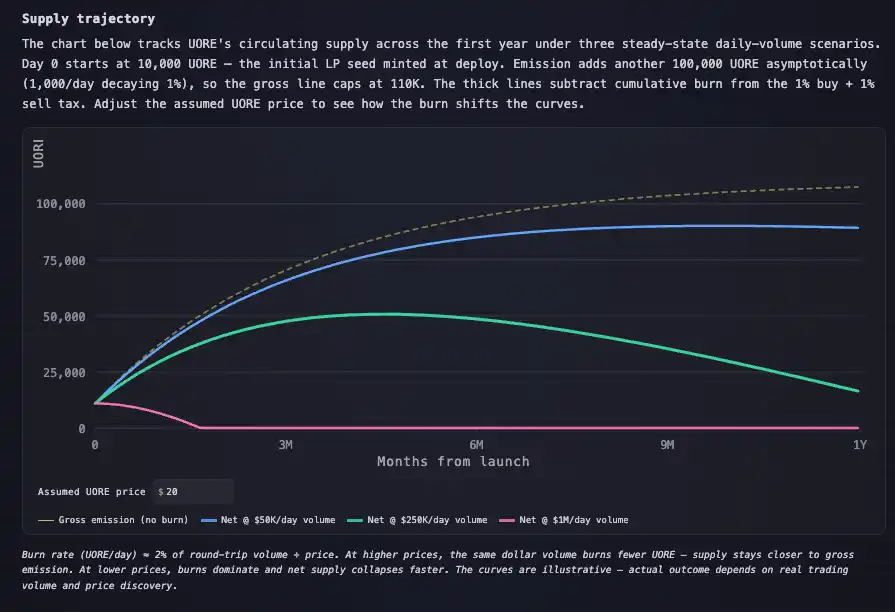
Stake your Oreling into the mine pool, and you start receiving a share of the daily UORE release proportional to your mining power. According to the project's whitepaper, 1000 UORE are released on the first day, then decaying by 1% daily, with a half-life of roughly 69 days. 80% of the release goes to stakers, 20% goes into the Motherlode prize pool.

This decay rate means 97% of the total emissions will be released within a year. The earlier you enter the mining game, the bigger your share of the pie.

There's a noteworthy design when claiming rewards: a 10% "refining tax" is deducted and redistributed to all stakers who haven't claimed yet. The whitepaper calls this the refined-ore boost.

In plain terms, those who claim later eat more of the taxes paid by others. People in a hurry to withdraw are subsidizing the patient ones.
Then there's the Motherlode, which translates to "lode prize".

Every time you buy UORE worth ≥ 0.1 ETH through the official channel, you automatically get a lottery ticket. The winning probability is linked to the purchase amount: 0.1 ETH gives about a 1/600 chance, 0.5 ETH about 1/200, and 1 ETH caps at 1/100. Buying over 1 ETH doesn't increase the probability further, preventing whales from farming chances.

If you win, the prize pool is split in half: 50% goes directly to the buyer, and 50% is randomly distributed to one staker (weighted by mining power). As of writing, there have only been 4 wins historically, with the largest prize being 6.4 UORE.

Finally, the deflationary flywheel.

Buying incurs a 1% tax directly burned, selling incurs a 1% tax sent to a buyback treasury. When the treasury accumulates 0.1 ETH, anyone can trigger an automatic buyback, and the bought-back UORE are all burned. As of writing, 58 buybacks have been executed, cumulatively burning 358 UORE.
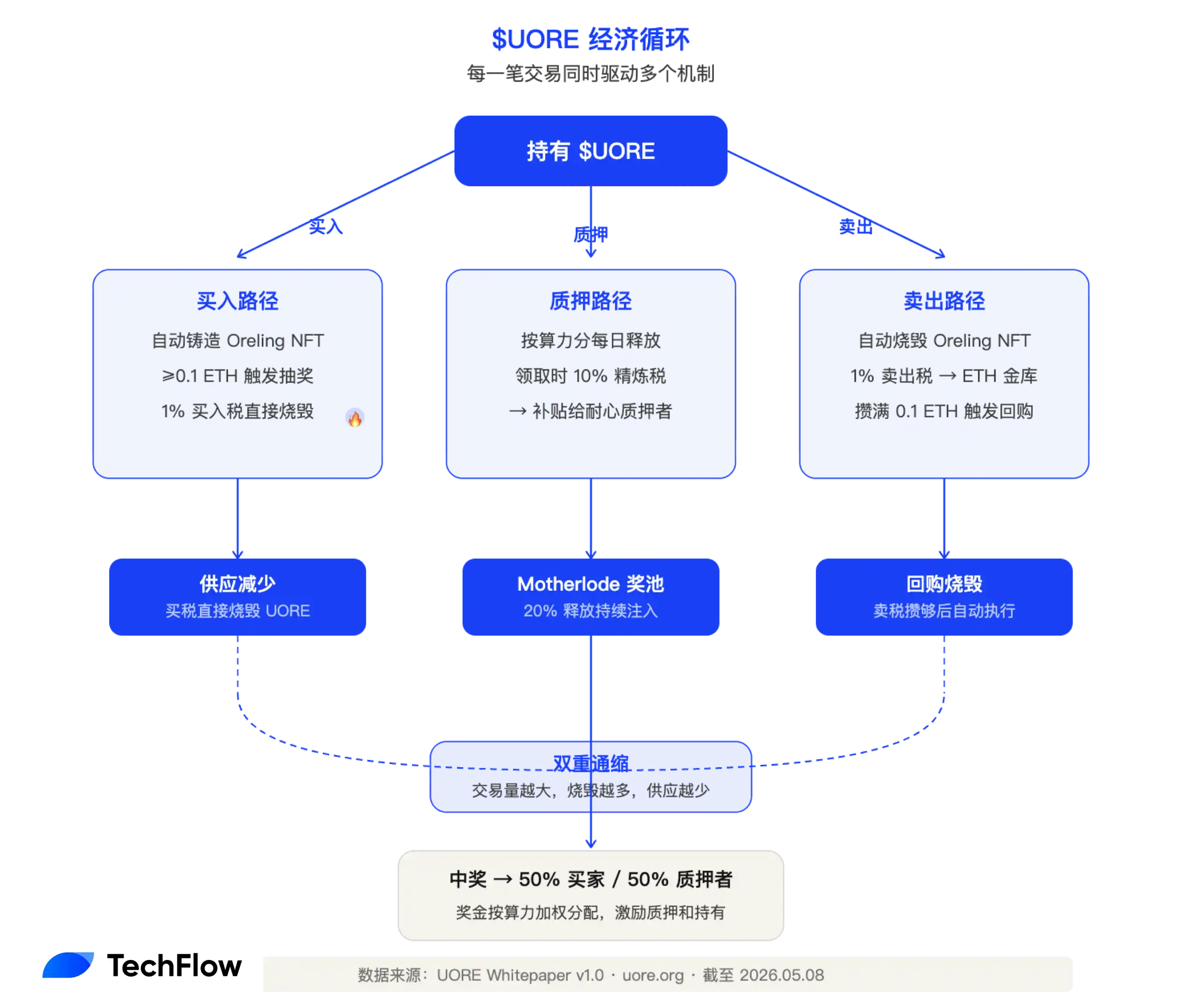
Looking at the entire design, it's a minor innovation in token-NFT play, an old trick for creating scarcity, yet another Ponzi in economic model design.

The Project's Code is Forked, Its Playstyle is Frankensteined

UORE wasn't written from scratch.

People in the community looked at the source code and found a folder named `reference/unipeg-hook-source/`. The founder, Noah, didn't hide it either. He directly stated on Twitter that UORE's contracts are forked from uPEG, and that he fixed two known issues with uPEG: duplicate NFT generation and flash loan attacks for farming rarity.
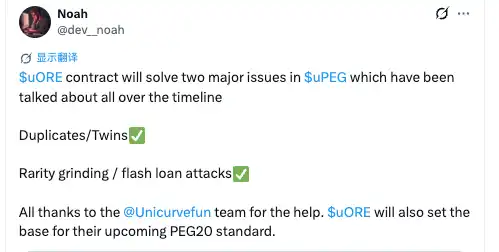
A quick look at this founder's profile shows a bio: "Ethereum dev & BAYC holder". On May 2nd, he tweeted his first post about UORE, saying the project combines the mining concept from Solana's ORE with the V4 Hook architecture of uPEG.

He also proactively @ mentioned Unicurvefun and Openpeg, asking if they could support Orelings trading once their markets go live.

From this public information, UORE's lineage is clear:

Solana ORE provided the "on-chain mining + lottery" gameplay template, uPEG provided the V4 Hook code skeleton, and Noah made improvements and assembled on top of these two.

Forking itself isn't the issue. I think the current problems are:

  1. Gas. There are reports on CT that each UORE transaction requires the Hook to execute six steps, consuming two to three times the gas of a normal swap. Swapping back and forth might leave little to no profit.
  2. Time window. The V4 Hook narrative was affected by uPEG's price drop, and subsequent projects will likely have lower ceilings. UORE is the fourth project in this wave of Hook hype, with the heat from the first three already cooling. The attention window for this sector waits for no one.
  3. Complexity. UORE is probably the most mechanically dense among these four projects. For an average user to understand the whole set of rules—Oreling rarity, mining power calculation, staking decay, refining tax, Motherlode probability, buyback trigger conditions—the barrier is high, and the official website is cryptic.

And the project's whitepaper is also interesting:
Read the contracts and understand the mechanics before deploying capital.

Translated into Chinese, this roughly means "Understand it first, don't blame me if you don't."

Combining insights from previous Hook projects, we can see this wave of on-chain trends features complex mechanism designs + massive information asymmetry. They have alpha potential, but the shelf life of that alpha is getting shorter.

SATO gave you a week, uPEG gave you a few days, and by the time it's UORE's turn, the time you have to understand the rules might be down to just a few hours...

By the time you understand it, the market move might be over.

İlgili Sorular

QWhat is the core innovation or 'hook' of the $UORE project on Uniswap V4?

AThe $UORE project packages multiple mechanics into a single Uniswap V4 pool transaction. With one buy or sell, the contract simultaneously handles token swapping, NFT (Oreling) minting/burning, staking power calculation, participation in the Motherlode lottery, token buyback for burning, and applying transaction taxes.

QHow does the $UORE project integrate an NFT (Oreling) with its token?

AThe Oreling NFT is directly embedded into the $UORE token. Each whole number of $UORE tokens held in a wallet automatically corresponds to one Oreling. The NFT is minted when tokens are bought and burned when tokens are sold, and it cannot be traded separately from the token.

QWhat is the 'Motherlode' mechanism in $UORE and how does it work?

AThe Motherlode is a lottery prize pool. Buying $UORE through the official pool with ≥ 0.1 ETH automatically grants a lottery ticket. The winning probability scales with purchase amount up to a 1% max chance for 1 ETH purchases. If a buyer wins, 50% of the prize pool goes to them, and the other 50% is randomly distributed to a staker, weighted by their mining power.

QWhat are the main criticisms or potential risks mentioned about the $UORE project?

AThe article highlights several risks: very high gas fees (2-3x a normal swap), a short attention window as it's the fourth V4 Hook project in a fading trend, and high complexity which creates a barrier for understanding. Additionally, its liquidity is low, token distribution is concentrated, and the economic model is described as a Ponzi.

QAccording to the article, what existing projects did $UORE fork or draw inspiration from?

A$UORE's smart contracts are forked from the uPEG project, fixing known issues. Its core 'on-chain mining + lottery' gameplay concept is inspired by the ORE project on Solana. The founder combined these two templates to create $UORE on the Uniswap V4 Hook framework.

İlgili Okumalar

In a Bull Market, Trade New Coins. Will the 'Hook' Concept Become the Sector That Opens the Bull Market?

In a recent surge of interest, the "Hook" concept on Uniswap v4 has captured significant attention from the retail crypto community, driven by projects like $upeg, $sato, and Slonks. Despite being introduced over a year ago, Hooks—customizable plugins for the Uniswap protocol—gained mainstream traction only recently. The article argues that earlier Uniswap efforts to promote Hooks focused too heavily on technical improvements and liquidity provider (LP) solutions, which failed to capture the imagination of everyday users. The breakthrough came with projects that introduced novel, engaging gameplay. $upeg combines trading with generative art, where each integer purchase creates a unique image, adding a layer of artistic creation and complexity to tokenomics. $sato leverages a bonding curve on Ethereum, appealing to the network's "diamond hands" culture with a decentralized, zero-intervention model that turns into a "belief game." Slonks uses an AI model to redraw CryptoPunks, creating a gamified ecosystem where users can burn or merge NFTs to earn $SLOP tokens based on how much the AI "deviated" from the original. These examples highlight Hooks' potential to transform Uniswap from a simple swap and LP platform into a vibrant ecosystem of innovative applications. While technically possible to build such projects independently, the synergy with Uniswap’s established user base and infrastructure provides mutual benefits. For "Hook" to become a true catalyst for a bull market, the author suggests that projects need compelling, original narratives, and Uniswap must further commit to positioning itself as Ethereum's premier application marketplace for creative on-chain experiences.

marsbit7 dk önce

In a Bull Market, Trade New Coins. Will the 'Hook' Concept Become the Sector That Opens the Bull Market?

marsbit7 dk önce

Saylor Softens Stance, STRC Weakens, Is BTC Facing a Do-or-Die Battle?

**Summary: Bitcoin (BTC) at a Critical Juncture? Saylor's Hint and STRC Softness Spark Concerns** This article examines two recent developments that could pressure Bitcoin's price: Saylor's hinted willingness to sell some of MicroStrategy's (MSTR) BTC holdings and a significant slowdown in the issuance of its Structured Token Receipt Capital (STRC) product. Previously, STR C was viewed as a powerful new source of ongoing demand for Bitcoin, as the funds raised were used to buy more BTC with leverage. However, MicroStrategy CEO Michael Saylor's recent acknowledgment that the company *might* sell BTC to pay dividends undermines the "never sell" narrative that underpins MSTR's valuation premium and the entire STRC-driven demand thesis. While mathematically sustainable if BTC appreciates, forced selling during a market downturn would severely damage the company's balance sheet and reverse much of its recent buying. Simultaneously, the STRC "flywheel" appears to be stalling. Unlike in previous cycles, the STRC price has failed to return to its $100 par value ahead of the May dividend date, indicating zero new BTC purchases via this channel for the current period. The author attributes this "softness" to a saturated market of arbitrage traders after huge inflows in March and April, whose selling pressure kept prices down, as well as higher opportunity costs in a surging stock market. The combination risks starting a "reverse flywheel": No STRC issuance means no new BTC buying, putting downward pressure on BTC's price. This weakens STRC's collateral backing, potentially raising its required yield and making it even less attractive, which further starves BTC of demand. Saylor's comments may be preemptively pricing in this scenario. The article concludes that the near-term direction of BTC hinges on whether STRC can regain its par value and resume meaningful issuance in the coming week. A small, recent STRC issuance and a brief return of positive Coinbase premiums are noted as faintly optimistic signals. However, failure of the STRC model could lead to a sharp BTC correction by removing a key perceived source of support.

marsbit14 dk önce

Saylor Softens Stance, STRC Weakens, Is BTC Facing a Do-or-Die Battle?

marsbit14 dk önce

İşlemler

Spot
Futures

Popüler Makaleler

ONE Nasıl Satın Alınır

HTX.com’a hoş geldiniz! Harmony (ONE) satın alma işlemlerini basit ve kullanışlı bir hâle getirdik. Adım adım açıkladığımız rehberimizi takip ederek kripto yolculuğunuza başlayın. 1. Adım: HTX Hesabınızı OluşturunHTX'te ücretsiz bir hesap açmak için e-posta adresinizi veya telefon numaranızı kullanın. Sorunsuzca kaydolun ve tüm özelliklerin kilidini açın. Hesabımı Aç2. Adım: Kripto Satın Al Bölümüne Gidin ve Ödeme Yönteminizi SeçinKredi/Banka Kartı: Visa veya Mastercard'ınızı kullanarak anında Harmony (ONE) satın alın.Bakiye: Sorunsuz bir şekilde işlem yapmak için HTX hesap bakiyenizdeki fonları kullanın.Üçüncü Taraflar: Kullanımı kolaylaştırmak için Google Pay ve Apple Pay gibi popüler ödeme yöntemlerini ekledik.P2P: HTX'teki diğer kullanıcılarla doğrudan işlem yapın.Borsa Dışı (OTC): Yatırımcılar için kişiye özel hizmetler ve rekabetçi döviz kurları sunuyoruz.3. Adım: Harmony (ONE) Varlıklarınızı SaklayınHarmony (ONE) satın aldıktan sonra HTX hesabınızda saklayın. Alternatif olarak, blok zinciri transferi yoluyla başka bir yere gönderebilir veya diğer kripto para birimlerini takas etmek için kullanabilirsiniz.4. Adım: Harmony (ONE) Varlıklarınızla İşlem YapınHTX'in spot piyasasında Harmony (ONE) ile kolayca işlemler yapın.Hesabınıza erişin, işlem çiftinizi seçin, işlemlerinizi gerçekleştirin ve gerçek zamanlı olarak izleyin. Hem yeni başlayanlar hem de deneyimli yatırımcılar için kullanıcı dostu bir deneyim sunuyoruz.

263 Toplam GörüntülenmeYayınlanma 2024.12.12Güncellenme 2025.03.21

ONE Nasıl Satın Alınır

Tartışmalar

HTX Topluluğuna hoş geldiniz. Burada, en son platform gelişmeleri hakkında bilgi sahibi olabilir ve profesyonel piyasa görüşlerine erişebilirsiniz. Kullanıcıların ONE (ONE) fiyatı hakkındaki görüşleri aşağıda sunulmaktadır.

活动图片