Cardano Founder Unveils Midnight Rollout Plan As Mainnet Launch Begins

bitcoinist2026-03-24 tarihinde yayınlandı2026-03-24 tarihinde güncellendi

Özet

Cardano founder Charles Hoskinson has announced the start of the federated mainnet phase for Midnight, a privacy-focused blockchain. The launch is being conducted gradually with daily operational checkpoints to ensure network stability. Initially, the mainnet is running in a guarded mode with limited transactions and dApp deployments. Federated node operators, including Google Cloud, Telegram, and MoneyGram, are managing the rollout. The first user-facing feature is DUST generation, accessible via Lace wallet. Hoskinson emphasized Midnight's complex architecture, which integrates zero-knowledge proofs and spans both public and private ledgers. Future upgrades will introduce composable contracts, cross-chain intents, and governance features, though full decentralization is expected to take 6–12 months due to the broad distribution of tokens via a "glacier drop."

Cardano founder Charles Hoskinson says Midnight has entered its federated mainnet phase, marking the start of a guarded rollout that he described as the first step in turning on one of the most technically ambitious networks in crypto.

In a March 23 livestream, the Cardano founder framed the week as “Midnight Week” and said the network was being activated gradually with daily operational checkpoints. “What’s happening this week is the federated launch and this is basically the mainnet network and it’s turning on step by step,” Hoskinson said. “Every day we have a go no-go meeting and based upon what we’re getting back from the federated mainnet nodes, they tell us a whole bunch of stuff. ... Basically the goal here is to get to a stable network.”

Cardano’s Midnight Launch Week Begins

That first phase is intentionally restrictive. Hoskinson said Midnight is live as a mainnet rather than a testnet, but operating in a guarded mode where transactions and decentralized application deployments are limited until the team is satisfied that consensus, block production, and core cryptographic components are working as intended. The immediate user-facing milestone, he said, is DUST generation, which should become visible through an update to Lace after the earlier Glacier Drop period ended.

The rollout is being handled by federated node operators, or FNOs, rather than an open validator set from day one. Hoskinson said those operators include firms such as Google Cloud, Telegram and MoneyGram, drawing a parallel to Cardano’s Byron era, when a small group of entities initially ran the network before control was broadened over time. Once the network proves stable, Midnight plans to lower its guardrails in stages and begin deploying applications in waves.

“So you go from just dust generation to Lace plus DApps and you can actually start using some of these experiences,” he said. “You’re basically looking for a stable consensus. You’re looking for stable block generation in the mainnet environment. And then as that gets stable, everybody’s happy, you go from guarded to less guarded to less guarded to less guarded.”

Hoskinson argued that Midnight’s launch path is more complicated than Cardano’s because the system spans both Cardano and Midnight, with separate roles for its assets and multiple address formats across public and private ledgers. He also pointed to its layered design, naming consensus components such as Aura, Grandpa and Beefy, while describing Compact as “basically Zcash with smart contracts.”

That framing is central to the pitch. Midnight, in Hoskinson’s telling, is not just another chain launch but a privacy-preserving smart contract system being opened in phases. The first version shipping with the federated mainnet includes zero-knowledge tooling such as Plonk and Halo 2, while later upgrades are expected to bring composable contracts, Nightstream-related infrastructure, capacity exchange, crosschain intents and the Midnight passport system.

The decentralization roadmap comes later. Hoskinson said Midnight is now entering phase two, with phase three set to introduce an incentivized testnet for stake pool operators, allowing them to begin making blocks in parallel with ongoing federated mainnet upgrades. Governance experiments are also expected to begin in that phase, although he cautioned that Midnight’s broad token distribution through its “glacier drop” means the ecosystem needs time to mature before full governance can be safely turned on.

“One of the problems with Midnight, and this is why you need at least 6 to 12 months to stabilize, is that Midnight was distributed with a glacier drop,” he said. “That’s a huge benefit because you get lots of people. The problem is that those people haven’t decided whether they want to be a good-faith member of the Midnight ecosystem community or if they just want to dump their NIGHT or be adversarial.”

Hoskinson also used the livestream to make a much broader claim about Midnight’s long-term role, describing it as infrastructure for privacy, compliance and AI-driven commerce. He said the system’s mix of zero-knowledge proofs, multi-party computation and trusted execution environments could make it a natural framework for autonomous software agents to transact and verify one another.

At press time, Cardano traded at $0.2611.
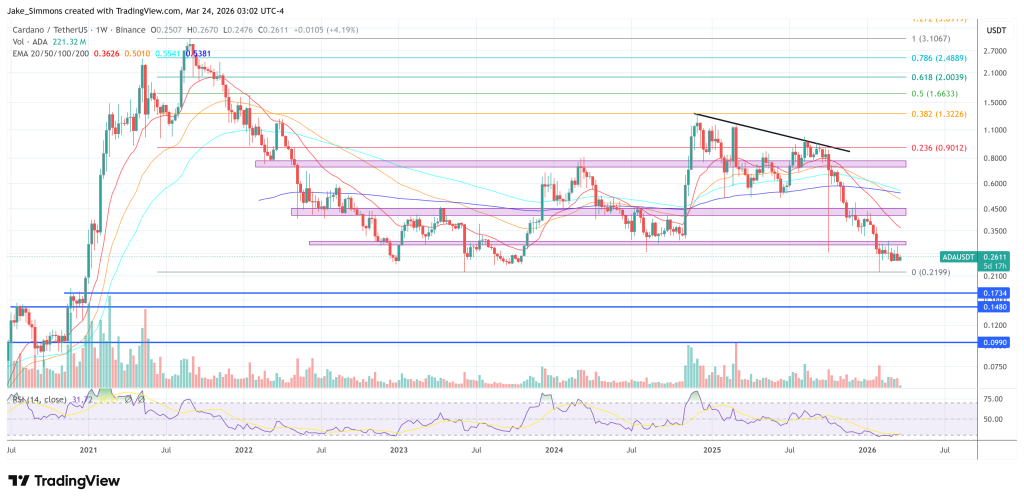
ADA hovers below key resistance, 1-week chart | Source: ADAUSDT on TradingView.com

İlgili Sorular

QWhat is the current phase of Midnight's launch as announced by Charles Hoskinson?

AMidnight has entered its federated mainnet phase, which is the start of a guarded rollout.

QWhich companies are mentioned as federated node operators (FNOs) for the initial launch?

AGoogle Cloud, Telegram, and MoneyGram are mentioned as federated node operators.

QWhat is the first user-facing milestone expected after the Glacier Drop period?

AThe first user-facing milestone is DUST generation, which should become visible through an update to Lace.

QAccording to Hoskinson, why does Midnight need 6 to 12 months to stabilize after launch?

AIt needs time to stabilize because the broad token distribution through the 'glacier drop' means the ecosystem needs to mature before determining if participants will be good-faith members or adversarial.

QWhat broader long-term role did Hoskinson claim for Midnight beyond being a blockchain?

AHe described Midnight as infrastructure for privacy, compliance, and AI-driven commerce, using zero-knowledge proofs, multi-party computation, and trusted execution environments for autonomous software agents.

İlgili Okumalar

GitHub Announces Default Use of Copilot User Data for AI Model Training Starting April 24

GitHub has announced an update to its repository policy, effective April 24, 2026, allowing the use of user interaction data to train its AI models. The data collection will include users of Copilot Free, Pro, and Pro+, covering model inputs and outputs, code snippets, contextual information, repository structures, and chat logs. According to GitHub’s Chief Product Officer Mario Rodriguez, the move aims to enhance the accuracy and security of the model’suggestions, with internal Microsoft tests already showing improved acceptance rates. The policy follows an opt-out model, meaning affected users must manually disable data sharing in their privacy settings, sparking debate within the developer community over data ownership and the definition of private repositories. Copilot Business, Enterprise, and educational users are currently exempt due to contractual terms. GitHub defended the change as consistent with industry practices adopted by companies like Anthropic, JetBrains, and Microsoft. However, the inclusion of private repository code in training sets challenges conventional notions of privacy. This shift reflects a broader industry trend where leading AI providers are turning to user interaction data as high-quality public code resources diminish. It signals GitHub’s continued transition from an open-source platform to a closed-loop AI training ecosystem and highlights growing tensions between data compliance and AI model advancement.

marsbit9 dk önce

GitHub Announces Default Use of Copilot User Data for AI Model Training Starting April 24

marsbit9 dk önce

İşlemler

Spot
Futures

Popüler Makaleler

ADA Nasıl Satın Alınır

HTX.com’a hoş geldiniz! Cardano (ADA) satın alma işlemlerini basit ve kullanışlı bir hâle getirdik. Adım adım açıkladığımız rehberimizi takip ederek kripto yolculuğunuza başlayın. 1. Adım: HTX Hesabınızı OluşturunHTX'te ücretsiz bir hesap açmak için e-posta adresinizi veya telefon numaranızı kullanın. Sorunsuzca kaydolun ve tüm özelliklerin kilidini açın. Hesabımı Aç2. Adım: Kripto Satın Al Bölümüne Gidin ve Ödeme Yönteminizi SeçinKredi/Banka Kartı: Visa veya Mastercard'ınızı kullanarak anında Cardano (ADA) satın alın.Bakiye: Sorunsuz bir şekilde işlem yapmak için HTX hesap bakiyenizdeki fonları kullanın.Üçüncü Taraflar: Kullanımı kolaylaştırmak için Google Pay ve Apple Pay gibi popüler ödeme yöntemlerini ekledik.P2P: HTX'teki diğer kullanıcılarla doğrudan işlem yapın.Borsa Dışı (OTC): Yatırımcılar için kişiye özel hizmetler ve rekabetçi döviz kurları sunuyoruz.3. Adım: Cardano (ADA) Varlıklarınızı SaklayınCardano (ADA) satın aldıktan sonra HTX hesabınızda saklayın. Alternatif olarak, blok zinciri transferi yoluyla başka bir yere gönderebilir veya diğer kripto para birimlerini takas etmek için kullanabilirsiniz.4. Adım: Cardano (ADA) Varlıklarınızla İşlem YapınHTX'in spot piyasasında Cardano (ADA) ile kolayca işlemler yapın.Hesabınıza erişin, işlem çiftinizi seçin, işlemlerinizi gerçekleştirin ve gerçek zamanlı olarak izleyin. Hem yeni başlayanlar hem de deneyimli yatırımcılar için kullanıcı dostu bir deneyim sunuyoruz.

581 Toplam GörüntülenmeYayınlanma 2024.12.10Güncellenme 2025.03.21

ADA Nasıl Satın Alınır

Tartışmalar

HTX Topluluğuna hoş geldiniz. Burada, en son platform gelişmeleri hakkında bilgi sahibi olabilir ve profesyonel piyasa görüşlerine erişebilirsiniz. Kullanıcıların ADA (ADA) fiyatı hakkındaki görüşleri aşağıda sunulmaktadır.

活动图片